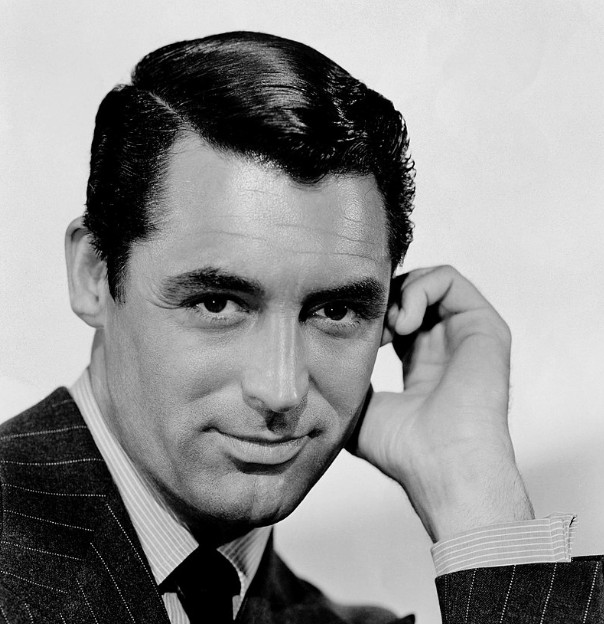
Cary Grant, RKO publicity still from Suspicion (1941) Public Domain
“I used to go out with actresses and other female impersonators.“
~Mort Sahl
by Norman B. Schwartz
Of all the occupations known to man, none has been more admired or reviled than acting. Once upon a time, society viewed acting as no better than a hanging branch of prostitution, the last refuge of criminals and inverts—its practitioners (male and female) utilizing the stage to peddle something other than drama. Signs on boarding house doors read JEWS, NEGROES, AND ACTORS NOT WELCOME.
It was not so in the beginning. In the 6th century BC, the age of Thespis, authorities did not condemn and banish actors from public spaces. Quite the contrary. Acting often ended in ceremony—the honoree crowned with laurel or handed a bag of gold. Those of a superior class gathered at the festive occasion assumed that the honorees had achieved exceptional excellence after many years of public practice.
If we jump ahead to the glorious and egalitarian 1960s, a period which some of you who lived it may no longer remember unless reminded by children and grandchildren, Andy Warhol (1928-1987) looked into his cloudy crystal ball, somewhat obscured by the fragrant smoke of marijuana, and perceived a future world in which every citizen (every actor?) would be guaranteed a quarter of an hour of fame.
In our time, present time, something has occurred that even Warhol could not have foreseen. Anyone with enough money or energy to swipe a credit card can buy a smartphone, the last true instrument of democracy. For all time, it will record one’s own performance, however uninspired. Today, on television shows like America’s (or Britain’s) Got Talent, millions now applaud amateurs who once could barely hold the attention of friends and family. And yet, despite this industrialization and modernization of the arts, the honorable profession of acting—the one that Thespis practiced—survives. There are still Dame Judis and Sir Daniel Day-Lewises treading the boards.
What do these exalted creatures possess that no credit card can buy?
Truman Capote (1924–84), a man born to hyperbole, had a theory. Casting his reptilian eye on the world around him, he agreed with Sahl. Great actors of both sexes, so Truman observed, were great pretenders – not only impersonators of mankind but often of their own sex. England, he claimed, possessed more such specimens than anywhere else because all its best practitioners were homosexual. Although there were no known statistics to prove or dispute his contention, few in the theater or film protested. Backstage gossip (often more accurate than government reports) supported his observation. Capote’s arch enemy, Gore Vidal,
would certainly have reminded him that “there was no such thing as a homosexual or heterosexual person. There are only homo- or hetero acts. Mostly people are a mixture of impulses if not acts.”

Is androgyny, then, the salient quality that no great actor should be without? No one would contest that an unusual number of actors have always been openly or closeted homosexual or bisexual. Neither has the profession been closed to heterosexuals. Tenderness and vulnerability have never been the exclusive property of actresses; nor unbridled violence the sole provenance of actors.
This confusion may have come about because the ideal of femininity and masculinity changes from culture to culture, generation to generation. John Wayne (1906-1979) was once the role model for many young American men and boys. Born Marion Robert Morrison in Winterset, Iowa, he played the stoic Westerner or war hero who had taught himself to hide his feelings not his gun.
On the continent less warlike European males created a more extroverted model. These men were less fearful of parading their sexuality and emotions. France gave us Gabin and Depardieu; Italy, De Sica and then Mastroianni. England, however, always had greater difficulty finding an ideal among its natives. The great film star Leslie Howard (1893-1943), born in Forest Hill, London, so prototypically English, was the first-generation son of Hungarian Jewish immigrants, recent arrivals in Britain. The first Bond, who sipped his martini and sampled his women, was a Scottish import.

In 1937, Clark Gable (1901-1960), then the essence of American machismo, petitioned Louis B. Mayer, head of Metro Goldwyn Mayer, to let him play against type. He wanted to impersonate Charles Stewart Parnell, the Anglo-Irish politician known in the House of Commons as “the uncrowned king of Ireland” Separated from a wife he would not divorce, Parnell had fathered three illegitimate children with his mistress, Kitty O’Neill, before marrying her. MGM scriptwriters sanitized that life, of course. The film portrayed Parnell as a sensitive soul, madly in love with his wife Kitty, played by his co-star Myrna Loy. Loy said, “(Clark) was a man who loved … fine literature, read it, and knew it. He would read poetry during breaks but didn’t want anyone to know it.” Gable believed the role would allow him to show something of his true self that he had hidden from his adoring public.

When the film opened in 1937, it was a colossal flop, losing Mayer and his studio over 600,000 dollars. Film critic Graham Greene dismissed it as an American dream “of how history should have happened.” Despite Clark’s best intentions, the public wanted to see him not as he was, or wanted to be, but as they imagined him. This rejection affected Gable so profoundly that he promised Mayer never to “stretch” again. A few years later in 1939, he redeemed himself to the studio and himself by returning to type by impersonating the charismatic but heartless Rhett Butler who told Scarlett O’Hara, “Frankly, my dear, I don’t give a damn.” But Gable and Gable’s public did.
However, there are exceptions to the rule that all actors eventually become in life and on screen what their public expects them to be. To this day, Archibald Alec Leach (1904-1986), born in Horfield, Bristol, in 1904, remains one of the few performers who escaped the occupational curse of becoming what their publicity said they were. Once, overtaken at a Hollywood party by a woman who told him that although he surely did not know who she was, she knew and loved him, Archie smiled his dazzling smile and said, “Madame, I, too, love Cary Grant. I only wish I could be him.”
Is androgyny, then, the salient quality that no great actor should be without?
Acting has progressed significantly since the Victorians imprisoned the Anglo-Irish playwright, Oscar Wilde, for openly parading a sexual preferences society found abhorrent. In our times, our greatest actors, gay or straight, or sometimes undecided, are free to exhibit all the dimensions of human behavior on stage and off.
Today, as every actor knows, we have found a much saner, more civil way of honoring those brilliant impersonators whose ambivalent souls display the best and worst of us. We neither crown our actors with laurel wreaths nor send them off to prison. In America, we award them with Tonys and Oscars. In Britain, we beknight them.
Norman B. Schwartz is the author of the comic novels ‘ALL THINGS small‘, Paradise Now, Don Juan in Space, True (Cinema) Confessions, Hollywood: Below and Beyond, and the DIY guide, The Art Of The Schnoorr. He spent over forty years working on films in Hollywood and Rome. Norman was the first ADR sound editor / director to be admitted to Academy of Motion Picture Arts and Sciences in Los Angeles.
Norman B. Schwartz’s essays will appear in sequence monthly in each issue of the
magazine with a view to Centre House Press publishing the entire collection of
essays in book form in Fall 2025
Discover more from Ars Notoria
Subscribe to get the latest posts sent to your email.
You must be logged in to post a comment.