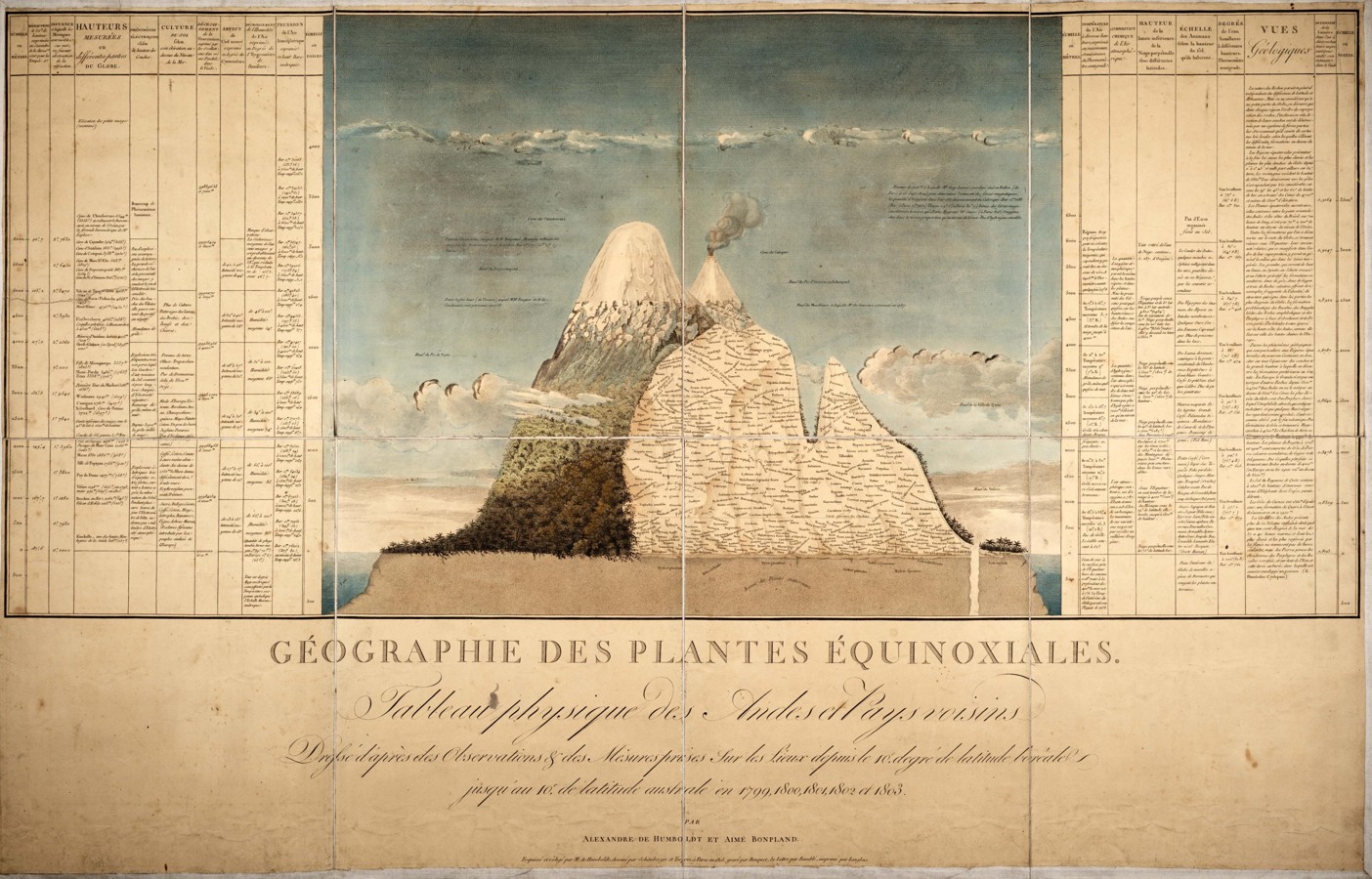
“Naturgemälde” illustration. Bonpland, Aimé and Alexander von Humboldt
The Danger of Categorising to the Norm
by Phil Hall
Human cognition relies on prototypes—idealised examples that define categories (Rosch 1975). A prototypical comet, for instance, exhibits outgassing, a dusty coma, and a visible tail. But when an object deviates from this template—as with 3I/ATLAS—scientists face a dilemma: stretch the definition to fit, or consider alternatives that may challenge conventions.
In cognitive science, prototype theory explains how we categorise objects not by rigid definitions, but by typicality. For example: a prototypical tiger is a large, four-legged, carnivorous, orange-and-black-striped cat. A white, three-legged, vegetarian tiger, on the other hand, is still a tiger—but a marginal case. A mechanical tiger toy might still be called a tiger, but it is also artificial.

The human impulse to categorise the natural world reveals as much about our cognitive frameworks as it does about reality itself. From Aristotle’s division of the blooded and bloodless creatures to Alexander von Humboldt’s sophisticated taxonomies based on his system of Naturgemälde (depicting nature), history shows us that taxonomies often reflect functional needs and cultural perspectives as much as empirical truths. These systems, whether scientific or notional, when simplistic, create boundaries where nature itself recognises none, forcing phenomena into artificial containers that frequently obscure more than they reveal.
This tension between rigid classification and fluid reality becomes particularly acute when examining astronomical anomalies like the interstellar object 3I/ATLAS. The object presents a profound challenge to our cosmic taxonomy, displaying characteristics that simultaneously evoke and defy our definitions of comets and asteroids. Its brightness suggests either an improbably large asteroid or a dust-enshrouded smaller body, yet it lacks the telltale cometary tail and outgassing that would make its categorisation straightforward. Like the white, three-legged vegetarian tiger that tests our definition of feline species, 3I/ATLAS exists at the margins of our classification systems, revealing their inherent limitations.

The scientific response to such marginal cases often follows a predictable pattern of reanalysis and definitional stretching. When faced with ‘Oumuamua’s anomalous acceleration, astronomers invoked “hidden” outgassing to preserve its classification as a comet, demonstrating how readily we retrofit observations to existing categories. Similarly, discussions of 3I/ATLAS frequently employ cometary terminology despite its deviation from prototypical comet behaviour, illustrating what Avi Loeb has identified as a fundamental paradigm bias in astronomical classification. 3I/ATLAS’s forward-scattering dust plume, contradicting comet models, is discussed in cometary terms, even as Loeb proposes alternatives.
This taxonomic conservatism mirrors broader historical patterns in scientific classification. Just as 19th-century naturalists initially resisted reclassifying whales as mammals rather than fish, contemporary astronomers often hesitate to entertain non-cometary explanations for interstellar objects. The upcoming perihelion passage of 3I/ATLAS in October 2025 will serve as a crucial test case, potentially forcing either an expansion of our cometary category or, more radically, the creation of entirely new classifications. Like the moment when Aristotle recognised dolphins as mammals, our categories serve as provisional tools rather than absolute truths.

The deeper lesson of 3I/ATLAS extends beyond astronomy to the very nature of scientific understanding. Von Humboldt’s documentation of nature and its interrelationships reminds us that categories often gain their value from utility rather than some essential correspondence with reality. When our classifications become obstacles rather than aids to understanding—when we find ourselves categorising to the norm without evidence—we must have the intellectual courage to forge new conceptual frameworks. The history of science shows us that true progress often occurs not through the reinforcement of existing categories, but through their careful examination and, when necessary, their abandonment. Definitions must adapt to evidence, not the other way around.
Science should not function by enforcing norms. Avi Loeb is correct. If 3I/ATLAS outgasses at perihelion, it is a comet and ranks “0” on the Loeb scale. If it remains inert but manoeuvres unexpectedly, it’s likely to be artificial and rank “10”. Artificial or edge cases (mechanical tigers, interstellar asteroids) force us to confront whether our definitions are descriptive or proscriptive.
References
Humboldt, A. von (1845). Cosmos: A Sketch of a Physical Description of the Universe.
Loeb, A. (2025). *The Nature of 3I/ATLAS: Comet, Asteroid, or Artifact?* Scientific American.
Rosch, E. (1975). Cognitive Representations of Semantic Categories. Journal of Experimental Psychology.
Phil Hall was born into an ANC family in South Africa. The family was forced into exile in 1963 after his mother was imprisoned and his father banned. They relocated to East Africa, where his parents continued their activism and journalism. In 1975, after a period living in India, they journeyed overland back to the UK, eventually settling in Brighton.
Phil pursued a broad education, studying Russian, Spanish, politics, economics, literature, linguistics, and English grammar and phonology. His path led him to live and study in Spain, the USSR (in Ukraine), and later in Mexico, where he married and started a family. Over the next decade, Phil and his partner balanced activism with work before relocating to the UK—a move initially intended to be permanent.
However, professional opportunities took him to Saudi Arabia and then the UAE, where he spent ten years before returning to the UK during the COVID-19 pandemic. Back in Britain, he founded Ars Notoria Magazine and, alongside fellow humane socialist Paul Halas, launched AN Editions, a small venture dedicated to publishing thoughtful, progressive and exciting new books.
Discover more from Ars Notoria Magazine
Subscribe to get the latest posts sent to your email.
You must be logged in to post a comment.