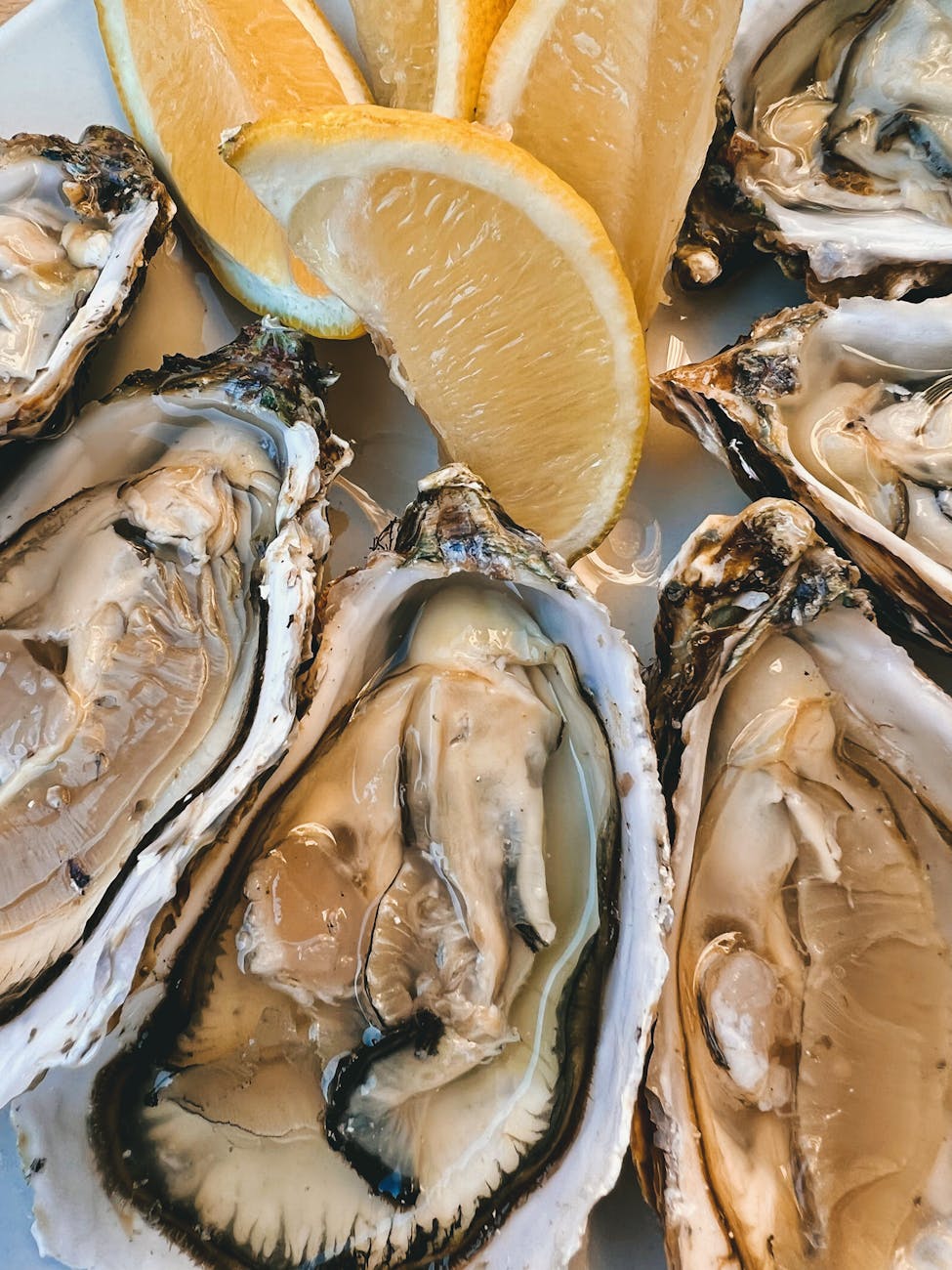
Briny oysters, shrimp curled like punctuation marks, langoustines, hunks of crab meat and claws piled high with effortless French design. Photograph by Gvantsa Gongadze
A punk-masaalchi essay on time, place and the flavours we carry.
By Arun Kapil
Some moments arrive so clean and sharp you can still taste the light around them. Honeymoon afternoon on the Atlantic coast, Île de Ré, sun warming our necks, a bottle of something crisp and cold beading on the table like it was sweating for us. The waiter set down a platter, a literal tower of fruits de mer: briny oysters, shrimp curled like punctuation marks, langoustines, hunks of crab meat and claws piled high with effortless French design. Just for me. Another waiter arrived and set down Olive’s soup. Soupe de Poisson: rich, savoury, dark with stock, memories of bones and shell topped with melty cheese and creamy rouille croutons – stale bread snippets – garlic and soft herbs. Equal in flavour, each sweet succour.
We smiled, amused at the spectacle, the sight of the two dishes side by side, then dived in – laughing, glass in hand, sea breeze swirling, threading through our hair. In that moment – that perfect alignment of love, hunger, salt, sound – I felt something like time stand up. An explosive ‘clash’ that only happens in a moment, that moment when tide and tine aligned perfectly, when the gods have granted you a snapshot of perfection.
Moments like that tattoo themselves onto your senses.
But blink and I’m somewhere else entirely. Rajasthan. A six-hour road trip through dust and scrub, horizon blurred by heat. We pulled into a dhaba with no plan, just thirst and a need to stop endless momentum, bumps and beeps. The place bustled with drivers, day labourers, with families stretching legs to the background beat of steel ladles clanking against vast steaming pots and to engines humming in the background like tired old gods clearing their throats. A man with hands like sandalwood roots took my notes and passed me a small clay cup filled with chai darker and sweeter than anything the Western wellness world has ever dared call a “latte.” Cardamom, sweat, diesel, dust. Life, served hot. I held the cup, felt its spice travel through me, ginger warmth soothing cramped limbs and suddenly the world made sense again.

The place bustled with drivers, day labourers, with families stretching legs to the background beat of steel ladles clanking against vast steaming pots. Photo by GOWTHAM AGM on Pexels.com
These two moments – oceans apart, culturally unconnected, atmospherically incomparable – sit in my memory with the same intensity, the same flavour-stamp. What links them isn’t place. It’s alignment, the chaotic coincidence of taste, time, weather, hunger and the people around you. The place the setting, not necessarily the undeniable authenticity, but the dimension of taste that comes from time and place.
It’s the flavour of a moment.
The thing you never quite manage to recreate. The thing you spend years trying to chase. The thing you remember long after the taste itself has dissolved. We talk about food as if it lives on plates, as if the magic is in the dish itself. But the truth, the punk truth, the masaalchi truth, my truth is this: a meal is never just a dish. It’s a timestamp. A mood. A pocket ‘food set’ barometer. A collision. Taste is temporal. It’s contextual. Taste is rebellion against an idea that flavour belongs in a cookbook, a post or a postcode.
That oyster, crab mash-up platter wasn’t just seafood. It was the beginning of a marriage, the briny punctuation mark at the end of a few too many seasons of chaos, the scent of possibility. It tasted of something real, of hope and sea wind. You can’t call that out in a recipe. Correlation doesn’t always imply cooking, or for that matter causation.
That dhaba chai wasn’t “tea.” It was diesel fumes mixing with cardamom, six hours of road dust, the comfort of a warm cup placed in weary hands by someone who didn’t know my name but smiled and fed me anyway. This is the part we forget. Flavour is atmospheric. It is emotional. It is never neutral. And this is the quiet truth I want more people to taste: you don’t need perfect technique to cook well, you need presence, appetite and the courage to stir with your instincts. Jaldi, jaldi. Cook.
Some meals don’t feed your stomach. They feed the part of you that’s still trying to work out where you belong.
We can chase the same ingredients, the same techniques, the same ratios but taste refuses to behave. It will not be caged by repetition. This is what I love and each day, I learn from cooking: wild, defiant flavour jumps timelines and refuses to repeat itself. Flavour is an uprising. It refuses to be summoned on command. It strikes when it wants. And when it does, it rewires you. That moment when butter chicken at Gulati in Pandara Market is transcendent on an everyday night in Delhi, but made to a same recipe at home in Cork on a grey Wednesday? Somehow flat. Somehow hollow. Something missing.
Food isn’t a performance. It’s a conversation between who you were, who you are, and whoever’s across the table. If you’re lucky, one good dish in a strange place will remind you you’re still alive. The Montorgueil steak frites – crisp, salty, bleeding perfection. The Munich ham hock, sublimely succulent, served with caraway induced sauerkraut and crisp sherbety, ice cold Pilsner delivered with that Teutonic blend of charm and relentless Gasthaus constitution. The Soho cafes from the late night 90s – somehow sticky, bright, sharp with anticipation and neon. The octave-low bouillabaisse eaten after a day of sunburn and too much rosé. And every time I tried to make them at home, they were… good. Correct. Capable. But never transcendent. Because I wasn’t just trying to recreate the dish, I was trying to recreate the moment. A doomed mission if ever there was one.

Food isn’t a performance. It’s a conversation between who you were, who you are, and whoever’s across the table. Photograph Arun Kapil
Modern food culture loves to peddle “authenticity”. Authentic Neapolitan this. Authentic Punjabi that. Authentic Parisian whatever. But half the time, “authenticity” is just nostalgia with a better PR hit. Authenticity forgets the diesel smoke. It forgets arguing lovers. It forgets the beautiful ache of family gatherings. It forgets late-night laughter on the street. It forgets weather, mood, travel, hunger, heartbreak, joy. It forgets everything that actually makes a moment taste alive. And home – the kitchen where we try to conjure memories like obedient spirits – simply can’t replicate the full orchestra, the band, like Jake and Elwood missing the bass punch of Donald ‘Duck’ Dunn. You get the melody, but the percussion never shows up. The brass section misses its cue and doesn’t seem to rasp with quite as much gusto.
My steak frites tasted technically perfect but emotionally muted. My bouillabaisse was politely correct but lacked the sea-wind tang of salt and sun scorched shoulders. My chaat was balanced, bright but missing the electricity of Chandni Chowk cracking through it. Taste without atmosphere is just technique. And technique alone is not enough. That’s why I’ve never believed cooking belongs only to the trained, the stainless-steel brigade. Anyone can coax beauty out of a pan if they start with hunger, a handful of spice and a bit of nerve. Jaldi jaldi, get the pan hot and trust yourself.
But here’s the twist in my masaalchi tale: you don’t carry those memories because you want to recreate them. You carry them because, in their own wild way, they save you. Food memories aren’t sentimental. They’re survival systems. Every one of us has those chaotic sensory touchpoints – the ones that remind us who we are, where we were formed, how we learned to taste the world. These memories are lessons disguised as lunches: proof that flavour comes from living, not always from Michelin choreography. Most of the best things I’ve eaten were made fast, without fuss, with whatever was at hand. Cook like that – quickly, honestly, instinctively – and your food will carry its own stars.
For me that starts long before Île de Ré or Rajasthan, it started in Scunthorpe, in Farley’s rusks, Bemax crunchy sprinkles, in fig rolls, Ribena, summers in the back garden where we threw thyme leaves from what we lovingly called the “turkey bush” onto the barbecue. Why turkey bush? Because Christmas was when we raided it most, of course. The scent of those leaves – simple incense, suburban sacred smoke – rising up from frozen Findus beefburgers spitting over coals. A collision of cultures so honest it makes me smile decades later.

Ribena, summers in the back garden where we threw thyme leaves from what we lovingly called the “turkey bush” onto the barbecue. Photograph by Eva Bronzini on Pexels.com
It continues with motorway journeys to west Wales, to Anglesey, seven hours of sunshine and tedium – long before the comfort of air-conditioning. Crammed into the backseat with brothers, luggage, blankets and sleeping bags, punctuated with lay-by stops and Mum’s coolbox feasts – all Tupperware and clingfilm. Whole boiled eggs, Scotch eggs (never that claggy “picnic egg” mince M&S later introduced, not for me), spring onions, tinned sweetcorn salads, sandwich spread sandwiches, ready-salted crisps crunched between mouthfuls of ham and ‘butter substitute spread’ sandwich softness. Pink milk. Roast chicken drumsticks wrapped in foil like treasure.
And it stretches back another generation. Dad, on rare occasions when nostalgia loosened his tongue, would talk about one of his purest food memories: a pint of cold lager in a British pub, a packet of crisps and a Scotch egg. Nothing fancy. Nothing curated. Taste as everyday poetry.
This – this messy, contradictory medley of tastes, textures and atmospheres – this is a true flavour archive. Not curated. Not immaculate. Not replicable. Not photo-ready manicured. But real. Memory as rebellion. Memory as identity. Memory as flavour that refuses to be neatly plated. This is where my tongue learned and my palette listened: Diesel and chai. Salad cream and masala. Incense and burnt burger fat. A world that never matched – and was better for it.
And yet, despite their madness, these moments prepare you for something: they train your instinct, they hone your flavour compass, they give you a way back to yourself. Even if you can’t recreate a moment, you can create new ones. Your kitchen becomes the laboratory where you stitch time back together. It’s the one place where you’re free from all that performance-cooking nonsense. No TV pressure, no shiny-domed chefs judging your chopping. Just you, heat, a splash of oil, a pinch of spice. Cook fast, cook bold – the moment will meet you halfway. This is the place where diesel chai hums faintly behind your ginger simmer. Where the Île de Ré sunlight flickers in your pan when you squeeze lemon over hot butter. Where you catch yourself grinning at the thought of motorway eggs as you salt your boiling water.

Dad, on rare occasions when nostalgia loosened his tongue, would talk about one of his purest food memories: a pint of cold lager in a British pub, a packet of crisps and a Scotch egg. Photograph Ewan Munro Wikimedia Commons
Christmas is where this all crystallises for me. Dad and Mum out at the care homes, us three brothers deciding one year to take over the meal preparation. No training. No supervision. Just a few well-judged cookbooks, some chaotic goodwill, tipsy coordination and a bubbling sense that feeding people you love is one of life’s true callings. Those halcyon days, menu writing, supermarket runs, long mornings in warm kitchens – they glow in my memory as brightly as that French afternoon or that Rajasthan chai stop. Because the point was never perfection. The point was presence. Being there. Tasting the world together.
So here’s the rebellion I want to leave you with:
Flavour of a moment is not nostalgia.
It’s not authenticity.
It’s not a dish you can replicate.
It’s not a recipe you can follow.
It is emotional weather. It is atmospheric chemistry. It is time calling out to you through taste. Flavour is the sum of every contradiction you’ve ever carried – the dark diesel chai, the lager and Scotch egg, the honeymoon oysters, the dusty road, the incense smoke, the motorway sandwiches, the Christmas coordination, the quarrels, the laughter, the hunger, the hope.
A dish doesn’t have to be perfect to matter. It doesn’t need a place to belong. It doesn’t need to be “authentic.” It needs only you, in that moment, alive to it. That is the flavour of a moment. Wild. Unrepeatable. Defiant. That’s the Jaldi Jaldi way: don’t wait for the perfect recipe, the perfect shop, the perfect day. Cook now. Stir now. Taste now. The moment you’re chasing might just be the one you’re standing in. Cook something tonight. Let the moment sort itself out. And that, I think, is the most hopeful truth of all: every meal you make – even the messy ones (particularly the messy ones) the rushed ones, the ones that don’t taste quite right – is a chance to create a new moment, a new memory, a new flash of alignment that might just tattoo itself onto your senses for decades.
It might be quiet.
It might be rowdy.
It might be simple.
It might be utterly chaotic.
But it will be yours.
And that is enough.
Because flavour, in the end, doesn’t care where you are. It doesn’t behave. It arrives uninvited, rewrites you and leaves you hungrier for life – a punk manifesto in every bite. And every masaalchi starts the same way: a cook who dared to begin.
Masale bolte hain. (The spices speak.)
My recipe for this issue deals with a classic, the roast centrepiece of many a Christmas table; full-on moist flavour. Guaranteed.
TURKEY, BUT WITHOUT THE TRAUMA

Photo by RDNE Stock project on Pexels.com
The masaalchi way to roast a bird without fear, fuss, or ghosts of dry Christmas past.
In my childhood, no one dared speak it: turkey isn’t complicated. It isn’t mystical. It isn’t a test of moral fibre or domestic worth. It’s just a big chicken and yet every December, the grown-ups would start pacing and panicking as if they were about to perform heart surgery. Someone would mutter about “getting it in overnight”, someone else would bemoan last year’s dryness, the bird would enter the oven like a sacrificial offering and emerge the next day dry as old sandals. No wonder the thing has a reputation. So, here’s my masaalchi counter-spell: cook it with confidence with lots of butter, a bit of spice and absolutely no fear. Massive flavour, moist meat, none of the drama. Jaldi jaldi – let’s roast.
TURKEY, BIG CHICKEN ENERGY
Serves 10–12
Forget the fuss. You’re going to season boldly, butter generously, respect the timings and trust yourself. The result: tender breast, juicy legs, stuffing that tastes like herby potato heaven and a bird that practically bastes itself.
You’ll need a good 4.5–5kg turkey – organic or Bronze if you want, frozen if that’s what you’ve got. Honestly, the bird doesn’t care. What matters is careful cooking, not pedigree.
Make your stuffing first because it needs to cool. Soften onions in butter until they slump into sweetness, then stir in mashed potatoes, chopped herbs – sage, thyme, rosemary, chives (the more green, the more cheerful), salt, pepper, nutmeg, Mixed Spice and orange or Clementine zest. Mix it all into one fragrant, buttery mash and let it sit.
Now get the oven roaring hot at 230°C (450°F). Pat your turkey dry like you’re preparing it for a selfie. In a bowl, mash softened butter with shallots, thyme, lemon zest, salt, pepper – or, if you’re feeling your inner masaalchi, pound coriander, allspice, fennel and mace and stir them in. Or just do it anyway – it’s better. This scented butter is your secret weapon. Slide your fingers under the skin of the bird (yes, get right in there), then push in great handfuls of the butter mix. The breast should be slathered and smug.
Spoon the cooled stuffing into the cavity – not too tight – and tie the legs together. Flip the bird breast-down in a big roasting tray, squeeze lemon halves over it, throw the squeezed lemons and thyme in, some shallots or sliced onions, seal the whole tray tightly with foil and into the oven it goes. Forty minutes. Set the timer and enjoy the smell of confidence.
Turn the oven down to 190°C (375°F) and let it go for another two hours. Then comes the moment of truth – take off the foil, gently turn the bird breast-side up, being careful not to tear the buttered skin, and roast for another half hour, basting it whenever you wander past. When a skewer poked into the deepest thigh runs clear, you’ve nailed it. If it’s pink, give it ten more minutes and try again.
Then rest it. Properly. Thirty to forty-five minutes under the foil. The juices settle, the flesh relaxes, the skin tightens, and suddenly you’ve got a bird worthy of centre stage – moist, delicate, perfumed, nothing like the Christmases of old.
Turkey trauma: cured.
Big-chicken energy: activated.
Masaalchi Christmas: served.
JALDI JALDI GRAVY

Gravy. Photograph by Arturo Añez. on Pexels.com
A ten-minute pan-sauce thunderbolt made from drippings, wine, sherry, lemon and a rogue splash of pickle juice.
When the bird comes out to rest, don’t you dare waste what’s sitting in that roasting tray – the sticky bronze bits, the fat, the citrus scorch, the thyme ghosts, the browned shallots that look like they’ve seen things. This is your gold. Set the tray across two hob rings, flames low and loosen everything with a big, unapologetic splash of dry white wine and the same again of sherry – the kind your aunt drinks at 11am on Christmas Day. Let it hiss and spit a little, scraping up the knobbly caramelised bits with a wooden spoon, coaxing them back into the world of the living. Throw in a handful of halved pickled silverskin onions; they’ll warm through, turning sweet and slippery, adding body without the boredom of flour.
Now the masaalchi twist: a spoon of the juice from the pickle jar. That touch of brine, acid, spice sharpens everything. Suddenly the gravy is awake. Reduce it until it looks a bit too thin, because you’re about to magic it into glossy perfection: cold cubed butter, dropped in off the heat, swirling gently until it emulsifies into a silky, midnight-brown sauce. A squeeze of lemon at the end tightens the edges, brightens the fat, gives the whole thing a kind of festive swagger.
Taste it. It should be bright, savoury, slightly boozy, glossy, and full of turkey soul, the opposite of gluey school-dinner gravy. Pour it into a jug, straight over the bird, or just dip bread into the pan while no one’s looking. Jaldi jaldi gravy: ten minutes, no whisking, no flour, no drama. Just deep flavour, fast.
Arun Kapil, Food Editor of Ars Notoria, and punk food poet, founded and owns a spice company, Green Saffron Spices. He works sustainably direct with partner farms mainly to the west and north of India and some in the south. He works directly from source. He owns total chain of custody, depleting links in the chain, bringing direct line of sight to fields of cultivation. Arun and his partner Olive began by selling one or two sachets a week of bespoke blends with accompanying recipes at a farmers market stall in Mahon Point, Cork. They now sell spices and seasonings to globally based blue chips, onward food processors and are just in the throes of re-launching their brand, based on Modern India meal solutions, sauces, spice blends, naan, condiments and basmati. They started the business boot-strapping from the bottom up, managed with a good deal of jugaard. He considers himself to be a masaalchi and at best a khansama supported by a strong network of Irish, Indian and British agri-experts and businessmen.
Discover more from Ars Notoria
Subscribe to get the latest posts sent to your email.
You must be logged in to post a comment.