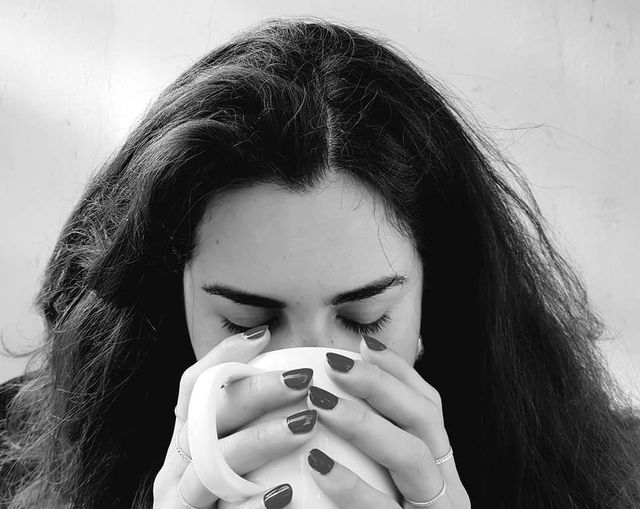
Drinking coffee in Abu Dhabi, 2018
by Phil Hall
I must have seen those small thick, white Lido hotel porcelain cups and smelled the rank contents long before I tasted the coffee inside them. The Lido is still there. On the road between Pretoria and Johannesburg. It was my grandfather’s hotel.
The first coffee I tried was in the form of red fruit plucked from bushes. We lived next to coffee plantations in Tengeru, near Arusha. One afternoon we were taken horse riding around one of the adjoining plantations.
I had ‘equestrian comfort’ in those days because I was used to riding horses and liked the warm taut feeling of the horse’s belly against my legs. I slipped sideways on the saddle, leaning over at a right angle and picked a few berries, before clenching my legs and righting myself again.
So, this was coffee! The berries were bright red and looked small, hard and waxy. I bit into one carefully. It was sweet with a thin layer of chewy flesh. Was this redness the coffee?
No. There was a pip inside, a seed. It was slippery and green. When you scraped the membrane off the seed, it had the shape of a coffee bean. I bit into the bean cracking it in two; it had no flavour at all, just the gritty texture of something hard and broken.
We must have smelled the coffee roasting in Moshi and Arusha, but the smell percolated slowly, seeping into consciousness. There was no single precise moment when I can say. I smelled roasting coffee for the first time.
Paris is a place of smells. A Korean, feminist artist made a picture of Paris using smells after she had visited it a few times. On her map of Paris you could smell: coffee, cigarettes, pee, buttery baking, drains, garlic and fish. The impression you get of Paris when you first arrive is strongly olfactory. Is it that way still? So there it was, coffee, woven into the fabric of a city, of its being. Coffee and Paris. But when we were small in Paris visiting my grandparents in their flat in Meudon, we didn’t drink coffee, we drank warm Nesquik from wide cups with thin decorated rims.
Passing through Istanbul on our way back to England from India, people seemed to be drinking as much tea as they were drinking coffee. I could smell the coffee, but saw people drinking coppery tea, sucking it through sugar cubes. I can’t remember seeing the coffee drinkers.
In Switzerland we visited an old admirer of my grandmother’s. He knew her from before the war. Many friends of my grandfather had been in love with her, she said – and I believe her. This friend of theirs had become a wealthy coffee trader.
He welcomed us. His house had a view of Lake Geneva. Inside he had samples of coffee and explained to us that the best coffee in the world was not Brazilian or Colombian, with their powerful, more bitter tastes, but Arabica, and, particularly, Arabica from the coffee growing areas around Mount Kenya and Mount Kilimanjaro – from Arusha, from precisely where we had lived.

In the late 70s and early 80s.There were no espresso shops in Brighton. At least none that I knew of, or could afford to go to, though there were one or two places in the side streets where they roasted coffee.
In the days before the Internet, everything was word of mouth. Either that or you would read Time Out or City Limits; you would have to know where anything was before you could visit it. If you wanted espresso you went to Italy – or Soho. You could also buy French patisseries in Soho at Valerie’s. Valerie’s became a chain. There was a Valerie’s in Kingston-upon-Thames for many years, but it was odd for me to see it there when for so long Valerie’s had represented inaccessible sophistication.
In 1981, I cycled across Holland and Germany. In Holland a generous (and curious) couple invited me in for a coffee. I tried their coffee and it was very good; it tasted strong, but mild at the same time. They drank it with with cream which made it even smoother. How was it that the Dutch had such good coffee? I asked myself. What could be the reason? Then I remembered the Indonesian restaurants in Amsterdam. Oh yes. Of course. Holland! The Holland which had had an empire. The Holland that had owned Java and exploited its resources and its people.

In Yugoslavia my friend Natasha taught me to make Turkish coffee properly. I had travelled all the way there to see her. In fact, Natasha was a mix of Turkish herself. Her eyes were black almonds . There is a little of the Ottoman in every Serb. How it got there, it is better not ask.
Turkish Coffee
- One spoon of sugar in a pot of water. Leave space in the pot.
- The pot heats up until little oxygen bubbles start to rise.
- Just before the water boils add two tablespoons of finely ground Turkish coffee.
- The coffee bubbles up like crazy.
- Splash the boiling mixture down with a little cold water.
- If you want it to be strong, let it bubble up again, then splash it down again.
- Allow the grounds to settle properly before pouring into Turkish coffee cups.
- Serve. Allow the grounds to settle before you sip.
- Do not sip up the grounds.
She made a special topping once with sugar blended up into a cream with egg yoke. I feel that this recipe was a young person’s way of making coffee more palatable.
Back again in London in the 1980s and all there was to drink in the average café was sour, overheated filter coffee – with a little milk to calm the bitterness. The coffee revolution hadn’t arrived yet. The Anglo coffee revolution started in the USA, which was famous for being the country where they made the worst coffee in the world. Another refill, Sir?
Off to Xalapa, to the State of Vera Cruz in Mexico to study literature. Now Coatepec, near Xalapa, is coffee growing country and so much so that the handicrafts – table lamps and carvings and so on – are made and assembled with pieces of polished coffee wood. The smell of good roasting coffee was everywhere in Xalapa. Here you could sit in a café and look out across to El Cofre de Perote and in the distance see the white dome of El Pico de Orizaba, the highest single standing mountain in the Americas, and sip excellent, aromatic, filter coffee.

In the mornings, they made café con leche. Often it was with a spoon of instant coffee. They served it sweet and hot in tall ice cream glasses. A good enough start to a student’s day, I suppose.

After my degree, I worked in Madrid. It was the Madrid at the tail end of ‘La Marcha’. This is when I really fell in love with coffee at the age of twenty six. I notice that my son and one of my daughters also fell in love with coffee at around the same age – in their mid twenties.
The amount of café con leche I drank was ridiculous. I combined the café con leche on my way to work – at seven am – with two halves of a large croissant, fried in butter. It’s the Spanish way. At lunchtime I combined the coffee badly with sandwiches of all kinds: bocadillos de jamon, bocadillos de calamar, bocadillos de mejillones. Spanish coffee is made with a mixture of Torrefacto and Columbian or Brazilian Robusta. The Torrefacto consists of coffee beans which have been roasted in sugar syrup.
My job was very demanding and so I fell asleep exhausted every evening during the working week. My students drained all the energy from me like vampires. But at the weekends I would go to a good café, like the Café Gijon, or something less grand in the Plaza Mayor, or a café on the Gran Via, or Plaza del Sol and read El País from cover to cover. Coffee after coffee after coffee, and my head full of Spanish.
It was a shock for me, on my first visit to Madrid, to see the Spanish come out at nine or ten in the evening to promenade with their families and go for tapas and a light supper, and maybe a coffee. Spanish coffee can be awful if they use bad beans, but most cafes don’t do so because the customers’ expectations are too high.
By twelve midnight the city was quiet again. The parks and boulevards. Sometimes after work we would visit the cocktail bars. They were better than any cocktail bars you can find in London, even now. The portions of alcohol were generous and the drinks affordable. The cocktail bars in Madrid were glamorous places to go to after a show – places of engraved glass and polished hard wood. The evening would end with an Irish coffee, which the Madrileños know how to make and seem to love.
In Mexico again, working. This time drinking Mexican cinnamon coffee with piloncillo – Café de Olla. Piloncillo is unrefined sugar. Mexican cinnamon prickles like pepper. It is strong tasting. Even when the coffee is good the taste of cinnamon and unrefined sugar overpowers it. The coffee is cooked for too long in a clay pot. You might drink it, perhaps, if you were having buñuelos for desert; fried crispy pastry covered in a molasses-like syrup.
Uruapan is famous for its coffee. The family run coffee company in Uruapan is called La Lucha (the Struggle). Like all locally grown coffees it has a distinctive scent, and if I smell La Lucha, I know I am in Uruapan.
Uruapan, Nelspruit and Arusha should twin with each other. They are all highland places. They all have well watered, rich soil where nuts (like macadamia) can grow. In Nelspruit where my parents lived in a house in a garden at the top of a wild and sloped piece of bush, my father refused to buy the local coffee, which smelled wonderful, and bought instead, a generic brand from his favourite supermarket. In my view, he had his reasons. Perhaps he came across the owners and took a dislike to them and their labour practices. That coffee was on sale at Millie’s, which is a roadside restaurant famous throughout South Africa for its creamy trout pie. Millie’s is the gateway to the lowveld.
For a while, I had a job as the coordinator of a foreign languages department in London. I was supposed to be preparing the ground for my family to move to London in the mid 90s. I mismanaged my money and spent too much of it in the new coffee bars that had started up. I drank so much coffee in an attempt to cheer myself up and buzz the loneliness away. Coffee nearly bankrupted me. I missed out on more than a year of my youngest daughter’s life as a result of this wasteful period. The coffee was not that good either. All I can remember about that coffee is the flavour of the cardboard cups, which grew soft and soggy if you didn’t drink the coffee quickly.
I hope there was some hidden cosmic agenda, some silver lining to came out of that disaster. Some meaning. Perhaps there is. Meaning comes out of even the most horrible experience, out of war and disease. Instead of coming to London in 1996 we actually came in 2002. By then my children were firmly settled into their first solid identity, a Mexican identity. Looking back, this is actually what I wanted for them. I have taught so many young people who have almost lost half their identity, and who fail to experience and respect one half of their family culture.
We forget that Mexico City is an old city, that its first university was established not long after Cambridge and Oxford; that Mexicans are mestizos of mestizos – mixtures of a mixture. In other words Mexicans are part Arab. They know about coffee. Colonia Roma has an old established tradition for coffee bars and good coffee. I would spend between six and eight hours driving every day in Mexico City. It was a nightmare, but in the morning, after two hours of driving to the southern part of the city from the centre and back again (I was dropping my children off at their school) I would park at a café in the Roma district, sip a cup of coffee, look at the old buildings in the crumbing square and, always, wonder how they survived the earthquake of 1985. I was first in Mexico City in 1984. The best coffee I have ever had we drank in Vera Cruz at La Parroquia.
When we came back to London, the coffee had improved but not by much. Which were the best chains then? Costa. Nero. Nowadays the best espressos are not from the chains at all, but from the little coffee bars that are all over the city. London has its own coffee culture now, but, to be frank, it isn’t very grown up. We drink our tea with milk and our coffee, too. ‘A skinny latte please!’ Few people nowadays drink coffee with cream. Remember those little plastic pots of cream with the aluminium tab, that when you tore it off would squirt cream out onto the saucer and the table; sour hotel coffee with cream. Dystopia!

In Saudi Arabia (I had to go there to earn money) I learned more about coffee. In fact, I had already learned a little about how Saudis drank their coffee from my students at Brunel and Kent. Arab coffee from Arabia is lightly roasted and doesn’t taste burned at all. It is to tea what Turkish tea is to English Breakfast Tea. Or, rather, when lightly roasted, Arabian coffee is the equivalent of green tea. Logically, it must be good for you.

Look at the point at which the coast of Yemen gets close to the coast of Ethiopia. There is a town there called Mokka. The Saudis are not the discoverers of coffee, the Yemenis are, and the Ethiopians. My parents lived in Ethiopia and they told me that the story goes like this: a goat herd saw how, after eating red berries and leaves from a certain bush, a goat started acting up – as Professor Calculus might say. The goatherd was curious and tasted the berry. Then he felt a faint uplift. He cooked the beans. This produced an aroma. But you can’t really eat coffee beans, so he made an infusion. Thus coffee was discovered. This must have happened ages ago. My mother, Eve Hall, told me that the coffee ceremony in Ethiopia was elaborate.
They do not drink much alcohol in Saudi Arabia so coffee is all important. It is a drink of the Bedu – to be sipped from tiny cups and served in miniscule quantities. Coffee is roasted in a pan over the coals of the campfire and the tradition is that your host will serve you and serve you and serve you, until you turn your cup upside down.
The people of the Arabian peninsula are intensely proud of their coffee. What is now the UAE was one of the poorest countries in the world and the way someone showed generosity and wealth was to season coffee with spices like cardamom. If you go to shops which sell Arab coffee they will sell it flavoured with cardamom. But when Arabic coffee has too many spices, to me it is almost undrinkable. It is like drinking perfume.
The part of the long Bedouin coffee ceremony that I like most – a ceremony almost as long and complicated as the Japanese tea ceremony – is when they grind the coffee. When they grind the coffee in the pestle and mortar they ring the mortar with the pestle like a bell, and one can imagine that everyone in the Bedouin camp would have heard that ringing and then approached the coffee tent to smell the coffee roasting.
Discover more from Ars Notoria
Subscribe to get the latest posts sent to your email.
You must be logged in to post a comment.