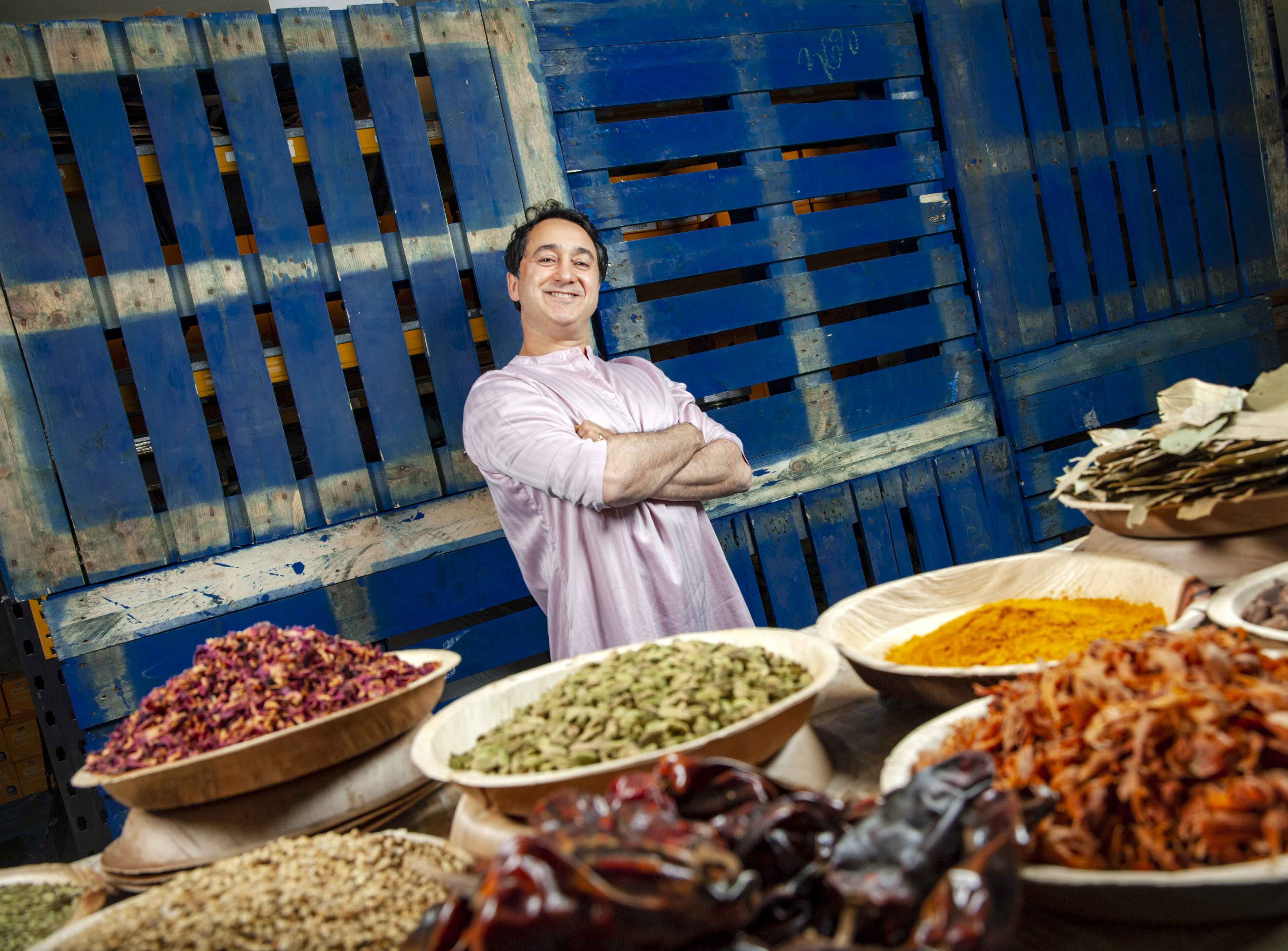
Arun Kapil, the owner of Green Saffron Spices, photo Daragh McSweeney
Indian Cooking: the Home, Street and Palace
by Arun Kapil
Can there be such a thing as an Indian restaurant? The whole Indian subcontinent, including Pakistan, Bangladesh and Sri Lanka, is so vast and its beautiful cuisine is so different from region to region that it makes such a generic title as ‘Indian’ food a nonsense. To try to define Indian cuisine really is a convoluted minefield of a conundrum.
The high street restaurants, so loved in the UK (and rightly so) are run on tight budgets under the strong supervision of their owners, and must meet the margins they need to keep to to survive in a hard and competitive environment. The chefs employed at these curry house restaurants are usually highly skilled line-chefs reproducing dishes by the numbers. Often, though less often these days, they use generic, bought-in sauces – buckets of commercially produced sauce which act, at best, as a daag base or, at worst, as the whole solution to what can often be a disappointing meal.
In the UK nowadays, most chefs who arrive from India can cook the food from many different states of India, and of other countries too. They perfect their skills through hard work in the Taj or Oberoi schools of excellence. But if they travel to the UK, it is unlikely they will end up in a high-street restaurant. They will prefer to stick with a famous name they know, or work for an enterprise a fellow chef from home has recommended to them.

Much of the food that people say is Indian is good. It’s great. But what of Indian food’s roots? Just what is it that can be stated as a ‘catch-all’ for what typifies Indian food? Well, as Japanese sushi relies on the freshness of the meat and Chinese food on the various sauces to impart the right flavour and taste, Indian food relies on the spices and fresh ingredients used in its creation. Spices have always been considered India’s prime commodity. Traditionally, many Indian dishes require an entire day’s preparation: cutting vegetables, pounding spices with a stone, or just sitting patiently by the fire for hours on end while an ingredient reduces – I’m thinking here of milk reduced (condensed) to its sweetest form, khoya. On the other hand, there are simple dishes which are ideal for everyday eating. It’s really quite cool, inspiring, to see an Indian cook at work with a palette of spices. Judicially they sprinkle powders in exact pinches into the pots pans and grills in front of them. You can only truly discover the many differences in the foods of the various regions by travelling around India, each region relying on its local produce to create its delicious dishes.

Most ‘Indian’ food available in the UK used to be based on North Indian, Bengali and Pakistani cooking. They were the first settlers if you like, and the food was derived from Raj notions of Indian food cultivated in the army mess and the Rajah’s palace. In reality, the variation in Indian food from region to region, from north to south, from east to west is quite staggering. Eating a ‘thali’ is commonplace in most parts of India. The classic West Indian thalis of Gujarat with their array of small bowls filled with spiced vegetarian dishes, curd, pickles and sweet desserts arranged around the plate, or splodged with love directly on to a banana leaf are a truly outstanding taste experience, served with savoury buttermilk, rice and heavy bread. In the North, where the weather varies from scorching heat to biting cold with a sprinkling of showers in between, the food tends to be rich and heavy. The Moghuls influenced meat eating habits among many Northern Indians but also introduced many different kinds of breads such as rotis, phulkas, puris and naan, all made from a variety of flours.

Let’s keep digging to understand the origins of cooking on the subcontinent. From ancient times Indian food has been divided into the Satwik and Rajsik varieties. Satwik was the food of the Brahmins and is more inclined toward promoting spirituality and health. It included vegetables and fruits, but not onions, garlic, root vegetables or mushrooms. The more liberal Rajsik diet allowed eating just about anything under the sun, with the exception of beef. Warrior-races like the Rajputs (from Rajasthan), whose main requirements were strength and power, ate this kind of Rajsik food.
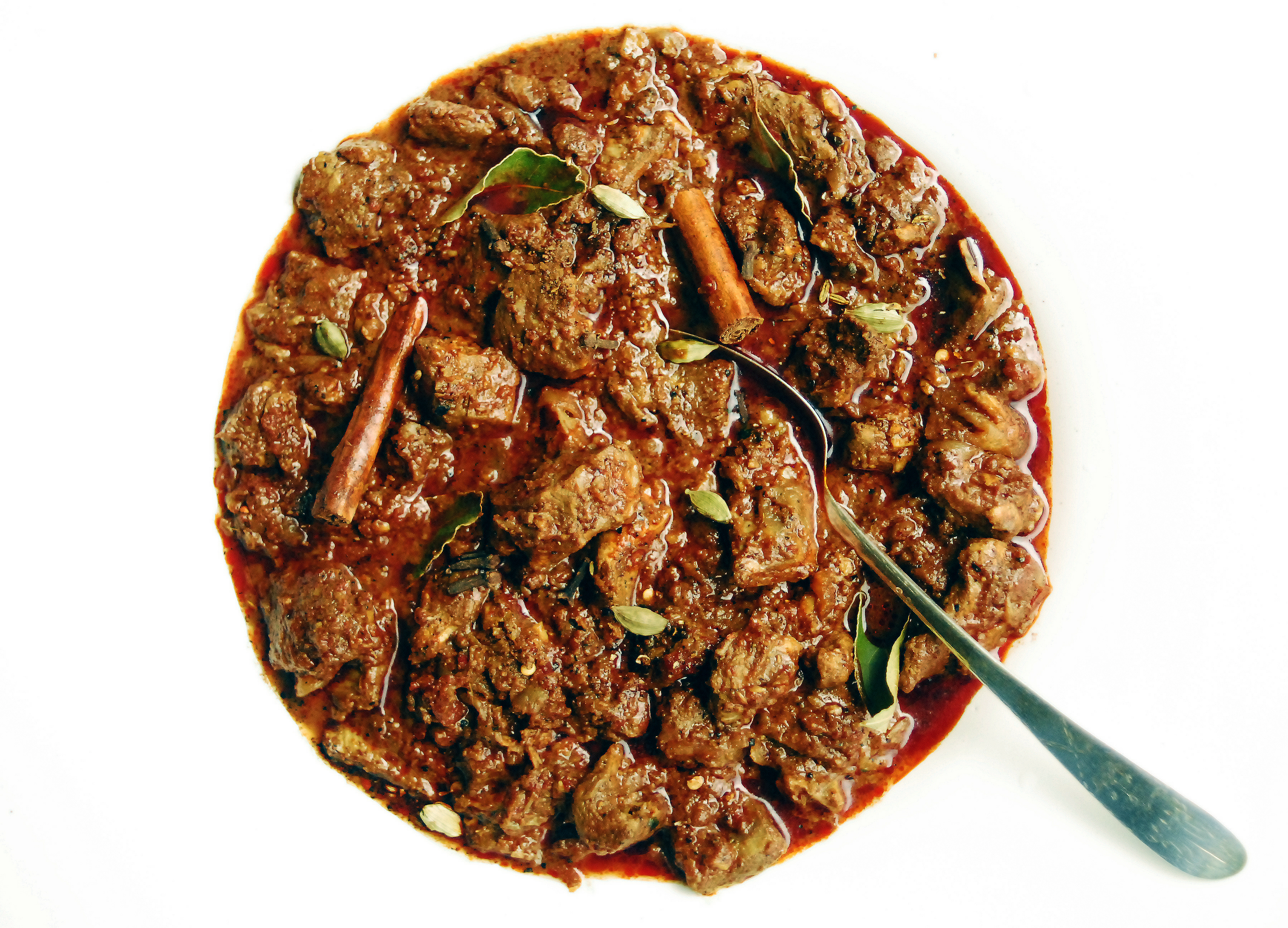
In the North Indian territory of Punjab, the everyday meal of a Punjabi farmer is centred around carb heavy flat breads, corn bread, greens and buttermilk (lassi). These help sustain the farmer throughout daily toils. Shredded vegetables mixed with spices are stuffed into the dough, rolled and roasted to make delicious stuffed parathas, rich, fulfilling and substantial. Some Punjabis eat meat dishes and almost always paneer, an Indian cottage cheese, pilau dishes garnished with fried onions, roasted nuts – on occasion topped with silver leaf and rose petals. Tandoori food, a favourite of many, is a gift from the Punjab region. Various meats are marinated with spices, ginger, garlic pastes, curd and roasted over a clay tandoor with a wood-fire burning beneath.

In the beautiful, rich North West valley of Kashmir, dishes are created around a main course of rice. A thick-leafed green leafy vegetable called hak grows in abundance here and is used to make delicious saag curries. The boat-dwelling population of the region use lotus roots as a substitute for meat. Morel mushrooms called gahchi are harvested and consumed throughout the summer. Fresh fish, abundant in the many lakes and streams, is eaten in many meals. Lamb and poultry are cooked in the Mughlai style. Indeed, the Kashmiri equivalent of the thali is a 36-course meal called the waazwaan.

Bengalis, to the East of India also eat a good deal of fish. One of the delicacies called the hilsa is often spiced using panch phoran – Indian Five Spice – wrapped in pumpkin leaf and cooked. Another unusual ingredient used in Bengali cooking is the bamboo shoot. Milk sweets from this region like the Roshgolla, Sandesh, Cham-cham are world famous. To the South of India, rice is eaten for breakfast, lunch and dinner. Raw rice, parboiled rice and Basmati rice are some of the different types of rice eaten here in the Telangana state and its temporary capital of Andhra Pradesh. Steamed rice dumplings or idlis, roasted rice pancakes or dosas are eaten along with coconut chutneys for breakfast. A dosa stuffed with spiced potatoes, vegetables or even minced lamb is the Masala Dosa, well known in the UK.

In the southern state of Andhra, most food tends to be quite hot and spicy reflecting the abundant chilli harvest of the region. By the way, eating a banana or yogurt after such a meal will help quench any fires raging within. Hyderabad, the capital city, is the home of the Muslim Nawabs and is famous for its superb Biriyanis, simply delicious grilled Kebabs, Kormas and rich puddings made with apricots. To the west and staying south is Mubai, where the food is a happy combination of northern and southern food. It uses both staples: both rice and wheat. A wide variety of fish is available along Mumbai’s Maharashtrian coastline; its Bombay Prawn and Pomfret dishes are delicious. Further down south along the coast, in Goa, a Portuguese influence is most obvious in dishes like the sweet and sour Vindaloo, duck baffad, sorpotel and egg molie. Just around the corner from Goa is Kerala where lamb stew and appams, Malabar fried prawns and idlis, fish molie and dosai, rice puttu and sweetened coconut milk are the many combinations eaten at breakfast.


And so to paan. It is served as a digestive after meals. The dark-green leaf of the betel-pepper plant is smeared with a little bit of lime and wrapped around a combination of spices like crushed betel-nuts, cardamom, aniseed, sugar and grated coconut. It is an astringent and is believed to help in clearing out the system. Mumbai is known to be a good place for connoisseurs of paan. It is banned indoors because paan spittle stains red.
To my mind, Indian food in India derives from the home, the street, or the palace. Most household and street cooking relies heavily on texture and taste sensations; umami is simply not part of Indian cuisine, or important to the Indian palate to create delicious, must-have dishes.
In palace cuisine the khansama had the freedom to innovate with ingredients sourced from all over the country and even the world. This was a privilege not many cooks had in 1700 and 1800’s India. From the late 1600’s to the early 1800’s, the palace cooks earned a reputation as the true innovators of Indian cuisine. The Khansama, or Maharaaj used everyday ingredients like potatoes, tomatoes and chillies, and then they mixed them with spices from all over the country. They created delicious dishes literally fit for kings. Even the idea of mixing spices from different regions of India was innovative. The cost of buying spices in the north that had travelled all the way up from southern regions was prohibitive. Indeed, it was often the palace cooks who went on to open restaurants, so beginning the fashion for restaurant and café dining that modern India enjoys today. Karim’s in Old Delhi is a prime example.

What is Indian cooking in the UK?
What is Indian cooking in the UK? Is it defined by the home, the street or the palace? One thing for sure is that India’s cuisine is so diverse, sophisticated and subtly complex that to truly capture it in a snapshot – a two hour dining experience – is near impossible. So, while the 60’s and 70’s curry houses introduced a delicious taste of spice, a generic overview of popular, easy on the palate flavours, to the UK. The diaspora and the modern Indian chefs, cooks and entrepreneurs bring the vibrant, the fresh and the truly tasty food of home, sometimes with a playful tweak, for us all to enjoy.
My point is this: in the United Kingdom there have always been the parallel tracks of authentic and the western palate pleasing for food from India. The authentic and palate pleasing run alongside one another happily. The question for me is: which one of these best represents the food of Indian origin people it in the UK: the food of home, the street, or the palace?

Born in Patna, Bihar, in the the North East of India, Sake Dean Mahomed brought The Hindoostane Coffee House, to London. It was just off Portman Square, W1. In 1810 it served authentic Indian street snacks, home dishes, and all with an abundance of coffee and in an atmosphere of fragrant Hookah smoke. An Anglo-Indian former-soldier from India stole away to Ireland where he married his love, Jane Daly from Cork. He converted from Islam to Christianity in the late 1700’s. He was as interesting a character in his business as personal life. Mahomed was a bon vivant. He moved to London with Jane and their four children in the very early 1800’s. For a few glorious years, he managed The Hindoostane, and then due to financial difficulties, they had to close The Hindoostane in 1812.
Then it was the turn of Edward Palmer, a retired Anglo-Indian army officer who decided to open the first Indian restaurant appealing to the Westerner. The restaurant tried to bring a taste of India to the plush, upmarket, diner – sometimes even royalty. Opened at 99 -101 Regent Street in twenties London, Veeraswamy offered dishes he gleaned from his experience in the British Army mess kitchens, and from the food of the palaces he had visited.

It was the first new wave of Indian chefs (not humble cooks) who came to prominence in the UK in the late 80’s, wanting to change the way their food of home was perceived. With skills in their heads, hearts and hands, Vineet Bhatia, Vivek Singh, Atul Kocher, Alfred Prasad, Cyrus Todiwala, Tony Singh were among the first to move away from the colonial style of cooking. They built their fare on the basis of the beautiful Raj repertoire of Edward Palmer’s Veeraswamy and then moved beyond it to create Larousse style Indian cuisine.
These chefs brought more with them than simply the art and love of their regional Indian cuisines. Beyond the cooking, they have the deft, instinctive touch of spice. They bring a real sense of how to elevate dishes by presenting it well. We receive a glorious cultural experience through their cooking.


The restaurants that have these chefs are the ones on the rise. They offer not only a sense of the real food of India but an environment that’s more than flock wallpaper with the dulcet jangle of a sitar in the background. Don’t get me wrong. I love this combination, bought up as I was on the home-cooked food of my North Indian father. I loved the special treat on Friday or Saturday, of an evening foray into the Doncaster institution that was The Indus Restaurant. Throughout the ‘70’s and 80’s our family would go down to Drummond Street packed into our burgundy coloured Peugeot 504 and eat eat the Diwana Bhel Poori restaurant and visit the Ambala sweet shop to leave laden with brightly coloured boxes packed with sweetmeats. Occasionally, we would go to The Gaylord instead, around the corner in W1.
In the 2020’s, Indian restaurants in the UK are now focusing and refining their menus according to region: according to whether they are haut cuisine, home-cooked, or street cooked, according to whether they are Eastern, Northern, Southern or Western, according to whether the food that is offered is healthy, indulgent, original.

Nowadays almost every Indian restaurant had its schtick. But it is not a gimmick, it is intentional. The point is to produce excellent food inspired by just one element of India’s myriad culinary styles, tastes and methods. It is possible that this trend was learned after long observation of the western bhāī establishments – after watching how other food and drink outlets evolved: chicken restaurants, burger joints, pasta houses, kebab shops, noodle bars, steak houses, vegan restaurants, bao bun places and seafood restaurants. Even simple water is now available in so many varieties. Now, many Indian restaurants offer dishes that centre on a single theme. They are no longer one-size-fits-all.
With fear of turning this writing simply into a list of UK based Indian restaurants, the new innovators, the chefs gunning for the Michelin and 5-star status number amongst the best regarded UK chefs: Ashok Kumar at Kaniksha, London, the leading light, Rohit Ghai, with his many restaurants, a couple in London Kutir and Manthan, Opheem in Birmingham with rising celebrity chef Akar Islam at the helm, Avinash (Avi) Shashidhara at Pali Hill, London, and skilled Indian brigades at the Prashad in Bradford and Haveli in Ponteland, otherwise known as Newcastle.

In the UK, we are seeing a whole new set of establishments emerging headed by brilliant women – cooks, chefs and innovators, each with their vision of what best constitutes food of their home. Doyennes of Indian cuisine like Asma Khan promote a desi home style of cooking at the Darjeeling Express with an all-women kitchen brigade represent the cooking of the home. Nisha Katona with her fabulous Mowgli Street Food chain of restaurants, have, arguably, created the new curry houses. They represent the cooking of the street. Ravinder Bhogal and her high-end Jikoni restaurant offers innovative dishes using the best available sourced English ingredients treated with Indian culinary magic. She represents the palace.

These women shine brightly, but they are not alone. The JKS Restaurant Group owns many an Indian jewel in its portfolio of refined Indian restaurants. They focus on both the street and the palace, from the Gymkhana and Brigadiers to the palatial Trishna and Bibi restaurants. Then there are the fashionable offerings: Harneet Baweja’s Empire Empire and Gunpowder. And a favourite of mine: the Fatt Pundit in Soho, a restaurant by Huzefa Sajawal focussing on the rising, Indo-Chinese Manchurian trend of Kolkata, East India. There are the Kricket and Dishoom venues in London, Dastaan in Surrey, the most excellent Asha’s chain of restaurants, a must visit when in Birmingham or Manchester, owned by singer Asha Bhosle. The menu has many of her favourite dishes from around India and a collection of those from her South West, Maharashtrian home.

The number of ways to taste real Indian food is also on the rise, not least with ultra-fast deliveries and the internet of Uber Eats – I’m told Mumbai Local is an must if in the the Wembley area and in the mood for a Maharashtrian feast. Now even pubs are being taken over and offer exceptional Indian menus. One might (rather wearily) call this the natural home of the curry house. Venues such as the Tamil Prince in north London and the Kenyan Indian fusion pub venue, The Regency Club in Edgware offer vibrant, authentic dishes of delicious curries and street-food inspired snacks. Or how about an Irish Indian fusion, Shankey’s in Hackney? My niece raves about this place and I will definitely make a bee-line to it when I’m next down that way.

Immigrant, diaspora, first, second, third generations of British Asians, whatever the monicker the strength of the UK’s affiliation with beautiful India can surely only serve to ensure that those cooks bringing the best of their home kitchens to Blighty’s shores continue the journey started by Mahomed and Edward Palmer of offering only the best, most joyous and generous of Indian cuisine. Besides, I don’t think the modern consumer, educated online or through travel, living in a cash strapped, cautious fiscal times will support anything but the best.
So, I encourage you to go out, discover and choose for yourself the dishes of India you most enjoy. Get stuck in and eat with hearty gusto the warming curries, soft tearing breads, ethereal biryani’s, crisp samosas, tangy street snacks, piquant pickles, achars and chatnis, they have all been cooked with love, a little soul and a handy dose of skilful understanding. Indian cooking, the pursuit of offering the most authentic regional and enlightened dishes of SE Asia is here to stay in the UK… Shukriya.


And finally . . . who am I? I’m a chittock of this, a tola, a gramme, an ounce, kilo, a pound of this and that. I was born in Lincolnshire to a loving forward thinking Hindu father, a doctor from UP, India and a strong, loving, creative mother from Yorkshire, a SRN. I was schooled in Northamptonshire, battered bruised and taught a proper thing or two in the entrepreneurial world of the music industry in nineties London and I now live in East Cork, Ireland married to my cáilín deas, a local farmers daughter, Olive. I founded and own a spice company, Green Saffron Spices. We work sustainably direct with partner farms mainly to the west and north of India and some in the south. We’re direct from source, we own total chain of custody, depleting links in the chain, bringing direct line of sight to fields of cultivation. Olive and I began by selling one or two sachets a week of bespoke blends with accompanying recipes at a farmers market stall over here in Mahon Point, Cork. We now sell spices and seasonings to globally based blue chips, onward food processors and are just in the throes of re-launching our brand, based on Modern India meal solutions, sauces, spice blends, naan, condiments and basmati. We started the business boot-strapping from the bottom up, managed with a good deal of jugaard. I consider myself a masaalchi and at best a khansama supported by a strong network of Irish, Indian and British agri-experts and businessmen.

Discover more from Ars Notoria
Subscribe to get the latest posts sent to your email.


You must be logged in to post a comment.