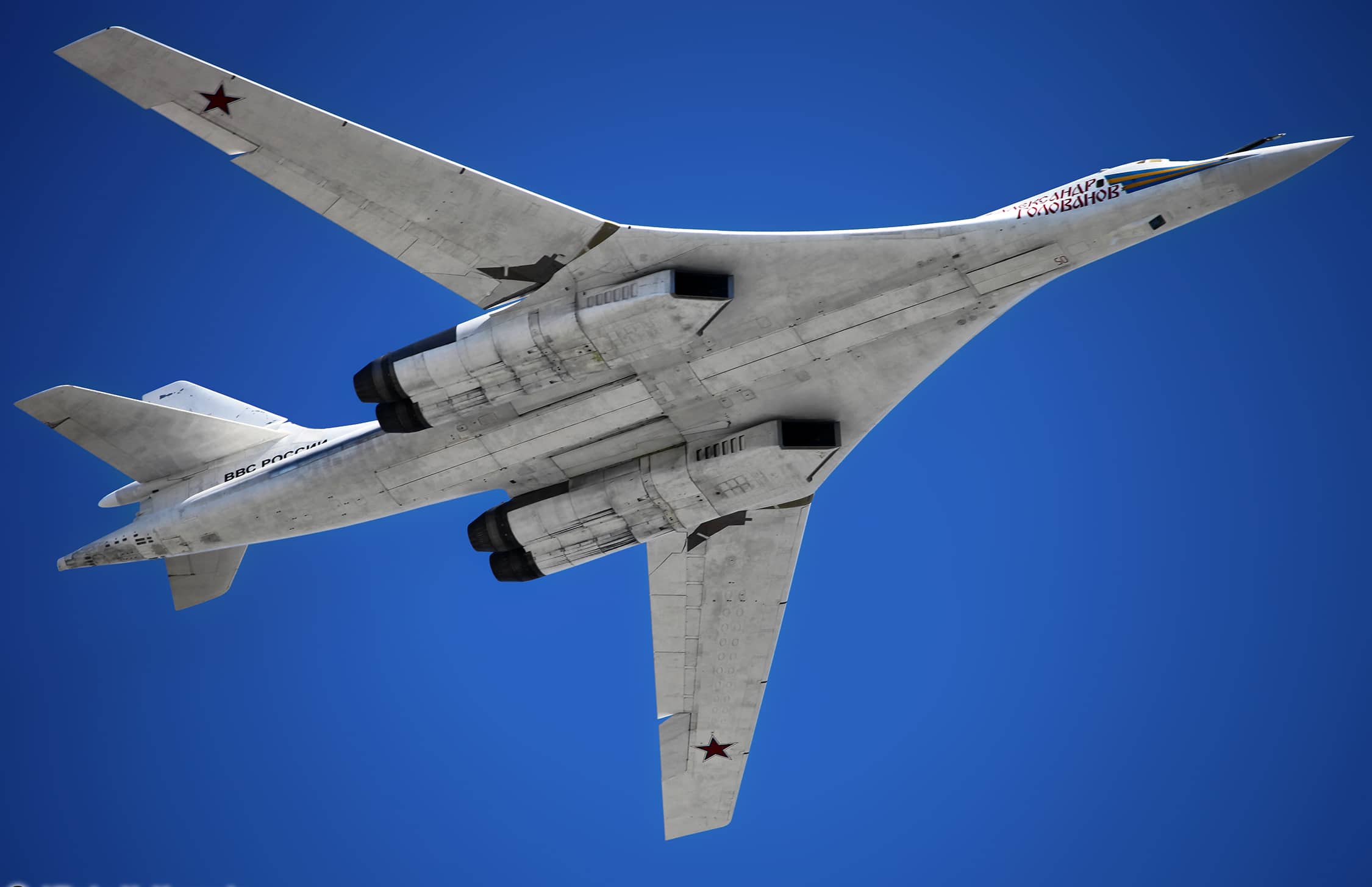
The nuclear capable TU-160, Vitaly V. Kuzmin, Wikimedia Commons
How many steps away are we from thermonuclear Armageddon?
by James Tweedie,
The war in Ukraine has now been raging for more than two years. While neither has published complete figures for its own casualties, methods such as monitoring online obituaries indicate that tens of thousands of Russians and hundreds of thousands of Ukrainians have been killed.
Without dwelling on the rights and wrongs of the conflict, it is necessary to make a sober and realistic assessment how close the various actors in this tragedy are to achieving any of their strategic ends.
We must be clear that strategic goals are not just tactical objectives on a grander scale. They are long-term political outcomes. That balance-sheet is not in the black for the collective West, and that may be a dangerous omen.
Ukraine
Ukrainian President Volodymyr Zelensky has codified many of Kiev’s aims in his 10-point “peace formula”, set for ceremonial approval by Ukraine’s Western backers at the exclusive Swiss Burgenstock resort on June 15 and 16.
The plan is problematic from the start, partly because it is not a plan at all but a set of accusations and demands, but also because Russia is not invited to the “peace conference.”
Points one to four, seven and eight are accusations, projecting the Zelensky government’s own acts — particularly its continued shelling of the Zaporozhye Nuclear Power Plan and its demolition of the Kakhovka dam — onto Russia. Points five and six are a demand for Russia to surrender all territory it has gained, plus regions already beyond Ukraine’s control in February 2022, with no concession from Kiev.
Point seven demands “justice” — or revenge — with a war crimes tribunal to prosecute Russian state officials exclusively. Point nine calls for a “post-war security architecture in the Euro-Atlantic space that will include Ukraine” — an obvious code-phrase for NATO membership. Point 10 says a peace treaty must be signed after the war is ended, putting the cart squarely before the horse.
All the ten points are unrealistic or contrary to peace. The abject failure of Ukraine’s summer counter-offensive proved that it cannot regain lost territory by force. In fact it has only lost more ground since. Christmas will not come early again for Zelensky like it did in 2022 and ‘23, when Kiev received hundreds of tanks and artillery guns. All of that came from NATO members own arsenals, which have now been stripped bare.
Kiev’s insistence on joining NATO — potentially allowing the US to set up bases as close as 200 miles from Moscow — was one of the main causes of the war. Any realistic peace treaty must rule that out. The argument that Ukraine has the “right” to choose its allies as it pleases is either naive or dishonest, depending on its advocate. Like in any exclusive club, every existing NATO member has the power of veto over new applicants. In any case, nobody has the right to upset the geo-strategic balance of forces that keep the nuclear-armed powers from unleashing Armageddon.
“There are no alternatives to this peace plan,” the plan concludes. “Only Ukraine, the country fighting against this war of aggression, can define what just and sustainable peace looks like.” Zelensky thinks he can dictate terms to his Russian counterpart Vladimir Putin from a position of weakness. He has even issued a decree forbidding talks with Moscow while Putin — who was sworn in for another six-year term this month — remains president. That is not the path to peace.
Russia
Russia’s stated aims at the start of the ‘special military operation’ were the demilitarisation and de-Nazification of Ukraine, along with the protection of its own citizens and the residents of Donetsk and Lugansk, the-Russian speaking regions which refused to recognise the government in Kiev following the ‘Euromaidan’ events of 2014.
The first two goals have been scoffed at in the West as either spurious pretexts or, at best, typically cryptic Kremlin jargon. But Russians understand them well.
Demilitarisation does not just mean removing Ukraine’s physical means of waging war on the breakaway Donbass republics, as it did from 2014 to 2022. That has already been partly accomplished by attrition in combat. It also means also forcing Kiev to renounce its aim of joining NATO, and ideally for NATO to agree to Russia’s so-called ultimatum of December 2021: to dismantle all bases and withdraw all foreign forces east of the German-Polish border and to stop its expansion.
The de-Nazification is clear: the well-documented fascist forces that led the Maidan Square riots and beat, shot and burnt to death scores of people in the Odessa Trade Union House massacre must be permanently banned from government, the state apparatus and the armed forces. Russia has already killed many of them and put captured members on trial.
Western pundits ridicule Russia’s apparent inability to crush the smaller and weaker Ukraine in the first months of the war — although Kiev’s forces were much larger at the outset than those of any NATO member but the US, and outnumbered the initial Russian force of 150,000 several times over. Even commentators sympathetic to Moscow’s position express their angst over the snail’s pace of Russian advances. But others argue that Russia is fighting a positional war of attrition against Ukraine. Time will tell, and maybe very soon.
Russia’s progress towards its goals has of course been hampered by NATO’s huge supplies of every kind of arms — short of nuclear weapons — to Kiev. But it has also destroyed huge quantities of that military aid which Western armies could not afford to give, and which will take years or decades to replace. NATO has demilitarised itself.
Vladimir Putin is also accused by the West or harbouring a fourth goal: to occupy and annexe all of Ukraine and range his thousands of Russian tanks and guns along Poland’s eastern border. But Moscow has never voiced such a desire, and credibly so. Does Russia really want to foot the bill for rebuilding a bankrupt nation seething with militant Russophobia?
Annexing Ukraine offers Russia no strategic advantage. It already borders Poland and Lithuania via its exclave of Kaliningrad, which NATO fears to attack. Jet fighters carrying hypersonic missiles based in the region that was once East Prussia can hit any European NATO member with no chance of counter-measures.
Still, three key Russian-speaking regions are still under Kiev’s control — Kharkov, Nikolayev and Odessa — along with the city of Kherson and the surrounding district on the west bank of the Dnieper River which bisects Ukraine. Kharkov is being used as a base for attacks on Russian cities, towns and villages in the Belgorod and Kursk regions. Russia finally launched a major offensive into Kharkov on May 10.
Putin himself told US journalist Tucker Carlson in their interview that he is willing to sign a peace deal which allows the West to save face. Negotiation is about give and take. Could Russia take Kharkov just to give it back in return for Ukraine’s neutrality?
NATO
The United States
The goal of US President Joe Biden’s administration, as stated by Defence Secretary Lloyd Austin, is to weaken Russia militarily and prevent it from recovering that strength. Side-quests include isolating Russia diplomatically, destroying its economy through sanctions, regime change in Moscow and even breaking Russia up into many smaller and weaker states that they probably hope will go the way of Ukraine.
The main problem is that it isn’t working. The Russian army is much bigger than it was at the start of 2022, to the tune of several hundred thousand personnel. The Soviet policy of mothballing all unused weapons since WWII, plus the huge surge capacity built into the nationalised Russian arms industry in recent decades mean there is no shortage of equipment or ammunition.
This year, four new countries joined the BRICS group — where the R stands for Russia — and 15 more have applied for membership. Russia’s economy is booming while the West is in recession. Some pundits argue that’s only because of increased military spending — OK, so the West forced Russia to grow its economy. Well done.
Russians overwhelmingly back the military operation in Ukraine, and re-elected Putin in March with 88 percent of the vote. Meanwhile many Western nations are in turmoil with massive protests on the street every weekend.
The other problem is the huge and obvious risk involved in one of the top two nuclear powers pushing the other into a corner. But Russia has avoided that fate and kept its strategic options open.
Another, more general US aim is to maintain its “global leadership” — economic and military hegemony and other nations’ belief in that. But the mask is slipping. The US economy has been parasitic on the developing world since the 19th century, but now Washington is pursuing policies that will see Europe de-industrialised for its own benefit — including the embargo on cheap Russian fossil and nuclear fuels and the open sabotage of the Nord Stream gas pipelines.
Washington also wants to protect Israel and Taiwan, its de-facto colonies. Ukraine must accept that Israel is Uncle Sam’s golden child and will get the lion’s share of his largesse.
With its primary war aims out of reach, the White House is trying to save face and keep NATO from breaking up in the face of defeat. It is trying to blame the sensible “populist right” of the Republican party for the inevitable collapse of the Ukrainian army. Israel’s offensive in Gaza provided a welcome distraction, but that has also become an albatross around Biden’s neck.
The ultimate goal of any government is to get itself re-elected. The US presidential and Congressional elections are coming in November. Biden faces a rematch with Donald Trump, who has promised to end the war before he’s even sworn in if elected. Foreign affairs don’t usually affect US elections, but going to the polls with two military defeats in Afghanistan and Ukraine under his belt — and maybe two more in Israel and Yemen — while voters deal with rampant inflation won’t do Biden any favours.
The United Kingdom
The British role in the Ukraine saga has been Machiavellian. Ask why Boris Johnson was chosen in April 2022 to tell Zelensky to reject the draft peace agreement with Russia, which Kiev’s envoy had already signed and which Russia had even begun to implement. Other European leaders would have welcomed the deal, which could easily be spun as a victory.
But BoJo was on the inside track and knows the real motives for backing Ukraine. He openly stated last month that a Russian victory would men “the end of Western hegemony” — like that’s a bad thing.
Downing Street supports Washington’s goals of destroying both Russia and Europe, with the caveat that it wants to avoid the same fate as Germany. It also wants to strengthen the transatlantic “special relationship” of being the number one henchman of the US in NATO — but faces competition from France and Poland. The British government and media have been even more strident cheerleaders for the whole Ukraine adventure than even their US counterparts, placing the UK in Russia’s cross-hairs.
But it has paid off: Joe Biden has muted the phoney-Irish Anglophobia he voiced during his 2020 election campaign, when he bitched about Brexit like a Guardian reader with a mouldy ciabatta. Johnson was an honoured guest at the White House after he made Zelensky an offer he couldn’t refuse. Biden is also full of praise for BoJo’s successor — even if he calls the new PM “Rasheed Sunook”.
The European Union
The EU, as usual, is a mess of contradictions. Having gaily followed the US into this adventure, the 27 member states are trying to limit the ensuing damage to their economies. Germany’s enthusiasm for punishing the country that keeps its lights on and homes heated is a case in point.
Poland, the Czech Republic and the “three chihuahuas” of the Baltic states are playing their usual passive-aggressive game of provocations towards Russia, counting on the big boys in the NATO playground to protect them. Slovakia started out as one of the loudest voices for war, but then its people elected a pro-peace government led by Prime Minister Robert Fico — who now lies in a coma after being shot by a pro-Ukraine liberal. Hungary has also taken a stand against Brussels’ attempts to make sanctions mandatory across the bloc and use its peace fund to buy arms for Ukraine.
European leaders continue to parrot the line from Washington and Downing Street that Russia will not stop at conquering all of Ukraine, but will roll its tanks westward into the former states of the Warsaw Treaty Organisation. Poland ostensibly fears having a common border with Russia — which it already does in Kaliningrad.
But NATO’s European members are certainly not acting like the Russians are coming over the hill. The Kiel Institute for the World Economy estimates that Britain, France, Estonia and Germany have each pledged or delivered around a quarter of their armed forces’ heavy equipment to Ukraine, the Netherlands and Denmark close to two-fifths, Norway more than half and the Czech Republic almost 60 percent. Why disarm yourself if you think war is imminent?
The Road to Armageddon
The result of the West’s strategic failures is a series of contradictory messages from Washington and the rest of the West, threatening war with Russia one minute and denying any such plans the next.
Democratic Party House of Representatives minority leader Hakeem Jeffries is just the latest Biden administration figure to threaten that US troops will be sent to Ukraine if the Russian army breaks through the Ukrainian lines — which it has already done. Jeffries was just echoing comments by Austin and Biden himself in recent months, along with French President Emmanuel Macron — who mooted sending around 2,000 troops to the City of Odessa as human shields against a feared Russian attempt to capture it.
Jeffries’ comments came the same week that British Foreign Secretary Lord David Cameron took now-obligatory photo opportunity in Kiev. Cam put his big foot in his bigger mouth when he declared that Ukraine has the “right” to use the long-range missiles gifted to it by the British taxpayer to attack sites deep inside Russia.
Days later, the Russian foreign ministry called in the British and French ambassadors for an unequivocal warning that any such malarkey would provoke Russian strikes on their forces, whether inside Ukraine or not. That was not an idle threat.
Direct US or NATO military intervention would not only risk rapid escalation to thermonuclear war, it would be a logistical nightmare. Ukraine is a big country, stretching 800 miles from east to west. It is bisected by the mighty river Dnieper, with a limited number of crossings which Russia has so far refrained from destroying — it was Ukrainian forces shelled and destroyed the Kakhovka dam in the Kherson region in 2023 to aid their attempts at troop landings on the Russian-held left bank.
The front line is literally on Russia’s doorstep, a fact underlined by the Frequent Ukrainian shelling of the city of Belgorod. The Russian armed forces can bring up supplies and reinforcements without leaving their own territory, and provide air cover from their home bases. They surround the eastern half of Ukraine in a 2,000-mile long horseshoe, and their missiles can strike anywhere in the country.
The US, by contrast, would have a logistics train stretching across the Atlantic Ocean and Baltic Sea to Poland, from where its fighter and strike jets would be unable to get to and from the combat zone without in-flight refuelling from vulnerable tanker aircraft. Muddy Ukrainian fields have already become a literal quagmire for the overweight US, German and British tanks already supplied to Ukraine.
Russia has a distinct geographical advantage, not to mention weapons of which the West has no equivalent. What escalation options would NATO have left if its much-hyped forces are defeated on the ground, or its expensive aircraft carriers are sunk in the Baltic or the Barents seas?
How many steps away are we from thermonuclear Armageddon?
James has lived and worked in South Africa and Spain. He has worked as a reporter and the international editor of the Morning Star newspaper, a foreign reporter for the Mail Online and an online journalist for RT.com. He has appeared as a commentator on BBC Radio 4, RT’s Crosstalk, Turkey’s TRT World and Iran’s Press TV.
He maintains an occasional blog (http://ositorojo.blogspot.com/), describing himself as “one of the most deplorable purveyors of fake news about populist strongmen (and women) around the post-truth world.”
Discover more from Ars Notoria
Subscribe to get the latest posts sent to your email.