The Polynesian Men of His Majesty’s Army Vessel, BOUNTY
by Glynn Christian
The trials and the contributions to Pitcairn Island of the Polynesian women who sailed aboard HMAV BOUNTY with Fletcher Christian have at last been more fully recognised by writers and historians. A few decades ago, a sign at the top of Pitcairn Island’s Hill of Difficulty listed only the nine European men who landed in January 1790. After some agitation in New Zealand, which I believe I began, a plaque with the names of the 12 Polynesian women and an infant has been added.
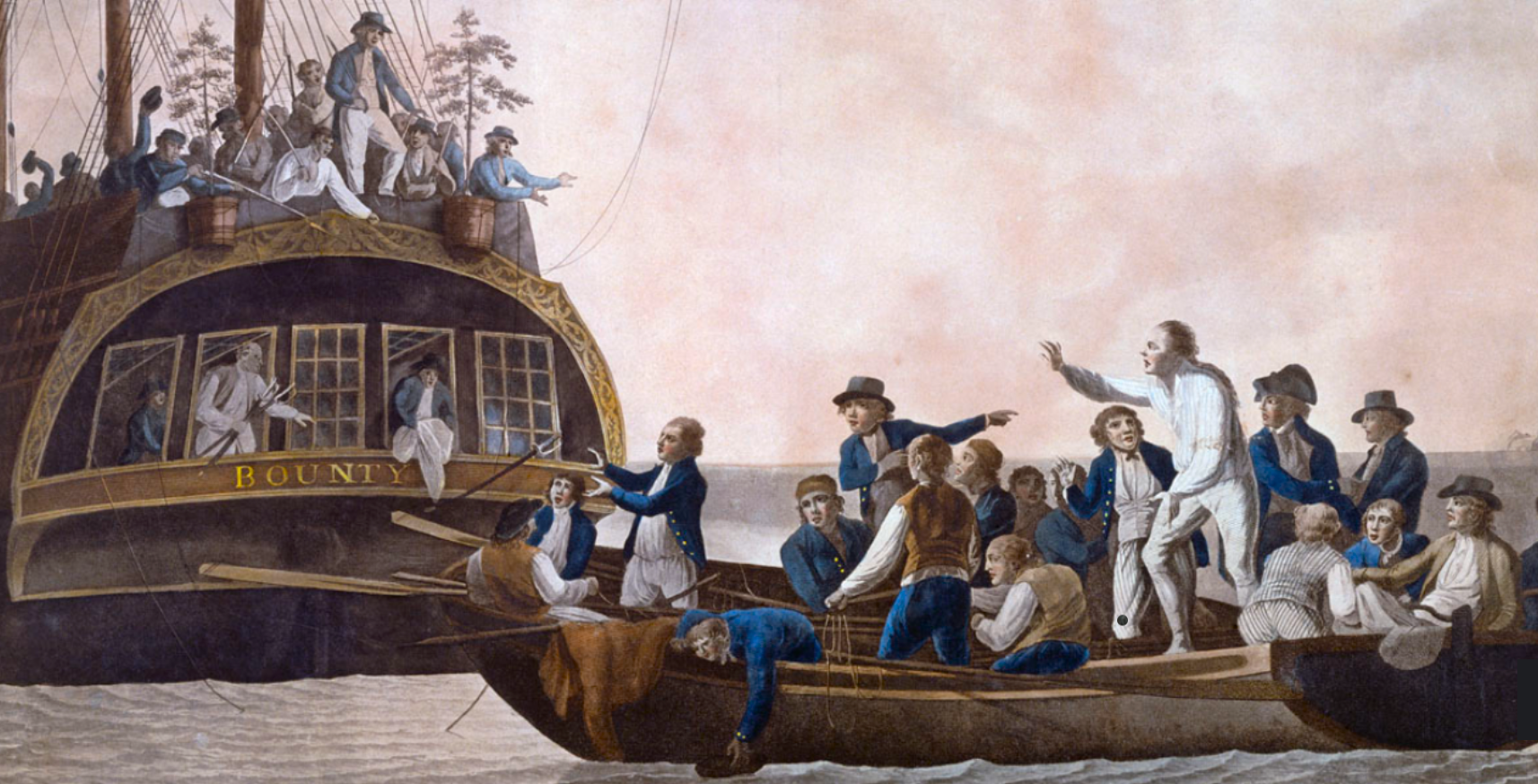
Six names are still absent, the six Polynesian men, three of them with noble blood, who also arrived on BOUNTY. They were treated appallingly and then all murdered. They are unrecognised victims of the BOUNTY mutiny and, in spite of being emasculated, enslaved, bullied and beaten, I believe they made important contributions to the early Pitcairn community.

Anyone with knowledge of 18th-century Tahiti understands it’s unsupportable that Fletcher Christian and BOUNTY ‘kidnapped’ 12 woman and a baby on BOUNTY. They were more than willing to escape the cruelty of life as women on what is incorrectly thought of as close to Paradise. It might have been so for men, but not for women. They were forbidden to eat pork, shark, coconut, lobster and other important foods. They were banned from participating in the religion that so occupied men and crushed womanhood. Most of their children were killed at birth if they were not perfect, the right size and the correct skin colour, according to the three Tahitian social classes. Upper class ari’i had to be pale: only the workers or manahune could be dark skinned. Blood could not cross class lines and mothers were more likely to lose a newborn if it were a girl. A girl allowed to live could only be fed by food gathered and prepared by her mother until she menstruated, an awful domestic enslavement. Men did most of the cooking because if women touched or walked over many food and other items, they were declared unfit.
A son who survived was likely to be clubbed to death as a sacrifice by priests.
Menstruation meant temporary banishment from the home. After giving birth, women could not use the same doors as men into their own houses. They were divorced at whim and had to keep their hair short, in contrast to the long elaborate hair allowed men. Oh, and as post-pubertal girls they were threatened with death if they cried out from the pain of hammered tattooing. It wasn’t nice being a Tahitian woman and other islands varied little. Wouldn’t you have wanted to escape?

A determination to create a new world where women at least had control over their bodies is seen even before BOUNTY found Pitcairn. During the eight months of searching the South Pacific for a home, including a failed attempt to settle on Tubuai, not a single woman was pregnant when BOUNTY arrived at the remote island. Yet exactly nine months later, the boss Fletcher Christian and his Tahitian wife Mauatua gave Pitcairn Island its first child, a son called Thursday October; Fletcher did not want this mixed-blood child to have either a ‘Christian’ or a Tahitian name.
This breakthrough realisation by me of the importance of Thursday not being preceded by other BOUNTY children, a not identified by hundreds of writers over centuries, showed the women must have used in secret their knowledge of contraception and three traditional abortion methods. They believed the spirit returned to the after-birth and they weren’t going to abandon such a sacred object at sea or on a strange island that was not home. The women who arrived on Pitcairn quickly decided they would make that a new home and marked this with a joint decision Mauatua would be first to have a child.
When Mauatua gave birth to her second son Charles, he had a club foot. On Tahiti he would not have been allowed a first breath, yet Mauatua prevented his smothering or bashing, an astonishing split-second dismissal of thousands of years of precedent. What could be a clearer indication that she and the other Polynesian women of Pitcairn wanted nothing to do with their awful male-dominated past.
Their determination that Pitcairn would be as they wanted was also seen by the first decision made about the ‘black’ men, a description of the Polynesian men used widely on Pitcairn in later years. None of them was allowed an exclusive wife but the six would share three of the 12 women. The sharing would not have been foreign to the men or the women. What has been overlooked by 100s of writers is why no full-blood Tahitian child was ever born. Mauatua and the women wanted to ensure they and their children would never be subject to domination by Polynesian men. They would be shared by Polynesian men but never bear their children, a cruel but defensible emasculation. Did either the mutineers or the Polynesian men understand this was an agreed secret strategy between Pitcairn’s women?
The idea of being part of such revolutionary thinking would never have occurred to the Polynesian men who sailed with Fletcher Christian. While recognising the adventure of finding and settling a new island away from their own internecine wars, they undoubtedly expected continuity of the entitled status birth had given them, especially the three men with noble blood. Has anyone given thought to the challenges they were forced to endure?
The adaptations to everything they expected, from control over what women and which newborns lived, were direct attacks on the unquestioned authority over women of Polynesian men for countless centuries. BOUNTY’s women knew they wanted everything different; her Polynesian men would have wanted nothing to be different and none of those men is likely to have had the resolve or the social skills to adapt. None would have landed on Pitcairn with violence in mind but thoughts only of a new Paradise, in common with all others who had sailed there with them.
Let’s meet these challenged men, most of whom were probably in their 20s. Niau was spoken of as younger and could have been a teenager.
Tararo: Also known as Talaloo, a noble or ra’atira from Raiatea, possibly related to Mauatua. Shot by Niau in 1790 or 1791
Oha: From Tubuai. Shot by Niau in 1790 or 1791
Niau: Tahitian and a younger cousin of Tararo. Shot by Edward Young
Teimua: Tahitian. Shot by Manarii while playing his nose flute for Teraura sometime after Massacre Day (September 20th, 1793)
Titahiti: Originally Taaroamiva. From Tubuai, younger brother of Chief Taaroa and thus also ra’atira, perhaps even ari’i. Killed by Teraura, then the wife of Edward Young, later wife of Thursday October
Manarii: Tahitian also known as Menalee. Killed by Quintal and McCoy when he hid with them after shooting Teimua
The full complicated story can only be told at length, but Tararo’s insistence that his status gave him the right to an exclusive wife was an early spark in the murderous early days of Pitcairn and what became Massacre Day when most white men died. His challenge to the white men was trivial compared to what most mutineers had in mind for him and his countrymen.
After the mutiny, Fletcher Christian introduced BOUNTY to voting, revolutionary but integral to his belief in late-18th century ideas of equality based on the Age of Enlightenment. It created a precedent that greatly enabled the women aboard, who could already eat freely, but that was later used against him.
Without his knowledge, the other eight mutineers voted to divide the island amongst the nine Europeans; Fletcher had expected it to be shared equally. It can’t be said the women complained about this, because a lessening of the entrenched expectations of Polynesian men was their unspoken goal.
Then, to the discomfort of sharing women, of being childless and landless, was added their treatment as slaves, put to building, clearing land, creating and maintaining gardens using the plants and seed brought aboard BOUNTY as well as making more of the old orchards and gardens abandoned by others, who once used the island as a source for stone-tool-making. Some were treated brutally; Quintal was said to beat with ropes and then rub salt into the wounds.
Even if only enslaved gardeners, these six men deserve recognition as co-founders of Pitcairn. Gardening was specialised men’s work on Tahiti. As well as their labour in generating the life-supporting gardens, they could add their inherited knowledge of what would grow best and where and when. This could not have been equalled by Brown, one of BOUNTY’s gardeners who had joined the mutineers. The same goes for animal husbandry. Who amongst the mutineers would know how to slaughter and butcher the pigs they brought without being taught by the Polynesian men? Or the chickens.
I have no doubt these men’s famed skills as navigators, using ocean waves and currents, observations of birds and profound knowledge of the stars helped BOUNTY find such as Rarotonga and then Pitcairn, marked on British maps 100s of miles from its true location. Could Fletcher Christian have sailed BOUNTY through unchartered waters without their help?
Today, I wonder if the community would have survived at all without the literal roots these six men put down. Who would have taught the Europeans their method of splitting logs with hot rocks, helped them construct huts and showed them how to make earth ovens – none of those were women’s jobs.
In the end, jealousy over women, including Tararo kidnapping the wife of a mutineer, led to hideous bloodshed, leaving only two Europeans alive of the 15 who had landed, John Adams and Edward Young.
Eventually Pitcairn’s Foremothers had what they wanted, a world without domineering men in which they could become mothers of all their children, eat what they liked – even create new designs on the bark cloth (tapa) they beat out. They no longer were forced to dance lasciviously while pork roasted but which they were forbidden to eat.
Much knowledge of this early revolutionary life for Polynesian women was based on practised lies, ‘hypocriting’ it was called. The first generation of native Pitcairners knew little of their bloody past and the women who survived misled them, referring to ‘bad black men’. With little true evidence, Pitcairn’s children incorrectly feared them as bogey men.
Tararo and his compatriots deserve much more than this, much more sympathy, much more empathy. It’s time they were unravelled and released from the webs of deflection and deliberate lies that have so buried them for over two centuries.
Equally, we must understand why the early untruths were told by Pitcairn’s women, for the protection of the next generation and in the hope that no British naval ship would arrest either Adams, the last surviving man, or any of the women for their actions in Pitcairn’s bloody past.
Might some of history’s greatest victims of conscious lying, ‘spin’ in today’s language, be the six Polynesian men pioneers of Pitcairn? Might we not now have the decency to value their contribution to Pitcairn and to regret their violent deaths?
Like all the Polynesian women and all but one of the mutineers, none of the Polynesian men has a known or marked grave. Perhaps their names should also be engraved on a plaque, joining the European Forefathers and Polynesian Foremothers of Pitcairn at the top of the Hill of Difficulty.
After more than two centuries it seems decent to give their six troubled, disappointed and tragic young lives on Pitcairn a marker of deserved dignity and value.

Glynn Christian is a gt gt gt gt grandson of BOUNTY mutineer Fletcher Christian and of Mauatua, his Tahitian consort. He is the first and only biographer of Fletcher Christian (FRAGILE PARADISE 1982) and a passionate advocate of the women of BOUNTY, who in 1838 became first in the world permanently to have the vote.
He is also a pioneering BBC television chef, co-creator of iconic delicatessen MR CHRISTIAN’S on London’s Portobello Road Market, and author of over 30 food books including REAL FLAVOURS – The Handbook of Gourmet and Deli Ingredients, voted Best Food Guide in the World at the Cordon Bleu World Media Awards. His Lifetime Achievement Award from the Guild of Fine Food remains the only one awarded to a writer.
Now living in Sydney, Australia, he uses his world of experiences, including that of being an Official Guide at the Victoria and Albert Museum, to write and to lecture aboard cruise ships. Meanwhile he is completing his second Deli-Detective novel and a stage-play based on the struggles and survival of the revolutionary Foremothers of Pitcairn Island.
For Glynn Christian’s BOUNTY-related books:
The Truth About the Mutiny on HMAV BOUNTY – and the Fate of Fletcher Christian (Pen & Sword)
Fletcher Christian – BOUNTY Mutineer (Hendon Books – Amazon Bookstore)
Mrs Christian – BOUNTY Mutineer (Hendon Books – Amazon Bookstore)
For further insight into 18th-century Tahitian life, see ANCIENT TAHITIAN SOCIETY (The University of Press of Hawai’i) by Professor Douglas Oliver.
© Glynn Christian 2024
Discover more from Ars Notoria
Subscribe to get the latest posts sent to your email.