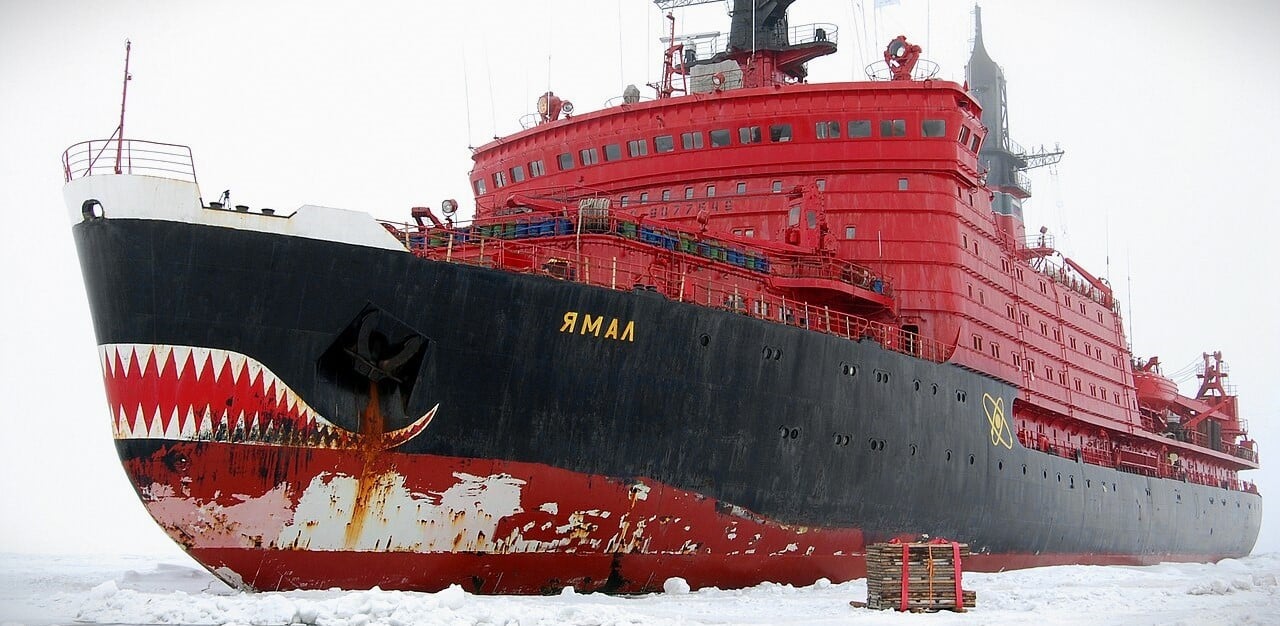
The Icebreaker Yamal, made in a Leningrad shipyard in 1986, photo Pink floyd88
A personal view
by Philip Hall
In the first place, anyone who has been involved in the struggle against colonialism, neo-colonialism and imperialism in Latin America, Africa and Asia and in the more neglected parts of Europe understands that the USSR was always their main ally and defender as long as it existed. The Cubans are an excellent example of a country that only survived because the Soviet Union supported it.
Cuba was a casino and a bordello under the control of a dictator who was in the pocket of the USA. When the people of Cuba fought for a better society they were forced into a corner and called on the aid of the USSR to defend them. Had it not been for the USSR the USA would simply have invaded and installed Fulgencio Batista again, or some other puppet. This is what they did in Central America (their ‘back yard’) from the late 19th century, and it is what they did repeatedly all over South America after 1945.
The Soviets were the counter-weight to Yankee imperialism, though they could not be so for every struggling, developing country that tried to use its own resources for the benefit of its own people. The Soviet Union’s foreign policy – whatever motivated it – led to the freedom of the Portuguese colonies in Africa, the freedom of Vietnam, the freedom of China, the freedom of South Africa, and freedom in other countries around the world.
Without the USSR the West would simply have stepped in and crushed all the opposition they found to their interests using superior economic and military power, in the same way that Great Britain did with its gunboats and armies during the time of colonisation and British neo-colonialism. Cheeky Great Britain, the pirate island, the power of the world, forced the Chinese to keep smoking opium.
But the influence of the USSR went much further. The USSR provided a model for society that was imitated to different extents all over Europe and throughout the world. Before the WW2, the United Kingdom was still a country of ‘Upstairs Downstairs’. There was still a vast servant class. My name, ‘Hall’ means that some of my forebears were servants at ‘The Hall’. The whole of social democracy came into being because of the existence of the USSR and its good example, not because of liberal reform. After the war, no self-respecting Briton would wipe the arse of the upper class. We may hate our oppressors and exploiters with a passion, but still tolerate them out of a desire for stability, order and deference, and because we are polite and realistic.

Now that it is gone (caveats aside) the USSR is fondly remembered by many of its ordinary people. What’s not to like: free healthcare, peppercorn rents, country cottages, pensions, unemployment benefits, jobs assigned to people, free holidays, cheap flights, cheap tickets to all kinds of cultural events. Extraordinary possibilities, given that the USSR was recovering from the death of 27 million people and the destruction of so much of their country as a result of WW2 which, truth be told, they won almost, but not quite, singlehandedly. They were the first into space, the best at sports and ballet and chess, patchily advanced. For me the image of the USSR is the image of an enormous ice-breaker crushing a path through the polar seas.
All of these are not the markers of a failed society, though the USSR was not an ‘Open Society’. Whatever Radio Free Europe broadcast into the USSR, whatever the Reader’s Digest wrote, whatever films Hollywood made about evil Soviet spies, whatever A’ Level history textbooks said, the USSR was evolving and had much to offer its people and the peoples of the world.
As people tangentially and directly involved in the struggle for freedom in South Africa, we were clear that the USSR was our ally. In fact the person who was responsible for many people going to jail in South Africa, including my mother, was one Gerard Ludi – left unprosecuted after the Truth and Reconciliation Commission. He was an undercover Special Branch (BOSS) operative, with links to the CIA. It was clear to us that the USA was our real enemy, the friend of our Apartheid enemy:
From a session of the Truth and Reconciliation Commission, Armed forces Hearing, 10th October 1997:
‘The Intelligence Services similarly started with the Republican Agency. Amongst the first exposures of its activity was its concentrated effort on getting journalists on their payroll as spies and that led then subsequently to BOSS, to NIS but the continuing attention to recruit journalists to use them not just to portray a certain image of the struggle of the then government but also to be sources of information on activities of what they regarded as counter- revolutionary activities started then. Gerald Ludi was amongst the first to be exposed that way and so was Gordon Winter who was writing for the Sunday Express.’
Still, today the USA is the enemy of almost every independent nation, or nation fighting for real independence in the developing world. Ask the people of any Arab nation, the people of any African nation, what they think of the foreign policy of the USA. At the time, in the early seventies, the USA armed and supported the Portuguese colonialists. When the colonialists were defeated the USA financed and armed the bloodthirsty counter-revolution in Angola and Mozambique; UNITA and RENAMO. The USA armed terrorist insurgents against nationalist governments everywhere.
At the same time, during that period, the USA was bombing and killing the Vietnamese. This led to the death of two million Vietnamese. There are endless accounts all over the world of the USA’s corporate controlled hydra of barbarism and imperialism wreaking destruction and havoc. Examples include: Iraq, Palestine, Syria, Libya, Indonesia, Pakistan, Nicaragua, Venezuela, and on and on and on an on.
The American Military Industrial Media Complex was simply taking on the evil mantle of British establishment and trying to secure resources, influence and markets for themselves at all costs.

The Vietnamese were obviously our allies, along with the Cubans. It was as clear as day. We had a piece of one of the B-52 bombers carved by a Vietnamese craftsman on our mantlepiece – probably by a soldier of the North Vietnamese Liberation Army whiling away time before battle in a foxhole. These huge bombers rained hell on Vietnam from high in the sky, but the Vietnamese managed to down a few of them anyway, and, at great cost, remove the claws of the imperial USA from their body.
Afghanistan was the example of a country that benefitted from non-alignment and the mere existence of the USSR. It was, in a way, like the countries to the north of Afghanistan that were inside the USSR. Afghanistan, right on the border of the USSR, was treated by the Soviets paternally. The centre of Soviet power saw the periphery as backward and difficult to bring up to the standards of their idea of civilisation. But they tried all the same, in a ham-fisted way, to help. The Soviets encouraged religious tolerance in Afghanistan and the rights of women and the separation of religious and civil power. They helped with its development in much the same way as they did in Tajikistan, Turkmenistan, and Uzbekistan.

But the Afghans were not in the USSR or controlled by it. No one tells the Afghans what to do. They were a part of the greater non-aligned movement and played the Soviets off the Americans. Half the road across the country from the west was tarmacked by the USA, the other half was concreted by the USSR. The non-aligned movement was another very positive result of the mere existence of the USSR – a counterbalance to the USA, that great new imperial nation feeling its oats, egged on by the British who hoped to ride the USA’s coat-tails. Half the experts in the Pentagon are British, I am told.
After the perceived failure of the USA in Africa and South east Asia, the intensity of anti-Soviet propaganda in the West grew and grew. The destabilisation of the status quo and balance between the USSR and the USA was inaugurated by the US sabotage of communist participation in the Italian government of 1976.
Gradually Reagan took us all to the precipice in the early 1980s turning our archipelago into a US aircraft carrier with 100 US bases on it and first strike nuclear weapons sited here. The whole Greenham Common women’s movement was about trying to force the USA to remove its first strike nuclear weapons from the UK. In 1983 during the Abel Archer incident the northern hemisphere of our planet came close to being bombed and irradiated. The USSR blinked first. Gorbachev represented the capitulation of the USSR. He folded.
Though side-lined in the struggle for freedom in South Africa, I decided to get to grips with the political reality of the USSR in 1980 and study Russian. For six years I studied Russian and did a degree in Russian and went to live and study in Kiev and Leningrad. To whom would I report back, I am not sure.
Trying to make sense of everything perceived in the USSR was a long process. Subsequently in 1990 and 1991 I lived and worked as a Lector in a Soviet Institute in Kiev and observed the transition. Observations were not made from the superior vantage point of a spy, a member of the military, or diplomatic service, but from the viewpoint of a young student, and then from the viewpoint of a university lecturer – from the viewpoint of someone who fell in love, briefly, with a Soviet woman. From the viewpoint of a South African, directly and tangentially involved in the struggle against Apartheid who was clear about where his obligations and loyalties lay.
What did I report back? I shall discuss this in my next article.
Phil Hall was born into an ANC family in South Africa. The family was forced into exile in 1963 after his mother was imprisoned and his father banned. They relocated to East Africa, where his parents continued their activism and journalism. In 1975, after a period living in India, they journeyed overland back to the UK, eventually settling in Brighton.
Phil pursued a broad education, studying Russian, Spanish, politics, economics, literature, linguistics, and English grammar and phonology. His path led him to live and study in the USSR, in Ukraine, and later in Mexico, where he married and started a family. Over the next decade, Phil and his partner balanced activism with work before relocating to the UK—a move initially intended to be permanent.
However, professional opportunities took him to Saudi Arabia and then the UAE, where he spent ten years before returning to the UK during the COVID-19 pandemic. Back in Britain, he founded Ars Notoria Magazine and, alongside fellow humane socialist Paul Halas, launched AN Editions, a small venture dedicated to publishing thoughtful, progressive and exciting new books.
Discover more from Ars Notoria
Subscribe to get the latest posts sent to your email.