by Betty Hossaini
Al-Hilla, ٱلْحِلَّة is only fifteen minutes away from Old Babylon. It is the capital of Babylon Province. When I was a child, I remember when they took me to Babylon. It was not like it looks like now, in modern times. Not at all!
Babylon was a set of old walls with huge staircases. You went down the staircase and all around you were high walls and on the walls, there were statues and reliefs. I was interested when I saw these sculptures set in the walls and the great reliefs and thought about how clever the people who made them must have been.
We climbed up the great staircase. I wanted to see the lion. When I saw the lion, I was shocked. It was attacking someone and I thought. ‘Oh no!’
The man was on his back and the lion covered him. He was on top of him. As a girl, I though it was awful, but then one of the teachers reassured me saying: ‘Don’t worry. This is just the past.’ And then she explained to me that the statue didn’t describe something that had actually happened, but that it was a way of showing how strong Babylon had been. Then I looked at the lion again and the poor man’s knee, and I and saw how strong the lion was and thought about how powerful Babylon must have been – and didn’t like that thought.

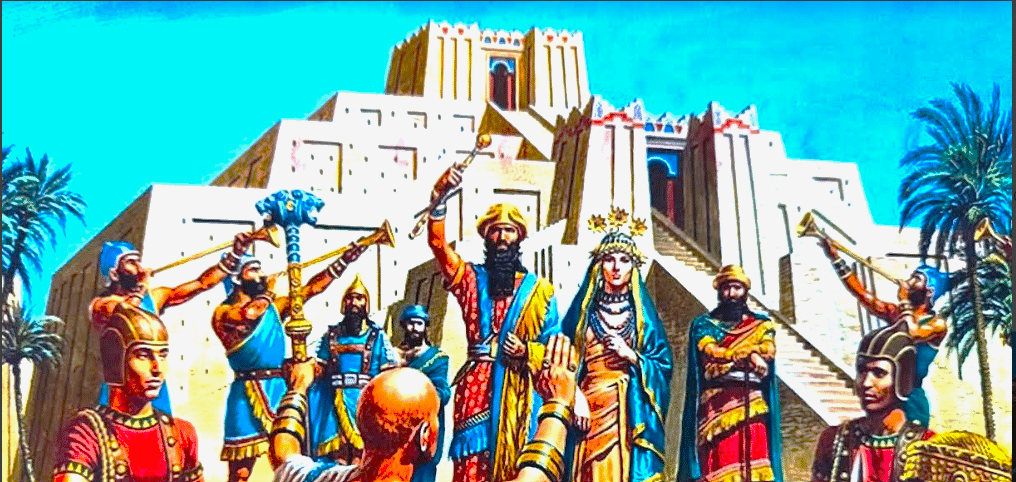
I didn’t see the gardens. They had told us about them and I had expected to see them in layers, all green. It was disappointing. I imagined that each step of the great Ziggurat would be full of flowers and other plants, and loaded with date palms.
I was proud of my town, Al Hilla, not of Old Babylon. I thought Al Hilla was much better than Babylon. When you go to Al Hilla you must cross a bridge over the river called the New Bridge, though it wasn’t new. Before the bridge there was an army camp. King Faisal was in power and we liked him. He was handsome and 18. He was very young, but didn’t seem young to me. He was engaged to a relative from Jordan. He came to Hilla and walked around and we waved to him from the pavement.
In those days Al Hilla was a beautiful town. Its name comes from the Hilla river, which is a branch of the Euphrates. The banks of the river were green. The river was quite wide, but on the river, there were only a few boats with oars. In the past Al Hilla had been a suburb of Babylon itself. There are a lot of little villages all around Old Babylon. When the foundations of the houses were dug people went through layers of pottery and bricks. They kept the objects and the trinkets that they found (or sold them) but they dumped all the tiles and pottery and bricks just as you might dump rocks or stones. They didn’t know the value of these archaeological remains and threw them all away.

Because so much of our town of Hilla was built with bricks taken from Babylon, they called our town The Father of the Bricks. But our house was not built out of bricks from Babylon; it was modern. It was very small, and when I went back to see it years ago, I wondered how we had all fit into it. We were four sisters and one brother. Two of my sisters were younger than me and one sister, my step sister, was much older. She’s still alive at 93. We slept right next to each other.
My father was always cheerful and happy. He had a flour mill. He had a lot of people who worked for him; grinding the wheat by hand using a big millstone as big as a table. I have seen something like it in Greece. The big round stone is placed over another big stone. I remember watching the man who ground the wheat. He was a blind man called Alwan in a dish-dasha with sandals. In those days nearly all men wore dish-dashas and sandals.
In Hilla the women didn’t cover their faces. I remember someone telling my mother to cover her face. She was beautiful, gentle and intelligent. She refused to cover her face. She didn’t have an education, but she listened to the radio and was thoughtful and considered in what she said. She used to say:
‘Don’t listen to people and accept what they say without thinking. ‘Don’t lie. Tell the truth. Don’t listen to gossip or gossip yourself.’ She said: Use the three ‘ms’ when you go to people. ‘I won’t say. I don’t know. I haven’t heard’: ‘Ma adri, ma arif and ma esm.’
I took her words to heart and have followed her advice. Even now, when someone calls me up on the telephone and starts to tell me about some scandal, I refuse to listen and hang up. I don’t pay any attention to these stories.
She used to give us camomile tea when we were sick. We didn’t like it, but she would say. ‘Please. It’s good for you. Take a sip.’.
My mother gave me courage. We had a forceful older cousin with a sharp tongue. She thought the worst of everyone and shouted at us. We were all scared of her and hid from her when she visited. But, following my mother’s advice I stood up to her once when she came round. She seemed very surprised because I was much younger. After that she avoided me and stopped coming around to bother us.
I loved dates and, especially, date syrup. When it is raw it is more like a puree, with bits in it. It is called dibs and dibs is very sweet. We would go to the house where they gathered the dates from the date palms by the river and watch. Once, I went inside the date factory shed to see how they made dibs. They smashed the dates with a big stone and ground them up. The dates were fresh and released a thick, sticky liquid, almost as thick as honey.
A worker called to me and said. ‘Habibte, what are you doing here? It’s dangerous.’ And I said. ‘I want dibs.’
‘It’s not good for you.’ he said, but here you are. Have your dibs.’ and he gave me a big cup of raw date syrup and I sipped at it with a straw. It was much too sweet, but I loved it and I still love it now, but I mix it with yoghurt.
When you look at the reconstruction of Babylon it is covered in blue- and gold-coloured tiles, but in the past, the Babylon I saw was just brown bricks. These days it is almost unrecognisable. The sides of the Ishtar gate weren’t there. They shouldn’t have built them.
When I went back to Al Hilla to see my brother a few years ago, we drove past Old Babylon. But I had no desire to visit it again. What a difference! Impressive as it is now, Babylon was not as I remembered it.

Betty Hosseini came to the UK from Iraq in 1971, She came because her husband had been assigned to be in charge of the Bank of Iraq in London. When her husband fell ill, Betty had to find a job to support her family and she did. She became a family psychologist. Her children have asked her to write down her memories for them, and for her grandchildren.
Discover more from Ars Notoria
Subscribe to get the latest posts sent to your email.