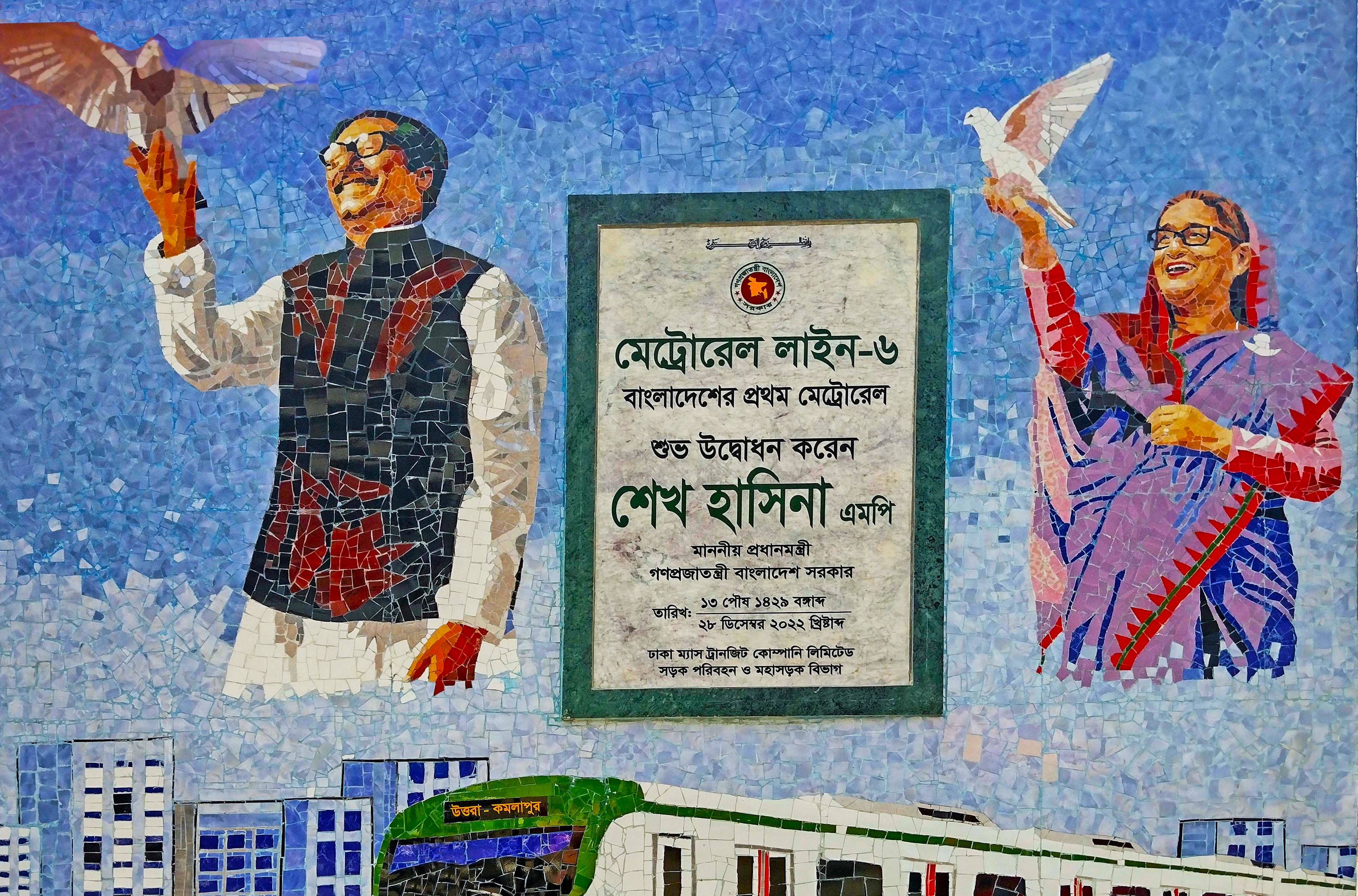
Inauguration plaque of Dhaka Metro Rail photo by Mehdi Abedin, Wikicommons
The 2024 elections are over in Bangladesh. What now?
by Afri Aysha
Bangladesh held parliamentary elections on 7th January 2024. The current Sangsad (parliament) was scheduled to expire on 29 January 2024. In order to guarantee that the election would be conducted in accordance with electoral law and the constitution, the 2024 Bangladesh Election Commission was formed on 27 February 2022.
The main opposition party, the Bangladesh Nationalist Party (BNP), demanded that the government hand over power to a neutral caretaker government before the next elections. This was rejected by Prime Minister Sheikh Hasina. Hasina’s resistance to a caretaker government arose following the 2006 –2008 crisis, during which a caretaker government assumed military control of the country and arrested a number of political leaders, including Hasina and BNP leader Khaleda Zia. The BNP is boycotting the elections.
Prime Minister Sheikh Hasina has been accused of authoritarianism, human rights violations, a crackdown on free speech and suppression of dissent. She has also while jailed some of her critics.
The government was under pressure from Western countries to hold free and fair elections. The United States, the top buyer of Bangladeshi garments, said in May it was implementing a policy of restricting visas to Bangladeshis who undermine the democratic election process.
The ruling party, Bangladesh Awami League has the strong support of India and Russia. Countering Western pressure, Russia and China condemned U.S. ‘meddling’ while India called the upcoming polls ‘an internal matter’.
In contrast to its domestic situation, Bangladesh has, in recent years, drawn positive and solicitous attention in the realm of geopolitics. Bangladesh is vitally important for its geographic location connecting South and Southeast Asia.
In my opinion, this election of Bangladesh is an important issue not only for Bangladesh but worldwide. In this election, the Awami League was re-elected and formed the government. After the election, the main opposition party BNP is continuing their protests and they are disseminating information and organising mass leafleting campaigns.
The USA has not yet imposed the sanctions it threatened to impose on Bangladesh. However, US representatives have said that the Bangladesh election was not fair and lacked participation. For the moment we can say that there has been less instability and uncertainty created in Bangladesh’s political and social situation. But time will tell. There has been a discussion about who will be the opposition party on the parliament. In order to achieve the status of the official opposition in parliament a party needs at least 10% of seats. Although there is no official ruling on this.
Bangladesh’s election formality is over, but the question is now what is next? There are three main questions that arise: a) which party will be the opposition party in the parliament? b) what will be the democratic situation in Bangladesh? c) what will ordinary citizens or the public gain from this election? It seems there will be a one-party system in the country. Many citizens are worried about the future of democracy in Bangladesh.

Afri Aysha is a human rights activist who was born in the Noakhali district of Bangladesh. She holds a Master of Arts (MA) degree in Political Science. Afri has worked with various organizations. Since 2017 she has been working at in an international NGO. As a student she was an activist. Afri is a free thinker. She writes stories and poetry and enjoys music and cinema.
A weak opposition means trouble for Bangladesh
by Advocate Md Shahnewadj Patwari
The result of the 07 January 2024 general election result was known to all before the election. It is not as simple as saying that the ruling party manipulated the result, or rigged the election. Rather, there was no stronger party than the ruling Awami League. It was obvious that the Awami League would secure a landslide victory. The different political parties, including the main opposition party the Bangladesh Nationalist Party(BNP), civil society members, UN representatives and other international communities have criticised the election saying that it was not fair, transparent, inclusive enough.
Since the independence of Bangladesh in 1971, no fully functioning, reliable democratic electoral process has been established. After the 1971 most of the ruling parties have tried to continue their tenure by manipulating elections processes.
After the brutal assassination of the Father of the Nation Bangabandhu Sheikh Mujibur Rahman in 1975, Bangladesh was ruled by several military governments till 1990. However, in 1990, in order to create better conditions for an election, all the political parties supported the establishment of a caretaker government which would organize free and fair elections.
The problem is that the caretaker government overstepped its bounds. The provision of caretaker government was intended to support the transition from authoritarianism to democracy but this government held power for several years without doing what it was tasked to do: organise an election. It tried to legitimise holding on to power by introducing a 13th amendment into the constitution.
The present ruling party, the Awami League abolished the changes the Caretaker Government made to the constitution of the People’s Republic of Bangladesh after the Supreme Court ruled that the provision of this caretaker government was unconstitutional. However, the court also said that provision of caretaker government could be retained in the constitution for the next two general elections.
Despite this qualification by the Supreme Court, the ruling party scrapped the provision of the Caretaker government in the same year the supreme Court reached its verdict. It is not a caretaker government that organises elections now in Bangladesh. For the last three general elections held in 2014, 2018 and 2024 the Election Commission of Bangladesh, with the help of ruling governments, have organised the elections. In these elections, unsurprisingly, the ruling party secured consecutive landslides. The results of the general elections of 2014, 2018 and 2024 were not well accepted at home and abroad.
The BNP boycotted the 2024 election. Several other political parties also joined them in this boycott. Their main concern was that the election under the ruling government would not be free and fair. In these recent elections, in Bangladesh, out of 298 seats, the Awami League won in 222 seats. Independent candidates won 62 seats (almost all of the independents are also members of the Awami League. The Jatiya Party won 11 seats, while Jatiya Samajtantrik Dal, the Bangladesh Workers Party, and the Bangladesh Kalyan Party won only one seat each. This election did not offer enough options to choose a government for the next five years.
The BNP previously also boycotted the 2014 election. However, the BNP did participate in the 2018 election, which was held under the same ruling party. Even so, they rejected the results of the election on the very same afternoon of election day saying that the ruling party had rigged it. From then on they have continuously demanded the resignation of the ruling party and a general election under a non-partisan caretaker government. The present government arrested most of the leaders of the main opposition party BNP and sent them to jail. The government has brought thousands of court cases against BNP leaders and supporters.
2024 election was widely criticized by civil society members, UN representatives, and different foreign countries the. But before the general election, repeated calls were made to the government to create a level playing field for all parties.
The present Prime Minister, Sheikh Hasina, daughter of the Father of the Nation, Bangabandhu Sheikh Mujibur Rahman, is a charismatic leader. She has gained popularity beyond the Awami League. Under her leadership, over the last 15 years Bangladesh has done well in many socio-economic indexes: women’s empowerment, per capita income, health, education, infrastructural development, digitalized government services and climate change. She also handled the Corona Crisis well. All this has helped generate real support for the Awami League. Sheikh Hasina’s many state funded well being activities have gained her and the Awami league popularity. They have given homes to homeless people, provided training to unemployed people, set up and run community clinic health services, increased of the amount of different allowances to a wide variety of Bangladeshi citizens in need.
However, Sheikh Hasina has not managed to reduce corruption, extortion among the several members of the ruling party, and she has not stopped price hikes of commodities. Her government has also became authoritarian and autocratic.
In contrast, the BNP has not been an effective opposition. It has not able to organize people meaningfully in order to spotlight government faults. The BNP lack people-oriented visionary programmes. This is a key reason why they have not managed to involve large numbers of potential supporters in their protests.
Now, the BNP is largely dependent on the US and western countries for its support in order to try to compel the government to organises new elections under a non-partisan caretaker government. The US government put the democracy of Bangladesh in their foreign policy in priority basis in the last two years and put pressure on the ruling party Awami League to create an enabling democratic space for all political parties. However, apparently, the US has failed in its endeavours to influence the unfolding of event as the Awami League organised the 2024 election and won conclusively without the participation of the BNP and other several political parties. The Awami League secured a landslide victory.

Shahnewaj Patwari is a human rights lawyer with expertise in Civic Space, Public Health and Digital Rights, particularly in the Bangladesh context.
Shahnewaj is member of the Committee on Economic, Social, Cultural, Civil and Political Rights of National Human Rights Commission, Bangladesh. Currently, he is working at ARTICLE 19 South Asia. Before joining ARTICLE 19, he was working with Bangladesh Institute of Law and International Affairs (BILIA), oldest civil society think tank in Bangladesh, as Research Officer. Prior to that, he worked as a lawyer in Sattar and Co., a leading law firm in Bangladesh.
His research articles on human rights and sustainable development have been published in the international and national peer-reviewed journals. He is lead author of the research article “Muslim Women’s Right to Divorce and Gender Equality Issues in Bangladesh: A Proposal for Review of Current Laws”, Journal of International Women’s Studies, Vol. 21, Iss. 6, Article 4 of Bridgewater State University. He is the co-author of the research article titled “Improper Labeling of Manufacturing and Expired Date of Food on Packet: A Legal Study on Safety and Food Quality and Food Waste in Bangladesh, Australian Journal of Asian Law, Vol. 18, No. 1, 2017 of University of Melbourne”.
Shahnewaj writes columns regularly on law and policy issues in different Bangla and English national dailies. He earned his graduation and post-graduation degree on law from University of Asia Pacific, Bangladesh. newazuaplaw@gmail.com
Discover more from Ars Notoria
Subscribe to get the latest posts sent to your email.