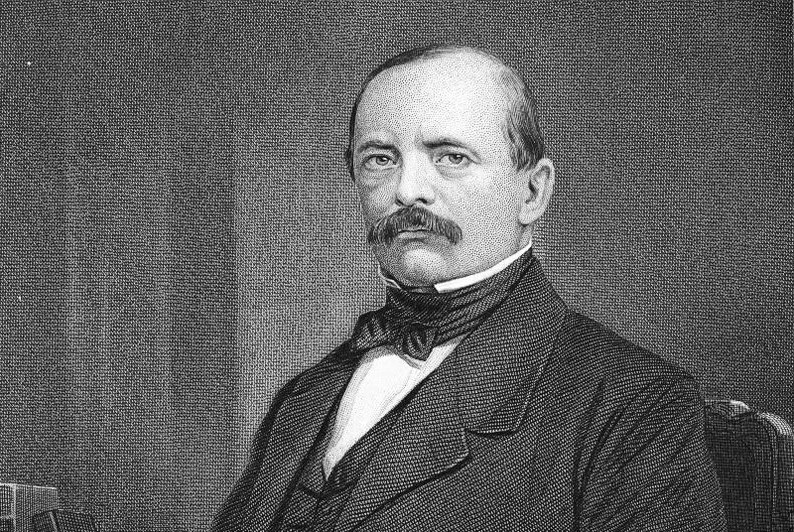
Otto Von Bismarck. Illustration Evert Duykinck
A mature, unified Europe must embrace its German-French core
by Philip Hall
German revanchism is quite justifiable. Europe must unite under German-French leadership to achieve true independence and strength. The Schiller Institute’s core proposition—though marred by bitterness and a personality cult—correctly identifies Germany as the key to a sovereign Europe. Hostility from the United States and Russia towards Germany arises precisely because they recognise Germany’s pivotal role in shaping an autonomous European power.
Germany was the most progressive and socially advanced country in Europe. In the 1920s and 1930s, while most of the British were voting Conservative or Liberal, and the British Communist party was irrelevant, opposition to the National Socialists in Germany included a broad coalition of progressive, socialist, communist, liberal, anarchist, trade unionist, and Christian groups. The Communist Party of Germany (KPD), aligned with the Soviet Union, was a militant anti-fascist force, but failed to unite with the Social Democratic Party (SPD). The SPD and trade unions represented moderate socialist opposition but were unable to form a strong front with the communists. Anarchist and syndicalist groups, such as the Freie Arbeiter-Union Deutschlands (FAUD), actively resisted the National Socialists but were numerically small. Christian opposition, including segments of the Catholic Center Party and Protestant groups, emerged later, particularly after the 1933 Reichskonkordat, with figures like Dietrich Bonhoeffer playing a notable role. Liberal and republican forces, such as the Deutsche Demokratische Partei (DDP), were weakened by economic crises and political fragmentation.
On the side of the National Socialists were over 300 German companies and industrialists, including Fritz Thyssen, Gustav Krupp, and IG Farben, who financed Hitler’s rise. The National Socialists promised to crush communism, suppress labour movements, and secure profitable rearmament contracts. The old Prussian landowning class and conservative military figures, such as Franz von Papen, saw Hitler as a tool to restore authoritarian rule. The petty bourgeoisie, radicalised by economic crises, supported the National Socialists out of fear of Soviet-style collectivisation. Rural Protestant areas were swayed by National Socialist promises of agricultural subsidies and anti-Bolshevik rhetoric. Intellectuals like Martin Heidegger and Oswald Spengler provided ideological justification for fascism, while nationalist groups such as Stahlhelm became National Socialists affiliates.
A significant challenge to Marxist theory was that around 40% of National Socialists voters by 1932 were working-class, contrary to the expectation of class consciousness. The German working class had failed to unite in 1918 behind figures like Rosa Luxemburg and Karl Liebknecht to overthrow the capitalist class, instead aligning with nationalist rhetoric. The National Socialists co-opted socialist policies, targeting unemployment through projects like the Autobahn and organising youth groups and support for pensioners. Anti-communism played a role, with many workers fearing Soviet-style collectivisation, particularly better-paid labourers in industries like chemicals and metallurgy. The National Socialists also scapegoated minorities, including Romani people, the disabled, LGBTQ individuals, and Jewish Germans. To many of them their status as Germans was far more important to them than their status as fascist defined ‘Jews’.
The National Socialists rose from being a fringe party to the largest in the Reichstag by exploiting economic crises and political polarisation. By 1932, they held 33.1% of the vote, still outnumbered by the combined strength of the KPD and SPD. However, under intimidation from the SA, their share rose to 43.9% in 1933. Meanwhile, liberal parties collapsed, and middle-class voters shifted to the National Socialists. But to say that Germany was a fascist country, even as late as 1933, is to traduce the memory of Germany’s opposition to the National Socialists.
The tragedy of Germany’s lies in its fall from a pre-1914 golden age, when a united Germany reached a pinnacle of progress in arts, sciences, industry, and culture. All this was eclipsed by post-war collapse, the rise of the National Socialists, and Germany’s pariah status after 1945.

Zollverein Coal Mine Industrial Complex, UNESCO World Heritage Site. Photograph Thomas Wolff Wikimedia Commons
The period between German unification (1871) and World War I (1914) marked Germany’s golden age, with unprecedented advancements in science, industry, philosophy, and the arts. Germany became the world’s second-largest industrial power, surpassing Britain in steel production, railways, and chemical innovations. Companies like Siemens, AEG, and IG Farben led global industries. Scientific dominance was evident in Nobel Prizes awarded to figures like Max Planck, Albert Einstein, and Fritz Haber. Cultural achievements spanned literature (Thomas Mann, Hermann Hesse), music (Wagner, Mahler), and art (Expressionism, Bauhaus). Germany’s education system and social reforms, including Bismarck’s welfare state, set global standards.
World War II’s devastation led to the suppression of Germany’s progressive traditions, with Allied denazification and Cold War politics polarising its intellectual legacy. German science and philosophy were discredited by association, with figures like Werner Heisenberg accused of collaboration and the Frankfurt School exiled. Cultural movements like Bauhaus and Expressionism were initially dismissed as “degenerate.” The economic and industrial legacy was dismantled or co-opted, with thousands of German patents seized by the US. The German Democratic Republic (GDR) attempted to reclaim progressive traditions but was itself authoritarian.
The Schiller Institute’s agenda, while advocating for peace and classical culture, also promotes German cultural revanchism by shifting historical blame onto the British Empire and rehabilitating German intellectual traditions. Figures like Webster Tarpley have attacked British icons like Newton and the Magna Carta while praising German contributions. This reflects a broader trend among German industrial and intellectual circles to rebalance historical memory in Germany’s favour.

Roche Tower in Basel. Photography by Taxiarchos228 Wikimedia Commons
Comparisons between British imperial atrocities and National Socialists crimes reveal that while Britain’s colonial policies caused immense suffering over centuries, National Socialists Germany’s industrialised genocide was uniquely concentrated. Britain’s long-term economic exploitation, including famines in India and forced labour, contrasts with National Socialists Germany’s shorter but more systematic brutality.
But Germany’s role as Europe’s natural unifier is rooted in history, from Charlemagne’s empire to the Holy Roman Empire and the modern EU. Culturally, Germany and France have dominated European philosophy, science, and the arts. Economically, the Rhine model integrates Germany with France and neighbouring states, while Britain’s economy tends towards the transatlantic. Geopolitically, post-Brexit Europe must look to German-French leadership to achieve sovereignty against Anglo-American dominance.
The Schiller Institute’s core argument—that Europe’s future depends on German-French unity—is sound, though its anti-British rhetoric can undermine its credibility. A mature, unified Europe must embrace its German-French core, not as domination, but as the natural leadership born from historical and geopolitical necessity. The path forward lies in deeper integration, from banking unions to a federal Europe, ensuring Europe’s place as a sovereign power in a multipolar world.
Phil Hall was born into an ANC family in South Africa. The family was forced into exile in 1963 after his mother was imprisoned and his father banned. They relocated to East Africa, where his parents continued their activism and journalism. In 1975, after a period living in India, they journeyed overland back to the UK, eventually settling in Brighton.
Phil pursued a broad education, studying Russian, Spanish, politics, economics, literature, linguistics, and English grammar and phonology. His path led him to live and study in Spain, the USSR (in Ukraine), and later in Mexico, where he married and started a family. Over the next decade, Phil and his partner balanced activism with work before relocating to the UK—a move initially intended to be permanent.
However, professional opportunities took him to Saudi Arabia and then the UAE, where he spent ten years before returning to the UK during the COVID-19 pandemic. Back in Britain, he founded Ars Notoria Magazine and, alongside fellow humane socialist Paul Halas, launched AN Editions, a small venture dedicated to publishing thoughtful, progressive and exciting new books.
Discover more from Ars Notoria
Subscribe to get the latest posts sent to your email.



You must be logged in to post a comment.