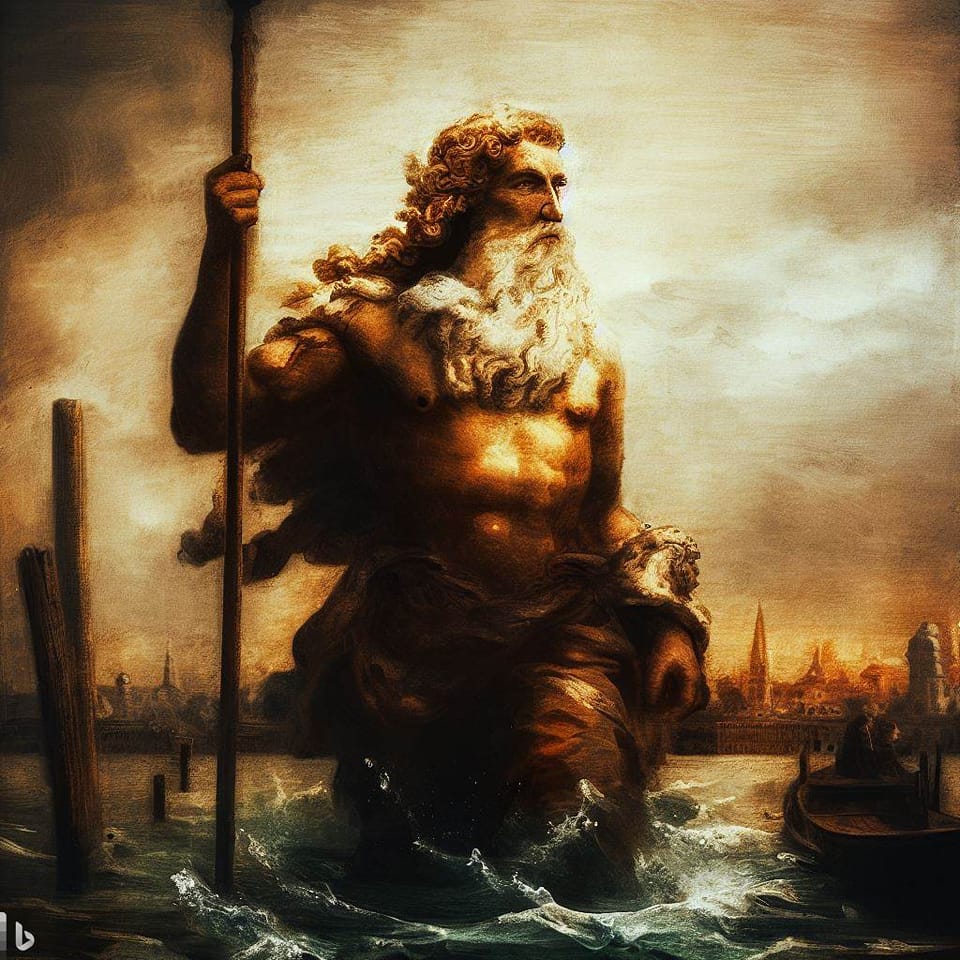
Image prompted by Phil Hall
Dealing with the Existential Shock
Something real did happen! The object was first detected on July 1, 2025 by the ATLAS telescope in Rio Hurtado, Chile. I wrote to Avi Loeb 9 days after it was detected on 10th July 2025. He acknowledged receipt and thanked me and I responded with the comment: ‘Of course, I was just making a rhetorical point.’ Loeb’s own ‘Dark Forest’ article came out 6 days later on July 16, 2025. The paper, which he co-authored with Adam Hibberd and Adam Crowl, was framed as a “pedagogical exercise” exploring whether 3I/ATLAS could be hostile alien technology consistent with the Dark Forest hypothesis.
Hi Avi,
Just thought I’d share this speculation with you.
All the best,
Phil
A SPECULATIVE ARTICLE: 3I-ATLAS and the Dark Forest
by Phil Hall
“Piensas mal y atinaras.”
— Mexican proverb
While films like Don’t Look Up! highlighted the danger of accidental asteroid impacts, a more disturbing possibility exists: intentional planetary bombardment. An interstellar object travelling at 60 km/s, if artificially directed, could serve as the ultimate planet-killer. Unlike random cosmic collisions, such an impact would represent a deliberate extinction event, one we might detect too late to prevent.
On July 1, 2025, astronomers detected 3I/ATLAS, an interstellar object approaching the inner Solar System at 60 km/s. As with previous interstellar visitors like ‘Oumuamua, its anomalous characteristics immediately raised questions. Professor Avi Loeb, known for his work on potential artificial origins of interstellar objects (Loeb, 2021), notes that if 3I/ATLAS demonstrates unusual trajectory adjustments or composition, it might warrant consideration as a potential artificial object.
The critical distinction lies in its behaviour. Natural comets follow predictable paths governed by gravity. As Loeb observes, “An object that changes trajectory to enter the inner Solar System would immediately suggest non-gravitational forces at work, whether natural outgassing or something more deliberate” (Loeb, 2021). While current data is insufficient, the mere possibility demands serious consideration.
The destructive potential of such an impact is well understood. Collins et al. (2005) modelled impact scenarios showing that a 10 to 30 km object at 60 km/s would release energy 10 times greater than the Chicxulub impact, and it would create a 500 km crater (land impact) or mega-tsunamis kilometres high (ocean impact), and trigger global firestorms and an impact winter (Toon et al., 1997).
The aftermath would be apocalyptic: blast waves would flatten everything within thousands of kilometres, global earthquakes and tsunamis hundreds of metres high would reach all coastal cities within 24 hours. Dust and aerosols blocking sunlight would cause temperatures to plummet 10 to 20°C for decades (Toon et al., 1997), destroying agriculture, and the ozone layer’s destruction would expose survivors to lethal radiation, with over 90% species extinction comparable to the K-Pg event.
The Dark Forest Hypothesis
This scenario coincides with Liu Cixin’s Dark Forest Hypothesis (2008), which argues that advanced civilisations might remain silent to avoid attracting hostile attention. The reasoning is clear, if pessimistic: all life everywhere competes for finite resources, other civilisations cannot be trusted to be benevolent, and pre-emptive strikes may be rational for survival.
Humanity has broken this silence. Since the 1974 Arecibo Message, we’ve actively broadcast our presence. Even ordinary radio and TV signals have leaked into space for nearly a century. As Loeb cautions, “Our assumption of alien benevolence reflects anthropocentrism, not evidence” (Loeb, 2021).
We exist in a dangerous transitional period: we are capable enough to alter our planet and broadcast our presence, but not advanced enough to defend against existential threats.
Conclusion
Of course, 3I/ATLAS has not yet been confirmed as artificial (much less hostile and artificial), and if it were, given the time it’s been travelling (0.8 billion years according to Loeb et al., 2025) it is unlikely to have been designed to kill higher level life on planet Earth. There was none 0.8 billion years ago. But the possibility of a planet killer, a black swan event, should be serious enough to be taken into consideration, no matter how far-fetched, because of its deadly potential. If 3I/ATLAS were an artificial planet killer on a collision course today, we would have roughly 100 days until impact and no way to stop it.
References
Brin, D. (1983). “The Great Silence: The Controversy Concerning Extraterrestrial Intelligent Life.” Quarterly Journal of the Royal Astronomical Society, 24, 283–309.
Collins, G. S., et al. (2005). “Earth Impact Effects Program.” Meteoritics & Planetary Science, 40(6), 817–840.
Liu, C. (2008). The Dark Forest. Tor Books.
Loeb, A. (2021). Extraterrestrial: The First Sign of Intelligent Life Beyond Earth. Houghton Mifflin Harcourt.
Loeb, Avi. 2025. “Is 3I Atlas a Comet or Something Else?” Medium, July 8, 2025.
Toon, O. B., et al. (1997). “Environmental Perturbations Caused by the Impacts of Asteroids and Comets.” Reviews of Geophysics, 35(1), 41–78.
To me, a nebbish former reader of Science Fiction, the object that came into the solar system and went through it in 2025 was obviously an alien spaceship. I was in email exchanges with Dr Loeb all through the period of its transit, and the anomalies kept on mounting up. In the end it showed up 22 different anomalies. The likelihood of it being natural was so remote that it was almost insignificant.
Avi Loeb said 3I/ATLAS was at number four on his Loeb scale of 10 rankings. Clearly it was higher on the Loeb scale, but Loeb held on and he refused to rate 3I ATLAS higher, as many people wanted him to do.
In the end I wrote him a final letter berating him, saying that if he knew there were 22 anomalies, and if it was so remote a possibility that it was natural, then why wasn’t he courageous enough to rate the object higher on his scale (his Loeb scale) at at least six?
The Loeb Scale
Green Zone (Levels 0–1): Natural. Levels 0 and 1 cover objects fully consistent with known natural phenomena, or with only minor, inconclusive deviations that don’t challenge a natural interpretation.
Yellow Zone (Levels 2–4): Anomalous. Level 2 captures a single major deviation, such as trajectory anomalies exceeding gravitational models. Level 3 requires multiple persistent anomalies across different domains. Level 4 is the critical threshold: the combination of anomalies is strong enough that a technological explanation must be formally considered alongside natural ones. This is the level assigned to both ‘Oumuamua and 3I/ATLAS.
Orange Zone (Levels 5–7): Suspected Artificial. Level 5 suggests artificial but non-operational technology, like a derelict probe. Level 6 escalates when operational signs appear: manoeuvres, electromagnetic signals, propulsion evidence, or deployed sub-probes. Level 7 applies when technology is confirmed but intent is unclear or potentially hostile.
Red Zone (Levels 8–10): Confirmed Artificial. Level 8 means artificial origin is confirmed with no impact threat. Level 9 means confirmed artificial with a trajectory posing regional impact consequences. Level 10 is the highest designation: confirmed artificial origin on a collision course with global, existential consequences.
(Note that the colour system is the same one used by special forces in the face of danger. Red means battle!)
An Existential Shock for Beatrice Villarroel

Four exposures of the 3 × 3 arcmin region of sky cantered on the triple transient identified in July 1952.
But then Beatrice Villarroel started publishing her work, and she is a celebrated scientist. Her work is on transiting objects discovered on Mount Palomar plates before there were any satellites in space. Think about that!
She discovered over a hundred thousand of them. A hundred thousand objects in space, with evidence provided by Villarroel who speculated that they were artificial. She such an existential shock from this discovery that she had to take a break from work for three months.
Beatriz Villarroel is an astrophysicist at the Nordic Institute for Theoretical Physics (Nordita) at Stockholm University. She received the L’Oréal-UNESCO For Women in Science Prize in Sweden in 2021 for her work on VASCO. In her work, recently confirmed by peer review studies and an update in 2026.
The VASCO project examines old astronomical photographs taken before the satellite era. Using images from the First Palomar Sky Survey, taken between 1949 and 1958, Villarroel and her team found around 107,000 patches of light that looked like stars that appeared photographic plates, but were gone by the time the next photographic plate was taken of the same area of the sky. Some of these transient stars/objects were arranged in straight lines.
No known human object could have been in orbit before Sputnik launched in 1957. No known natural or instrumental cause (like lens artifacts) explains Villarroel’s transients and the objects almost never appear when the sky is in Earth’s shadow. This means that sunlight is reflecting off something, possibly something shiny and metallic. Villarroel thinks the reflections come from flat, shiny objects in geosynchronous orbit, at about 42,000 km up. She also found transients were 45% more likely to be observed within a day of a nuclear test, and the probability of the transients appearing on the plates increased by 8.5% when there were reported UFO sightings. The transients more than doubled when the two coincided. To reiterate, Beatriz Villarroel is a respected, prize-winning scientist published in peer-reviewed journals.
Now at this point Loeb was negotiating entry into the US American government UAP project as its head. And at this point, as head of the UAP Science Advisory Council for the government of the United States, Loeb, clearly, was co-opted into silence. He rejected Villarroel’s findings. His podcasts and TV appearances dried up and he started rowing back. Though without denying his earlier work. You have to remember that Loeb is a patriotic Israeli-American, and very much on board with the pressing needs of US national security in all its dimensions.
‘The Angry Astronaut’ is a YouTuber who produces a lot of clickbait, but at the same time he’s also highly principled and has a huge audience. People listen to what he says, and what he says is imaginative and speculative, but very often quite rational. And he invited Loeb onto his programme several times, and Loeb appreciated the Angry Astronaut’s support, because the whole of the astronomy community was criticising him despite the fact that Loeb had such powerful credentials. However, when the Angry Astronaut brought up the work of Beatriz Villarroel, Loeb dismissed her work. When the Angry Astronaut pushed back, Loeb blocked him and ghosted him.
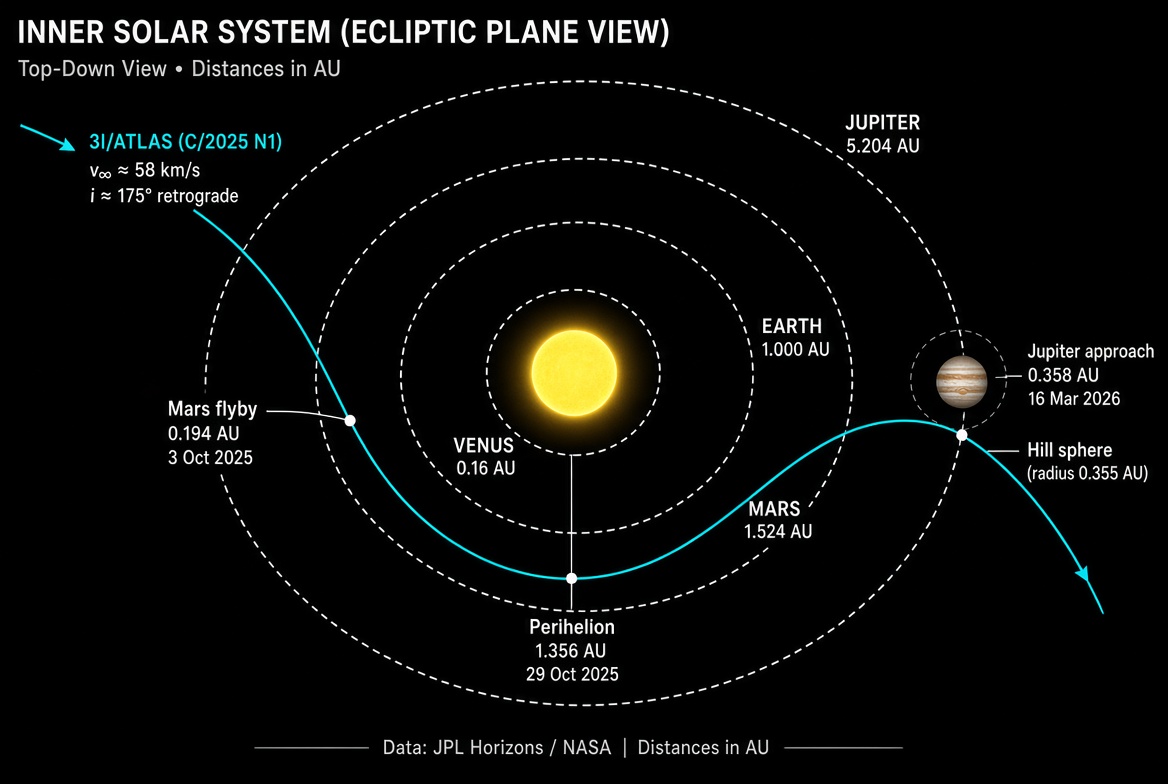
But there was another article that, in another bears-do-shit-in-the-woods moment, I wrote before, which was to point out to him that Jupiter was the destination, and that there was a reason why 3I Atlas was headed for Jupiter. Absolutely everyone following Loeb and 3I Atlas was thinking the same thing. Clearly, Jupiter is the most resource rich part of our solar system, with three planets, each of which has more water than our entire planet. Europa, Ganymede, or Callisto contain vast amounts of water and ice.
And the point is this: why do you, as an interstellar object, artificial, travel from one star system to another only to fly through it? Clearly, if you have a destination of Jupiter, you’re going to do something at Jupiter.
So we go back to Arthur C. Clarke, the science fiction writer. Loeb, as an eminent scientist and rationalist, doesn’t like science fiction. But he should remember that it was Arthur C. Clarke who invented the satellite. It was Arthur C. Clarke who predicted what first contact might look like with Rendezvous with Rama. And all of us who’ve read science fiction immediately recognised the scenario from Rendezvous with Rama when we first heard of 3I Atlas.
The ground had been prepared for us by Dr Loeb’s observations on ‘Oumuamua, which Loeb had argued was probably a flat piece of space trash from another star system. Again, let’s not get into that right now, but the question remains:
What the hell did 3I Atlas do at Jupiter?

The last words of ‘2010: The Year We Make Contact’ by Arthur C. Clarke. Image prompted by Phil Hall
What does an advanced interstellar spaceship do when it gets to the most resource rich part of our solar system, coming right up to Jupiter’s Hill Radius? Right up to it, with an actual course alteration at the Sun to bring it closer? And what’s to say that such an object might not deposit its load and then go back out to the Oort Cloud and lurk there, only to come back in for another swing in a few years?
And everybody who followed the whole case, all 3I Atlas watchers, wants to know what the hell happened at Jupiter.
The Sentinel Network makes a very good point. The point it makes is that the team that Loeb has gathered together is not primarily a scientific team aimed at investigating interstellar objects. It’s a team put together aimed at managing the problem of disclosure. The Sentinel Network’s point is that this is not a team built purely to investigate interstellar objects. It has a substantial communications and perception-management component, and that composition is itself a signal about what the council is actually for.
In addition to the rather hard science team, the UAP Advisory Council includes. Omer Eldadi, a psychologist at Reichman University in Israel; Jennice Vilhauer, a clinical psychologist specialising in quantitative psychology; Ross Howard, a science communicator and producer of the Event Horizon podcast with the Sol Foundation; Peter Skafish, a sociocultural anthropologist also with the Sol Foundation; and Michael Shermer, a professional sceptic and founder of Skeptic magazine. Liberty Capito, a data science professor at Washington University in St. Louis; Carol Cleland, a philosophy professor at the University of Colorado Boulder, and Robin Hanson, an economist at George Mason University
Personally speaking, it may sound silly, but I’m really worried. I’m really worried by what 3I/Atlas came in to do. You may not be convinced. You may just shrug your shoulders. You think, what’s it got to do with me? Is it even worth thinking about? Let’s be real.
And I have to say that black swans are real! Just, as Loeb himself was saying. Black swan events are real: unexpected, catastrophic events happen! Whether it’s a volcano, or a meteorite, or a tsunami, or a flood, or the arrival of Columbus in the Americas, or, and I know this sound nuts, the arrival of an interstellar craft into our solar system headed directly for the most resource rich part.
If the motive is colonisation and resource exploitation, the objects trajectory and behaviour makes good strategic sense: survey the inner system, then deliver the main payload capability to the richest accessible water reservoir in the Solar System (the Galilean moons) via a precisely timed Hill-sphere-edge release. Callisto would be the rational first beachhead, followed by the more radiation-intense but ocean-bearing moons.
The need for bulk resources, industrial logistics and operational security mean the Jovian system is vastly more attractive to an interstellar colonist. Earth’s unique value is almost entirely tied to its inhabitants and biosphere. A purely resource-and-colonisation-driven mission would therefore have strong reasons to treat Jupiter as the main objective and Earth as a side interest to be monitored rather than immediately occupied.
The latest video on 3I ATLAS from Loeb (after a silence of many months) was published just as I published this article.
Works Cited
Brin, David. “The Great Silence: The Controversy Concerning Extraterrestrial Intelligent Life.” Quarterly Journal of the Royal Astronomical Society, vol. 24, 1983, pp. 283–309.
Clarke, Arthur C. Rendezvous with Rama. Harcourt Brace Jovanovich, 1973.
Collins, Gareth S., et al. “Earth Impact Effects Program: A Web-Based Computer Program for Calculating the Regional Environmental Consequences of a Meteoroid Impact on Earth.” Meteoritics & Planetary Science, vol. 40, no. 6, 2005, pp. 817–840.
Liu, Cixin. The Dark Forest. Translated by Joel Martinsen, Tor Books, 2015.
Loeb, Avi. Extraterrestrial: The First Sign of Intelligent Life Beyond Earth. Houghton Mifflin Harcourt, 2021.
—. “Is 3I Atlas a Comet or Something Else?” Medium, 8 July 2025.
Loeb, Avi, Adam Hibberd, and Adam Crowl. “Is Interstellar Object 3I/ATLAS an Artificial Technological Probe? A Dark Forest Pedagogical Exercise.” arXiv, July 2025.
The Angry Astronaut [Jordan Wright]. The Angry Astronaut. YouTube, http://www.youtube.com/c/TheAngryAstronaut. Accessed 4 Oct. 2026.
Toon, Owen B., et al. “Environmental Perturbations Caused by the Impacts of Asteroids and Comets.” Reviews of Geophysics, vol. 35, no. 1, 1997, pp. 41–78.
Villarroel, Beatriz, et al. “Exploring Nine Simultaneously Occurring Transients on April 12th 1950.” Scientific Reports, vol. 11, no. 1, 2021, p. 12794.
—. “The VASCO Project: Search for Vanishing and Appearing Sources during a Century of Observations.” The Astronomical Journal, vol. 159, no. 1, 2020, p. 8.
Villarroel, Beatriz, and Kevin Krisciunas. “A Civilian Astronomer’s Guide to UAP Research.” arXiv, Oct. 2024, arXiv:2411.02401.
Phil Hall was born in South Africa into an ANC family with British, French, Austrian, and German roots. After his parents were exiled, they lived in East Africa and India before returning overland to the UK. In the UK he studied Russian and Spanish literature, politics, and economics. After graduating he specialised in descriptive and applied linguistics. Phil has lived and worked in Spain, the USSR, Mexico and the Gulf. Returning to London during the pandemic, he co-founded the Humane Socialist magazine, Ars Notoria (the Art of the Noteworthy) and the micropublisher, AN Editions.
Discover more from Ars Notoria
Subscribe to get the latest posts sent to your email.


You must be logged in to post a comment.