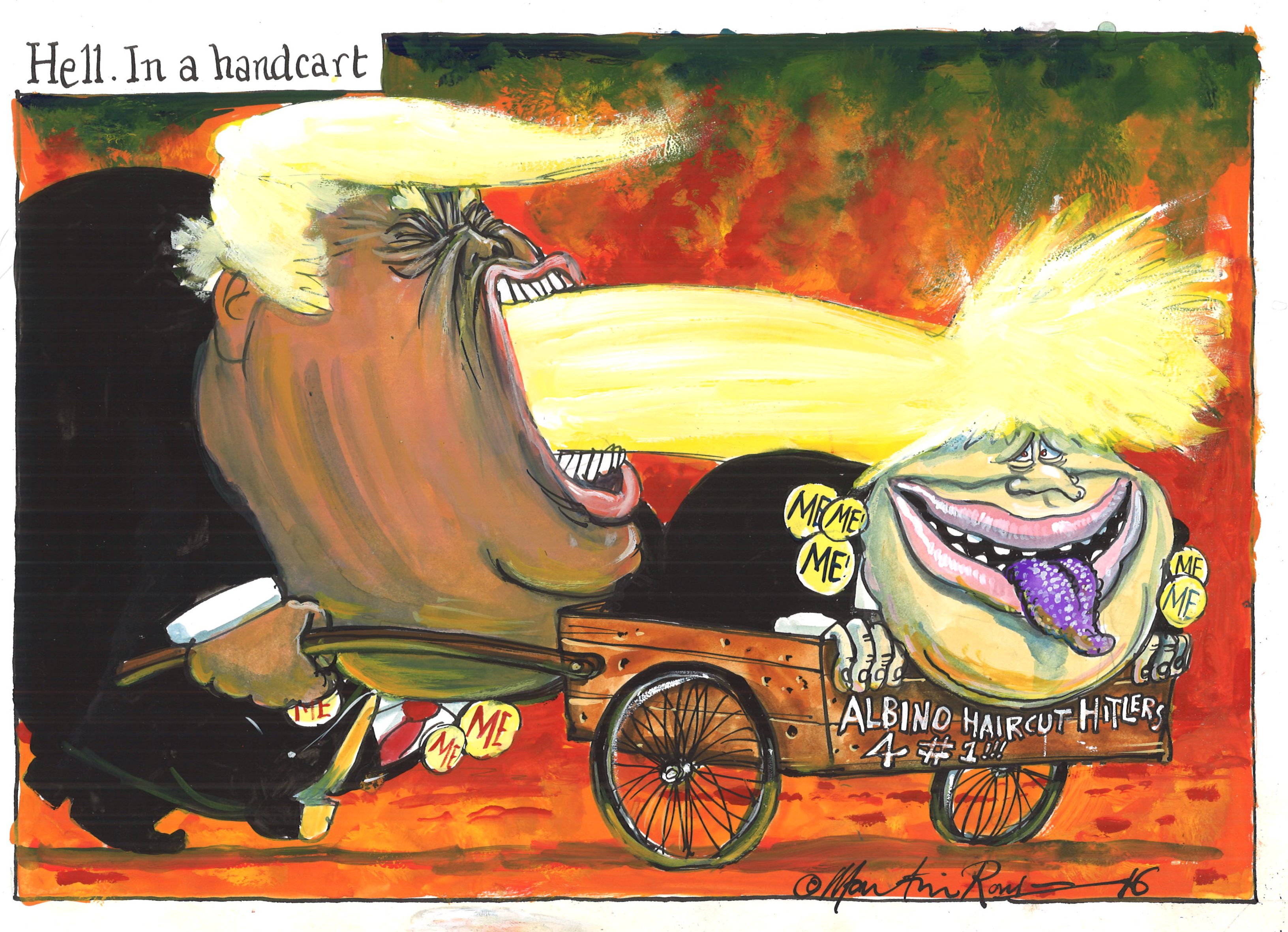
Trump & Boris. Illustration by Martin Rowson, published in the Tribune
A CONVERSATION WITH MARTIN ROWSON
– with Paul Halas and Phil Hall
Martin Rowson’s political cartoons started appearing in the national press in the 1980s, and he’s been metaphorically eviscerating the great, the good and the very bad ever since. He was appointed Cartoonist Laureate in 2000 (for which he receives a stipend of a pint of beer a year), and is published in numerous outlets, including The Byline Times, The Morning Star, and particularly the Guardian (or rather The Graun). He probably would object to being called a Guardian stalwart, because it hasn’t always been a marriage made in heaven – Rowson is very much his own man and depicts people as he sees them, warts and all – but it has endured.
A great complexity of both images and ideas is apparent in all Rowson’s cartoons. Savage, scurrilous, visceral, as well as being highly well-informed, intelligent and insightful. He follows the traditions of the great late eighteenth century political cartoonists, lampooning all the pomp and ridiculousness of our betters, but there’s also an even more grotesque element to his visual style, reminiscent of the nightmare visions of Pieter Bruegel the Elder and Hieronymus Bosch. One also sees the more humorous grotesqueries of the strange beasts and gnome-like gargoyles that adorn many gothic cathedrals and churches. There’s a lot of devil in the details; simply glance over a Rowson cartoon and you’ve probably missed a big part of it.
Cartoonist, painter, author, illustrator, performer… We were meeting another of those damned polymaths.
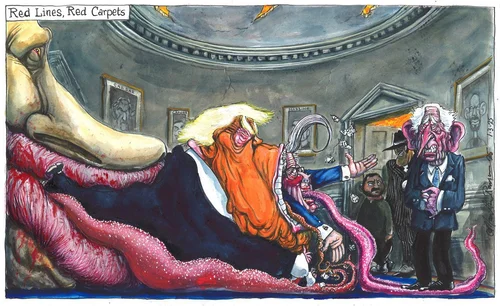
‘Red Lines, Red Carpets’. Illustration by Martin Rowson, published in the Tribune
Paul Halas: Pleased to meet you Martin. Maybe it would be helpful if we gave you a potted version of who and what we are before we really get going.
Martin Rowson: Hi… Please do. I hope you don’t mind if I carry on painting while we speak, because I can think and paint at the same time. I have this rush job which is a leaving present for Marina Hyde, who is leaving The Guardian.
Phil Hall: It’s like driving and talking, isn’t it? We can steam ahead.
Paul: So, Arsnotoria. We’re an arts, politics, and general interest magazine. We espouse the idea of Humane Socialism, in all its many forms, and publish essays, photography, poetry, articles about food, stories, and of course art and interviews with artists… so we’re very pleased to be able to speak with you.
Phil: Ars Notoria… the art of the noteworthy. From a humane socialist point of view… so what is worthy of note from a humane socialist point of view? You qualify, certainly!
Paul: Maybe we can start with where you came into cartooning? You read English at Cambridge University I understand.
Martin: Yes, I wrote not very much English at Cambridge, as I always say. I hated that place. I hated the course. I hated the complacency. But I started doing cartoons for two-bit student papers and I enjoyed that. I got utterly bored and fed up with the whole place before my Part One exams. I deliberately wrote nonsense answers to the questions because I just wanted them to throw me out, but they didn’t. They said the responses were very clever, but they didn’t answer the questions. So I was given a sort of special degree, because, although I didn’t answer the questions, I was a smart boy. They’d given me an open award when I did the entrance exam, and then they knew they couldn’t admit they made a mistake.
Rather than wandering off into the darkness, I went back a year later, but most of the time I was doing cartoons for two-bit student papers. And I ended up with an eye-wateringly bad degree. But I had a very useful education in the importance of mastering a deadline, which wasn’t about writing essays. It all was about working for this magazine called Broadsheet, where we used to have wonderful paste-ups using offset litho. There would be film reviews, etc., and when they were pasted up there would be gaps on the page, which immediately needed to be filled by cartoons by me.
Paul: Were you politically motivated back then? Cambridge had the reputation for being a hotbed of communist spies.
Martin: Ha! No one ever tried to recruit me. They probably realised I’d be completely unreliable. But I was certainly a member of various left-wing groups, used to go on demos, Anti-Nazi League marches, things like that.
I was very proud of the fact that we could go into the bar of a very right-wing, sporty college, and drive the rugby team out of there by singing revolutionary songs.
Phil: Jerusalem is a revolutionary song, isn’t it. Did you just sing it louder? There was a Little Red Songbook, wasn’t there?
Martin: There was. My friend Michael Foot said they wanted to throw Jerusalem out of the Labour Party songbook and he said, over his dead body. Jerusalem was written by a mystic socialist. Sir Hubert Parry, who wrote the music, was a guild socialist. So it’s a good left-wing song.
Paul: Coincidentally, we were discussing whether you were more aligned with Michael Foot or Paul Foot before the interview. Paul Foot was a very erudite man, but he worked for Private Eye, and you’re quoted as saying you’ve worked for everyone except Private Eye and…?
Martin: The Sun. I liked Paul. But Michael was a witness to history. I knew him because of my connections with the Tribune, for which I used to work for no money. He and I used to frequent the Gay Hussar restaurant, and we’d have rather jolly lunches.
During one lunch, around the time of his 90th birthday, he pointed to one of the tables in the corner and recounted how as editor of the Evening Standard he’d had lunch with the Soviet ambassador, Maisky. Apparently he’d been sent there by Beaverbrook to tell Maisky the date of Operation Barbarossa, which had been discovered by British intelligence, only when Maisky told Stalin, Stalin didn’t believe him… which is real history.
Paul: The Gay Hussar was a big fixture among the Soho filmmaking community as well. My mother and father, who made animated films, used to go there a lot in the 1950s. I remember it as having been a hotbed of creative people, gay animators, bohemians generally… I take it the Gay Hussar was also a haunt for politicking and politicians too?
Martin: It was. We were witnessing the dinosaurs roaming about before the comet struck, because they’d all still have their lunches there. Even New Labour… who tried to stop the lunches.
I remember when I drew Paul Foot in the Gay Hussar, he was having lunch with Gus MacDonald, then a Labour minister and peer. During the lunch his pager went off – it was either Mandelson or Campbell – and he had to get back to the House of Lords. Foot, a very old friend of MacDonald’s, gave him a really hard time after that. Too many stooges running about doing what they were told to do.

‘Paul Foot with Gus MacDonald’. Illustration by Martin Rowson
All of that was great to watch, and certainly New Labour drank like fish. Tom Watson (newly an employee of Palantir), would have eight-hour lunches when he was a whip. And Hilary Armstrong, one-time chief whip, Methodist and teetotaller, was careful to keep her distance from him during the mornings.
Phil: I reserve my dislike for Neil Kinnock in particular, because at a critical vote for the deputy leadership, where it was between Tony Benn and Denis Healey, it was Kinnock, along with Joan Lestor and one of the right-wing unions that swung it for Healey. It was a Jeremy Corbyn moment; it felt like a stitch-up.
Martin: I remember it well. It was another moment when the Labour Party decided to put its head up its own arse. Which it is very, very good at doing.
And I should add, I am not now, nor have I ever been, a member of the Labour Party.
Paul: You drew a number of caricatures for meals, I understand.
Martin: This is the way that gig started. I was having dinner at the end of 1999 and suggested the manager allow me to draw people in the restaurant. I’d wanted to do it for a long time, because I enjoy drawing in the wild, as it were. You catch people immediately.
So you sit down and you’re drawn in about 45 minutes. Then you see how they respond. Like Cartier-Bresson. You had one take. It was so interesting to see how people responded, with some reacting extremely badly… which was always quite funny.
Anyway, when I’d suggested this to the manager, John Wrobel, he said he hadn’t a budget for it, which is how I ended up drawing caricatures for meals. There was a problem when the place closed because the new owners took all the pictures… which was wrong, because it had been agreed they were only on loan. It all resolved eventually, however, and now they’re in the National Portrait Gallery.
Paul: It’s intriguing seeing you painting away there. Staying on your cartooning, you describe yourself as a journalist who paints rather than a cartoonist per se. But what you paint is incredibly visually literate.
Phil: The last cartoon was amazing. The Shakespearian piss-take of trouble in the royal family.

‘War of the Poses’. Illustration by Martin Rowson, published in The Guardian
Paul: Yes… for example!
You’re talked about working in the tradition of Hogarth, Gillray and Rowlandson, which is spot on. But I also see something medieval, like gothic church gargoyles… And like Breughel or Bosch…
There’s something wonderfully potent about your more acerbic cartoons. I love them.

‘The Exorcist’. Illustration by Martin Rowson, published in the Guardian
Martin: Thank you. The reason I said I was visual journalist wasn’t because I didn’t want to associate with being a cartoonist… I’m very happy and proud to do so. But I don’t want to associate myself with artists too closely… though I live in south-east London, and Goldsmiths gave me an honorary fellowship about 10 years ago.
I just found the combination of art and Saatchi nauseating; so many of those young artists seemed so happy just to screw money out of Saatchi. Good luck to them on that front. But that work was grave goods; he was building a pyramid, not a gallery.
So I take the opposite direction. I’m very happy to be associated with cartoonists and actually, the older I get, the more I think this stuff of mine is rather good. I’m doing it rather well. The reason why what I do is journalism, though, is because it’s art made to be reproduced.
About 15 years ago, Front Row on Radio Four invited me and Maggie Hambling to a Francis Bacon exhibition. I don’t know why they chose us to do it.
Maggie was in a very bad mood because she’d just given up smoking again. We got past Three Figures at the base of a Crucifixion and moved on to some Bacons I’d never seen before, including one of a baboon, sort of barking like this (Rowson imitates the Bacon baboon’s expression). I’d never seen something like that. It was so big and had such dynamism. I was also amazed by the sparsity of paint. Anyway, I was just commenting that it was fantastic, that the baboonness of that baboon was palpable, and that it was a great caricature… at which point Maggie’s eyes narrowed. She said, ‘How dare, you! Take it back!’
Paul: Exactly. A lot of Bacon’s work is cartoon-like.
Martin: I couldn’t quite understand her reaction. It wasn’t just the giving up smoking.
I think there’s a difference between being a cartoonist and an artist because I’ve had regular work for the last 42 years. I still publish once a week in the Guardian and once a fortnight in the Morning Star… who actually pay me nowadays. These days I’m doing stuff on a commission. I’m keeping busy.
Even before the advent of the internet there was the chance that my work would be seen by hundreds of thousands of people I’d never meet, now it’s potentially seen by millions.
After a work is published I can then sell the original, so I can get paid twice. And if you’re an artist, you probably spend six months doing a fantastic painting which then nobody buys. So the one thing you have is status; you don’t have a regular income, but you have status.
I’m just a sort of hack. I was interested in the great Gillray. Historians always see him as a caricaturist without conscience, etc., saying that he satirised the French Revolution, that he was a businessman, he was making money (in the same way that I am)… But in fact he did say he had an opinion. His agenda was that people in power, even if they’re well-intentioned, are just as thick and useless as you and me, and we should keep an eye on them. One of the best ways to do so is to hold them to account by laughing at them.
Phil: I’m about to publish a book of poems and essays called Temario, and some of my poems are just so angry. I’ve turned them into curses. They’re basically really powerful curses and I hope they find their mark. I read that you too are a sort of amateur Voodoo practitioner.
Martin: I’d say that what I do is Voodoo in as much as it’s doing damage at a distance with a sharp object. In this care a pen. But it’s definitely sympathetic magic.
I realised this in the Gay Hussar actually, when I was drawing Alastair Campbell, back in 2002, and it was clear that unlike other people, who just got on with their goulash, he hated the whole experience of being drawn by me. He wasn’t getting on with his goulash, and glared at me from across the restaurant. At one point, he shouted across the crowded room, ‘You won’t be able to prevent yourself from drawing me as a really bad person,’ to which I replied, ‘I draw what I see.’ And when I went to show it to him, he really didn’t like what was going on in the drawing.

‘Alastair Campbell’. Illustration by Martin Rowson
He knew what I was up to. He knew that in a way I was actually stealing his soul, but I had the perception of a human being with a lot of darkness inside him. It was sympathetic magic because I was recreating that darkness by caricaturing and somehow diminishing him.
So he gathered his soul, wherever he keeps it, and left. And I thought, I’m in a long tradition that probably goes back hundreds of thousands of years. It’s a kind of shamanism… well, it’s more than that.
Phil: Have you heard the story of Quetzalcoatl and Tezcatlipoca in Mexico? Quetzalcoatl was supposed to be this wonderful god. And then Tezcatlipoca showed him his real face in the black mirror, and his real face was horrible. And for that reason, Tezcatlipoca was calumnied as the devil because he called Quetzalcoatl’s bluff. Quetzalcoatl was really pissed off with what he saw.
Martin: Exactly! At the moment I’m doing this leaving present for Marina Hyde. I painted it this morning, and when I sent a picture of it the Guardian people said they were presenting it to her on Thursday and wanted to make sure she didn’t throw it back at them, so could I make it a bit nicer? I answered that I always paint what I see. ‘Yes, but there’s a chance she might actually throw it back at us.’ That’s why I’m still painting during this conversation.
I don’t know why people have a problem with the way they look. People have drawn me in the most atrocious ways, and that’s what I look like. It’s not their problem.
Paul: You jokingly said you hate caricatures of yourself.
Martin: Yes, I was joking. They fail to capture the young Harrison Ford I see looking back at me in the shaving mirror every morning. Of course I know that isn’t true.
I had a commission to draw Russell Brand, and the person who asked for it kept coming back and asking for changes, because he was so self-conscious about the way he looked. Probably because he stares at the mirror all day long. But it was a caricature, and it was pretty obvious that Russell Brand would be obsessed by his own image.
If you have a problem with it, then instead of a cartoon you should ask for a photograph, or possibly an oil painting.
Paul: We talked about you not working for Private Eye. They have it in for everyone, while at Arsnotoria we nail out colours to the mast. I certainly do in my fiction. When it comes to your cartoons, you caricature, you lampoon, but I think one also sees where your sympathies lie a bit. You go easier on some people than others.
Martin: That’s probably true. But let’s take a celebrated example: throughout his years as leader of the Labour Party, Jeremy Corbyn’s supporters were always after me for drawing him in such a terrible way. Well, I always drew him with a Lenin hat with a red star on it. I thought it was funny, and he does wear a hat like that. So what’s the problem?
And, as you know, on Twitter someone accused me of being personally responsible for the existence of food banks in this country, all because of the way I chose to draw Jeremy Corbyn’s hat. I was told, ‘You shouldn’t do that because you’re one of us.’ And I answered. ‘Actually no, I’m not in any way one of you. Though I am more sympathetic to you than almost any other caricaturist, except for Steve Bell.’
The fact that Jeremy Corbyn put himself up to be prime minister means he wanted to have power over my personal agency, and therefore he’d not glorified.
I’m like this slave in Ancient Rome whispering in the ear of the conquering hero, ‘You are mortal, and you have really stupid ears as well.’ The unquestioning worship of anyone seeking power is, I think, very dangerous.
Phil: Although we supported Corbyn, in terms of foreign policy he wasn’t the sharpest knife in the drawer. He was friends with Lopez Obrador, former president of Mexico, who was in cahoots with the cartels. During South African Apartheid, despite being urged by the ANC and trades unions not to join in, he demonstrated outside the South African Embassy with an extremist sect called City Group. He cosied up to sectarians such as Hamas and the IRA. Which isn’t to say I didn’t vote for him.
Martin: He’s obviously good in some ways, but he certainly didn’t want to be prime minister, and who would?
I mentioned the Morning Star earlier. When I started working for them in the 2000s they didn’t pay me (socialists!), but they did say it was a useful place to show stuff that wouldn’t get published elsewhere. And on the day Corbyn was elected party leader, 12th September 2015, I pitched an idea to the Guardian that I knew they’d never take: the Twin Towers of Blairism and Brownism, hollowed out, seen from behind, with Jeremy dressed as Mary Poppins, floating towards them beneath his umbrella. I was going to caption it 9/12. It was quite a long time after 9/11, but I respected the Guardian’s squeamishness and pitched it to the Morning Star. The art director and the cartoon editor loved absolutely loved it, but the paper’s new chief editor, Ben Chacko, who was probably just finding his feet, turned it down. ‘Oh, I don’t think Jeremy’s people will like it if we’re suggesting he’s linked to terrorists.’
We need holy fools in politics but we don’t need them running the country, and I don’t think he wanted to be prime minister in the first place. They should’ve got John McDonnell instead.
Paul: Even Steve Bell lampooned him, and he was very pro-Corbyn. Fair game, I’d say.
Martin: But when Corbyn was re-elected as party leader I did one of him as a kind of mixture of El Cid and Don Quixote dreaming the impossible dream, with Tom Watson as Sancho Panza. I sold the original to a Corbyn supporter who loved it. ‘Dream the impossible dream!’ That’s what I’m going to carry on doing, thank you very much. So you can interpret the work in very simple ways.’

‘Impossible Dream’. Illustration by Martin Rowson, published in The Guardian
But then I was told by a guy involved with Momentum at the time that one of their leaders had been furious and said, ‘Rowson has betrayed us.’ Well, I wasn’t even aware that I wasn’t supposed to betray them. If they wanted me to do their propaganda, they should pay me.
Phil: Were you friends with Seamus Milne?
Martin: I’m very fond of Seamus, but he’s a complete nutcase. I always got the feeling that in his head was fleeing from safe house to safe house in Saint Petersburg in 1915, on the run from the Okhrana. That he was a kind of cosplay Communist.
But he was a very, very good editor. In the Guardian he’d get people from across the political spectrum to write for it, and he had passion. He was excellent at that. But I understand one of the problems of the Corbyn leadership was that Corbyn’s press office never delivered their releases on time because they spent so much time arguing about what the line was. They all had slightly different iterations of the line. It was a kind of aristocratic Stalinism, which held them back.
Paul: I always had the impression that Milne allowed Corbyn to keep his head above the parapet… to be shot at.
Martin: Yes, maybe that as well. Maybe that’s what I mean. One of Corbyn’s problems was that he couldn’t run his private office, and no more could Starmer, And you know that when you’re being told what to do by your spads and wonks you’ve failed completely.
Phil: Can I just ask you if you have any influences in your art from other countries? From the French or American cartoonists, for example?
Martin: Not really. I very self-consciously follow in the tradition of British cartoonists, which is different from anywhere else. I eventually worked out why British cartoons are so different from the way the Americans do them. It’s simply because of the method of production. There’s no national press in the USA, so most cartoonists will have their work syndicated. Let’s say to one newspaper per state. And the size in the newspaper is different from paper to paper, so you can never draw up to the edge of the page. The British tradition is to draw up to the edge of the page, and that comes from Hogarth and Gillray. And you can see how it’s carried on for 300 years.
Paul: We have a very long tradition of hard-edged political cartoons… although maybe it was a little less pronounced during the Victorian era. It was done in a way that didn’t happen in any other country, except perhaps in Simplicissimus Magazine and maybe Le Canard Enchaîné and Charlie Hebdo… but that’s tenuous. They don’t have the range and breadth of generations of English cartoonists.
Martin: I agree with that. And they say that the American style of cartoons was invented by Thomas Nast. So it was. They don’t seem to have picked up from what we were offering. And every single time I encounter some of my American colleagues they’re all slightly amazed when they see our work.
You could say we’re direct descendants of Hogarth. And Hogarth wanted to be taken seriously as a painter. Sometimes he went to print first and then did the painting. He wanted to invent an entirely new British school of art, which he did, and it was satirical. And we’re all in his shadow, and still doing the same thing. So if you look at any political cartoonists, there are rules that are used. And the more stuff you can cram into the image, the more fun there is for the reader.
Phil: Do you think this could go back to the pamphleteering, during what Christopher Hill called The English Revolution?
Martin: I think that’s right. You have gospels with free expression. Under the Long Parliament there was an amazing outpouring, that was suppressed in the aftermath of The Restoration, when you could be hanged for being rude about the king. Until, that was, this wonderful, forgotten moment in British history when they forgot to renew the Royal Licencing Act, in the Parliament of 1695. The lapsing of that draconian act opened Pandora’s Box, allowing the opportunity to write and draw all sorts of rude stuff about the powerful. For the next 20 years the great and the good tried to get the Royal Licence back on the statute book, but to no avail. People like their freedom too much. So they introduced the Stamp Act to tax free expression instead.
Paul: Last year we interviewed Tom Bachtel, the wonderful caricaturist from the New Yorker. When we asked him (very gently) about political leanings, we were given the impression he and his colleagues had far less leeway that you have here. But are lines here too, aren’t there? You’ve had issues with some of them, and Steve Bell perished on his pen.
Martin: Yes… And you know what happened with me is different from what happened to Steve. When I was accused of antisemitism it was a mistake I took to heart, because it was clear that the art could be misinterpreted, and so I made good.
I have a lot of Jewish friends, and it was nothing to do with Israel. It was just a fuck-up on my part, and if I offend people I haven’t targeted I apologise. I sorted it out, and I would never argue about my inalienable rights to do racist cartoons. I don’t think I should do racist cartoons, and I don’t think anybody else should either.
In the USA the government is trying to terrorise people into total obedience to the mad jibberings of Trump, and power to those cartoonists who spend all their time caricaturing him. But it can all get a bit painful and unpleasant.
Phil: A hypothetical question: what if one of your MI5 or MI6 colleagues at the Guardian approached you to do cartoons that, say, showed Putin or the president of Iran in a really bad light?
Martin: I’d say I’m not told what to do by the Guardian, and never have been. They won’t actually directly tell me what to do. I take your point, though.
Phil: You’re probably not a fan of Putin – not many people in England are – so maybe such a cartoon would align with your views. My father, a magazine journalist all his life, said be careful what you write. Even if it’s justifiable, people will use it to beat other people with. This was particularly the case with Trotskyists who were against the Soviet Union. They were the most ferocious anti-Communists, and the most useful ones as well. If you put yourself in that position, you could be found quite useful.
Martin: I’m quite sure I could be useful in all sorts of different ways.
This could sound very irresponsible, but why should I be responsible? I’ve never claimed to have any control of my work after it’s published, so if people want to completely misinterpret the cartoon they’re going to do it. Not much I can do about it.
After the Guardian started putting my work online and then publishing my email address underneath it to give the punters the right to reply, the amount of death threats I’ve received has increased exponentially.
People are constantly accusing me of all sorts of things that just aren’t in the cartoons. And some of them are those with whom I might possibly be in agreement, and want to find something to comfort them with. Such as the Momentum member who accused me of betraying them. There’s nothing I can do about it.
Phil: One of the reasons why I was very interested in meeting you is the Morning Star cartoon which had all the leaders of the European countries looking up at a fireworks display that spelled out: ‘WE’RE FUC… ’E’RE FUC…’ And I thought, well, this isn’t something MI6 or MI5 would like to see. So here’s a man with an independent agenda.
Martin: As I said at the beginning of this conversation, it’s always a source of great regret that I was never approached by MI5 when I was at Cambridge… but I don’t think anyone would ever be stupid enough to recruit me. What on earth would I do?
The Trots have always been incredibly useful and incredibly idiotic in all their different permutations. I sort of wonder what Leon would’ve thought about that… about Frank Furidi (founder of the Revolutionary Communist Party, who went over to Orbanist Ethno-nationalism), I mean, what would Leon Trotsky think about Frankie?
Phil: Jack Straw.
Martin: Yes.
Paul: Claire Fox or Brendan O’Neill ?
Martin: Yes, all of those guys.
Phil: Christopher Hitchens didn’t turn out very well in the end.
Martin: My friend Joan Smith was obliged to hang out with Hitchens rather more than she wanted to, and thought he was a monster. During a Tribune dinner at the Gay Hussar the conversation got around to “Fuck or Die”. Someone mentioned Peter Hitchens as an awful choice, but Joan disagreed. ‘Peter is much better than Christopher. If you were on a desert island with Peter he’d catch you a fish, build you a shelter, and a fire to attract passing ships. You’d have to listen to his opinions, but he’d be helpful. But Christopher would eat you.’
Paul: When we were talking about cartooning and racism, making a cartoon that could be interpreted as racist, I immediately thought of Robert Crumb. He attracted a lot of flack after one comic in particular, The war between the N*****s and the Jews, which was intended as a satire on racist stereotypes. His usual number of death threats went sky-high, although I believe most of them were still from the right.
Martin: One of the perils of my profession is ambiguity, because it has to be very ambiguous. It has to be deniable because you’re attacking the powerful. If someone powerful questions why you’ve made a dreadful cartoon attacking them, you can tell them it didn’t look at all like them and they had it wrong.
A wonderful example was when the Royal Licencing Act was repealed, Daniel Defoe jokingly wrote that the quickest way to deal with dissenters was to execute them all. Nonetheless he was taken to court and sentenced to the stocks… where his supporters all threw flowers at him.
Saying it was all a joke is the ultimate get-out clause, but the people you’re satirising can refuse to get the joke.
Phil: I’ve been familiar with your cartoons for some forty years. They always have an impact on me, but they also give me the feeling of viscera. I enjoy them enormously, but sometimes with a sense of revulsion too. I don’t see that with anyone else… except maybe Steve Bell. But you go beyond him, and you have your imitators too.
Martin: I find my viscera a very useful way of keeping alive. This fear and abhorrence of bodily functions, the stuff that comes out of our bodies every day, is the basis of our sense of humour I think.
The sound of poop will make any toddler laugh, and that’s something we retain. Alan Rusbridger has a very strong dislike of shit in cartoons, and during the 90s, when I was working for Time Out, when the Tories were enmired in scandals, I drew them up to the necks in shit creek for several weeks running. The editor rang me and told me he was worried about my mental health, that I kept drawing shit in my cartoons. I asked him if he could think of a better metaphor for that government. He told me to carry on.
Going back to Private Eye, the reason I don’t publish there is that Ian Hislop hates my guts. And it’s mutual. I did a nasty drawing of him in the Daily Mirror in 1996 (a long time ago!) and he started rolling me in shit as a consequence. I sent him an email saying I was glad to know he could take it as well as give it out.
Paul: I didn’t see that cartoon. But (for some reason) I’m reminded of all the gargoyles on pretty near every gothic cathedral – shitting and puking and all sorts. If that was good enough for the medieval Christians it’s probably good enough for us.
Martin: Exactly. One of the reasons Hislop and I don’t get on is his definition of satire, which is that its purpose is to puncture pomposity. Which I think is one of the most pompous phrases in the English language.
The purpose of satire is to remind people who want to be treated like gods and have power over over individual agency that they’re like us. They shit like us and they will die. That’s the purpose of satire: to remind the powerful that they’re human.
Phil: My father was an editor of a magazine in the 80s and he had a boss called Salim Lozie. And Salim Lozie was a really puffed-up person. My father said that whenever he wanted to feel better after being harangued he just imagine Lozie taking a shit on a toilet.
Martin: Exactly. This is how we cut them down to size. Because I’ve never pretended to be better than anyone else, but then again no one’s better than me. And we should remember this.

There are people walking amongst us who think they’re gods. Nigel Farage is clearly a deranged narcissist who thinks he’s fit to run the country. He’s also a squalid little grifter. But he thinks he’s one of the greatest men who every lived. Boris Johnson thought he could be prime minister and he’s just a nut-job. We’re constantly surrounded by people who want to deprive us of our agency, by seeking authority over us. And we should always kick back against that.

Boris Johnson ‘Wank’. Illustration by Martin Rowson, published in the Morning Star
Paul: Going back to the medieval theme, you describe yourself as being a bit like a court jester. Speaking truth unto kings. The kings are still there of course, but it gives you agency being able to poke fun at them.
Martin: Indeed it does, and I’ve got away with it for forty years. I’ve only had a couple of hairy moments, so I’ve been very lucky. Certainly luckier than many of my colleagues around the world who live in unhappier countries and suffer accordingly. I’ve always been very mindful of supporting cartooning colleagues around the world who are persecuted by their governments, or other oppressive powers. Like my friend Muhammad Saba’aneh, a Palestinian cartoonist.
Paul and Phil: This brings us to a very fitting point to wrap up now. Thanks so much for your time and all your insights!
Paul Halas, the Arts and Lifestyle Editor of Ars Notoria and co-founder of AN Editions, is a writer of Jewish heritage whose escape from 1970s hippidom was the discovery that he could invent stories. He spent forty years contributing to various Disney magazines and books, as well as a variety of non-Disney comics, books and animated films.
Phil Hall was born in South Africa into an ANC family with British, French, Austrian, and German roots. After his parents were exiled, they lived in East Africa and India before returning overland to the UK. Phil has lived and worked in Spain, the USSR, Mexico and the Gulf. Returning to London during the pandemic, he co-founded the Humane Socialist magazine, Ars Notoria (the Art of the Noteworthy) and the micropublisher, AN Editions.
Discover more from Ars Notoria
Subscribe to get the latest posts sent to your email.


You must be logged in to post a comment.