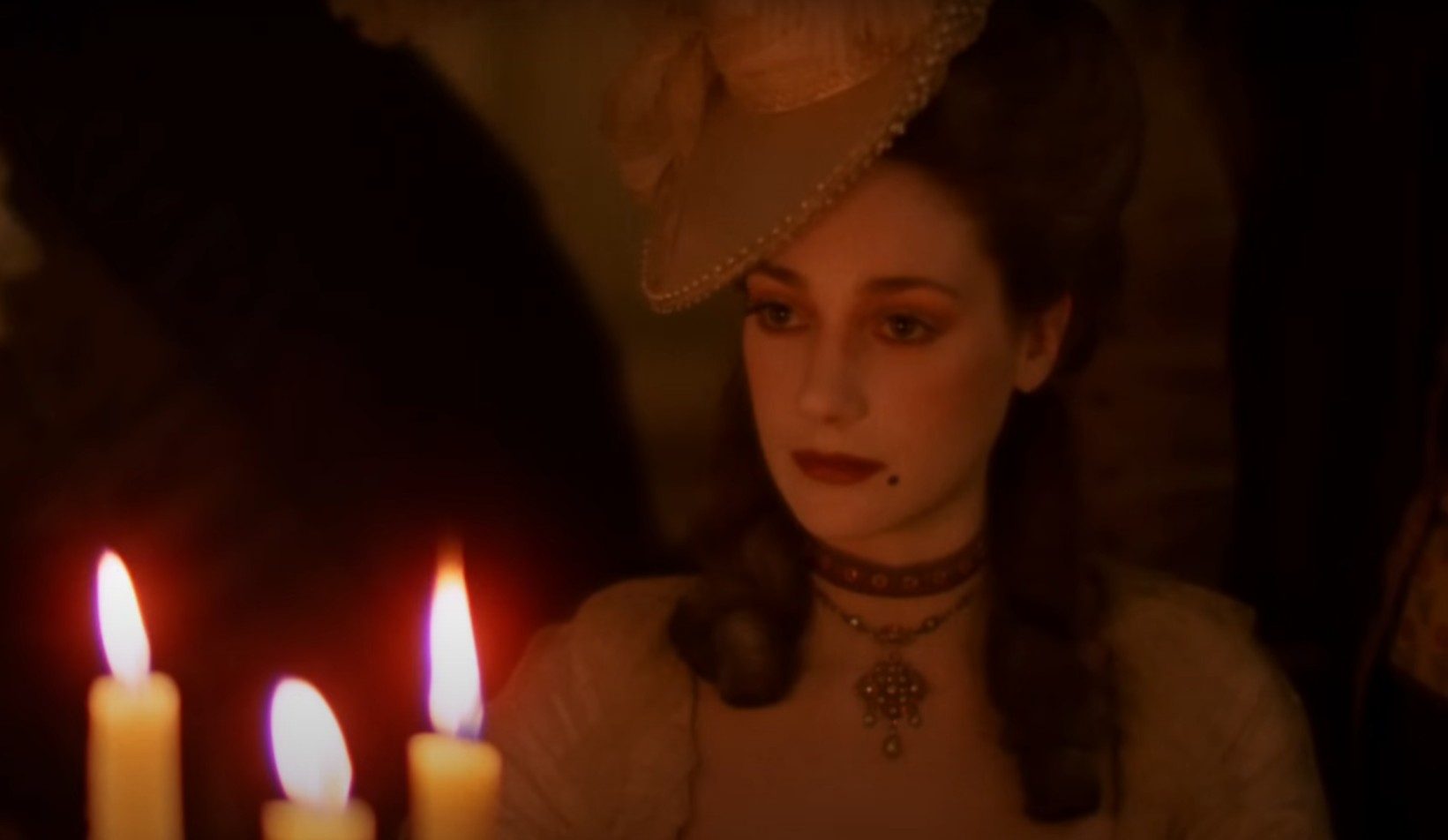
Sit back and look at pretty pictures: Barry Lyndon, (screenshot) Fair Use
by Norman B. Schwartz
Stanley Kubrick was born in 1928 in the Bronx. His father, a Russian/Polish homeopathic doctor, encouraged his precocious son’s interest in photography, buying Stanley his first Graflex, a bulky camera much favored by police photographers. Young Stanley began roaming the streets of New York, taking pictures of anything that caught his attention. So successful was he at documenting the daily life of the big city that when Look magazine bought one of his photo essays most people did not realize that he was only 17. By the final year of the Second World War, 1945, Stanley was the youngest photojournalist in New York.

Fascinated by the moving images of film, Kubrick next began experimenting with short documentaries in which he imitated the more naturalistic style of the European films he saw in the city’s art houses. At 25, the same age as Orson Welles when he made Citizen Kane, Kubrick borrowed money from an affluent uncle to make his first feature film, Fear and Desire (1953). Shot in 16mm and blown up to 35mm for theatrical release, it was a grim story about a group of soldiers trapped in a forest behind enemy lines. They are discovered by a young girl, whom one soldier ties to a tree. He does not violate her; he watches her reactions. Critics commented on the imagery. With a modest budget and limited means, Kubrick somehow conjured an atmosphere that was both erotic and chilling. Kubrick rejected his directorial debut as a commercial failure, comparing it to “a child’s drawing on a fridge,” and attempted to erase it from anyone’s memory, including his, by buying every copy he could find when he became famous and rich.

Thanks to the generosity of a Bronx pharmacist, he soon had another go at making a film. His next effort, The Killer’s Kiss (1955,) which he photographed on location in New York, was a tale of a boxer who falls in love with a ballerina. Irene Kane, the actress who played the dancer, described her director as someone who “is all about sex and sadism.” This talent for combining the violent with the erotic would surface again and again in his future films, one distant day prompting his future nemesis in the critical establishment, Pauline Kael, to refer to Kubrick as Stanley Strangelove.
She might have better distinguished him by calling him Stanley Strangeluck.
Unlike many other pioneer iconoclasts and innovators who preceded him—D.W. Griffith, Erich von Stroheim, Joseph von Sternberg, Preston Sturges and Orson Welles—Kubrick’s comet did not flare brilliantly only to burn away after early success. Over the years to follow, his films continued to grow and glow steadily.

Kubrick’s early success is largely because of James Hill, Rita Hayworth’s last husband, an independent producer who helped him find superior scripts and Hollywood backing. Hill and Kubrick’s second project, the anti-war film Paths of Glory (1957), was shot on location and in the Bavarian film studios. Kirk Douglas, who played a French officer and whose company, Bryna Productions, was partially responsible for the film’s financing, was much impressed by his young director’s method of work, particularly how, unlike the average studio director, Kubrick worked alongside his German camera crew, picking up shots using a handheld Arriflex.
Two years later (1959) after only three weeks of shooting on Universal Pictures’ Spartacus in California, actor-producer Douglas fired the director Anthony Mann, and insisted, despite studio resistance, that the then unknown New Yorker Kubrick take over. Given a $6 million budget, Kubrick remained unfazed by both his volatile star and producer and the studio’s usual, formulaic approach to filmmaking.

The New York rebel clashed quietly with everyone—including his star/benefactor and his cameraman, Russell Metty. A.S.C. Metty was not the usual studio hack shuttled from one project to another. He had only recently photographed Orson Welles‘ visual masterpiece, Touch of Evil. But Kubrick, with the youthful confidence of someone who knew he knew better, declared that his understanding of modern lighting and lenses, and how and when to move the camera surpassed that of anyone from the old studio system. He demanded and received final say on lighting and camera composition, a privilege then unheard of. Ironically, at the time of the Academy Awards, the film was nominated for four—none for its director. His nemesis, Metty won the year’s Oscar for Cinematography.

Spartacus was an enormous success, bringing Universal Pictures a return of almost $15 million at the box-office and establishing Kubrick in the industrial hierarchy as a money-maker of epic films, a job description he would hold before him like a shield throughout the rest of his career.
Kubrick, at the early part of his Hollywood career, would have his flops and hits, and yet somehow Hollywood never treated him as it had treated other nonconformists and troublemakers, perhaps because Kubrick did not fit Hollywood’s default image of the insolent enfant terrible. Unlike his outrageous predecessors who delighted in pushing their artistic superiority into the faces of their inferior studio heads, Kubrick, was a man of few words, most to the point. He had a knack for making his bosses feel confident in their abilities.
Kirk Douglas, his star and boss with whom Kubrick fought every step of the way, paid him an unusual left-handed compliment “He was a bastard,” Douglas said, “but he was a talented, talented guy.”

After the enormous success of Spartacus, Kubrick, disappointed at the studio’s re-cutting of the film, wisely demanded total artistic control of any project he agreed to do. He also did something few of his predecessors had thought of doing. He moved away from the United States to England in 1961, never to return to his homeland to make another film. Setting many of his later films in the United States, he saw no reason to go there when one could construct or find almost perfect replicas of American and European locales on sound stages not too far away from his country home. The big studio moguls and their underlings did not object. Hollywood continued to finance him. The costs of his set building and location shooting were far less expensive in England than in the United States. His distance also gave him an additional benefit—an unusual protection from their meddling. They were too far away to bother him.
Settled quietly and gentlemanly in the English countryside, never too distant from giant film studio facilities like Shepperton, Pinewood or Elstree, he surrounded himself with the best of English technicians. The first movie he considered making with Hollywood backing was the controversial Nabokov novel Lolita (1962) which many considered unphotographable. Kubrick got its author to write the screenplay, and he photographed it. He next chose Doctor Strangelove (1964)—a surrealistic exercise in dark comedy that earned back about the same amount of money as his first English film made on a similar budget. (Over $9 million dollars on a $1.8 budget.) Kubrick then waited six years to release his next project, a triumph in never-seen-before special effects. 2001: A Space Odyssey (1968) succeeded beyond expectation, making him rich and famous; initially earning $31 million, it would go on to make over $146 million in worldwide sales. A Clockwork Orange (1971) brought in another $114 million; Barry Lyndon (1975) $31.5 million, The Shining (1980) $47 million; Full Metal Jacket (1987) $120 million. Eyes Wide Shut (1999) Kubrick’s last film, made $162 million on a $65 million budget, making it his highest grossing film.

To this day, except for his juvenilia, his films have not dated because their appeal is as fundamental and universal to filmmaking as that of another master showman C.B. DeMille, a director no one today would label as a serious artist. Kubrick shares with C.B. that rare talent of depicting sex on the screen without the slightest hint of pornography.
When C.B. DeMille showed us glimpses of excessive sin, often Roman bacchanalia, he always felt obliged to remind us that those on-screen pleasures, which we so enjoyed observing, necessitated punishment. In contrast, Kubrick, the friendly kid from the Bronx, snapping away with his big camera, saw no need to wave his finger at his audience nor punish his on-screen hedonists. For that reason alone, his films when viewed today, unlike those of C.B., do not seem dated or hypocritical. You never feel Kubrick is keeping one eye wide open to ensure he was giving his gullible ticket-buying public the salacious tastes they craved. Every film Kubrick shot reeks of total honesty and admirable schoolboy sincerity. He is not interested in shocking us for shocking’s sake; he is interested in everything.
When asked what his 1967 film 2001: A Space Odyssey was about, Kubrick answered: “You’re free to speculate as you wish about the philosophical and allegorical meaning of the film—and such speculation is one sign that it has gripped the audience at a deep level—but I don’t want to spell out a verbal road map … that every viewer will feel obligated to pursue.” When asked by a journalist whether Full Metal Jacket was pro- or anti-war, Kubrick choose neither. He said: “It’s just the way things are.”

Indeed, Kubrick’s universal appeal, his genius perhaps, is that he only asks the viewer to share a smorgasbord of astonishing visual and aural experiences with him. Kubrick invites us to sample what seems most appealing and easiest to digest. He is not a polemicist. He has no interest in debating with his audience. Kubrick is the ultimate voyeur who only wishes us to see what he sees and make up our own minds.
While examining his catalogue, it is easy to question whether the director understands or even cares about the meaning behind these images. Films for Kubrick, are not a philosophic adventure; they are visceral, empirical experiences. The director’s obligation, as Kubrick sees it, is only to take the viewer on a journey, whether it be out to space or into Lolita’s bedroom. He never asks us to delve too deeply into experience and ask why; instead, he advises us to walk around it, seeing everything with a cool, not cold eye and click.
Wherever you are, wherever he takes you, you are kept a safe distance, free to step away and escape it. Kubrick is in every sense of the phrase film’s first true post-modernist. He does not ask for philosophical understanding; he only demands emotional response.
How can anyone dispute such a remarkable lifetime of achievement? Come with me, please, he says. Don’t think. Just look and feel. Sit back. Enjoy: Dr. Strangelove. Sit back and look at pretty pictures: Barry Lyndon. Sit back and have your wits scared out of you: The Shining. Sit back and witness the stupidity of war: Full Metal Jacket.
A passive experience, you might say. One not too demanding of the viewer? But isn’t that what going to the movies has always been about?
Norman B. Schwartz is the author of the comic novels ‘ALL THINGS small‘, Paradise Now, Don Juan in Space, True (Cinema) Confessions, Hollywood: Below and Beyond, and the DIY guide, The Art Of The Schnoorr. He spent over forty years working on films in Hollywood and Rome. Norman was the first ADR sound editor / director to be admitted to Academy of Motion Picture Arts and Sciences in Los Angeles.
Norman B. Schwartz essays will appear in sequence monthly in each issue of the magazine with a view to Centre House Press publishing the entire collection of essays in book form in spring 2026
Discover more from Ars Notoria
Subscribe to get the latest posts sent to your email.


You must be logged in to post a comment.