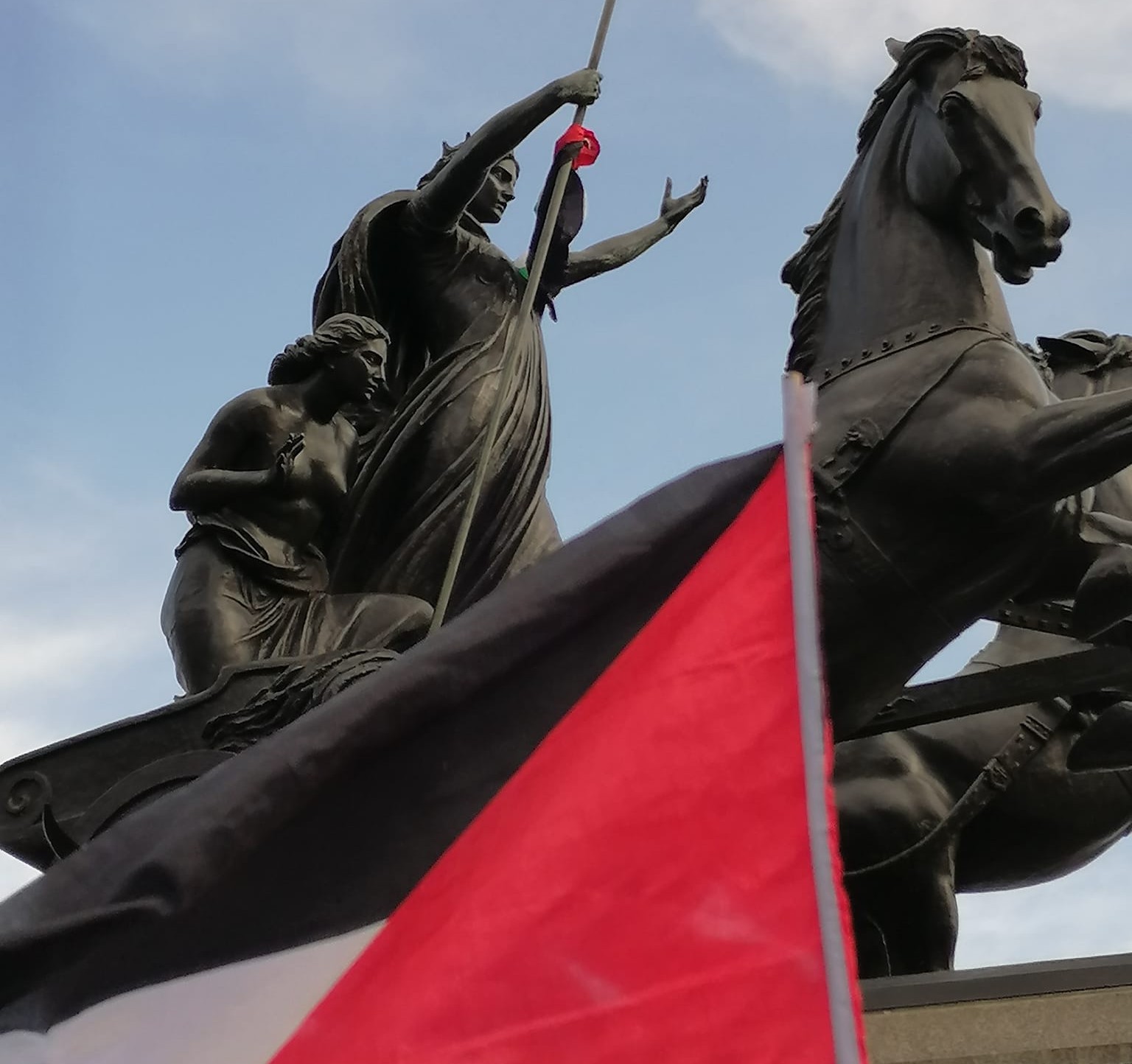
Palestine Solidarity Campaign march, photo Phil Hall
Palestine Action is Leading Activists into a Dangerous Backwater
by Richard Steinhardt
The streets of Britain are full of outrage about Israel’s genocidal actions; crimes of a magnitude unseen since the German fascists destroyed the Warsaw Ghetto, and attempted to exterminate all the people who they defined as Jews.
Hundreds of thousands have participated in huge pro-Palestine demonstrations. Sometimes the number of people demonstrating has approached a million. And this is only in London. These demonstrations are happening across the world. Yet, for all their scale, this movement has not put sufficient pressure on the British state (and its US/Israeli/corporate backers) to make it halt the starvation and killing of hundreds of thousands of Palestinians in what some Israelis boast is ‘the second Nakba’. The British public is outraged. It condemns the most vile atrocities perpetrated by this settler state and US proxy in the Middle East.
However, it is a well-documented counterintelligence tactic to redirect dissent away from the basic issue at hand: the urgent need for boycotting the Israeli state, freedom for Palestine, and the establishment of a unitary, secular Palestinian state where all people are equal under the law. Palestine Action has served to redirect the public’s attention toward peripheral controversies. You should not support Palestine Action and I certainly do not.
Protests that should focus on British complicity: arms sales, military collaboration, and political cover for Israel, are instead derailed by debates over “extremism” and “public order.”
The case of Julian Assange and WikiLeaks serves as a blueprint for narrowing the focus of the public’s attention. Once a platform exposing war crimes, WikiLeaks was neutralised by shifting focus from Wikileaks revelations to Assange’s legal battles and personal character. A similar dynamic now unfolds with Palestine Action, where performative militancy, such as spray-painting military bases and factory occupations, dominates headlines, eclipsing the passionate demand of the British people expressed in huge demonstrations for arms embargoes and sanctions.
Diverting Dissent into a Backwater

The dismantling of WikiLeaks followed a recognisable counterintelligence pattern. Rather than address the Collateral Murder video or diplomatic cables exposing war crimes, Western governments and media fixated on Julian Assange’s asylum in the Ecuadorean embassy, his personal and sexual conduct, and his legal battles. Campaigns framed him as a “Russian asset,” or a narcissist, diverting attention from the atrocities his organisation exposed.
The debate shifted from “Should governments commit war crimes?” to “Should Assange be extradited?” Liberal outlets, even those sympathetic to press freedom, increasingly framed the issue as a legal dispute rather than a systemic critique of US militarism and an exposure of the USA’s attempt to preserve global corporate hegemony.
This same tactic is now being deployed against the Palestine Solidarity Campaign. Protests that should focus on British complicity: arms sales, military collaboration, and political cover for Israel, are instead derailed by debates over “extremism” and “public order.” When activists occupy arms factories, the media fixates on property damage rather than the weapons being produced and exported to a genocidal state. The discourse shifts from “Stop arming Israel” to “Are these protesters going too far?” Moreover, protesters breaking into a military base could just as easily been carrying Improvised Explosive Devices. Palestine Action gave the government grounds for invoking anti-terror legislation and this may not be a coincidence. One can only feel sorry for the very young activists goaded and manipulated into taking this action while the people egging them on stayed in the shadows.
The Curious Case of Palestine Action

The government, in turn, uses Palestine Action’s militancy to justify harsher policing of all protests, as seen in the 2023 Public Order Act, and to demonise the vast numbers of people who have participated in Palestine Solidarity Campaign demonstrations.
Several anomalies raise questions about Palestine Action’s origins. Its patterns align with documented cases of state infiltration. Undercover policing inquiries have revealed how small organisations, founded and led by agents provocateurs, encourage radical actions to discredit movements. While there is no direct evidence that Palestine Action is state-led, its tactics directly serve state interests by isolating the movement and justifying repression. It is an organisation that has no organic roots that appeared out of nowhere in 2020, with a co-founder who had barely any social media presence at all, multiple arrests and few serious convictions. These are red flags for infiltration and manipulation.
Unlike the Palestine Solidarity Campaign (PSC), which emerged from decades of organising, Palestine Action appeared abruptly with no prior base. Its co-founder, Richard Bernard, has an elusive background, crossing over from activism in Extinction Rebellion (also closely monitored by the police). Most movements escalate tactics gradually, building public support before engaging in high-risk actions. Palestine Action, however, began right away by destroying property; a tactic guaranteed to provoke media backlash and legal crackdowns.
The organisation’s stunts generated headlines, but failed to halt arms shipments. Meanwhile, they provide ammunition for pro-Israel lobby groups like the Campaign Against Antisemitism (CAA), which cite Palestine Action’s behaviours in order to smear the entire Palestinian solidarity movement as “extremist.”
Sustained Resistance

Palestine Action’s vandalism allows authorities to frame activists as “violent,” shifting focus from their demands. In contrast, when Quakers are arrested for peaceful civil disobedience, or people associated with them, this galvanises broader support. Palestine Action’s high-risk actions, however, alienate unions, faith groups, and politicians who might otherwise endorse BDS (Boycott, Divestment, Sanctions).
The Palestinian cause does not need isolated acts of provocative militancy, it needs a strategic, sustainable mass movement. The anti-apartheid struggle won through boycotts, labour strikes, and international pressure, not symbolic vandalism.
For Britain’s solidarity movement to succeed, we can agree that it must focus on systemic complicity and demand arms embargoes, sanctions, and an end to military collaboration; it must avoid tactics that justify repression. Britain’s Palestine solidarity movement must build broad alliances with unions, faith groups, and political factions.
Mobilise people don’t alienate them! We need boycotts and sanctions not symbolic vandalism, strikes against collaborating companies and international pressure and broad intersectional coalitions. We need to legally target systemic political enablers of the genocide and, reject tactics that invite repression.
Corbyn and Sultana’s new party will offer a platform and allow British people to push for real change and to pressure for support for Palestine. Victory will require patient, relentless mass organising. Anything less plays into the hands of those who seek to silence dissent.
Richard Steinhardt is a committed socialist and a radical humanist and has published in the Morning Star and a variety of other communist and socialist publications. He believes that human conscience and understanding should always precede dogma and deterministic formulas posturing as ‘social science’.
Discover more from Ars Notoria
Subscribe to get the latest posts sent to your email.



You must be logged in to post a comment.