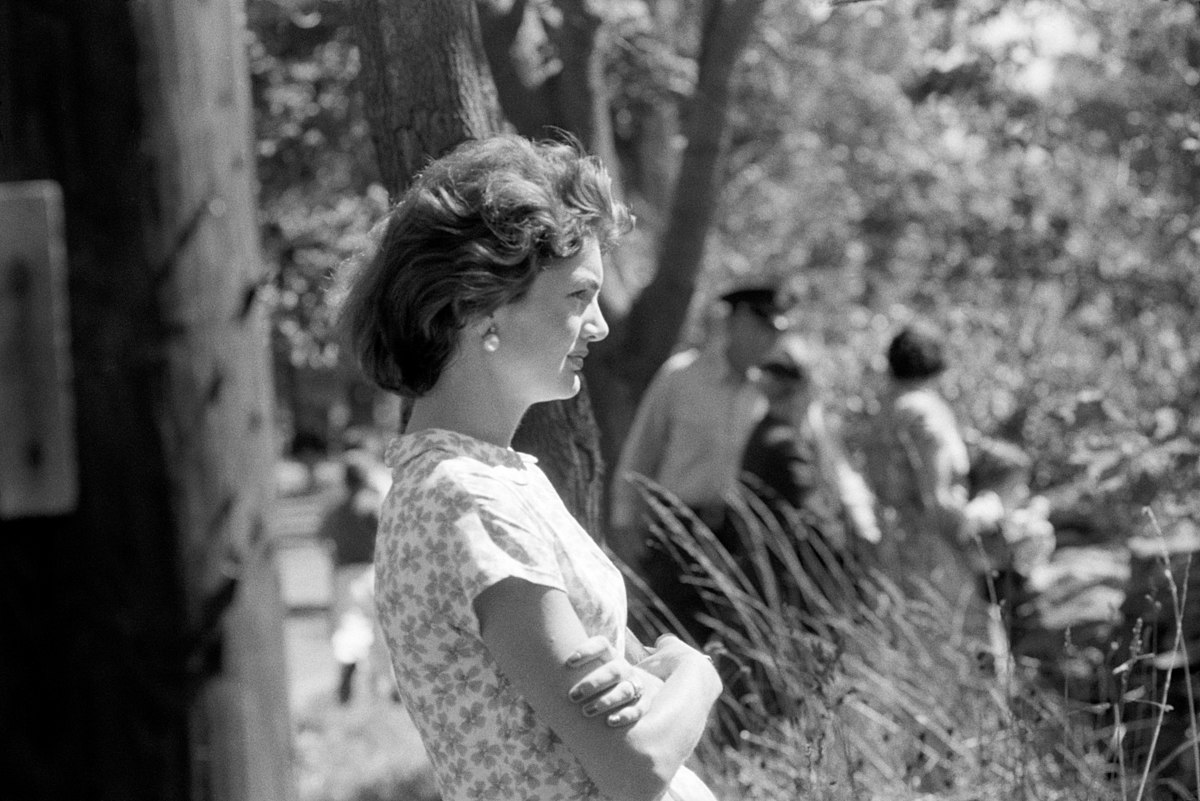
Jacqueline Kennedy, photo Toni Frissell Library of Congress 1957
Jackie Kennedy, Before and After
by Norman B. Schwartz
Jacqueline Kennedy, the First Lady in the land, and the novelist and essayist Gore Vidal, shared one thing in common – a stepfather. Both Jackie’s mother and Gore’s mother were married to the same man. Not at the same time. Gore’s mother, Nina, married Hugh Dudley Auchincloss Jr in 1935 and divorced him seven years later in 1942, the same year Jackie’s mum, Janet Lee, went to the altar to become the third and final Mrs Auchincloss. That marriage lasted thirty-five years, until Auchincloss’s death in 1976.
In his day, Hugh Dudley Auchincloss Jr must have been quite the catch. Not handsome by conventional standards, nevertheless he was the embodiment of the eligible young American Protestant aristocrat born not only with a silver spoon in his mouth, but with a mother who held piles of stock in Standard Oil. Hugh’s father, Hugh Senior, though not as wealthy as his wife, had nothing to be ashamed of. The son of a prominent financier in New York and a member of the city’s best society, Hugh sent his young son, Hugh Jr, to Groton, the prestigious eastern prep school which Franklin Delano Roosevelt and Secretary of State Dean Acheson had attended. After graduation from Yale University, Hugh served as an officer in the US Navy during World War One; post-war, he studied at King’s College, Cambridge, earning his degree in law at Columbia University.

Following the tradition of other well-born men of his time, he did not leap instantly into a career bound to guarantee a partnership in a white-shoe Wall Street establishment. He chose instead civic duty, serving for a time in Washington, specializing in the new science of aeronautics. He then opened a brokerage house in Washington, D. C., and became a member of a number of gentleman’s clubs – in the capital, the Metropolitan and the Burning Tree, and in New York the Yacht Club and the Racquet and Tennis Club. These accomplishments made him both rich and respectable. As he grew older, secure in his wealth and social position, Junior lived a quiet gentlemanly existence at his family estate, Merrywood, northeast of the nation’s capital. Rarely in the newspapers, he bothered no one, he created no scandals. A lifelong Republican, he preferred it that way.
Before marrying Auchincloss, Jackie’s mother, Janet Lee, had led a less stable, more controversial existence. Coming from a southern family who often claimed connection to the Confederate general of that surname (when dropping such a name was a social advantage), as a young woman she had married the handsome stockbroker, John Vernou Bouvier III, whose grandfather had fought in the Napoleonic wars and whose family had been among the first French Catholics to settle in the New World. In their twelve years of their marriage, Janet Lee’s life was tumultuous. She and her husband had two beautiful daughters, Jaqueline Lee (born 1929) and Caroline Lee (1933), but that alone was not enough to keep the family together. Black Jack, as the father was known because of his good luck and reputation as a womanizer, had lost most of his money in the stock market crash of 1929 and was addicted to gambling.

In 1940 Janet sued for divorce. Difficult as it was then for a Catholic woman to obtain one, Janet somehow managed. Unlike those discreet Episcopalian Auchinclosses who made certain that there was never any publicity about them, either complimentary or adverse, everyone knew about Janet’s divorce.
Many who knew Janet Lee in those years considered her a social snob, a climber obsessed with money and social position, not surprising given her husband’s behavior and addictions and her own upbringing. Although the Bouvier girls did not have much money, certainly very little compared to their circle of friends, Janet saw to it that they acquired all the trappings of the privileged class into which she had married. Janet sent her daughters to the best schools, among them Miss Porter’s boarding school in Connecticut where young Jackie was much admired by her schoolmates for her skills as a prize-winning equestrian. When she made her debut in New York society, the Hearst society gossip columnist Igor Cassini, who was one day to design 300 of Jackie’s clothes, crowned her Debutante of the Year. When time came for college, Jackie preferred the arty Sarah Lawrence but obeyed her mother’s wishes and went instead to the most sociably acceptable Vassar College. There she studied art, history, and literature and spent her junior year abroad polishing her schoolgirl French.
Upon her return to the States, where she graduated with a degree in French literature – obtained from George Washington University in the nation’s capital, she won a competition to work as a junior editress at Vogue in New York City. Unfulfilled with her job, she quickly decided to return home to Washington, D. C., to be near her mother and stepfather. He knew everyone and was instrumental in getting her work at $25 a week as the Inquiring Camera Girl at the Washington Times-Herald. (Girls from rich families were poorly paid because everyone knew they did not need to support themselves.) While doing this, she met and fell in love with a congressman from Massachusetts eleventh district, the dashing John F. Kennedy, someone who seemed destined for a great career in politics. He was twelve years older and Catholic. By Washington standards, they were an ideal couple. Jackie and Jack married in 1953.

Much has been made or inferred in hundreds of books about Jackie’s troubled marriage. Very early on, she became aware of her husband’s chronic infidelity. Advanced from Congressman to United States Senator, he was as unfaithful to her as Black Jack had been to her mother. As Jack had repeatedly given her sexually transmitted diseases, she blamed him when their daughter, Arabella, was delivered stillborn. Years after his assassination, Jackie confessed her unhappiness to her lover, Jack Warnecke, an architect friend who designed JFK’s Eternal Flame monument at Arlington National Cemetery. Warnecke in turn shared his pillow talk with J. Randy Taraborrelli who promised the architect he would wait until 2023 to publish what he had been told (Taraborrelli, Jackie – Public, Private, Secret). He wrote that in 1956, Jackie, angry that John stayed in Europe rather than return for the child’s burial, told her father-in-law, the Kennedy family patriarch Joseph Kennedy, once FDR’s ambassador to the Court of St James’s, that she was going to end her marriage. Father Joe knew that this dissolution would end his son’s excellent chance of being elected the first Catholic president of the United States; he begged Jackie to remain with John and offered her $100,000 – over $1 million today (approximately £760,000) – for any child “carried to term.” According to Taraborrelli’s biography of Jackie Kennedy, Jackie accepted.
In 1961, JFK, Jackie by his side, was inaugurated President of the United States. Once resident in the White House, Jackie took every opportunity to play the part of First Lady, a role for which she seemed born. Dismayed at the sorry appearance of the official presidential residence, calling it “that dreary Maison Blanche,” she envisioned it becoming a miniature Versailles and ordered that “Everything in the White House must have a reason for being there.” The first thing removed upon her arrival from its place of honor was the portrait of the former First Lady, Mamie Eisenhower, at the entrance. No sooner was it taken down than Jack had it put back, knowing the ex-president would soon be coming for a visit.

She also discovered that the White House held a vast storehouse of treasures, among them a desk made from the wood of the British ship HMS Resolute, which Queen Victoria had presented to President Rutherford Hayes. Jackie had it moved to the Oval Office where it remains to this day. Given a government allowance to restore the residence, she bought and borrowed furniture – a sofa once sat upon by Dolly Madison, a suite of furniture owned by Lincoln – and invited artists and writers to become part of the ceremonial life of her palace. During Jackie’s reign, art and governance mixed as they were never to mix again. Leonard Bernstein, Norman Mailer, Pablo Casals, Igor Stravinsky and her half-brother Gore Vidal were often invited for special occasions when foreign dignitaries visited.
When JFK was assassinated in 1963, Jackie studied Lincoln’s funeral procession of 1865 and had his casket removed from storage. On the day of the funeral, she insisted on walking behind the closed coffin rather than ride in what she called “a fat black Cadillac.” (A horse named Black Jack, her father’s name, followed behind her.) As she had played the role of First Lady to perfection, so did she play the part of the First Widow. Her husband’s father, aware of the prestige she had brought to the family, saw to it that Jackie was made a beneficiary of the JFK Trust, giving her a lump payment of $20 million per year should she not marry again. But Jackie was no one to wear widow’s weeds beyond her self-appointed expiration date. Her half-sister from her mother’s second marriage to Auchincloss, Janet Jr, once told her, “People say money can’t buy happiness. Jackie retorted, “Only people who don’t know where to shop.”
But when her brother-in-law, the Attorney General Bobby Kennedy was killed as well, she did not wear black to his funeral; she grew fearful. “If they’re killing Kennedys, then my children are targets…I want to get out of this country,” she said.”

In 1968, within five years of her husband’s assassination, Jackie shocked the world by discarding her widow’s weeds to marry a foreigner, a man twenty-three years older, the Greek shipping magnate Aristotle Onassis, said to be one of the richest men in the world. By marrying again, she automatically lost the Kennedy stipend and the protection of the Secret Service. But Onassis offered her something she considered irresistible – a private island on which to live, and both absolute privacy and 24/7 security for her and her children. As J. Randy Taraborrelli reports in his book, she once told Jack Warnecke that “Money is power and I want both.” Before marrying again, this time to Onassis, she demanded and received a pre-nuptial agreement guaranteeing her the equivalent of $150 million (£115 million). Unlike the Kennedys who were often unhappy about Jackie’s personal expenditures, Onassis won her by agreeing to grant her an unlimited clothing allowance.
Like her father and the deceased president, her Greek husband and protector, Ari, as he was known, continued his many love affairs. Jackie had come a long way from her days as the wide-eyed debutante and Inquiring Camera Girl, one madly in love with the handsome Irish American whose father was determined he would one day become US President. She accepted her new husband’s infidelities as she had learned to live with JFK’s. For a price.

Despite her marriage to Onassis, the former First Lady of the United States chose not to reside in Greece. She spent most of her time in Manhattan, bringing up her children properly as her mother Janet Lee had taught her and as her distinguished stockbroker stepfather Auchincloss had supported. Onassis, none too pleased by her continual absences, responded by cutting down her monthly allowance, and rewriting his will. When he died in 1975, she and his nearest kin, his daughter Christina, fought over its conditions. Greek law made Jackie unable to inherit his fortune; Christina offered her stepmother $20 million (£16.1 million) as final settlement, but Jackie refused, threatening to release evidence she held about a series of corrupt deals he had made to benefit his business. Jackie and Christina eventually settled on $26 million.
Once again, Jackie had a choice to make. She chose neither to play the Bereaved Once First Lady of the land, nor the Gay Divorcée. Instead, she chose another role she could perform to perfection: the adoring and protective working mother of two adorable children whom she often walked to school at the most prestigious private schools in Manhattan. She had also accepted a job as literary editor at New York’s best publishing houses, first Viking then Doubleday, a job she would hold for twenty-five years.

Jacqueline died on 19 May 1994, aged sixty-four, and was laid to rest beside President Kennedy in Arlington National Cemetery. On her deathbed, Jackie told Warnecke she regretted letting JFK’s assassination “poison my life…. What a shame to spend so much time tormented by the thing I could never change.”
This is hardly what one would have expected the widow of the President of the United States to say, but Jackie, despite her sanctification in the eyes of her admirers, refused to be anyone’s plaster of Paris ornament. Jacqueline Bouvier Kennedy-and-Onassis was a very complex woman determined to live her life as she wished. Her half-brother Gore Vidal, who knew her well, perhaps better than most people ever did, said of her that the one thing we must never forget about Jackie was that she was both “rapacious and salacious.” In her honor, examining Jackie’s life led fully with courage and elegance, I believe we should precede his description with another word, perhaps more fitting … “Gracious”.
Norman B. Schwartz is the author of the comic novels ‘ALL THINGS small‘, Paradise Now, Don Juan in Space, True (Cinema) Confessions, Hollywood: Below and Beyond, and the DIY guide, The Art Of The Schnoorr. He spent over forty years working on films in Hollywood and Rome. Norman was the first ADR sound editor / director to be admitted to Academy of Motion Picture Arts and Sciences in Los Angeles.
Norman B. Schwartz’s essays will appear in sequence monthly in each issue of Ars Notoria Magazine with a view to Centre House Press publishing the entire collection of essays in book form in Fall 2025
Discover more from Ars Notoria
Subscribe to get the latest posts sent to your email.


You must be logged in to post a comment.