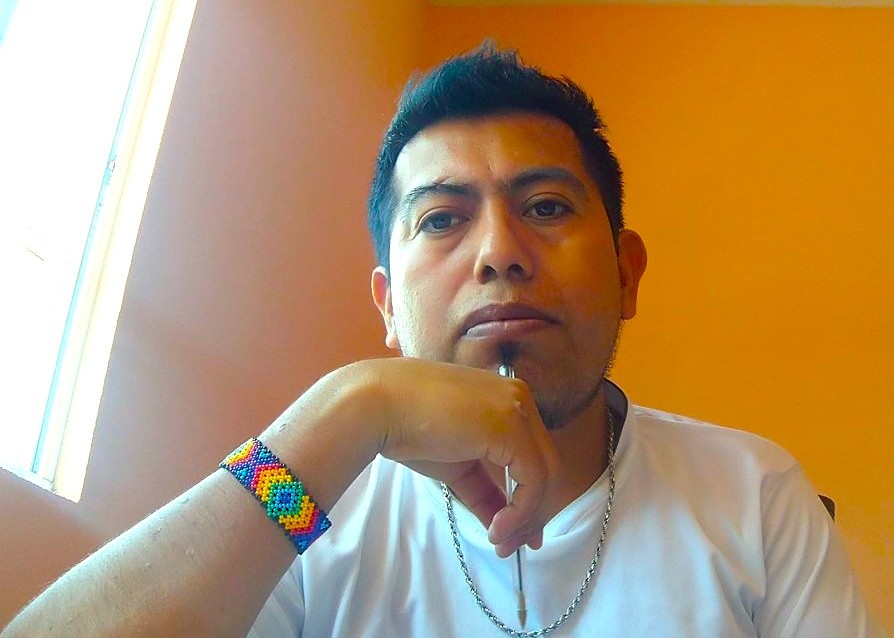
Dentro de los ecos del Coloquio Internacional de Poesía & Filosofía, compartimos dos poemas de Martín Tonalméyotl, en náhuatl y en su traducción al español (en la versión del propio autor).
Los poemas pertenecen a la antología “Otro mundo en la Tierra”, compilada por Ulises Paniagua (Corazón de Diablo Ediciones, 2023).
Reverberating out from the International Colloquium on Poetry & Philosophy, we share two poems by Martín Tonalméyotl, in Nahuatl and in their Spanish translation (in the author’s own version).
The poems belong to the anthology “Another World on Earth”, compiled by Ulises Paniagua (Corazón de Diablo Ediciones, 2023).

IJTITONPITS
(Náhuatl)
Kijtoua nonantsin kampa noyej nijtitetompits,
kampa nitlajnekue ken se chiche
niman notlanko tlacha ken se okuilin,
kampa nochipa nikijnekue
niman nikneke nikuas tlaltsintle.
Nochipa ijkon nikchiua kuak
nikijnekue tlajle uan patstik,
nikmate kenejke yolik kalake ipan noyakaktsol,
kenejke yolik yejko nojtikopa
niman peua kinmolinia nokuitlaxkoluan.
Se tonajle onechnextito nikuajtika tlajle
niman noyej okualan niman onechnakasuijuilan.
Kijtoua kampa nojte kinmiyolitijtika
on tlintefieros okuilimej istakej
uan nokuajkuateketsaj niman kinekej kuaskej tlajle.
San onikuajnajnankilej niman onikijle ¿kenejke
ompa noskaltiskej on yolkamej
ijtik noteuatsal tlakayotsin kampa kinaman
tlapachiuej noachikij omikuan?
Onikijlej,
noyakajtsoluan nouaxkauan
niman amo inuaxka on temolokokuilimej.
Nikneke nikuas tlajle kampa yajua se tonajle
no ijke nechtolos iuan noomikuan.
Onechijlej:
tla ijkon tikijtoua,
kuak uajkisaskej motsimpan
on kuitlaokuilmej,
xtimitsinkixtilis niman nikitas
tla melauak sa noyej tixkojtik ken tikijtoua
niman xnineke nikitas tikistikisa titsajtsitij
ken on konetl uan kuitlatemojke.
PANZA DE OLLA BARRIGONA
Mamá dice que tengo la panza de olla,
olfato de perro
y boca de lombriz.
Huelo la tierra como a nadie
y me la como a pedazos.
Es un vicio muy mío
de comer la tierra mojada
porque el olor entra por mis narices,
llega a mi estómago
y comienza a revolotear mis tripas.
Un día, me atrapó comiendo tierra
y no se limitó a jalarme las orejas.
Dijo que mi estómago era el creador
de esos horripilantes animales blancos
que asomaban sus cabezas para oler tierra.
Le respondí diciendo ¿qué de donde carajos
voy a crear esos animales pegajosos
en un cuerpo casi momificado en donde apenas
se sostienen mis huesos de chiquigüite?
Le dije,
mis narices son mías
y no de esas apestosas lombrices.
Y quiero comer tierra porque ella un día
me terminará comiendo hasta los huesos.
Me sentenció diciendo,
el día que se te cuelguen vivos en el culo,
no meteré las manos y ojalá,
seas tan valiente como lo eres ahora
y no un niño tan chillón
que sale corriendo despavorido.
POT BELLY
Mama says I got a big belly round like a pot,
a dog’s nose &
a worm’s mouth.
I smell & eat soil in chunks
like nobody does
It’s a bad habit of mine
to eat wet soil
‘cause the smell goes through my nose,
gets to my stomach
& starts to flutter in my guts.
One day, Mama caught me eating a chunk
& she pulled my ears.
She also said my stomach was a home
for those creepy white worms,
that jut their heads out of the grown
to smell the soil.
& I said,
how the heck am I going to house slimy worms
in this mummified body,
where my chiquigüite bones
are barely holding up?
I said,
this nose is mine
& that’s all.
I want to eat soil
because eventually soil will eat me up to the bones.
She warned me that if one day
those worms hang out of my ass,
she’ll keep her hands off
& hopefully I’ll be as tough
& not run away.

NOKA ONOKAYAJKEJ TEKOYOTSITSINTIN
Noche onikchij tlin onechijlej nokojkoltsin.
Onikuaj garbansotlaxkajle niman onikonik
cafe uan tlachijchijtle ika tlaxkalsosojle uan yotlatlak.
Kuak nemiya noueyenantsin
onechititej kenejke amo ninosokitokas,
kenejke ninokixtilis atsintle kuak ajakakiyouiya,
kenejke ninajkopilos ipan uakax ikuitlapil kuak uajuetsiya atepeyatl
niman kenejke nikinuiuitlas notlauan para amo nikinpotstekis.
Noche notlantsitsiuan onikinuiuitlak
kenejke onechititej noueyenantsin.
Onechijle maniktlajkajle notlan ipan se tejakajle,
kampa ompa uajkisas se tekoyotsin
uan kinekis iuan ninotlampatlas.
Onochijle kampa kuak nikontlajkalis
kineke kualtsin niknojnotsas on yolkatsin,
ijkon, yajua kiselis notlantsin ika noche iyolo
niman uelis okse nechakas uan chikauak.
Oniktenkak noueyenantsin
niman kuak kisaya se notlan,
nikiliaya tekoyotsin pampa manechaka
se notlan uan noyej chikauak.
Ijkon onikchij niman on tekoyotsitsintin
melauak noka onokayajkej
niman onechinmakakej tlantin
melauak tepajpatlaktijkej ken tlayolposojle
uan okinenpolojkej intero nokamak.
Aman, melauak nitlannejnepantik
Tla san noueyenantsin nemisia,
nechijlisia kenejke nikchiuasia
niman kenejke nikinkuajlalisia notlauan.
LA MALDAD DE LAS RATAS
Fui obediente a las enseñanzas de mi abuela.
Comí memelas de garbanzo
y tomé café de tortillas viejas y quemadas.
En su existencia de madre grande
me enseñó a desenterrar mis pies del lodazal,
a protegerme de la lluvia con viento,
a cruzar la corriente de agua colgado en la cola de un toro
y a como arrancarme los dientes sin quebrar alguno.
Todos los huesos de mi boca fueron extraídos
conforme a las reglas de mamá grande.
Me aconsejó a aventarlos al tejado
donde un ratón los recogería
y regresaría otro más grande y fuerte.
Antes del trueque
uno pide de buen modo
para que el diente sea recibido con bien
y pueda ser sustituido por otro más duro.
Hice caso a este consejo
y cada que se me caía uno,
le pedía al ratoncito me regresara otro
en condiciones mucho mejores.
Cumplí el ritual y las malditas ratas
se burlaron de mí,
dándome unos dientes
tamaño maíz pozolero,
los cuales destruyeron toda mi dentadura.
Ahora tengo los dientes chuecos.
Si mamá grande existiera
seguro, practicaría otro ritual
para enderezar la maldad de las ratas.
EVIL RATS
I was well trained with my grandmother’s teachings.
I ate garbanzo bean memelas
& drank coffee made of burnt tortillas.
During her great mama’s life
she showed me how to dig my feet
out of the mud, how to find shelter
from windy rain, how to cross a river
hanging on to a bull’s tail,
& how to pull out my teeth without breaking them.
Every tooth in my mouth was pulled out
under Big Mama’s rules.
She advised me to keep them on the roof
where a little rat would come
to pick them up, then bigger
& stronger teeth would grow back.
Before the swap,
one could only wish
a warm welcome for the tooth,
& a stronger one in return.
I took Big Mama’s advice
& every time a tooth fell out,
I asked the little rat for more.
I complied with this ritual
but the damned rats scammed me,
they gave me fake teeth
as big as corn grain
that cracked & grew sideways.
Now I have a crooked smile.
but if Big Mama were alive,
she sure would shake the evil
out of those rats.
Martín (Jacinto Meza) Tonalmeyotl.
Poeta y escritor nahua, originario de Atzacoaloya, Guerrero, Licenciado en Literatura Hispanoamericana por la Universidad Autónoma de Guerrero, Mtro. en Lingüística Indoamericana por el CIESAS y profesor de la Universidad Intercultural del Estado de Puebla. Ha participado un sin número de encuentros y simposios de literatura y poesía. Por ejemplo, en el VI Encuentro Nacional de Jóvenes Escritores, Literatura en voz de sus autores, en la 3ª Feria del Libro Guerrerense, en las Fiestas de Nuestras Lenguas, entre otras. Su obra poética ha sido publicada en la revista Sin fín, Mujeres en la historia II, Poesía Mapuche, en el periódico La Jornada en los suplementos: La Jornada del Campo y Ojarasca. Es integrante del libro: Los 43 Poetas por Ayotzinapa (2015).
Martín (Jacinto Meza) Tonalmeyotl.
Nahua poet and writer, originally from Atzacoaloya, Guerrero. He holds a Bachelor’s degree in Hispanic American Literature from the Autonomous University of Guerrero and a Master’s in Indoamerican Linguistics from CIESAS. He currently teaches at the Intercultural University of the State of Puebla. He has participated in numerous literary gatherings and poetry symposiums, including the 6th National Meeting of Young Writers, Literature in the Voice of Its Authors, the 3rd Guerrero Book Fair, and the Festival of Our Languages, among others. His poetic work has been published in the magazine Sin fin, Mujeres en la historia II, Mapuche Poetry, and in the newspaper La Jornada in its supplements La Jornada del Campo and Ojarasca. He is featured in the book 43 Poets for Ayotzinapa (2015).
Discover more from Ars Notoria
Subscribe to get the latest posts sent to your email.


You must be logged in to post a comment.