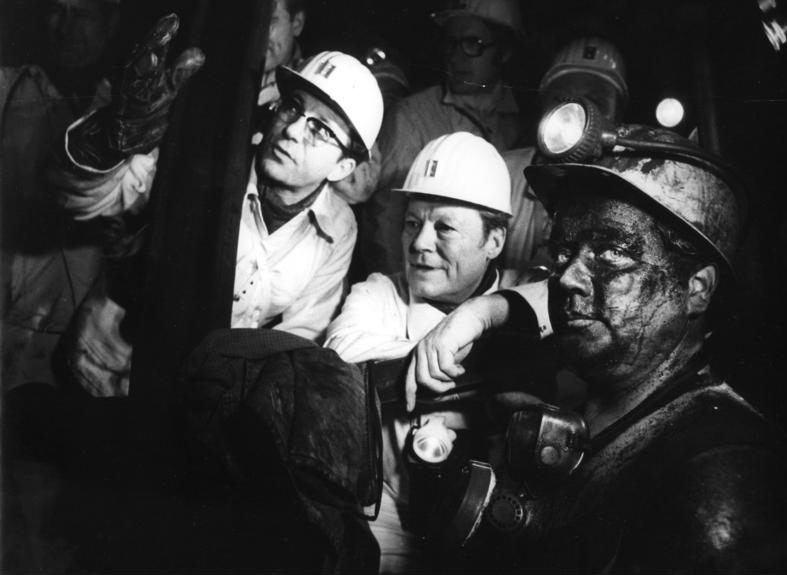
Bundeskanzler Willy Brandt besichtigte am 1.3.1974 die Zeche “Minister Stein” in Dortmund-Eving
Despite its Recent Pivot, Germany Was Always a Counterweight to American Adventurism
by Phil Hall
The American empire is bankrupt, deindustrialised, and addicted to war. Its “leadership” is a farce. The U.S. has caused more global instability than any nation since World War II and yet it escapes full accountability due to media control and financial hegemony. The USA is a rogue state. Despite this some US analysts have the chutzpah to point the finger at Germany and accuse it of warmongering and recidivism.
Yes, today, under figures like Friedrich Merz (a former BlackRock executive and clear comprador of US financial and geopolitical interests) Germany is being steered toward a reckless confrontation with Russia, inverting its post-war legacy, but this alignment with Washington’s neoconservative agenda (backing NATO expansion, sabotaging energy autonomy, and escalating arms shipments to Ukraine) must be seen for what it is: a temporary hijacking of German policy, not its natural trajectory.

The map does not lie. Europe is not an island, adrift in the Atlantic, forever bound to Washington’s failing project. It is the western peninsula of Eurasia, its southern shores lapped by the same waters that touch North Africa and the Levant, its eastern plains blending into the vastness of the Russian steppe. This is our geography, and it dictates our interests. Before the Americans decided that every bridge between Europe and its neighbours must be blown up, we were building them through trade, through energy, through diplomacy. The time has come to rebuild what their neocon pirates destroyed.
For decades, Germany acted as Europe’s rational counterweight to American adventurism. Its Ostpolitik eased Cold War tensions; its resistance to Reagan’s sanctions over the Siberian pipeline defended European energy sovereignty; its refusal to join the Iraq War proved independence was possible. Even its much-criticised austerity policies, however destructive, were at least rooted in some notion of Eurozone stability and not the blood-soaked profiteering that defines US foreign policy.
Yet Germany’s record is far from unblemished. During apartheid, it maintained economic and military ties with South Africa, supplying submarines and uranium while companies like Siemens, Mercedes-Benz, and Rheinmetall circumvented sanctions. It backed the brutal Greek junta (1967–1974) with arms and aid, while simultaneously paying billions in reparations to Israel under Wiedergutmachung and later supplying tanks to Israel in the 1960s.
Despite professing neutrality, Germany participated in NATO’s bombing of Kosovo (1999), deployed 5,000 troops to Afghanistan (2001–2021), and supported the 2011 Libya intervention. Domestically, it imposed harsh austerity on Greece (2010–2018), exacerbating economic suffering—even as it became a top global arms exporter.
The Merz faction’s warmongering which is justified with hypocritical invocations of WW2 guilt, is a grotesque parody of German responsibility. True atonement for fascism means rejecting great-power conflict, not bankrolling it.
Germany’s historical role as Europe’s industrial core and diplomatic bridge remains its only viable future. The alternative is vassalage: a BlackRock-run Germany as the staging ground for America’s dying empire, sacrificing European prosperity for Wall Street’s wars.
The Willy Brandt era (1969–1974) marked a departure. Through Ostpolitik, West Germany normalised relations with East Germany, the USSR, and Poland, recognising post-war borders in the 1970 Warsaw Treaty—an achievement that earned Brandt the 1971 Nobel Peace Prize. This policy of rapprochement (reconciliation) defied Cold War tensions, emphasising economic interdependence over confrontation.
Under Chancellor Helmut Schmidt, Germany resisted US pressure to abandon the Siberian gas pipeline, finalising the Urengoy–Pomary–Uzhhorod line to supply Soviet gas to Europe. Companies like Krupp, Siemens, and Thyssen collaborated with Soviet industry, fostering stability. Brandt’s government also mediated the Angola-Namibia accords and opposed US interventionism in Nicaragua, positioning Germany as a pragmatic neutral actor from 1970–1990.
In contrast, since 1945, the US has orchestrated 80 coups, backed 40 dictatorships, and caused an estimated 20 million deaths through direct wars (e.g., Vietnam), proxy conflicts (e.g., Syria), and sanctions (e.g., Iraq). Its military-industrial complex thrives on perpetual war, while its tech monopolies (Google, Microsoft) dominate Europe’s digital infrastructure.

This independence of Brandt alarmed Washington. The CIA targeted Brandt, exploiting his aide Günter Guillaume’s exposure as an East German spy to force his resignation—though they had known of Guillaume’s ties for years. CIA-funded media like Bild-Zeitung smeared Brandt’s private life, while intelligence agencies monitored left-wing SPD members.
A more extreme case was Olof Palme, the Swedish prime minister assassinated in 1986 after opposing US wars, apartheid, and CIA-backed coups. Declassified files reveal the CIA and South Africa’s BOSS conducted surveillance of Palme as a “Soviet agent.” Such tactics fit a broader pattern: the CIA backed far-right groups (e.g., Operation Gladio) to destabilise progressive European leaders and preserve NATO hegemony.

After reunification, the US and West Germany deliberately deindustrialised the East. The Treuhandanstalt privatised 85% of East German industry, causing 70% unemployment in some regions. CIA-linked economists like Jeffrey Sachs advocated “shock therapy” to prevent socialist resurgence. East German pensions were capped at 40–70% of West German levels—a disparity persisting today.
Meanwhile, ex-National Socialists retained positions while 1.5 million East Germans were purged for Stasi ties. Media like RTL flooded the airwaves with anti-communist propaganda, erasing the GDR’s social achievements. Economic despair was redirected toward immigrants. Though East Germany had few migrants, far-right groups (with alleged CIA links) scapegoated Turks and Yugoslavs. Today, the AfD thrives in former East German states, where wages remain low and BND surveillance targets leftist parties like Die Linke.
Yet Europe has the means to break free. With an €18 trillion GDP, nuclear capabilities, and advanced industries, it could replace NATO with an independent defence framework. Reduce the participation of US firms from in critical infrastructure like energy and the tech industry, reduce the role of Atlanticist think tanks like the German Marshall Fund, and the US sponsored media (Politico). Europe could restore ties with Eurasia, including Russian energy and China’s Belt and Road Initiative and take the high road and oppose the genocide in Gaza and support the rights of everyone in Palestine to live in a multicultural secular state respecting everyone’s rights – like any country in the European Union.
Germany, as Europe’s industrial core, must lead this shift. Its tradition of Ostpolitik proves dialogue trumps bombs. Its refusal to join the Iraq War (2003) showed independence is possible. Now, as the US declines—hollowed out by Wall Street and political dysfunction—Europe must act.
The path back to sanity is clear

The Mediterranean, Russia, and the Arab world are not threats but partners. Nord Stream’s sabotage by the US was economic warfare to force reliance on overpriced LNG. Meanwhile, US tech giants monopolize our data, and CIA-linked networks manipulate our politics.
The action Europe, with Germany at the head, must take is to strengthen its political and economic independence from the USA; to politically realign against US / US corporate hegemony and imperialism with the majority of the people who live on this earth.
Restore energy ties with Russia, not out of love for Putin, but because no viable European industrial strategy can be built on $1000 per cubic metre American LNG.
Rebuild relations with the Arab world, not as charity cases or migrant deterrents, but as partners in infrastructure, agriculture, and renewable energy. The Mediterranean solar belt could power Europe, if we stopped letting Washington bomb every government capable of maintaining a grid.
Engage Iran as a regional power, not as a pariah. The Iran nuclear deal was working until the Americans torched it. Europe watched, did nothing, and then wondered why its credibility evaporated.
Europe is not an Atlantic outpost but the western peninsula of Eurasia. Its destiny lies in unity, not as a militarised bloc, but as a sovereign power built on social democracy, industrial resilience, and peace.
None of this is radical. It is simply a return to the logic of geography and economics that existed before the USA decided every relationship must serve their hegemony. The tragedy is that Europe has the means to do all this tomorrow. The obstacle to European sovereignty is not capability, it is captivity.
Phil Hall was born into an ANC family in South Africa. The family was forced into exile in 1963 after his mother was imprisoned and his father banned. They relocated to East Africa, where his parents continued their activism and journalism. In 1975, after a period living in India, they journeyed overland back to the UK, eventually settling in Brighton.
Phil pursued a broad education, studying Russian, Spanish, politics, economics, literature, linguistics, and English grammar and phonology. His path led him to live and study in Spain, the USSR, (Ukraine) and later in Mexico, where he married and started a family. Over the next decade, Phil and his partner balanced activism with work before relocating to the UK—a move initially intended to be permanent.
However, professional opportunities took him to Saudi Arabia and then the UAE, where he spent ten years before returning to the UK during the COVID-19 pandemic. Back in Britain, he founded Ars Notoria Magazine and, alongside fellow humane socialist Paul Halas, launched AN Editions, a small venture dedicated to publishing thoughtful, progressive and exciting new books.
Discover more from Ars Notoria
Subscribe to get the latest posts sent to your email.


You must be logged in to post a comment.