by Phil Hall
The history of Ukrainian nationalism, in one of its earliest iterations (and most virulent forms) rose out of the civil war in the early 1920s when 22 armies invaded the Soviet Union in an attempt to overthrow the Soviet government.
Britain was the main backer and enemy of the USSR, while the United States sent troops to Arkhangelsk and Vladivostok. Japan seized parts of Siberia, Germany sent Freikorps units to fight in the Baltics. Czechoslovakia sent 60,000 men to hijack the Trans-Siberian Railway. Greece, Serbia and Romania tried to carve up the Black Sea coast. Canada, Australia, Finland, Estonia, Latvia, Lithuania, Turkey, China and Hungary all piled in with the various Cossack & White Russian warlords to overturn the Russian Revolution.
All the anti-communist forces were mobilised and armed by the Western imperialist nations. Britain was at its apogee then, having stolen one-fifth of the land surface of the earth, economically controlling many countries it did not even possess. Countries were cajoled and induced into invading the young Soviet Union, which was only five years old when the civil war started. It is a testament to the power of the communist ideal and to the unity and conviction of the people of the USSR that all 22 invading armies were defeated.

The point of empire and its wars is always to find disaffected minorities and to fund them and use them as proxies. With a lot of money and a huge propaganda campaign and a series of inciting incidents using psyops techniques, it would, for example, be easy as pie for the USA to split up Britain: Cornwall for the Cornish! And so on and so forth—except for the fact that ethno-nationalism in a multicultural country, (the seat of a formerly huge empire) is a sick joke, taking into account all the land the British Empire took and its derecinations, ethnic cleansing operations and slaughtering. South Africans fleeing apartheid going “back” to Scotland and becoming arch Scottish nationalists. The sheer hypocrisy of British ethno-nationalist dreams makes you want to laugh and puke at the same time.
Let me give you an example of divide and rule, if you need one, an outlier. Honestly, if you have not been paying attention to the shenanigans of Western corporate imperialism over the last few decades, then Artificial Intelligence deserves to inherit the world, because if you haven’t then you, my friend, are not fully alive and compos mentis, but a form of ectoplasmic, protoplasmic, survival amoeba.
Let us take the so-called “revolutionary” uprising in Chiapas. It was clearly an attempt by the United States to split off a potentially oil-rich enclave of the Mexican Federation at a time when US corporations could not get their grubby hands on Pemex. The US permanent state wanted to cause an insurrection in Chiapas, as they had already done in so many Central American countries before, to control the unexploited mineral and petroleum and gas resources of Chiapas.
Using the historic grievances of poor peasants who, for centuries, had been mistreated by the great landowners (the latifundistas) and who had legitimate grievances, the CIA helped catalyse a rebellion in Chiapas. Into the mix came white, light-skinned, highly paid, trained agents of the USA like Marcos. You will find people like this everywhere: dollar-bought souls convinced that they use the forces that are using them. According to a Mexican government agent, the so-called Zapatistas had the latest M1-9 carbines that had not been issued yet to the U.S. Army. Only the CIA had them.

Of course, another example of this was Kuwait, carved out by British imperialism for its access to the Gulf and its coast, robbing Iraq of all but a tiny outlet to the sea. A sheikh was found and paid and armed, and voilà—Kuwait.
The wedges and tools used to control and split countries are, preferably, legitimate opposition. In places like Iran, it is easy to find opposition to what is, after all, a tyrannical Islamic regime run mainly by corrupt and evil power hungry hypocrites. Such a regime, like the regime of Saddam Hussein, will have many legitimate political opponents, people from the oppressed ethnicities, people in underdeveloped regions, communists, liberals, anyone who will turncoat on a dime.

Funding the legitimate opposition in a country you want to end up controlling, however, is sometimes not possible. Often the legitimacy of some of the opposition groups the corporate-controlled states of the West end up supporting and using is questionable.
For example, the money that went into funding the mujahideen in Afghanistan funded the traditional landlord class, who were angry about land reform and the removal of privileges and angry with increasing secularisation taking away their power. The mujahideen were the remnants of feudal Afghanistan. What is the moral legitimacy of such a class seen from the viewpoint of a progressive liberal democracy? It had none. Many of the dictatorships that the United States funded and caused to come into power were backed by wealthy groups with ties to western companies defending their interests against opposition movements or democratically elected governments that threatened to redistribute of wealth. In countries like Iran, Congo, Indonesia, Brazil, South Africa, Turkey and Greece.
And one must not underestimate the influence of the British contingent of the corporate-controlled Anglo-sphere in this equation. The knowledge of the British Empire and how it was controlled was and is easily absorbed in Washington and Virginia. Transatlantasism joins New York and London at the hip. Brits infest the US establishment, infest the latest cyber iterations of the US security services and rise to the top of organisations like the NSA. They are absorbed into them and used. GCHQ in Cheltenham is at the service of the new metropolitan centre of empire

The Ukrainian opposition to the Soviet government was nurtured for many years, regardless of the fact that it is irretrievably tainted by its deep and profound associations with National Socialism. Ukrainians were there at the inception. They shaped German fascism along with the ideological input coming from a racial America that had genocided and slaved its way into existence. Read Madison Grant on The Great White Race.
The Ukrainian nationalists lost the Civil War. When the Whites were defeated, the nationalists fled to places like Munich… where a WW1 veteran and failed water colourist named Hitler was holding meetings. Ukrainian anti-communist forces were actually involved in the setting up of the National Socialist Party in the 1920s and in the shaping of its racial ideology.
Theophil Kosmack (Ukrainian nationalist émigré in Munich) helped establish early fascist paramilitary networks.
Alfred Rosenberg (Baltic German with Ukrainian ties) became the National Socialist Party’s chief racial theorist, authoring The Myth of the 20th Century.
Volodymyr Kubijovyč (later a Waffen-SS collaborator) promoted the idea of Ukrainians as a “pure” Aryan race distinct from Slavs.
Yevhen Konovalets (leader of the OUN, Organization of Ukrainian Nationalists) worked with German intelligence to destabilise Poland and the USSR.
These exiles, many based in Munich and Vienna, fed Hitler’s obsession with Judeo-Bolshevism—the myth that communism was a Jewish conspiracy. They also reinforced the belief that Ukrainians were a “noble” Aryan people oppressed by “Asiatic” Russians.
In the 1930s, they carried out insurrections in the USSR, which were put down, and they organised these in exile with help from the usual suspects. And in the 1940s, during the war, Ukrainian nationalists collaborated with the Germans to such an extent that they fought and were involved in some of the worst massacres of Soviet citizens—for example, at Babi Yar. Many of them, like John Demjanjuk and Yaroslav Hunka (recently given a standing ovation in the Canadian parliament) and like the grandfather of the current head of MI6, Constantine Dobrowolski (The Butcher) were stone-cold killers. Western Ukraine (then Poland) was where the Nazi-Ukrainian fusion crystallized:
Dmytro Dontsov (OUN ideologue) preached “racial purity” and worshiped Mussolini.
Mykola Stsiborsky wrote Natsiokratia—a blueprint for fascist dictatorship.
Stepan Bandera’s OUN-B adopted the Nazi salute, SS-style ranks, and the slogan “Ukraine for Ukrainians!” (meaning: purge Jews, Poles, Russians).
In fact, the racial ideology of Hitler and of that group could, in its origins, be said to be more of a reaction against the Austrian Empire than some enemy in Germany itself, though National Socialism ended up taking root there. Germany was the most advanced industrial nation in Europe with three million members of socialist and communist parties and nine million votes for both the Social Democratic Party of Germany (SPD) and Communist Party of Germany (KPD) in 1932. The former Galicia (which is now split between Poland and Ukraine) was part of the Austrian Empire until 1918. Hitler’s pan-Germanism began in Austria not Germany. And the hatred many of the fascists had for multiculturalism was a hatred for the Austrian Empire, which they described as ‘mongrel’.
The Austrian Empire was full of Slavs and even respected the rights of small minorities such as its significant minority of 300,000 assimilated Jews. Austro-Hungary was not “German,” though its administration and lingua franca was German. In being more inclusive and tolerant than many other nations and empires, the Austro-Hungarian Empire engendered the loyalty of the people of the disparate nations it included within itself, and, in so doing, it earned the enmity of the pan-Germans. The Austrian mix was roughly Germans 23%, Slavs 51%, Hungarians 20%. The Jews represented only 0.6% though from all the fuss you would think there were many more. Germans like Georg Ritter von Schönerer (Hitler’s early influence) loathed the Empire for its Slavic influence.

Support for such pan-Germanic forces—for extreme forms of ethnic nationalism—increased tremendously as a result of the economic devastation that was triggered in Mitteleuropa in the aftermath of World War I. Extreme inflation exacerbated everything and became a kind of atrocity and social torture: the elderly starved when their savings evaporated; schools closed because teachers couldn’t afford to commute; malnutrition stunted a generation as farmers hoarded food.
Berlin had 600% more sex workers by 1923. Gangs looted freight trains and crime was rife. These are the kind of atrocities you might see nowadays in the worst slums: in the favelas, outside Manila in the Philippines, or outside Nairobi in Kibera. This was the experience of the ordinary people of Mitteleuropa. What do people do when they are utterly desperate? It is not a pretty sight. Some of them join the mafia; others become ethnonationalists.
The National Socialists invented national myths and talked of Ultima Thule and invented and made up superhero origin stories: Nordic warriors, Vikings, and hale and hearty women with pigtails. Wagnerian and tragic.
Fascist philosophers like Heidegger built up their Sturm und Drang philosophies around the esoteric question of ‘terroir’ and belonging and mystical connections to the land.
The Ukrainians told these stories too. In fact, they were the source of some of them. They were—the children in Ukrainian nationalist camps in the USA, Scotland, Canada, Australia, and western Ukraine were told—descended from the Norse people. They were (Oh my best beloved) the last outpost of Western civilization to the east. This is one of the reasons why Banderites have taken the stories of J. R. R. Tolkien to heart. They see themselves in terms of this new Arthurian fiction—Tolkien as a new Thomas Malory, with the men and women of Gondor (Ukraine) looking out East across the plain at the Southrons and the orcs (the Russians / Asiatics).

Historically speaking, there is a smidgeon of justification for this if you listen to how the Golden Horde was so utterly vicious—how they slaughtered, how they raped and killed and destroyed, settling on civilizations like ravening locusts. They destroyed great Kiev. There is an emotional power to such a story that still resonates with the people of Kiev and Ukraine and Russia and it angers them.
But of course, the Soviet Union, as a socialist (not an ideal communist) state, included many nationalities to the south and east. The Soviet Union, as a socialist state, included Mongols, Tatars, Kazakhs, Uzbeks, and Siberians, peoples who could feel comfortable about possessing shared cultural connections with countries like Turkey, Iran, or China.
And so, in a sense, the Soviet Union, by covering so much land and including so many peoples, was and is indeed an ‘Asiatic state’. The Russian Federation is more Asian than European. If you look at Putin, you could guess by his high cheekbones and narrowing gaze that he is indeed a product of all that welcome mixing that took place in the USSR and the Russian Empire. In an echo of the accusation leveled at the Austro-Hungarian Empire: the Russian Federation is the mongrel product of a Mongol empire that rolled over it, squashed into unity by the Great Khan.
The great danger for Europe and its continent-sized former colonies and the corporations that are in control of them has always been that Asia would fuse into an economic, cultural, and political regional bloc—that China, whose revolution was supported by the Soviet Union, with China’s enormous productivity and its population, would no longer see the Soviet Union or the Russian Federation as a regional rival, but, instead, come to see the Russian Federation as a natural partner and unite with it.
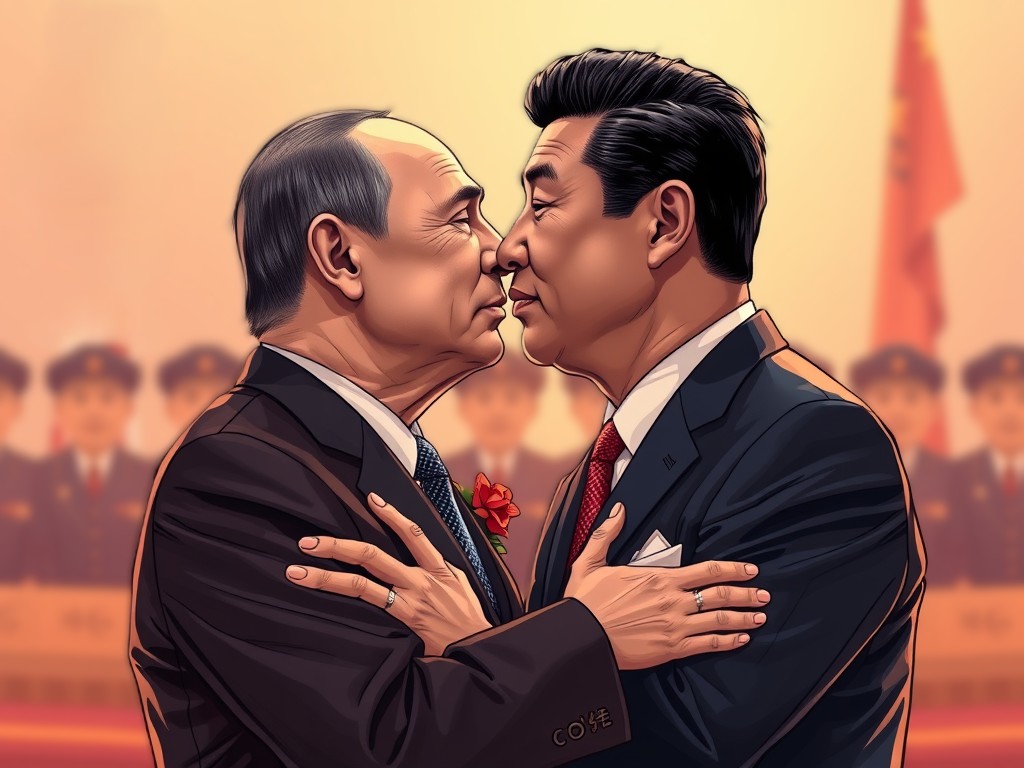
Recently, through its many machinations, the U.S. security state, at the behest and command of global US based corporations in pursuit of a lebensraum, resources, strategic dominance and hegemony (Brookings Institute morons, take a bow) has caused a crisis for Western imperialism. Recently, stupefyingly dangerous aggression coming from the Biden presidency (and now the Trump presidency) has caused China and Russia to come together in an unbreakable, unshakable, alliance of convenience. It is a natural union, resting on proximity, on geography and supply chains and trade and historical associations. The union of the Russian Federation and the People’s Republic of China is eminently logical and desirable.

BRICS is a misnomer. Really, Brazil and South Africa have little to do with the real power of that organisation and will not be a part of it in the future. BRICS would actually be called actually RICI—Russia, Iran, China, and India. The real power source is this regional Asian bloc.
Seen in this light, it is easy to understand why political earthquakes happen at the tectonic plates where Asia and Europe collide. In other words, in the Levant and in Western Ukraine. Because, of course, Europe and the USA will also need to fuse together in their oncoming adversity in turn, and the Americas, North and South, will also have to create a closer union and integrate more into Western corporate capitalism so that coporate centre can survive in opposition to RICI. Brazil will be seduced, persuaded, forced to enter into a stronger alliance with the Western Hemisphere bloc and to join with it.
Now, this is not to say that somehow, predictably, the world will be divided into two warring camps. On the contrary, global integration proceeds apace, catalysed by technology. Capitalism has its contradictions—naturally, it will need to be slapped down and managed in a future Bonapartist West.
But what all this does actually mean is that, in the short to medium to long term, there will be no romantic rapprochement between the “nation” of the USA (a corporate agglutination of power) and the Russian Federation.
The dreams of friendship between the agglutinated, corporate-controlled entity with flags called the USA and the mixed economies of Asia in close regional association in the form of a self-sufficient Eurasian superbloc, are childish pipe dreams—which is, of course, not to say that individuals in the Russian Federation won’t be capable of making friends friends with individuals in the USA.
Reading
Snyder, T. (2010). Bloodlands: Europe Between Hitler and Stalin. Basic Books.
(Documents OUN-B’s role in Holocaust atrocities)
Lower, W. (2005). Nazi Empire-Building and the Holocaust in Ukraine. UNC Press.
(Details SS-Galicia Division recruitment)
Rossoliński-Liebe, G. (2014). Stepan Bandera: The Life and Afterlife of a Ukrainian Nationalist. Ibidem Press.
(Examines OUN’s fascist ideology)
CIA FOIA files on Project AERODYNAMIC:
CIA’s declassified OUN files
Smele, J. (2015). *The “Russian” Civil Wars 1916-1926*. Hurst & Co.
(Lists all interventionist forces)
Declassified British Cabinet Memos (1919):
UK National Archives CAB/23/9
(Shows Churchill’s anti-Bolshevik plans)
Weinberg, B. (2000). Homage to Chiapas. Verso.
(Traces US counterinsurgency links)
Declassified NSA memo (1994):
NSA FOIA files on Chiapas
Kolhatkar, S. (2002). Bleeding Afghanistan. Seven Stories Press.
(Documents CIA funding of rural elites)
Soviet Archives (1980s):
Russian State Library collections
(Land reform records pre-1979)
Dorril, S. (2002). MI6: Fifty Years of Special Operations. Fourth Estate.
(Details post-WWII intelligence networks)
Snowden leaks (2013):
GCHQ-NSA joint programs
Hamann, B. (1999). Hitler’s Vienna. Oxford University Press.
(Hitler’s anti-Habsburg radicalization)
Habsburg Census (1910):
Austrian National Library
(Ethnic breakdown proving “mongrel” claim)
Feldman, G. (1993). The Great Disorder. Oxford University Press.
(Corporate profiteering during inflation)
Weimar Police Reports (1923):
Bundesarchiv Berlin
(Crime/suicide statistics)
Lukin, A. (2018). China and Russia: The New Rapprochement. Polity.
(Energy/military integration)SCO Summit Texts (2022):
sectsco.org
(Official joint statements)
Phil Hall was born into an ANC family in South Africa. The family was forced into exile in 1963 after his mother was imprisoned and his father banned. They relocated to East Africa, where his parents continued their activism and journalism. In 1975, after a period living in India, they journeyed overland back to the UK, eventually settling in Brighton.
Phil pursued a broad education, studying Russian, Spanish, politics, economics, literature, linguistics, and English grammar and phonology. His path led him to live and study in the USSR, in Ukraine, and later in Mexico, where he married and started a family. Over the next decade, Phil and his partner balanced activism with work before relocating to the UK—a move initially intended to be permanent.
However, professional opportunities took him to Saudi Arabia and then the UAE, where he spent ten years before returning to the UK during the COVID-19 pandemic. Back in Britain, he founded Ars Notoria Magazine and, alongside fellow humane socialist Paul Halas, launched AN Editions, a small venture dedicated to publishing thoughtful, progressive and exciting new books.
Discover more from Ars Notoria
Subscribe to get the latest posts sent to your email.

You must be logged in to post a comment.