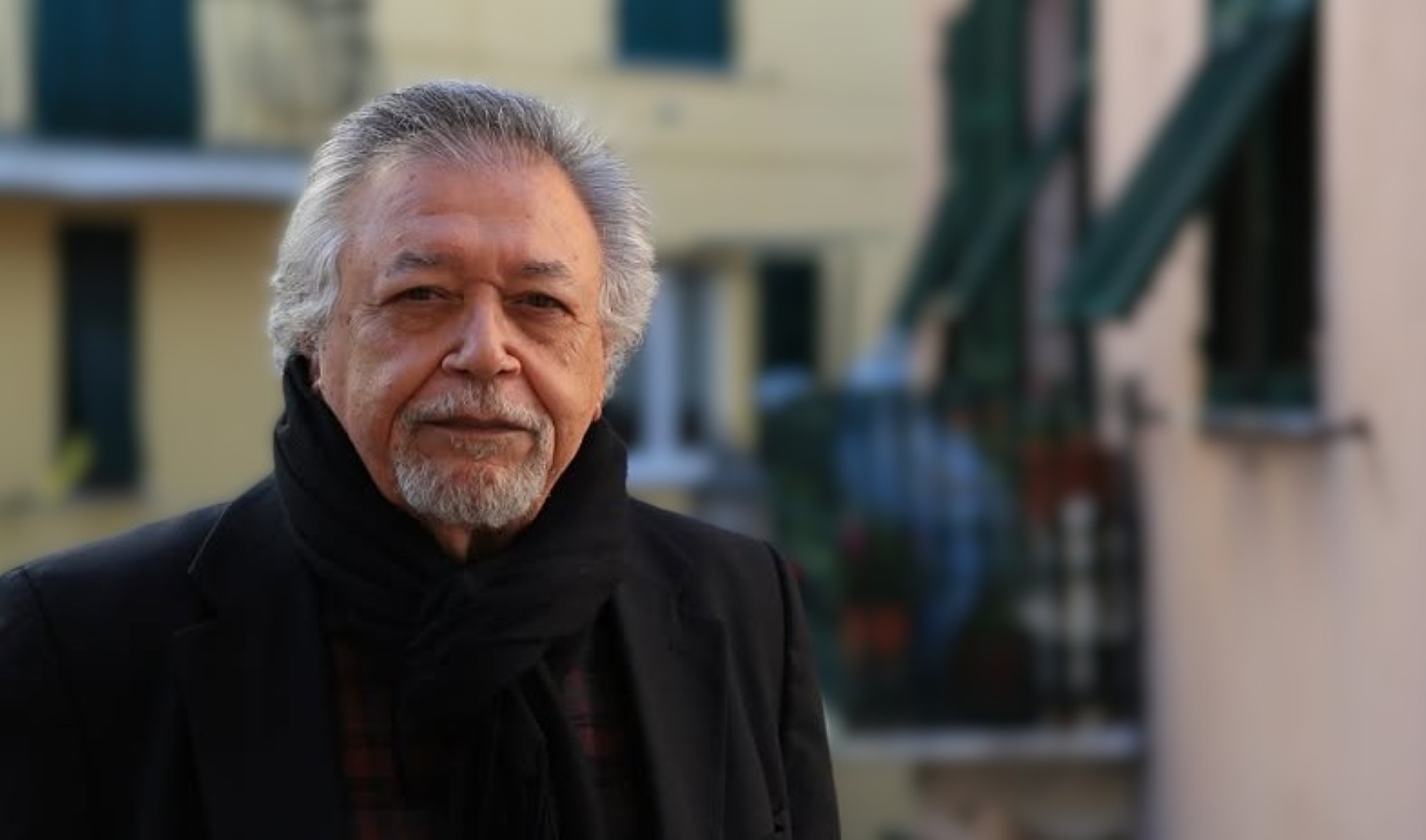
José Pulido, photo José Pulido
Quinto Coloquio Internacional de Poesía & Filosofía
The International Colloquium of Poetry and Philosophy is the brainchild of the Mexican poet and writer Ulises Paniagua. Taking part in the fifth iteration of the colloquium, Jose Pulido, the renowned and universally revered Venezuelan poet read out several of his poems and was interviewed by the Mexican poet Gustavo Alatorre.
CĂRTĂRESCU HAS A PENCIL AND A CAT
Grandmothers weave gentle loves for cats
Grandmothers die and leave the furniture of yesterday empty
Cats chase after angels, eager to leap
onto their wings—sometimes they jump, and it’s a truck
Angels show a preference
for Romanian poetry and jot down in their notebooks
the names of poets and their poems
Mircea Cărtărescu is a doubt turned to light
he has seven eternal lives in poetry
and will only vanish if the angel who gifted him
his first pencil
takes a school eraser and wipes him from the notebook
Phrases with magnetism and transparency
are drawn to his heart
poetry spills from his mouth like a breath
of mirages
because imagination flows through his body
like blood
and perhaps they share the same origin
I speak of the poet Mircea Cărtărescu
whom I would have liked to call brother
From side to side, dotted with small shrubs
the highway beckoned me, waving manes of rebellious grass
and I regretted scrutinising so many barren strips
of the planet I inhabited
because my eyes stumbled upon the sudden corpse
of a dead cat
fortunately, sorrow did not turn to baseness
because it made me remember Mircea Cărtărescu
for whom poetry is the most precious thing there is
it’s like a dead cat:
no one can put a price on it
Grief cut short my inner attempts
to bloom again with all due fertility
but I could pray for the cat and give thanks
for the inedible beauty of its being
GRANDMOTHER’S DRESS
If grandmother died and it’s her body
lying in the living room
who will make the gnocchi?
Grandmother would ask me to bring her
black cigarettes and a liter of grappa
she wanted to see me married and would say
“you must conquer a woman”
As if I were Alexander the Great’s army
My grandmother and I spent Fridays
drinking grappa, and she would recall
that as soon as she caught her breath from cooking
her man would hike up her skirt
and right there they’d start chasing orgasms
“My orgasms were like white tigers,”
she’d say
She had kept a dress from the seventies
that she adored and wanted to wear on her funeral day,
which had now arrived
she would show it to me whenever we got stuck
in the photo album and tell me, playful and wild:
“That was the first dress my man lifted
with great futility on his part”
On one of those days of eating and drinking, she confessed
that the bit about the man hiking up her skirt in the kitchen
was a fiction of love
and I regret saying: Grandmother, love is fiction
THE DANCER
I think I saw her dancing
Swan Lake by Pyotr Ilyich Tchaikovsky
(I like to believe I know the composer)
I think I saw her dancing, or maybe she was a film actress
one of those who only make a single movie
her poster hung in the Metro, and I walked
toward her, growing more excited by the step
but she got off at the next station
limping, wearing a wig
Later I learned she’d been in
a car accident
and I saw her again having coffee in the same place
where I pretend to be a poet every morning
I spoke to her, and she answered with crushing,
crushing sweetness
I asked if I could sit with her
and she said no
José Pulido interviewed by Gustavo Alatorre

Gustavo Alatorre: Hello, good day. Let’s begin this interview.
First, I’d like to ask: Do you have a defined concept of what poetry is? Have you managed to form your own definition through reading and writing it?
José Pulido: “All verses and all music are promises of the promised land, which does not exist.” That’s what Marina Tsvetaeva said—one of the poets I’ve read most fervently.
Like all poets, I love poetry and feel poetry. But I’ve only glimpsed some of its features; I couldn’t define it entirely—doing so would be a lie. I have a few strokes I’ve fixed for personal use, to repeat like a prayer.
Poetry is the certainty that we are more than mere vessels of language—we are its creation. And poetry is the way language tries to open our eyes, but not just these eyes. Also the eyes we have in our most distant past, the eyes of the skin, the eyes of mercy, the eyes of humility, the primary eyes of dreams.
The poem itself—the one that contains a sounding light, the one that succeeds in piercing blindness and deafness—is a prayer directed at the spirit. At every spirit. The first spirit it touches, the one it crosses like a bridge, is the poet’s own. Then it touches the spirit of whoever reads or hears it. I’m speaking of the poem. The poem is one thing; poetry is another. When the poet asks the poem, “What do you want from me?” and the poem answers, “What you haven’t been able to say,” then the mystery occurs. And what we call poetry happens.
GA: Was this conception different at some point? That is, did you have a different view of poetry at another time in your life?
JP: At every stage of my existence, the only thing that has remained intact is my love for poetry, because it’s my way of living in time and among people. The process of changing, of growing in sensitivity and experience, in reading and sincerity, makes poetry grateful and draws it a little closer to you. Like everyone, I started with clichés and sentimentality, and I’ve come to recognise that poetry’s first demand—to allow you to love it—is that you achieve the most authentic humility possible.
JP: Do you believe there’s a deep, close relationship between poetry and philosophy, or do you think they have no connection?
I think philosophy seeks truth with the mind and investigation, while poetry does so with imagination and language. Both seek truth. In any case, language—as the origin of the placenta that shapes man into a different kind of animal—unites us at times and divides us at others. But without philosophy, poetry would have a weakness, and without poetry, philosophy would never reach that space between the mind and the chest—the space we’ve long called the heart.
GA: Do you think there are poets you’ve read who achieve a genuine philosophical proposition in their texts? How do they do it?
JP: I believe great poets contain philosophical paths, philosophical allusions—like Hölderlin, a poet who sailed in philosophy. Martin Heidegger noted this with magnificent precision and wisdom, concluding briefly:
“Poetry is not an ornament accompanying human existence, nor just a fleeting exaltation or excitement and amusement. Poetry is the foundation that supports history, and therefore it is not merely a manifestation of culture, let alone the mere ‘expression’ of the soul of culture.”
Rainer Maria Rilke, a pinnacle of poetry, is also one of philosophy if you pay attention to his Duino Elegies.
GA: Do you think there are philosophers you’ve studied who achieve a poetic quality in some of their paragraphs or ideas? In what way?
JP: Some philosophers’ great sin is not knowing how to use written language, but most contain rhythms and music borrowed by poetry—because it’s impossible to make comparisons without resorting, even lightly, to metaphor. Just as I believe James Joyce was more poet than storyteller (an incredible poet), I also think Ludwig Wittgenstein’s Tractatus Logico-Philosophicus overflows with so much poetry that perhaps that’s why it confuses those who try to approach it coldly.
Friedrich Nietzsche is an example of a philosopher who, in his most difficult moments, discovered the poetic fuel driving him. His Dionysian Dithyrambs are a good example:
“You who see man as both god and sheep—
to tear the god in man
as you tear the sheep in man, and laughing as you tear—
that, that is your happiness! A leopard’s and eagle’s happiness,
a madman’s and poet’s happiness!”
GA: Do you think poetry exists beyond words, or is it exclusively a written matter?
JP: If it were only written, there would be no Shakespeare, Joyce, Rilke, Homer, Dante, Akhmatova, Anne Carson, John Ashbery, Rimbaud—an endless list. When you feel and understand poetry in its essence, you discover it goes beyond words because it’s the spirit of language. I think immersing yourself in Rilke would be enough to prove it. Poetry is, at times, a magical simplicity and a simplicity in magic.
And suddenly, it vanishes into its quantum thing. That’s when I’m amazed at how ignorant I am. And I want to keep searching for it, to catch a glimpse.
GA: How do you see the current state of the world, and what does the future look like for your loved ones and the planet, in your eyes?
JP: Very cruel powers have consolidated their domination over the world, and the enormous population revels in ignorance, in the pursuit of spectacle and appearances. People prefer to seem rather than to be. Hatred is manufactured. People want to blame something or someone for their misfortunes or daily stumbles. And those seeking power take advantage of that. We Venezuelans have fallen under an international dictatorship that has kept other nations under its boot and enjoys sympathy from many first-world countries. I’ll keep saying it: ideologies are more negative than positive—they’re an infection of the soul that spreads until it achieves new forms of slavery. We’re screwed.
GA: Do you think poets and philosophers should contribute to building a better future—not out of obligation, necessarily—or do they have no relation to that? If the answer is yes, how can they do it?
JP: As long as self-serving lies persist, as long as opinion matrices are crafted over years to keep people from deeper thought, intellectual activity—the creation of concepts or ideas—won’t do much. What I mean is that neither philosophy nor poetry should serve anyone. Only by dismantling lies that entrench ignorance could anything change. People skim when they read and hear what they want to hear. How do you change stagnant mindsets if you can’t break that vicious cycle, that circumstance? If a philosopher or poet only wants recognition, prominence, a name, a career of supposed successes—what could they change? Philosophy and poetry aren’t for that. A philosopher and a poet are nothing if they don’t give themselves authentically to their craft.
GA: In your opinion, do poetry and philosophy intersect in everyday life? If so, how?
JP: Seeking truths, discovering how many realities exist, understanding that imagination is a precious instrument—these are things human beings aspire to do daily, often without realizing it. Philosophy and poetry do this as a compulsory, conscious task, an existential objective. Every time someone asks a question, they invoke philosophy. Every time someone feels something they’ve never felt, they invoke poetry.
GA: Would you like to share a poetic or philosophical message for the near future? Thank you very much.
Listen, you who are born or about to be born:
you must learn to need what doesn’t seem necessary.
José Pulido Venezuelan poet, writer, and journalist, born in 1945. Currently residing in Genoa, Italy. He is a member of the Venezuelan Academy of the Language and the National College of Journalists of Venezuela. From 1999 to 2012, he served as deputy director of BCV Cultural, the cultural magazine of the Central Bank of Venezuela.
In 1989, José Pulido won the Second Miguel Otero Silva Novel Prize from Editorial Planeta. In 2000, he received the Municipal Poetry Prize for his collection Los Poseídos (The Possessed). In September 2022, he was awarded an Honorable Mention in the First International Sor Juana Inés de la Cruz Poetry Prize, and in 2024, he received the International Excellence Award “Ciudad del Galateo – Antonio De Ferrariis” in its 11th edition (Milan, Italy). He has published nine poetry collections and nine novels.
Gustavo Alatorre (Mexico City, 1979) is a poet, essayist, and professor at the National Autonomous University of Mexico (UNAM). He has published five poetry collections, including his most recent work, Breve Zoología Fantástica de Animales que Arden (Brief Fantastic Zoology of Burning Animals, Beyond Dimensions, U.S.-Mexico, 2023). His literary awards include the UNAM’s Premio Universitario de Poesía Décima Muerte (2005 and 2012), first prize at the Juegos Florales Universitarios (Autonomous University of San Luis Potosí, 2008), first place in the Campeón de Campeones poetry tournament Adversario en el Cuadrilátero (2016), and second prize in the Punto de Partida Literary Essay Contest (2015), among others. He directs and coordinates the National Poetry Gathering Max Rojas CDMX.
Discover more from Ars Notoria
Subscribe to get the latest posts sent to your email.

You must be logged in to post a comment.