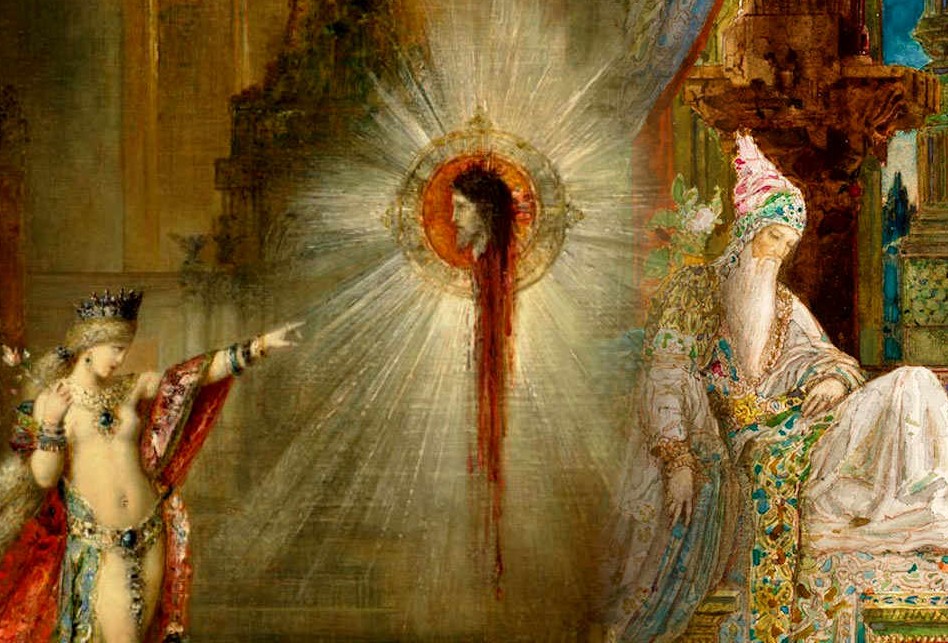
Detail from Gustave Moreau, The Apparition (1876)
From Desert Scrolls to Modern Cults
by Phil Hall
Religions often begin with a core, a simple idea that becomes complicated as it unfolds through history. The art historian Kenneth Clark once observed that Islam was the simplest of the great religions invented by man.
But what happens to that initial, clear insight? It grows and expands, much like the parable of the mustard seed that Jesus used: “The kingdom of heaven is like a mustard seed, which a man took and planted in his field. Though it is the smallest of all seeds, yet when it grows, it is the largest of garden plants and becomes a tree, so that the birds come and perch in its branches.”
Simpler even than the basic idea of Islam, the Shahada (مُحَمَّدٌ رَسُولُ ٱللَّٰهِ لَا إِلَٰهَ إِلَّا ٱللَّٰهُ) is the dualism of Gnosticism, the primary source of which, is the Nag Hammadi Library, a collection of Coptic manuscripts from the 3rd–4th centuries CE.
To the theologians living in Upper Egypt (which is nearer to Sudan) living in the material world is not about experiencing the sacredness of God’s creation, but to exist entrapped in a matrix of matter; a prison, created by a flawed and evil demiurge, controlled by Archons. The divine Sophic spark of “True Self” is separated from the whole and trapped in bits within material existence. Salvation is achieved not by faith or good works, but through secret knowledge (gnosis) that saves.

The root of religions are simple ideas made complicated through argumentation and justification. What happens to the initial clear insight?
The most influential text of Gnosticism is the Apocryphon of John, which outlines the classic Gnostic creation myth about the unknowable Monad, the fall of Sophia, the creation of the flawed material world by the demiurge Yaldabaoth, and the possibility of saving the divine spark through gnosis acquired through the Logos, the Word of God.
The origins of Gnosticism come from the desert, 35 miles from Thebes, the capital where Akhenaton grew up and became Pharaoh. The dryness of the air preserved the fragile Gnostic Nag Hamadi papyrus scrolls in their leather cases.
For the people of the desert, water was the singular source of life. In the desert, a body does not decompose into loamy soil; it dries to bones and releases all its water. Stark desert reality forged the metaphors of Gnosticism and the Bible.
Does water evaporate? So, does the soul! And where does it go? Into the sky? And so does the soul! The Gnostic tradition sees the Earth as a place of waiting, a painful interval. And so, to the logic of our more poetically-minded, short-lived ancestors it was obvious that water eventually turned into light – and that this change was a hidden, and liberatory clue.
Light is the only pure, unsullied substance, because, even as water gets dirty, in the logic of analogical thinking, when water evaporates it becomes light, and irreproachably pure.
And hence the behaviour of John the Baptist, who stayed up all night preaching and dunking people in the water, and with the dawn light, the water accelerated its evaporating—that was the essential visceral lesson of the baptism: the liquid life of the soul within sublimates. John’s baptisms were a powerful symbol of the soul’s rehydration in preparation for departure.

In the north, in contrast, the imagination of the people was surrounded by trees. The young, in their health and intelligence, told stories in the autumn afternoons and imagined a continuation of roots and growth downwards, and evergreen wreathed in mistletoe, stretching skywards.
This connection of the old pagans to the green is profound; trees were not just living things but gates to the otherworld. The Welsh poem The Battle of the Trees (Cad Goddeu) describes a magical army of trees led into battle, linking between the natural and spiritual. In England, great trees may grow out of graves.
The brightness of the desert, where the sun doesn’t disappear behind clouds but, instead, burns relentlessly, produced religions where the contrast was dialled right up, not hidden in fog and drizzle. It was this, the Egyptian desert and civilisation, that gave rise to the Gnostic tradition. The irradiated language of the scrolls took on on the patterns of the desert and seeds grew when they were in irrigated soil. Strong metaphors gave rise to radical conclusions. In Upper Egypt water is precious. In the day, the sun is obvious, singular, omnipresent, omnipotent.
Environment shapes perception, and perception extends into language. The Whorfian hypothesis, often debunked but always referenced, claims that Inuit have a multitude of words for snow allowing them to perceive a different world that is contingent on their experience. Saharan Arabic has more than twenty words for sand.

Water evaporates, like the soul! The earth is not always a fertile home but sometimes unattractively dusty. In heaven the waters flow through gardens full of flowers, producing honey and milk, but they didn’t in Nag Hamadi. The worldview of the 3rd century Egyptian Gnostics reveals their deep embitterment, and suspicion of the material world – including hatred of the female body, which was thought of by the Gnostics as a trap set for the divine spirit.
Earlier religions of the desert celebrated the female: Isis and Ishtar, the fertile Alia, Hathor and Bastet, Sekhmet and Nut. But Gnostic texts like the Testimony of Truth from the Nag Hammadi library explicitly blame women for bringing death into the world, stating: “The woman is the one who initiated sexual intercourse… she is the one who led astray the one who was not going to sin.” The technical term for Eve’s original sin is metempsychosis, Eve as the conduit into the world.
It is interesting that Northern fertility cults (Norse Freyja, Celtic Dana) sacralised menstruation, while the desert patriarchies made menstruation taboo; the desert patriarchy tied female biology to leaky, corrupt worldliness and matter.
The woman-hating impulse was part of a broader dualism, a counter-intuitive Gnostic path born from the philosophical failure to reconcile a world of both goodness and suffering. The Logos could explain a lot, but not why the inexplicably good was God or the inexplicably bad was the devil.
And you may argue that Christianity is different to Gnosticism and celebrates life and God’s creation, and yet the inner core of the Christian tradition, the tradition of the Christian initiates who live in communities together and who constantly perform esoteric rituals night and day, produces no new life. These religious insiders are celibate. Benedictines take the vow, the conversatio morum. Monasteries; seminaries and nunneries are not supposed to be baby factories, they are biological dead ends.

This is the Gnostic tradition preserved, the idea that sex is impure and a form of entrapment. But if God’s creation were so wonderful according to Christianity, how can people be ‘entrapped’ into it? Clearly, the Gnostic, masculine tradition of the inner core of the religious cabal at the centre is not the same finger wagging philosophy that is expounded to uninitiated parishioners.
The celibate, symbol using, inner-focused core of some Christian churches resembles that of a secret Gnostic tradition; where ‘life’ is a code word for the ‘life of the spirit’. Ordinary people are told to avoid birth control and produce children and what ordinary people do has nothing to do with that great murmuring and rustling of ermine under stone.
Christianity’s, concept of the soul is a hybrid of the Platonic and the Gnostic. To the east the Orthodox is more influenced by Gnosticism.
It is natural, then, that people from the damp, fertile north of Europe might initially have found the Bible’s alienating, desert-born metaphors difficult and deracinating. Still, Christianity wins out wherever it goes because it is compelling narrative of wisdom, victimhood, redemption and impossible hope, and crucially, it served the purposes of the slave owning Roman emperors, and subsequently, of the feudal lords and kings of the Middle Ages.
The aristocracy adopted the Gnostic Christianity’s religion of the sun because it could be used to justify hierarchy, despite the fact that the hero was a humble carpenter—Christianity was used to justify the power of ‘divinely appointed’ kings, and their courts, standing in for God and his angels— a core symbol of Christian Gnosticism and the torment of the flesh, the crown of thorns, was turned, mockingly, into gold and topped with jewel encrusted crosses and spikes.
The worst and most dangerous aspect of the core Gnostic tradition, is its unfalsifiability. The claim of Gnosticism is that the material world is an illusion and that makes any belief system based on Gnosticism immune to disproof; Gnosticism is arrogantly dismissive of empiricism and science and works for rapture.
Any counter-evidence to assertions about an inner reality and a hidden truth that goes against the Gnostic tradition can be dismissed as part of the deception. Gnosticism is the perfect religious attitude of the charlatan and the cult leader. For a Gnostic, ancient or modern, there is a war being conducted between the material, unenlightened self and the hidden, divine “True Self.”. “Secret knowledge” creates a hierarchy, with the leader as the sole dispenser, fostering a dependency reliant on blind faith and self-delusion.

The rejection of material reality goes along with the rejection of science and all that civilisational knowledge derived from hard work, scholarship and common sense, because, according to the Gnostic cultist, all this research is research into the corrupt material world.
The Gnostic framework is a blueprint for religious con artists. It provides a simple, radical, and potentially lucrative explanation for a world in conflict and chaos, where the price of spiritual peace is submission to a religious master, possibly the purple track-suited son of God. Only he will explain and show you the way out.
Gnostics, old and new, might guide you across sand dunes to a a spiritual oasis, a riverbank, but they won’t be quite as adept at leading you through a trackless temperate forest to a clearing, a glade.
Phil Hall was born in South Africa into an ANC family with British, French, Austrian, and German roots. After his parents were exiled, they lived in East Africa and India before returning overland to the UK. In the UK he studied Russian and Spanish literature, politics, and economics. After graduating he specialised in descriptive and applied linguistics. Phil has lived and worked in Spain, the USSR, Mexico and the Gulf. Returning to London during the pandemic, he co-founded the Humane Socialist magazine, Ars Notoria (the Art of the Noteworthy) and the micropublisher, AN Editions.
Discover more from Ars Notoria
Subscribe to get the latest posts sent to your email.
You must be logged in to post a comment.