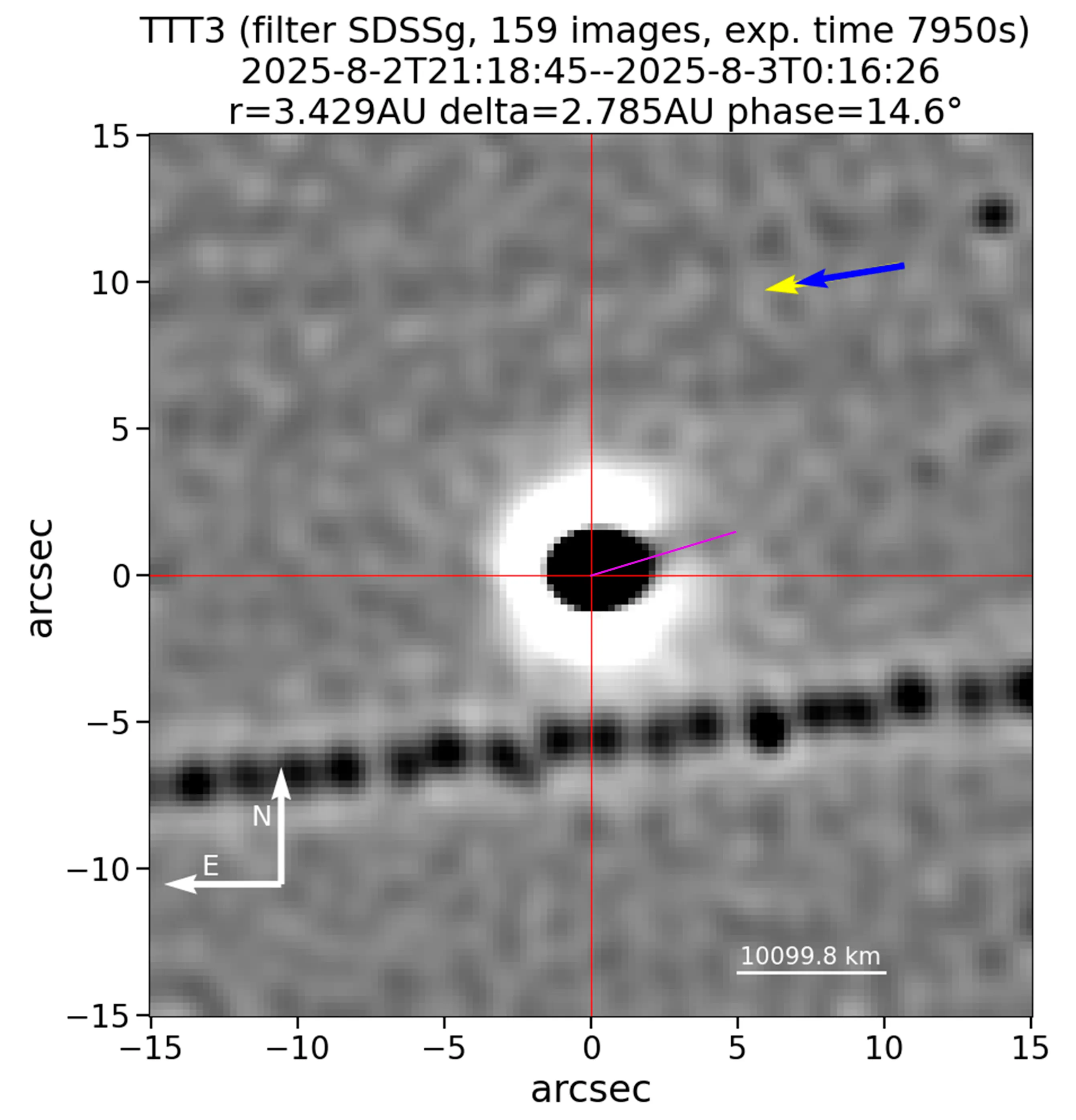
Cited from A. Loeb: 3I/ATLAS from the Two-meter Twin Telescope in the Canary Islands, August 2, 2025. It shows a faint jet pointed towards the Sun, extending out to a projected distance of about 6,000 kilometers from the nucleus, The direction away from the Sun (where a generic cometary tail should have pointed), is shown in yellow. (Credit: M. Serra-Ricart et al., October 15, 2025)
An Alien Intervention in the Face of Human Crisis?
by Phil Hall
Is the perihelion of 3I Atlas a precipitant alien intervention in the face of human crisis. I’d like to explore the hypothesis that the arrival of the unidentified interstellar object designated 3I Atlas, and its anticipated perihelion on 29 October 2025, in the spirit of H.G. Well’s futurism. One of the purposes of this kind of futurism is to prepare humanity for the possibility of Black Swan events. In other words, to wake people up from the fallacy of inductive reasoning. If all the swans I have seen until now are white, then all swans are white—until along comes a black swan.
In the event that 3I Atlas turns out to be an alien mothercraft, then my view is that this represents a calculated intervention by an extraterrestrial civilisation. Using humanity’s own historical trajectory and potential future as a model, we can project the likely behaviours and motivations of a more advanced intelligence. My argument is that, if 3I Atlas turns out to be an alien mothership, this is not a first contact, but the overt culmination of a long-term monitoring process. The timing of this event is analysed as a precipitous response to an imminent, existential crisis within human civilisation—specifically, the heightened and escalating risk of global nuclear conflict. The appearance of the mothercraft is interpreted as a strategic signal, intended to alter humanity’s self-destructive course.

H.G. Wells. photograph George Charles Beresford, 1920
The Fermi Paradox—”Where is everyone?”—logically suggests that a galaxy old enough to host advanced civilisations should already be colonised. The silence, therefore, implies that such civilisations, if they exist, are either undetectable or operate using a stealthy strategy we do not yet understand. I suggest aliens are present, but stealthy, and that the recent, scheduled appearance of 3I Atlas is a direct function of human self-endangerment.
To understand a potential alien intent, we must use the only model of technological civilisation we have: our own. This is not mere anthropomorphism, but a necessary exercise in projecting plausible motives and capabilities. I term this analytical framework “allo-morphizing” (from the Greek allos, meaning “other”)—the act of attributing relatable motives, drives, and logical processes to a non-human intelligence based on the observable patterns of advanced, tool-using societies.
Let’s take human development as a template for development. Humanity’s developmental timeline provides the only plausible blueprint for any space-faring species we can use:
~300,000 years ago: Anatomically modern humans reach their current form.
~60,000 years ago: humans reach every part of the planet except for Antarctica.
~7,000 to 5,000 years ago: Flourishing of the first large, settled communities like Çatalhüyük.
~5,000 3,000 years ago: The dawn of civilisation, with coordinated systems in technology, building and agriculture, leading to shared worldviews and massive constructions in places like China, Mexico, and the Middle East.
~3,000 years ago: Development of rigorous systems of governance, mathematics, and philosophy.
The Axial Age (~600-400 BCE): Emergence of foundational, world-spanning religious and philosophical systems (Buddhism, Zoroastrianism, Greek philosophy, the compilation of the Hebrew Bible).
400 to 150 years ago: the enlightenment, the consolidation of modern science, industrialisation and the beginning of capitalism.
The current era: The rocky evolution of capitalism and experiments with socialism, culminating in information technology, space travel, global communications, and the manipulation of life itself (genetics) and matter (atomic weapons).
This trajectory from a biological and social origins living in a subsistence economy, to a technologically saturated, globally connected, yet crisis-prone human civilisation is likely a universal pattern. An older civilisation would have passed through similar stages.

A high point of human civilisation, Interior of the Haga Sophia. Photograph by Tuğba on Pexels.com
A civilisation considering an interstellar voyage to a world with a developing technological civilisation would never embark without good, detailed information. The journey is too vast, the resources too great, and the cargo (whether biological or technological) too precious. Their process would mirror our own planned steps:
Remote Sensing: Using telescopes far superior to the James Webb Space Telescope to identify habitable planets, seeking both biological and technological signatures.
Dispatching Probes: Sending automated, AI-driven Von Neumann probes to establish a permanent, stealthy monitoring system within the target solar system.
Data Relay and Analysis: Information, including our electronic communications and historical development, would be relayed back and analysed. A decision to build and dispatch a mothercraft like 3I Atlas would be made with a near-complete understanding of our world.
This means that by the time 3I Atlas was launched, its creators possessed a comprehensive record of human history, likely more detailed than our own. They would have witnessed our wars, our art, our philosophies, and our repeated brushes with catastrophe.
At almost the exact same time as we observe 3I Atlas slipping behind the sun, evidence suggests the surmise may very well be correct. Adding rigorous, academic weight to the argument for long-term, non-human surveillance, astrophysicist Beatriz Villarroel and her team have published peer-reviewed papers, detailing the VASCO project. This research investigates the appearance and disappearance of seemingly star-like objects in historical sky surveys, objects arranged in linear formations; potential satellite-like objects in geostationary orbit in images from the 1950s—a time before any human-made object could have been there.
The Intervention Hypothesis: Why the Perihelion of 2025?

The M57A1 Army Tactical Missile System missile. U.S. Army photograph, public domain
The precise orbital mechanics of 3I Atlas, culminating in a perihelion on 29 October 2025, transforms it from a passive object into an active, scheduled event. This timing is the core of the intervention hypothesis. The question is not just “why now?” but “why this specific now?”
A civilisation that has studied us for millennia would have a profound investment in our cultural and civilisational wealth. Having witnessed the rise and fall of empires and the birth of philosophies, to see this legacy on the verge of nuclear destruction would be the ultimate tragedy. The current geopolitical climate represents the closest humanity has come to self-annihilation:
The war in Ukraine, with attacks on sovereign Russian territory, sparked off in 2014, almost unleashed Armageddon ten years later in late 2024. If we assume that the closest sun-like star is Sirius A, and if that were the origin of 3I Atlas (which comes from the direction of Sagittarius where Sirius A is located) and we consider the tragedy of the ongoing genocide in Gaza, fuelling global instability and we take into account the overarching and unresolved strategic competition between the United States, China, and the Russian Federation: BRICS countries, then a monitoring intelligence, with perhaps a 10-year light-speed lag on general data but real-time data from local probes, would identify the period leading to late 2025 as a window of maximum danger.
The arrival of 3I Atlas would therefore be a precipitant intervention. It would be a “circuit breaker,” an unmistakable demonstration of an alien presence that can no longer remain passive and simply watch as we destroy ourselves, intended to fundamentally alter humanity’s strategic calculus by introducing an incontrovertible, external variable.
What are the implications and the nature of possible contact? The appearance of 3I Atlas is likely just the tip of the spear—the most overt announcement of a presence that is already deeply embedded on Earth. bases in inaccessible locations (e.g., under the oceans), a pervasive surveillance network, and potential influence within our own systems are all logical precursors. This is a fait accompli; we are not in a position to defend against a technology and a presence that may already be integrated deeply into our infrastructure.

So, it is aliens after all. Photograph by Lisa on Pexels.com
But this is not a colonial expedition. A species capable of harnessing the resources of its own star system would have little need for our territory. Probably, the main “resource” they seek is the accumulated knowledge and cultural legacy of humanity itself and a productive companion civilisation. Their intervention is therefore not necessarily one of conquest, but of preservation. They are not coming in hot and heavy to destroy, but to prevent destruction.
To conclude, using humanity as a model, we can construct a plausible narrative for the arrival of 3I Atlas. It is not the beginning of a relationship, but a late-stage development in a long-standing observation. The timing of its perihelion on 29 October 2025 is precipitated by our own failure to manage the existential risks of our technological adolescence. The current global political crisis, teetering on the brink of nuclear war, provides the most compelling explanation for why a previously stealthy presence has chosen this moment to become overt. The primary motivation appears not to be invasion, but a last-minute intervention to prevent the loss of a unique and studied civilisation. The coming year is not just a countdown to a celestial event; it is a test of our species’ ability to comprehend the profound warning it represents.
Phil Hall was born into an ANC family in South Africa. The family was forced into exile in 1963 after his mother was imprisoned and his father banned. They relocated to East Africa, where his parents continued their activism and journalism. In 1975, after a period living in India, they journeyed overland back to the UK, eventually settling in Brighton.
Phil pursued a broad education, studying Russian, Spanish, politics, economics, literature, linguistics, and English grammar and phonology. His path led him to live and study in Spain, the USSR (in Ukraine), and later in Mexico, where he married and started a family. Over the next decade, Phil and his partner balanced activism with work before relocating to the UK—a move initially intended to be permanent.
However, professional opportunities took him to Saudi Arabia and then the UAE, where he spent ten years before returning to the UK during the COVID-19 pandemic. Back in Britain, he founded Ars Notoria Magazine and, alongside fellow humane socialist Paul Halas, launched AN Editions, a small venture dedicated to publishing thoughtful, progressive and exciting new books.
Discover more from Ars Notoria
Subscribe to get the latest posts sent to your email.



You must be logged in to post a comment.