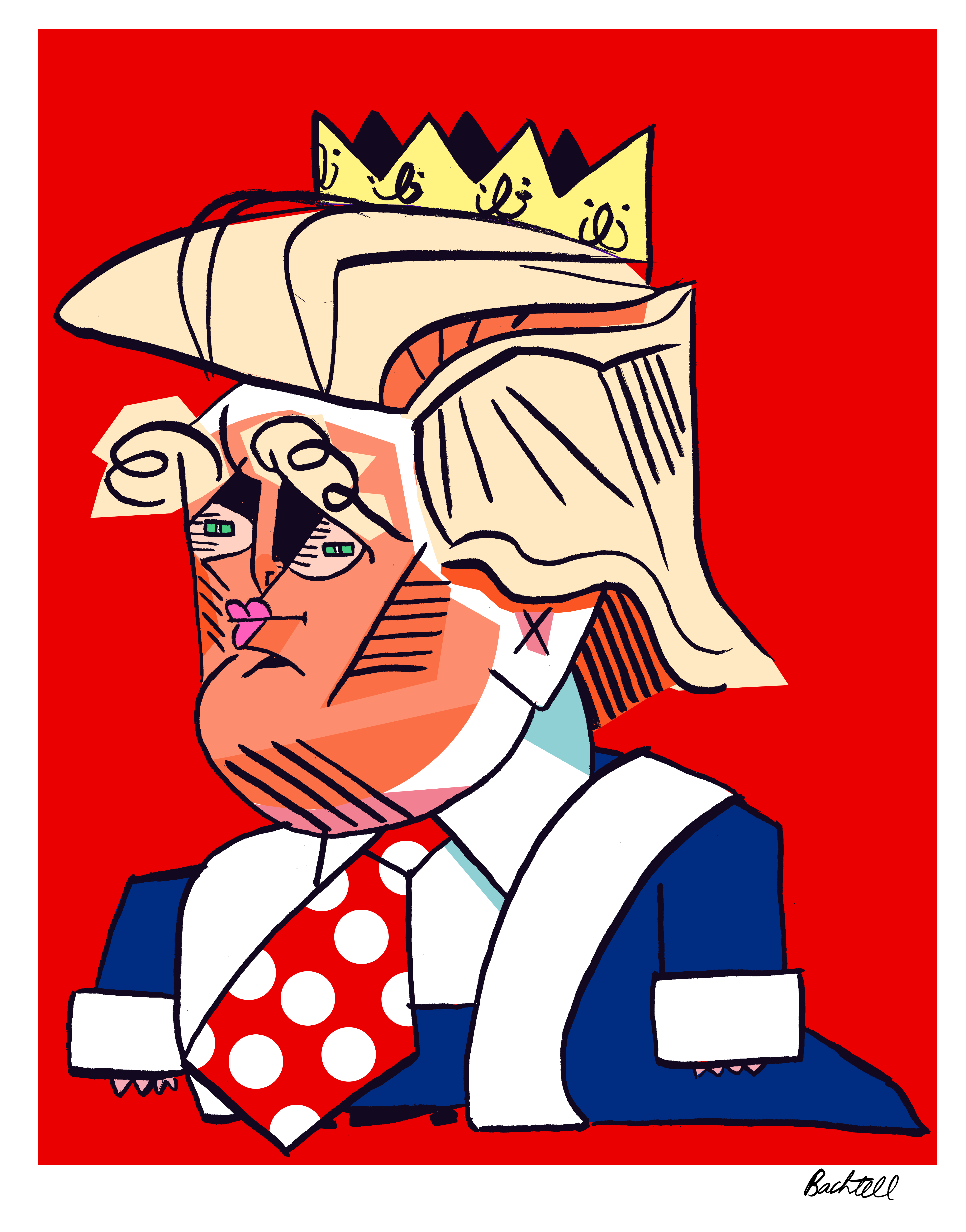
King Donald, ©Tom Bachtell
Paul Halas — interview with Halas & Hall
Anyone who has seen a copy of The New Yorker over the past thirty or so years will be familiar with the work of Tom Bachtell. He’s the guy who created so many of the wonderful caricatures that illustrate the Talk of the Town column, in a style that both reminds us of the great cartoonists of the 1930s, 40s and 50s, yet is wholly his own. It’s little wonder that he has claimed his own corner of The New Yorker’s iconography, but his illustrations have also graced a wide variety of other publications, such as Newsweek, Forbes, New York Review of Books, The New York Times, the London Evening Standard… to name just a few.

Tom Bachtell doesn’t limit himself to caricatures. He also produces stand-alone cartoons that, while executed with the typical Bachtell panache, often make a very powerful point in their own compelling way. Some are funny, some satirical, some whimsical and playful. But all show a great sense of style and design which elevates them to a form of fine art, in the tradition of such masters as Saul Steinburg, André François and Ronald Searle. Most cartoonists are to an extent self-taught, insofar as they don’t generally follow standard forms of training. You can go to college to study fine art or art history, how to animate and how to draw comics, but it’s hard to find anything on cartooning pure and simple. Perhaps that’s because as a medium it’s just too individualistic. If cartoonists absorb rules, they do so in order to break them. What is important, however, is to have a wide base of cultural knowledge, be that low or high culture. And Tom Bachtell grew up in a fertile environment. When asked about his childhood, he recounted:
“My mother was an artist, she came from a line of artists and artisans. My great uncle in Cleveland did calligraphy. There were two companies that printed and created movie posters for Hollywood, and one of them was in Cleveland. It was a lithographic company, and he did calligraphy for classic movie posters mostly. But he was an artisan. And I just remember seeing the posters that he did. So, my parents were educated, and my mum was definitely an artist and a writer. I think she had a huge influence on me.”

Paul Halas: So you grew up in a culturally rich milieu . . . ?
“That was my environment; that was what I was born into. My parents subscribed to The New Yorker, so we had collections of cartoons by Charles Addams and Peter Arno and James Thurber. In fact we had the Broadway cast album of A Thurber Carnival. And so, that was kind of my embryonic introduction. I absorbed all that. Like a lot of cartoonists, I’m self-taught. I studied a lot of cartoonists. I think many cartoonists feel, as I did, that cartooning is not a high art. It is what it is. But I think, at its finest, it can be a very fine art itself.”


Paul Halas: Looking back at some of those fabulous old New Yorker cartoons and caricatures, such as those of the Marx Brothers, Mae West, W C Fields and other stars of the 1930s, there was a style then of caricaturing for the critiques which was wonderful—and very stylized. But those simple designs didn’t simply rely on great drawing skills alone.
“Well, also those drawings were really alive. That was something I think I responded to on a visceral level.”
Paul: Your drawings have been compared to Al Hirschfield’s.
“Yes… But I remember actually being scared by his drawings. They looked like they were ‘lit’. They’re kind of a world of their own, but alive. I think that’s one of the things that has always kind of motivated me when I’m working—how to make it alive. And I realized at some point that I had the ability to make drawings live. And they certainly do.”
Paul: Do you think the desire to cartoon is somehow innate, part of being human? Like cave painting – literally oozing life. An art that transcends formal training, that’s far more immediate and visceral?

“I think so. And that was certainly the case with me. I just loved to draw, and it goes back to some of my earliest memories, especially with my mother. She would often gather my brother, sister, and me around the kitchen table, and we would draw. Those are really important primal memories for me. At some point, my parents had a chalkboard—a big chalkboard in my bedroom—and I loved drawing on it. Once, my parents had a party, and I loved seeing all these people in the house. So, I drew the party. I was probably eight years old or something, but it delighted people because I somehow captured the quality of the people there. There was a kind of satiric quality to it. And I think that is one of the great aspects of this sort of innate talent that you’re talking about—the ability to observe life satirically.”
Paul: There was music going on at these parties, and music is obviously very important to you. In both your graphic art and your life in general.
“Music is a very important part of my life. I studied music and ultimately attended a conservatory. But yes, the music, the dancing, the drawing—they all kind of fit together. It took a whole lifetime for me to realize how they’re connected, but all the art forms that I’m interested in have this sort of connection with rhythm or pulse.
“And you know, I was just thinking the other day… I’m a swing dancer. It’s one of the things that I do, and I often put on swing music, like Django Reinhardt. I love Django Reinhardt. And when I’m working, I realized that at a certain point I started moving to the music. I started feeling like Fred Astaire, moving around the office. But that music for me is almost like snake charming music. I can’t help it. I become one with the music. It’s a way of tapping into the rhythms of life.”

Paul: As well as music, there’s a great sense of time and place in your drawings. A shorthand of where and when.
“They’re very strong elements. The power of those drawings to affect us that way, to give that sense of place… How do you—and how does one—capture a sense of place, time, and place? And seasons as well. The New Yorker often goes on about the jacket—when is it time to take out your jacket? That’s especially true when one looks at the covers. So, I’ve always been aware of that in art, in drawings that I admire. And I try to do it myself, but I realized that that’s part of our job in a way—to capture the moment, the place, the moment.”
Phil Hall: Those drawings can also evoke a sense of nostalgia. Even nostalgia for places one’s never known. Good art can do that.
“I feel that way too. Going back to my early childhood and seeing those drawings—all those early illustrations—and just being bowled over by them, but also feeling that it was a place I didn’t know but wanted to know. I wanted to be there. I wanted to live there.”

Paul: Not so long ago, we did a piece on the English cartoonist Andrew Birch. He brought up the question of drawing electronically—which he tried and very quickly rejected. What are your thoughts on that?
“Well, as the technology has sort of come at us, I’ve certainly thought about it. Way back when tablets first came into being, I tried it, and I hated it. One of the first things I noticed was that tablets, being digital computers, smooth everything out. And they take all the life out of the line. A big part of my work is done with brushes—different kinds of brushes. My choice of brush has always been random, purely by accident, trying new brushes out. So, there are a lot of accidents that I try to take advantage of, and mistakes… And that seems anathema to digital smoothing out. So, I tried it and very quickly reverted to pen and paper. I don’t know if Andrew Birch uses brushwork or ink, but I think the whole digital and computer streamlining has really been the death knell of animation.”
Paul: Going back many, many decades, all animation images were brush traced, involving high levels of artistry and skill.
“I agree. And when you go even further back and look at early animation or early film, even where people are just doing the best they can with the limited technology of the day, they’re creating things that are more magical than stuff done now with huge resources. They relied on imagination, and imagination is also a kind of muscle too, right? You have to exercise it. Then look at AI art, which is just… I can’t even look at it because it’s so static.”

Paul: Back to the present day, and your caricatures, which even when satirical show great generosity of spirit. We live in a strident, polarised world, yet you’re able to step back from being overly judgemental. In an earlier conversation you said that we’ve got to be able to hear everyone’s point of view. There’s a kind of temperance there. Or maybe it’s the art coming before the comment?
“Good questions… I started working for The New Yorker really before I thought I knew what I was doing. And so I really had to learn the craft of caricature. When I translate people into line, I think what I’m doing is trying to make observations about them. And then my mind somehow fabricates or synthesizes lines that suggest what I’ve observed. And I came to the theory that as long as everything I put into a drawing is true, it’s going to look like the person. So that actually allows me a lot of freedom to break up the drawing and make it more abstract because the elements are still true. I don’t know if that makes sense.”
Paul: Perfectly. Many caricaturists succeed by simply focussing on the grotesque, and by doing so they reduce their subjects to mere objects. But you go far further than that. There’s something of the subject’s personality that always shines through.

“I try to get that. A huge part of my work is the sketch process—the studying. I do a gazillion sketches of people, and a lot of them don’t work, but maybe one little part of it does work. I really try to capture something. So, it’s an act of recognition, and when we look at the pictures, we then share in that act of recognition. I think that’s part of what happens, and that’s kind of magical, really. And some of it’s kind of inexplicable, that process. But to the extent that I can, I’m so grateful that I’ve been able to tap into it. I often have an internal argument with myself when I’m looking at people and thinking about them. I try to be careful not to project too much because part of the looking and studying at people is deciding how I feel about them—whether I like them or don’t like them or what. So, I try to be careful. I think some of this came about because of The New Yorker work. I had to be careful not to project too much or contradict the tone of a piece I was illustrating.”
Paul: Tone is interesting, because in The New Yorker it’s something that’s changed a lot over the years. If one goes back a number of years many of the attitudes we considered quite normal would horrify us; attitudes that (hopefully) have been consigned to history. Take the work of Peter Arno, one of The New Yorker’s greats, his work now looks so sexist. We’re no longer comfortable with all the sexism, racism and classism of yesteryear. While your work can be happily exonerated from all those charges, there has been an evolution in sensibilities, even if the pace has been pedestrian.

“The magazine is still very cautious. And a lot of that sort of rubbed off on me. But I think that where Donald Trump in particular is concerned… well, often I’ve noticed I struggle with how to draw somebody who is so awful—a combination of grotesquely funny and truly awful. Often, you see drawings where people just try to draw him as horribly as they can, and it kind of loses its effect. It’s too easy, isn’t it? That’s probably why they go for it. But how do you convey that? I think he is one person where I will sometimes really go for the jugular and project.”
Phil: You must understand him far better perhaps than we non-Americans do. For us, the hair, the style, the accent… He’s a New Yorker. He was in Studio 54, he’s brash, confrontational, egotistical, and frankly frightening. Does he not cause a sort of chemical reaction in many people? One would think they’re so embarrassed that he’s projecting this unsophisticated, chintzy, kitschy view of Americans abroad, that makes them cringe internally.
“That’s true of some people. But others embrace him precisely for those reasons. I think when Donald Trump first came on the scene a lot of my New York friends just said, ‘The guy’s from Queens, you know,’ and whatever.”
Paul: Queens, for non-Amercians?

“Queens is one of the boroughs, and that’s where he started. It has its own sensibility. A lot of those qualities you’re talking about come from there. But I think Donald Trump is both very much of New York—I don’t think he could have been created anywhere else—and also from a certain kind of New York that a lot of New Yorkers are sort of embarrassed about. So, I think a lot of New Yorkers feel really conflicted about that.”
Paul: He has also tapped into Midwestern sensibilities, the Christian far-right, the Rust Belt… He’s managed to appeal a great swathe of them. While we find it desperately difficult to understand the phenomenon, the Trump narrative is becoming predominant.
“I just cancelled my subscription to The Washington Post, and I’m grateful that I’ve been like that. I subscribed to The Guardian, and I realized that I’m probably going to be relying more and more on The Guardian to help me see things. Because, yeah, I need that kind of outside perspective.”
Phil: But do you feel that you have to conserve a light, or a memory, or a spirit of place, a spirit…in your current America?

“In a word, yes. And I think that I’m trying really hard. This is a really hard moment for me right now, creatively. I’m trying to keep my head above water and understand the moment. But also, your question is really important because keeping that light burning… yes, this moment is crucial for artists to keep that spirit going and to connect with people and the community around us, to connect our voices. So, I’m very conscious of that.
“The other day, I did a portrait of J.B. Pritzker, the governor of Illinois, who gave a really strong speech during a budget address about the Nazis and authoritarianism. I was so grateful to hear his words that I decided it’s important to draw people who are speaking up, who are doing good things, because so many aren’t. It’s amazing how Democrats have just been so voiceless, or the opposition, I should say. It’s rare that people are able to act. So, I’m trying to figure out how I fit into all that and how I can be effective. That’s a big part of it.”
Paul: Reverting to happier subjects, no apologies for bringing up The New Yorker once more. As far as contributors are concerned, it’s a very elite club. Back when you were establishing yourself, what was it like actually to knock on the door of The New Yorker and say, ‘Would you be interested in publishing my stuff?’

“It’s actually kind of interesting. From early childhood, I somehow had this thought about The New Yorker, that I wanted it to be ‘my home’. And as you know, if it’s possible to will something into being, I feel like maybe I did. I started drawing for smaller places, and again I didn’t really know exactly what I was doing. Over the years, before they gave me jobs, I would send The New Yorker drawings, or I would go to their office and leave work, but it never amounted to anything. And then I did a drawing of Tom Wolfe that was in Advertising Age. It was around the time he wrote Bonfire of the Vanities. And again, it was kind of my crude attempt at caricature, but it worked. And I got a call from the art director of The New Yorker. Wow. Yeah. And I couldn’t believe it in a way… but I also could. I felt outside of myself during that phone call, and I just thought, ‘This is the door opening. You’ve got to go in.’ So, yeah, but it’s really funny how things like that happen. They do happen, you know. It’s like this connection. Yeah.”
Phil: A lot of magic going on with you, Tom. Magic in your drawing and magic in your life.
“Yes, and I wish that on everybody you know.”
Paul: Thank you so much, Tom. It’s been a privilege and a pleasure.
.
Paul Halas, the Arts and Lifestyle Editor of Ars Notoria and co-founder of AN Editions, is a writer of Jewish heritage whose escape from 1970s hippidom was the discovery that he could invent stories. He spent forty years contributing to various Disney magazines and books, as well as a variety of non-Disney comics, books and animated films. He has recently finished the second edition of his book The Rights of Man and Fish which was recently launched at the Chapel Market Tavern On March 6th and is working on his next book: The Sarah Chronicles. Halas is a self described Humane Socialist.
Discover more from Ars Notoria
Subscribe to get the latest posts sent to your email.

You must be logged in to post a comment.