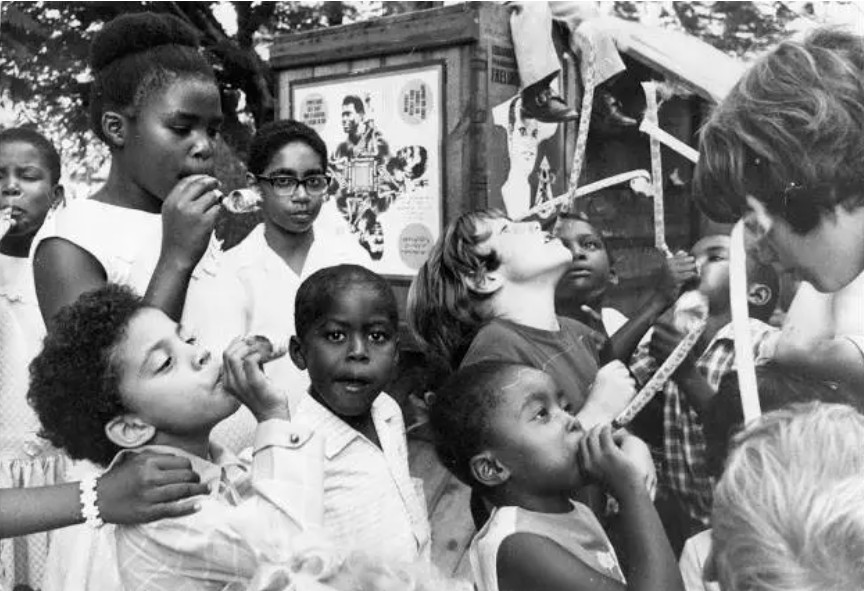
‘Blowing bubbles distracts these children from the war poster behind them.‘ Front page of the Tanzania Standard, June 1971.
Dar-es-Salaam 1971-72
by Philip Hall
At twelve, I was bespectacled and precocious and political, living with my family in Upanga, Dar-es-Salaam. A towering kungu tree stood outside our house. It was 1971–72, and my parents were deeply engaged in the anti-colonial and revolutionary upheavals of the time. We had left England in disgust, and my father had taken a job at The Standard, Tanzania’s new socialist newspaper, edited by Frene Ginwala. Mom worked at the ANC as the editor of the Voice of Women.

Our flat had previously been occupied by Agostinho Neto and his family, head of Angola’s MPLA. In the evenings, our small lounge became a gathering place for liberation leaders—figures like Marcelino dos Santos, FRELIMO’s vice president, and senior ANC comrades. I would sit quietly, listening intently to their discussions.
This was the era of the Vietnam War, a daily reminder of U.S. foreign policy’s brutality, alongside the entrenchment of South African apartheid and the dictatorships in Portugal and Spain. The geopolitical lines seemed stark. The U.S., Britain, France, and Germany routinely blocked U.N. motions against apartheid while pouring investment into South Africa as an anti-communist bulwark. Their intelligence services collaborated with South African and Rhodesian operatives to assassinate and imprison African leaders fighting for liberation. Even Nelson Mandela’s arrest had been facilitated by a CIA informant, Gerard Ludi.

Dar es Salaam’s port welcomed pale blue Chinese cargo ships, and those who could afford them rode gleaming Chinese bicycles. Shops sold China Reconstructs, its pages filled with graphic images of surgeries performed under acupuncture anaesthesia—patients smiling serenely as doctors, their gloves slick with blood, removed appendices behind green surgical drapes.
Looking back, I cringe at how I interjected into these weighty discussions, but forgive myself because I was only 12. Out of respect for my parents, these seasoned revolutionaries would humour me, nodding gravely before offering an earnest reply. I did my best not to embarrass my family. We wore Tanzanian patterned shirts and attended the International School.

One memorable figure was Hank, a charismatic Texan friend of my parents. He once substituted for a teacher—a modern-day Tarantino cowboy, but a genuine hero, not some thug. Lean, in jeans and boots, he announced: “Well, kids, I’m supposed to teach geography, but I’m not gonna. Instead, I’ll tell you how the U.S. stole Texas from Mexico.” And he did. He also teased us for our colonial Kenyan accents.
Once, while babysitting, he made me cook him a fillet steak with peppercorns and garlic—then refused to share it, leaving my siblings and me with only bread. “I’m teaching you what it’s like to be poor,” he said. My parents later told me he spent 30 years teaching in Khartoum, enduring civil war and hardship. (I later learned, while working in Saudi Arabia, that he eventually returned to the U.S. for a PhD.)
Politically, I felt like Thérèse de Lisieux, ready to immolate myself on the pyre of revolution. Our anthems were Paul Robeson’s ballads, Joan Baez’s protest songs, the Russian Army Choir, French Communist Maquis hymns, and the ANC’s anthem. At ANC meetings, I was awed by my older comrades, comrades like Josiah Jele. These were clear-eyed, selfless, brave people sacrificing everything for a South Africa they might never even see, knowing their struggle might go unrecognised.

One day, The Standard ran a front-page photo of me, my brothers, and other ANC, MPLA, FRELIMO and PIAGC children playing in a makeshift house I’d built from packing crates on the lawn. The second part of the caption read: “Soon, these children will join the struggle for a free South Africa.”
In 1972, we took a surreal trip to apartheid South Africa to visit my grandparents. The first time we had been back since the twins and I were toddlers. Only we were allowed back, my parents would have been arrested on arrival. There, we saw something of South Africa’s Apartheid. We were taken to Soweto. And, in stark contrast, we saw the wealth of white South Africans. How almost every house in the suburbs seemed to have a swimming pool. We witnessed the defiant spirit of family members like Mike, Linda and Dallas. Their 60s idealism bravely confronted the country’s oppressive and discriminatory mood and, from a white perspective, they seemed to bear the emotional brunt of South Africa’s apartheid. They offered us their perspective on apartheid. Meanwhile, Grandpa John and Nola tried to “de-program” us of our parents ideology, only adding another layer of political entanglement to the visit.
Later, in Dar-es-Salaam, my parents sent us to an ANC camp. We rode proudly on a Chinese truck, where fighters shared a rich chicken stew with us. Overcome with revolutionary zeal, I begged a camp leader: “Please, let me be a spy! I want to help the ANC!” He laughed. I felt foolish, but many of my young comrades later trained in Russia, fought in Angola, and now serve in post-apartheid government. No one laughed when the South African police shot the protesting children in 1976 in cold blood. Children carry the political weight of their parents forwards into life. The children in Gaza are political from the moment they can think.
On the ride back from the ANC camp, we passed a group of about ten African Americans with towering Afros. They glared at us: white children in an ANC truck—their faces twisting with disdain. They looked at us; we wore the whiteness of their enemy. To them, we were interlopers. But to us, barefoot products of Africa’s red earth, they were the ones who seemed, glamorous, exotic and unreal.
Phil Hall was born into an ANC family in South Africa. The family was forced into exile in 1963 after his mother was imprisoned and his father banned. They relocated to East Africa, where his parents continued their activism and journalism. In 1975, after a period living in India, they journeyed overland back to the UK, eventually settling in Brighton.
Phil pursued a broad education, studying Russian, Spanish, politics, economics, literature, linguistics, and English grammar and phonology. His path led him to live and study in Spain, the USSR (in Ukraine), and later in Mexico, where he married and started a family. Over the next decade, Phil and his partner balanced activism with work before relocating to the UK—a move initially intended to be permanent.
However, professional opportunities took him to Saudi Arabia and then the UAE, where he spent ten years before returning to the UK during the COVID-19 pandemic. Back in Britain, he founded Ars Notoria Magazine and, alongside fellow humane socialist Paul Halas, launched AN Editions, a small venture dedicated to publishing thoughtful, progressive and exciting new books.
Discover more from Ars Notoria
Subscribe to get the latest posts sent to your email.
You must be logged in to post a comment.