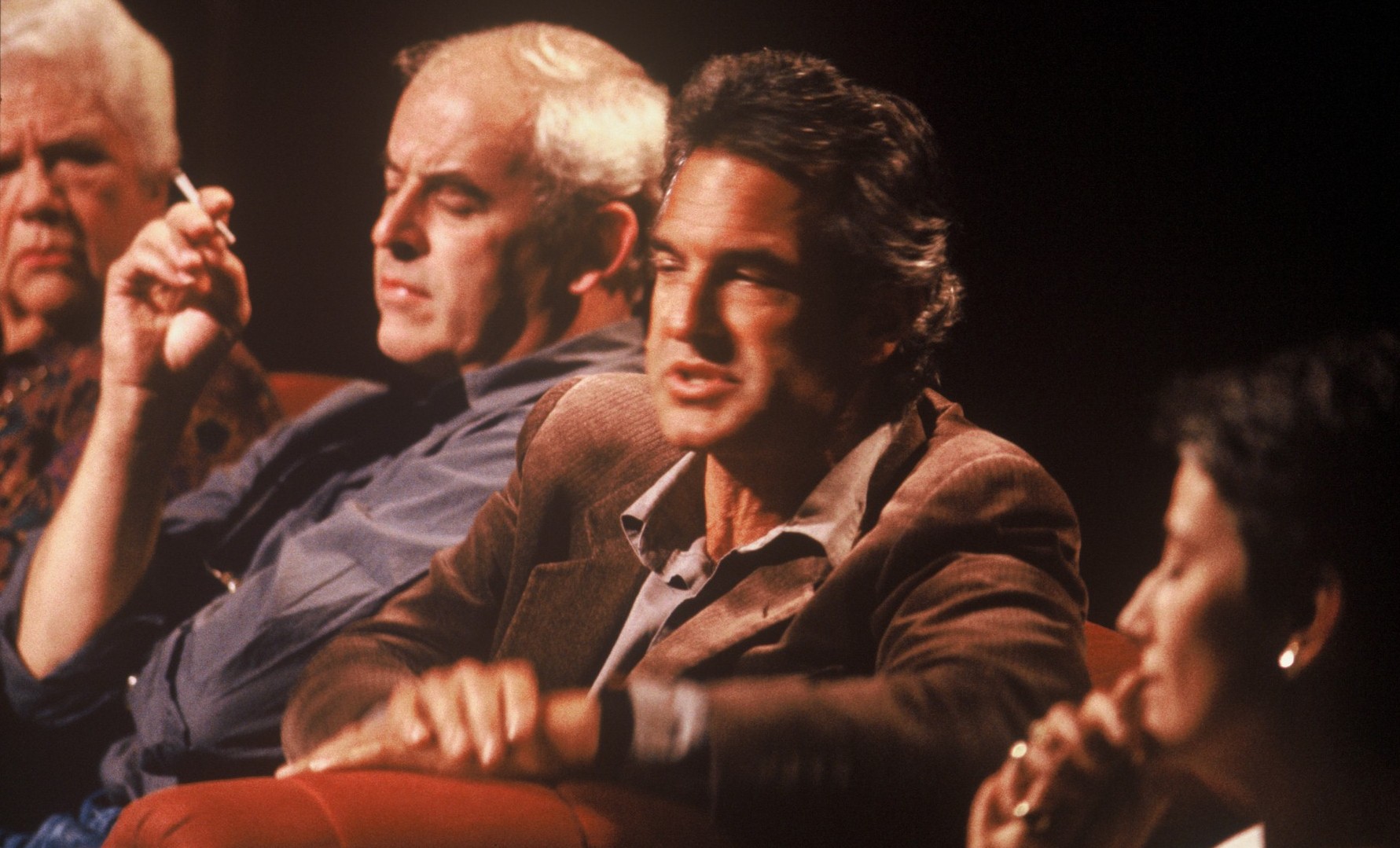
Appearing in 1989 on the British TV discussion programme After Dark, Wikimedia Commons
Have we Misunderstood Freud?
by Tina Bexson
Freud challenged us to go beyond appearances and to consider that what a person consciously thought to be only a small insignificant part of their personality. He was then the first to place a concept of the unconscious at the heart of his psychological system. By the 1890s, he had become the founding father of psychoanalysis. Over a century and a half later, however, some of Freud’s theories have a rather large question mark hanging over them.
Funnily enough, when everyone criticises Freud—from the layman to psychotherapists adhering to a tradition other than that of psychoanalysis—they get it wrong.
Not so much for their glib misunderstandings but simply for their failure to address a central point of his theory. That is his abandonment of the seduction theory in favour of the Oedipus complex, and along with it all the implications resulting from that fatal decision.
One person though has addressed these very issues. And that’s Jeffrey Masson. And he got vilified and ostracised for it. Not only by the press but by his own profession. He wasn’t a critic or a two-bit journalist; in fact, he was a Freudian analyst himself. As he said at the time of publishing his book, The Assault on Truth: Freud’s Suppression of the Seduction Theory, “The word has been given out to abandon me, and a void is forming around me.”
Masson seemed to have come up with the most damning evidence of all, which he said caused he himself to be put on trial “due to an emotionally charged aversion to the truth of the theory itself.”
In The Assault on Truth, he states that Freud “… by shifting the emphasis from an actual world of sadness, misery and cruelty to an internal stage on which actors performed dramas for an inevitable audience of their own creation, Freud began a trend away from the real world that … is at the root of the present-day sterility of psychoanalysis and psychiatry throughout the world.”
So what exactly was the seduction theory?
Well, let’s go back to 1896, when Freud wrote a paper entitled “The Aetiology of Hysteria,” where he revealed that the origins of neurosis lay in early sexual traumas, which he called “infantile sexual scenes.” He believed hysteria was caused from the psychological after-effects of patients being sexually molested as children. Freud stated that his patients recalled traumas “with all the feelings that belonged to the original experiences.”
“The word has been given out to abandon me, and a void is forming around me.”
Jeffrey Masson
“Without exception,” Freud said in his paper, “at the bottom of every case of hysteria there are one or more occurrences of premature sexual experience, occurrences which belong to the earliest years of childhood, but which can be reproduced through the work of psychoanalysis in spite of the intervening decades.”
Masson strongly believed then that Freud was fully aware of the reality of the physical and sexual abuse of children, not only from his patients’ accounts and witnessing them re-living their experiences in the consulting room, but also through his experience observing the work of the forensic medical scientist, Augustas Ambrose Tardieu at the Paris Morgue, during which he witnessed the corpses of children who had been sexually abused. Of Tardieu’s 616 corpses of children who had been sexually abused, more than half (339) had been raped.
After the seduction theory was poorly received by his colleagues and surrounding professional community, Freud apparently began to doubt the authenticity of it entirely. In 1908, he publicly retracted it, stating that:
“I was at last obliged to recognise that these scenes of seduction had never taken place and that they were only fantasies which my patients had made up.”
Patients, he said, had told tales of seduction to repress memories of their own erotic feelings at that time. What’s more, he believed this repression was specifically due to the guilt they felt for their incestuous desires and fantasies for the parent of the opposite sex. So, in short, Freud’s patients’ memories of seduction were now all fantasies and products of the Oedipus complex.
Unsurprisingly, Masson accused Freud of giving a false account of human growth, and by saying his patients were fantasising about child abuse, he denied them their experiences.
Masson also noted that Freud had another new insight at the time: that children have aggressive impulses against their parents. These hostile impulses, such as a wish that their parents died, were seen as an integral part of neuroses. However, Masson believed that Freud failed to acknowledge these impulses would have simply been healthy signs of protest.
“An act was replaced by an impulse, a deed by a fantasy,” Masson said.
Freud used the term ‘transference’ to describe the irrational feelings of the patient towards the analyst (the original parental figure). Though, as Masson points out, this is not necessarily a case of transference; it is simply an “awareness of something done to the patient in childhood surfacing in the adult.”
So, with Freud’s adoption of the Oedipus complex, the only way in which treatment could be successful is if the patient suppressed the knowledge of the past and came to believe they were fantasising, as told to them by their analyst. In this sense, the patient would have to deny his or her ‘self’. What’s more, says Masson, “by not believing in the abuse, the analyst inevitably does violence to the inner life of his patient.”
The question of whether psychoanalysis would have emerged had Freud retained his earlier belief that the memories of his patients were real and not fantasies is a central consideration to the practice of psychoanalysis, insists Masson, as he maintains that most therapies are based openly or implicitly on Freudian theory. Indeed, according to Masson, most psychoanalysts at and nearer the time agreed that “the abandonment of the seduction theory was the central stimulus to Freud’s later discoveries”.

Anna Freud, Freud’s daughter, herself wrote at the time Freud abandoned the seduction theory:
“Keeping up the seduction theory would mean to abandon the Oedipus complex and with it the whole importance of phantasy life, conscious or unconscious phantasy. In fact, I think there would have been no psychoanalysis afterwards.”
It’s imperative to reveal here that in the eighties, when Masson was preparing a new edition of the correspondence between Freud and Fliess (The Complete Letters of Sigmund Freud to Wilhelm Fliess), and given access to the jealously guarded Freud archives, he found omissions made by Anna Freud. In letters written after September 1892, when Freud was supposed to have given up his seduction theory, all the case histories dealing with the sexual abuse of children were removed. Masson also noted that members of Freud’s intimate circle had suppressed evidence connected with his abandonment of the theory.
If the world’s psychoanalysts ever fully truly acknowledged Masson’s findings, the threat to their profession would be immeasurable. By not acknowledging them, the profession of psychoanalysis has avoided the sufferance of any repercussions.
The implications of a continued belief in the Oedipus complex in therapy can be seen in the statement by the American psychiatrist whose work primarily focuses on the treatment of incest and traumatic stress: “Further failure to realise the reality of child sexual abuse has led to misdiagnosis and mistreatment of numerous women and children who turn to psychiatrists for help. It is time for psychoanalysis to free itself from the neurotic re-enactment of its history.”
Maybe it would also be worth considering whether psychoanalysis can incorporate the seduction theory and the Oedipus complex
This all takes us to wonder what reason Freud gave for abandoning his seduction theory. Freud himself said it was due to the absence of success, as analysis was not coming to any real conclusions. As Masson points out, Freud also said he couldn’t believe the probability of such “widespread perversions”.
A more illuminating explanation of why Freud abandoned the seduction theory, highlighted by Masson, is that Freud would gain an internal reconciliation with his colleagues and fellow analysts, who had previously disowned him over his paper, “The Aetiology of Hysteria”.
Masson believed that ever since then “analysts have been denying the realities of their patients’ lives”.
Of course, Masson knows that Freud did not suddenly dismiss the seduction theory, nor did he believe all accounts of seduction were actually ‘fantasies’. Freud admitted some were real, but he doubted the theoretical importance of seduction and referred to it as an “accidental influence”, adding that “the seducers as a rule turned out to have been elder children”.
Masson’s criticisms, although significant, are not vast, and it is unlikely that they will ever do irreparable damage to psychoanalysis. They certainly haven’t yet. Besides, he does not entirely dismiss Freud and strongly believes Freud made it more acceptable for people to openly discuss their sexual lives, and of course he recognises Freud’s large number of genuine discoveries, such as the reality of the unconscious, the nature of transference and resistance, repression, unconscious emotions, and a need to repeat early sorrows (repetition compulsion).
Obviously, Masson’s findings should be recognised. Maybe it would also be worth considering whether psychoanalysis can incorporate the seduction theory and the Oedipus complex, the latter in its unconscious sense only, of course.
Masson, though, made a clear case for dismantling the entire therapeutic profession in his book, Against Therapy: Emotional Tyranny and the Myth of Psychological Healing.
Masson’s view here is that in psychotherapy, with one psychologically dependent on the other, the relationship between female patient and male therapist can never be equal.
He proposed that psychoanalysis is hazardous to our mental health as it is ‘intrinsically’ a question of using power against somebody. What he means is that the patient, by virtue of his or her dependency situation, is eminently exploitable. He states that there is often an “unconscious cruelty involved in taking a position over someone else” and that is “intrinsically harmful”. As a result of this, the patient can be abused financially, intellectually, emotionally, and sexually.
Although highly critical of most forms of psychotherapy, he does believe that the “corrupting effect of the therapist’s power” can be lessened in non-hierarchical, non-fee-paying settings and where counsellors have been through what the person presenting them with has been through. He also goes as far as saying that the higher your status in a professional hierarchy, the less likely you are to be able to help others, and that it is a direct means of insult for an analyst to interpret in patients accounts of their thoughts, feelings, and emotions.
Most of all, he says that we need more kindly friends and fewer professionals.
Tina Bexson lives between Sinai, Cairo and London, and has done for many years. She is also Ars Notoria’s Middle East Editor. Tina is a freelance researcher and news and features writer for both national newspapers and magazines. Publications include: the Guardian, London’s Evening Standard, The Times, Ars Notoria, Environmental Health Journal, Environmental Health News, Public Health News, Your Life Magazine, Hotdog film Magazine, Mental Health Today Magazine, Jack, Maxim, Midweek, and Living Abroad Magazine.
Subject areas include: Travel photojournalism, health, psychology, war, the military, crime, criminology, prison, psychiatry, social issues, environment, lifestyle, film, the arts.
Discover more from Ars Notoria
Subscribe to get the latest posts sent to your email.
You must be logged in to post a comment.