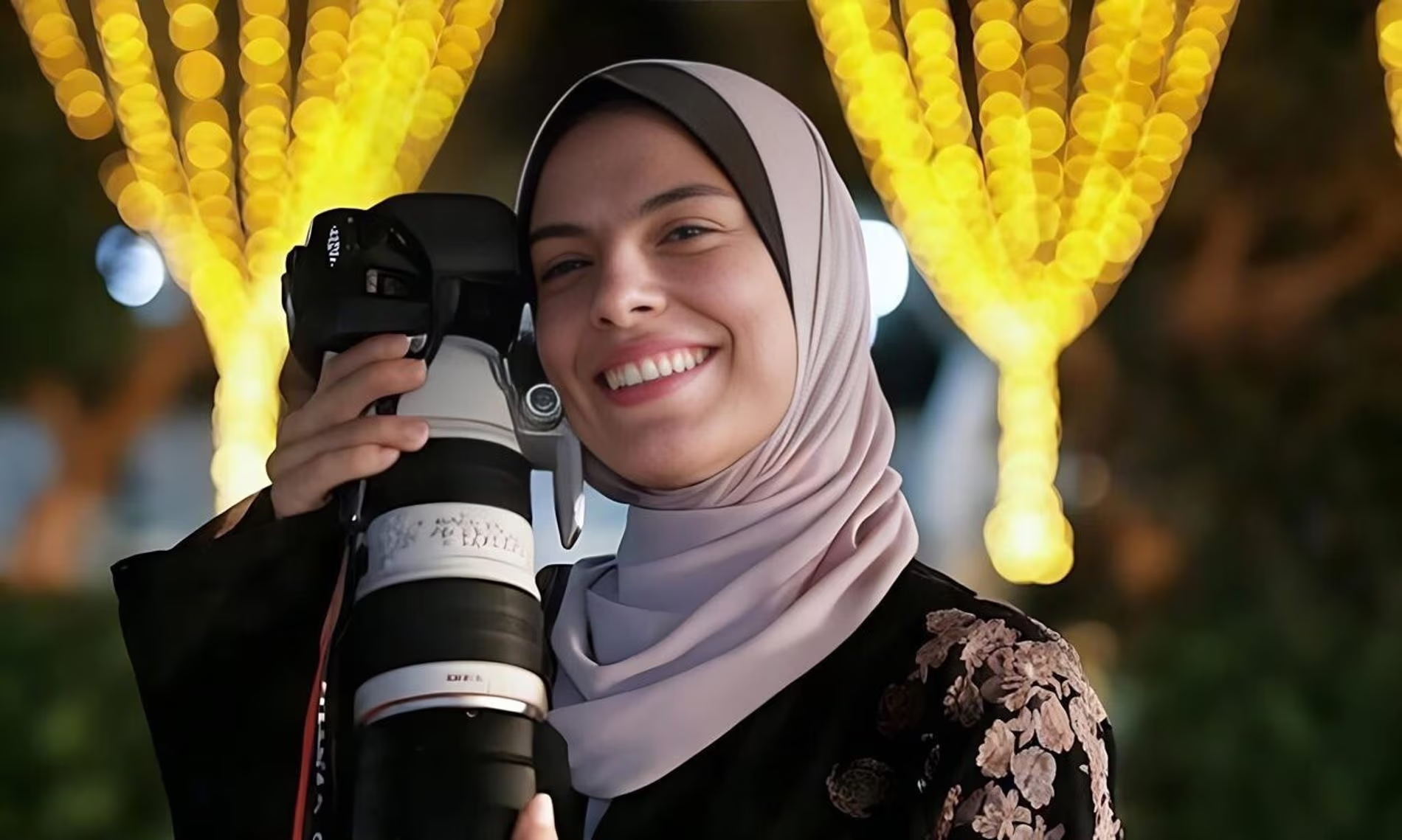
Fatima Hassouna photographer, murdered in Gaza by the Zionists. Photograph: Fatima Hassouna
Alternative media and citizen journalists have ripped apart Israel’s legitimacy, and caused the USA’s foreign policy to be globally reviled
by Phil Hall
I remember going on a demonstration in 1977. We went to Brick Lane to stop the National Front, a neo-Nazi organisation, from marching through an area well known for being the home of immigrant communities. The police formed a cordon at the kerb and started pushing everyone toward the shop windows. At the time, we didn’t know this tactic had a name: kettling. I was at the front, facing a large, sweating, overweight policeman. Beside me stood a young woman who shouted something at him. It was a generic insult, nothing personal. The policeman’s response was to punch her with full force in the breasts.
That moment shocked me to the core. Should I have defended the young women by attacking the policeman? I don’t know. I didn’t. It was just one punch. The police were pushing us back so hard against plate-glass windows that people risked being shoved through them, potentially killed, or seriously injured. The officers didn’t seem to care. Their priority was clearing the way to allow the National Front to march through the East End.
I saw a family friend, Phil Raikes, a Sussex University lecturer with long, blonde, frizzy locks, being dragged across the pavement by his hair. He was pulled to his feet and thrown into a police van. The fact that the police had singled out a man with long hair and punched a young woman in the breasts suggested a subtext to their aggressive behaviour. Perhaps the officer wanted an excuse to touch the young woman’s breasts. Perhaps the one dragging Phil Raikes despised him for his long hair.
In 2025, all of this would have been recorded on smartphones. The officer who punched the woman would likely have been disciplined, if not sacked. The one who dragged the lecturer might at least have faced a warning. This is the power of sousveillance (Steve Mann 2004). Sousveillance acts as a brake on the actions of the oppressor. Of course, today, police wear body cameras, which cut both ways. They can identify protesters, but they also record police misconduct.
Citizen-watching-power has rewritten the rules of accountability. This shift mirrors what we’ve seen in conflicts like Gaza, where many of the airstrikes and dead and dying children and innocents are documented in real time, forcing the world to bear witness. Citizen Journalists like the photographer Fatima Hassouna gave their lives to document the Zionist regime’s crimes.
Compare this to the 1990s, when Western sanctions starved half a million Iraqi children to death with barely a flicker of media attention. Madeleine Albright could coldly declare their deaths “worth it” because there were no viral videos of skeletal infants, no algorithms to amplify their suffering. The Iraq War’s million-plus deaths unfolded in a moral obscurity that sousveillance of Gaza’s horrors have shattered. While the mainstream media holds the line. ‘Israel has the right to defend itself’ they blare.
Weapons of Mass Destruction (WMD) claims went unchallenged for months in 2003. In 2024, Israel’s “40 baked babies” propaganda was debunked within hours by open-source investigators. Sousveillance hasn’t stopped the bombs, but it has made the architects of the destruction of Gaza pay a price—not in blood, but in legitimacy. Israel’s global standing now is lower than apartheid South Africa’s, it has lost all legitimacy, and the global protests and wall-to-wall outrage on social media show how dramatically the situation has moved on. We don’t have CND, but we have TikTok, Facebook, Instagram, YouTube, online magazines, and all the other platforms.
What have been the effects of sousveillance in Gaza through citizen journalism, like that of Fatima Hassouna, the journalism of respected media outlets like The Gray Zone and Declassified and the reporting of more mainstream outlets like Middle East Eye? Realistic estimates, possible only through citizen journalism, suggest over 200,000 Palestinians have been killed. Social media ensures that Hind Rajab’s recorded pleas under Israeli fire traumatise the global conscience. Compare this with Madeleine Albright’s obscene calculus—where the deaths of half a million children passed almost unnoticed by most ordinary people in the West.
Today, sousveillance has raised the cost of such brutality. Israel’s legitimacy is in tatters; US foreign policy is globally reviled.
Unlike in China, Russia, or other authoritarian states, Western democracies are open societies. This openness relies on independent institutions, checks and balances, tolerance of dissent, legal protections for free speech, and a free press. These elements allow us to criticise our government’s actions, even on contentious issues like Palestine. We can post almost anything on social media, organise massive marches through central London, and vote in MPs who share our views.
Communication is the essence of community. Language, the glue of the social contract, evolved because we are social beings. Sousveillance only thrives and works in open societies. In closed ones like China or Russia, those who practice it are imprisoned, executed, or erased from public discourse.
Sousveillance must be protected from co-option and repression and citizen journalists work in tandem with expert oversight.
Even in democracies, sousveillance operates within legal limits set by legislators. But its reach has gaps. When mining or fracking occurs in remote regions, when logging destroys forests, or when secret corporate abuses go unchecked. Yet when privatised industries dump raw sewage near public beaches, sparking outrage and media coverage, the social contract is tested. Either it breaks, or reforms follow.
The key to effective sousveillance is a functioning democracy with a legitimate social contract. But when powerful people with sinecures, lobbyists, and private interests sabotage the will of the majority, the system falters. Studies show that when media scrutiny lapses, corporate fines drop by 75%. Corporations counter sousveillance by controlling narratives and weaponising the law against critics—though in democracies, they will not always succeed, and there are countermeasures people can take.
Surveillance itself is not all bad. Public CCTV, for instance, deters robbery, vandalism, hooliganism, serious crime and more petty crimes like littering. But when the state adopts and enables mass surveillance, the balance easily tips toward oppression, where monitoring serves power alone.
Consider the pre-Factory Acts era, when foremen beat child labourers and sent them down the mines and between the spokes of dangerous steam-driven engines, where workers toiled 16-hour days in deadly conditions. The factory owners used surveillance to ensure compliance. But reform was the result of oversight and surveillance from above and from below—from the sousveillance of the powerful by journalists like Dickens and writers like Engels, who exposed cruelty and abuses. Public awareness and agreement that such behaviours by the factory owners were unacceptable, together with organised opposition from the workers themselves, helped bring about change.
Nowadays, Amazon warehouses mirror those 19th-century horrors, with workers denied bathroom breaks and breaking their backs under relentless quotas.
Even state surveillance has layers of different kinds of oversight. The Epstein scandal revealed how intelligence agencies used blackmail operations to control extremely wealthy and powerful individuals. Maxwell, Mossad, and MI6 were rumoured to collaborate on a system compromising powerful figures through underage sex trafficking. When the truth emerged, QAnon’s absurd conspiracy theories (like Hillary Clinton running a pizza-parlour sex ring) diluted public trust in all exposés—a classic psyop tactic. Yet sousveillance from below, led by researchers like Whitney Webb, peeled back the layers, making such operations harder to conceal.
The lesson is clear: sousveillance doesn’t stop atrocities, or corporate crime or the abuse of power, but it mitigates their scale and erodes corporate and state immunity from social condemnation and prosecution. The very health of the social fabric of an open society, requires that we have unmanipulated alternative media outlets, principled and respectable traditional media outlets (how few are left!), and brave citizen journalists.
Sousveillance must be protected from co-option and repression and alternative media outlets and citizen journalists work in tandem with expert oversight. The alternative to this system of checks and balances is a return to the early 19th century, where power operated almost unchecked, and the social contract hung by a thread. Instead of being subverted, controlled, and repressed, for our society to function healthily, a free press and citizen journalists must be protected—they must be free to report, to give their considered opinions, and be empowered. A free press must be allowed to hold our governments to account when, for example, in the most painful and horrific instances, these governments of ours collaborate with and enable murderous ethno-settler states.
Phil Hall was born into an ANC family in South Africa. The family was forced into exile in 1963 after his mother was imprisoned and his father banned. They relocated to East Africa, where his parents continued their activism and journalism. In 1975, after a period living in India, they journeyed overland back to the UK, eventually settling in Brighton.
Phil pursued a broad education, studying Russian, Spanish, politics, economics, literature, linguistics, and English grammar and phonology. His path led him to live and study in the USSR, in Ukraine, and later in Mexico, where he married and started a family. Over the next decade, Phil and his partner balanced activism with work before relocating to the UK—a move initially intended to be permanent.
However, professional opportunities took him to Saudi Arabia and then the UAE, where he spent ten years before returning to the UK during the COVID-19 pandemic. Back in Britain, he founded Ars Notoria Magazine and, alongside fellow humane socialist Paul Halas, launched AN Editions, a small venture dedicated to publishing thoughtful, progressive and exciting new books.
Discover more from Ars Notoria
Subscribe to get the latest posts sent to your email.