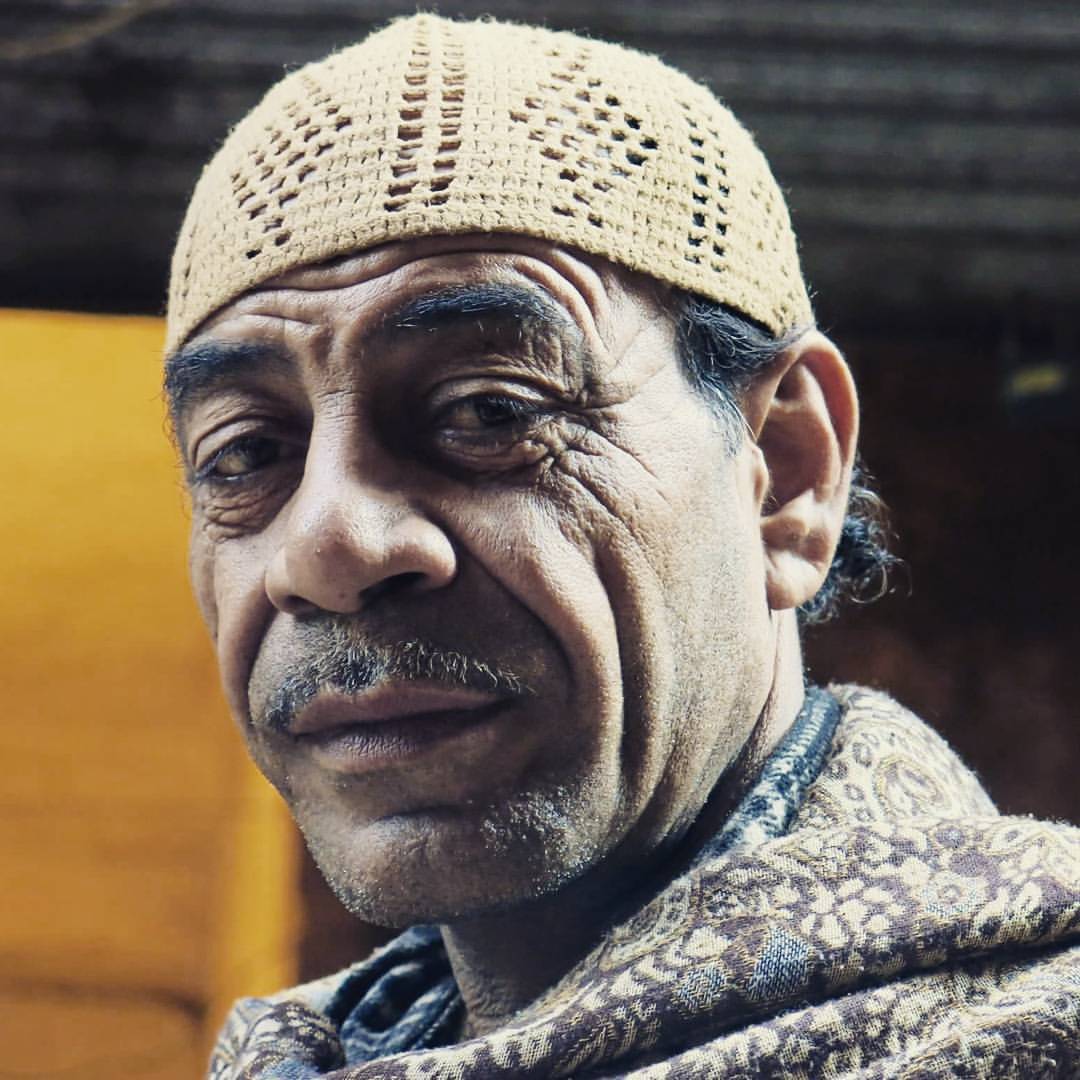
Singer celebrating Sayeda Zeinab Mulid , photo Tina Bexson
by Tina Bexson
He took the brown-wrapped parcel for the English wife he had left a year ago. Walked out of his hotel along the tree-lined streets of Zamalek, scattered with embassies and nineteenth-century apartment blocks exuding the Westernised ambience and nightlife he abhorred. Then he reached her villa. It had one of those rusty gold mail slots with a hinge that squeaked when he pushed the parcel through. It landed with a soft thud in the sand of her garden. No point ringing the bell. She’d be out celebrating her fiftieth birthday. Somewhere glitzy, expensive. Somewhere safe. He hoped. He remembered her past birthdays when they’d dined simply on the local boats decorated with lights and drifted down the Nile.
He’d taken just two steps back to the street when the gate rattled. Then a staccato rhythm of unlocking. Then he saw her. She wore a burgundy chiffon dress and multi-strapped heels. Her face shone under the moonbeam light.
‘What the hell…’ she said.
‘Hello, Hannah.’
‘Why are you here, David?’
‘They sent me back. To cover the Morsi protests.’
Her eyes rolled. He’d bored her already.
‘And I wanted to give my wife something for her big day. Something to remember me by.’
She bent to pick up the parcel, strained under its weight. He turned towards the 1920s villa. Their villa. The one they’d restored together. Purple balls of bougainvillea now hung from its freshly painted yellow walls. The catkin-like flowers of the casuarina trees dripped into the pool. The lawn glowed fluorescent green. She’d have gone over their quota of fresh Nile water, he thought. He’d be fined, again.
‘Can I come in?’ he asked.
‘I’m having a do later,’ she said. ‘I don’t have much time.’
Inside, he sat on the soft-cushioned sofa while a breeze blew in through the French patio doors. He closed his eyes, inhaled lamb prune tagine stewing on a fire. A warmth nudged his buttocks. Pepsi, her Staffordshire Bull Terrier, curled up beside him. He stroked the dog’s stiff brown fur, looked around. Everything was tidier than he’d remembered, apart from that nothing had changed. Except in place of the yucca plant now stood a shiny shisha pipe that couldn’t have been hers.
He pulled the coffee table towards him, peered into an ashtray full of Marlboro butts. A smaller tray, half full of Cleopatras, sat at the other end of the table. He placed the unwrapped present between the two, then turned the sound up on the television. Images of tanks entering Rabaa Square flickered across the screen.
‘Damn the military. And damn you, David,’ she said, returning from the kitchen with two large gin and tonics. She grabbed the remote, pressed mute, sat down on the other side of Pepsi. ‘It’s my birthday, for God’s sake.’
She lit a long, thin Cleopatra. He reached for a packet of Camels from his jean pocket. She poured more gin into her glass and shook a bottle of nail polish. Then she began painting her fingernails Egyptian blue. A ritual he’d watched her perform before every party they’d once hosted together.
‘I didn’t know you’ve now got a thing going with Ayman Nabil,’ he said.
‘Oh, I thought everyone would’ve known about that by now.’
He gulped down his drink. ‘So, where is he?’
‘Visiting his children for Eid al-Adha, of course,’ she said. ‘You know it’s Eid, David. And you know damn well that Egyptian men have no choice but to visit their families for the feast. And at Ramadan. AND at Eid al-Fitr, which, incidentally, was the last time you turned up.’
‘So, he’s with his wife then.’
‘No, he’s not with his wife.’ She sighed. ‘Why are you here, David?’
He wondered. Was it only because he’d heard about her and Ayman? Ayman, the fastidious hotel manager they’d met and befriended at a party five years ago. Or was it because of her birthday?
The wind picked up, the surface water in the pool rippled. A flicker blew in through the open windows and caught his eye.
‘I have to pee,’ he said.
Upstairs in the bedroom, he opened her pale-oak wardrobe. On the clothes rail, her many dresses had been hung in order of length. The rail began at one end with her longest dress and ended at the other with the shortest. He watched as the hems of the dresses swayed in a diagonal line. He had never seen them like this before. On the bottom of the wardrobe, her shoes had been ordered in a line determined by the height of their heels. A pair of pink flip-flops lay in the right-hand corner. But she never wore flip-flops. He laughed out loud. Of course, Ayman must have bought them. He’d have needed a pair of ‘flats’ to complete another perfectly straight slanting line.
He thought of Ayman. Ayman and his OCD. It was his saving grace. His fastidiousness and attention to detail were quite legendary.
He wandered into the en-suite bathroom, stared at the historic black-and-white photographs now hanging on the walls. The Maadi Sporting Club’s Nymphéas Pond, its 1952 tennis team; the 1953 Lycée Français, today a mosque; a submerged bridge pictured in the flash flood of 1945. Then he unzipped his fly, reached for the larger of two toothbrushes from a crystal glass, held it under his stream as he urinated. And then rubbed it around the toilet bowl.
He walked back down the long, winding staircase that looked onto the pool. She was crouched down, running her fingers around the rim, just above the surface of the pristine blue water.
‘You should get your prostate examined,’ she said as he stood beside her. ‘And you look tired. You should have retired from that stupid newspaper long ago.’
She retrieved her dripping hand from the pool, held it up to the light, inspected her painted nails.
‘What protests exactly did they send you over to cover this time?’ she asked.
‘Rabaa.’
‘What?’
‘The Muslim Brotherhood protestors in Rabaa Square. It’s not that far from here. You should take care.’
‘But why are they protesting?’
‘They’re angry. The military ousted their president.’
‘The military are crazy in this country,’ she said.
‘Yes.’
‘So why did they get rid of the president?’
‘The military said the people asked them to. The people who were protesting in Tahrir Square.’
‘Those tanks on TV. Are they in Rabaa?’ she asked.
‘Yes.’
‘But why, if they’ve already got rid of the president?’
He sighed, exasperated.
‘Because, Hannah, the supporters of the Muslim Brotherhood, of the president, are now angry they took him down, and they are the ones protesting outside the mosque in Rabaa.’ He sighed. ‘For God’s sake. It’s been worldwide news, Hannah. You should know all this by now.’
‘It’s confusing, David. To me.’
He said nothing. His eyes softened. A little.
‘Anyway, so why are the tanks needed in Rabaa?’ she said.
‘To bulldoze the dead.’
She got up, straightened her dress, strutted back inside. By the time he joined her, he noticed her toenails were Egyptian blue too. He lit another Camel, stared into her blank canvas of a face. Then he moved his eyes towards the shisha pipe, which gleamed with fresh polish. He imagined water bubbling as a melon vapour ran up its flexible hose.
‘Why is Ayman living here?’ he asked. ‘You’ve never let any of them do this before.’
Her body stiffened. He reached for the gin. Took a swig right out of the bottle.
‘One day you will get Mohamed-ed,’ he said.
‘What do you mean?’
‘Haven’t you heard of My Mohamed’s Different? MMD?’
‘What are you talking about?’
‘Oh, come on? Every Western woman believes her Mohamed loves her; will never hurt her; no longer sleeps with his wife. But he does. And even his wife knows he’s a gigolo milking the cows.’
He stubbed his Camel out into the ashtray full of Marlboros.
‘Actually, your Mohammed is an Ayman. So that would make your MMD a MAD. A mad. Hahahaha.’
She grimaced. ‘Leave, David. Leave now. Please.’
After she heard the gate slam, she turned the sound back up on the television. A reporter in a flak jacket huddled in Rabaa Square. He said there were 800 dead. Killed by the military. Rabaa Adawiyya Mosque was now a morgue.
Tomorrow she would visit Rabaa. She’d see for herself this slaughter. It couldn’t be that bad. Not as bad as Eid. Oh, she’d never forget seeing those poor lambs downtown. Queuing up on the street to have their throats slit. So much blood. The stench. How could Ayman let his children witness such horrors? It sickened her. Truly.
What was Ayman doing now, she wondered. Wasn’t Eid celebrated to commemorate Abraham’s willingness to sacrifice his son? At least before God put his butt in and offered him a lamb instead. She couldn’t imagine Ayman sacrificing anything. He even managed to put on weight during Ramadan by eating—gorging on—during the moonlit hours. It would keep him going right through the sunlit ones.
She remembered the parcel. Where was it? She went into the garden, salivated as she passed the lamb tagine. On the surface of the pool, bits of wrapping paper danced like butterflies. An empty, chewed-up cardboard box lay on the patio. She picked it up, peered into it, took a deep breath. Then she puckered her lips to whistle, but she could produce no sound. So she called out into the night: ‘Pepsi. Pepsi Cola. Come here. Now. Pepsi? Please!’
He caught a taxi and asked to be driven through the lushly landscaped avenues of southern Cairo. He thought of his city. How it’d been shaped by the water of the Nile. How the cisterns of the hundreds of sabils, the drinking fountains in the squares, were filled with it. The water was carried to them from the river in leather bags. He thought of the bridges and the boats, and how the Nile was the city’s greatest escape.
To be continued…
Tina Bexson lives between Sinai, Cairo and London, and has done for many years. She is also Ars Notoria’s Middle East Editor. Tina is a freelance researcher and news and features writer for both national newspapers and magazines. Publications include: the Guardian, London’s Evening Standard, The Times, Ars Notoria, Environmental Health Journal, Environmental Health News, Public Health News, Your Life Magazine, Hotdog film Magazine, Mental Health Today Magazine, Jack, Maxim, Midweek, and Living Abroad Magazine. She writes about health, psychology, war, the military, crime, criminology, prison, psychiatry, social issues, environment, lifestyle, film and the arts and does Travel photojournalism,
Discover more from Ars Notoria
Subscribe to get the latest posts sent to your email.