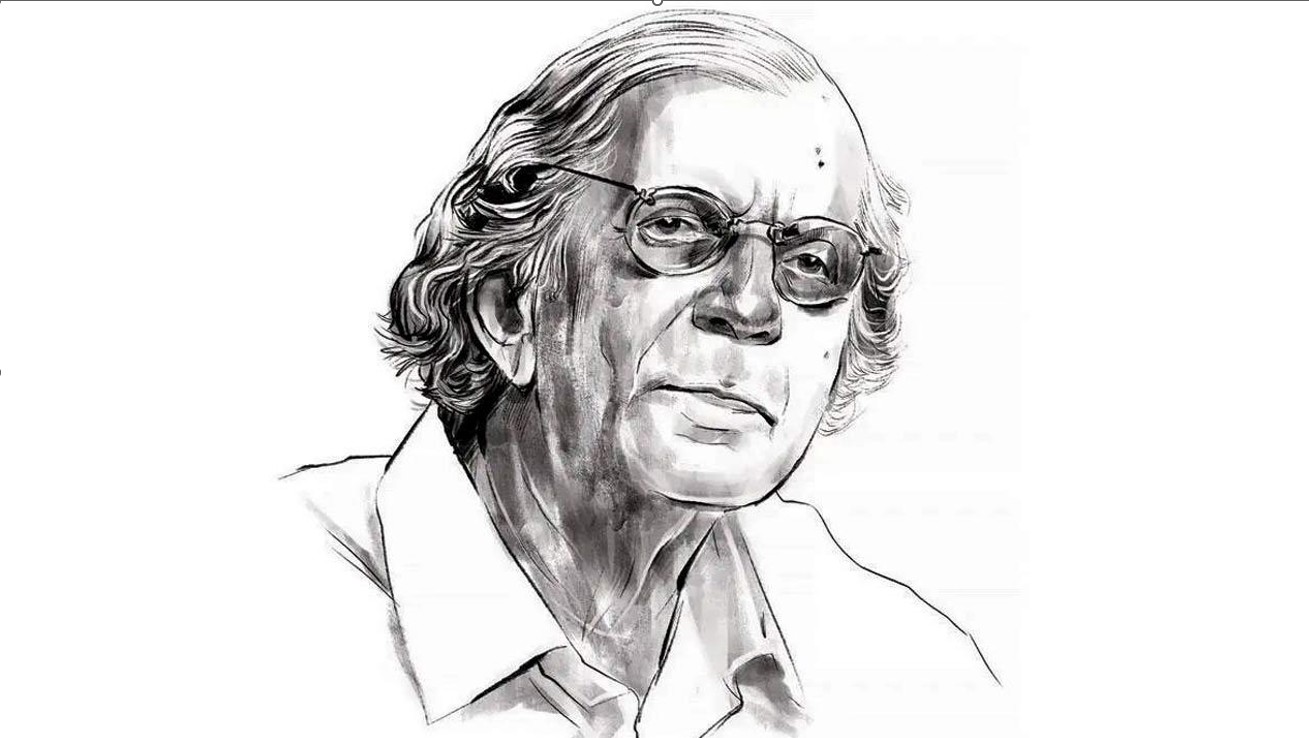
Nissim Ezekiel, illustration
A Tribute to the Herald of Modern Indian English Poetry
by Anjana Neira Dev
As we commemorated Nissim Ezekiel, the herald of modernity in Indian English poetry; on his hundredth birthday, and enter a season of heat and dust and of course the king of fruits, I would like to begin my tribute with a personal favourite, one of the concluding poems of his collected works[1], to see how he attempted to stabilize the swinging pendulum of Indian English poetry that negotiates between the siren calls of tradition and modernity. He sought to find if not stasis, at least a temporary repose and as he will say in “On an African Mask” (6), “in the passion of mind or heart/ Acquire the equilibrium of art”.
I am referring here to the twenty-first section of from Edinburgh Interlude, “Mangoes”
“I have not come
to Edinburgh
to remember
Bombay mangoes,
but I remember them
even as I look
at the monument to Sir Walter Scott,
or stroll along
in the Hermitage of Braid.
Perhaps it is not the mangoes
that my eyes and tongue long for,
but Bombay as the fruit
on which I’ve lived,
winning and losing
my little life.” (293)
In this tribute, I intend to touch briefly upon some aspects of Ezekiel’s oeuvre of the 240 poems available to us; his negotiations with the creative and linguistic medium and his perspectives on the cultural landscape of his poetic universe.
English is the first and only language used by Ezekiel in his poems and his concern is therefore not with the language he should use, but with questions of prosody and perspective. He does however make the occasional reference to the fact of his alienation from his surroundings being partly caused by his inability to share in the linguistic milieu around him. As he says in “Minority Poem”
“It’s the language really
separates, whatever else
is shared.” (236)
In other poems he talks about the difficulty he has in communicating with others and how “much is always distant, out of reach” (“Communication,” 7) when he is talking to others. This is the problem he faces in “Speech and Silence” when he says
“Man is alone and cannot tell
The simplest thing to any friend.
All speech is to oneself, others
Overhear and miss the meaning.
And yet to speak is good, a man
Is purified through speech alone,
Asserting his identity
In all that people say and do.” (53)
The poet also refers in two of his poems to the kind of communication that does not need words to be mutually intelligible to its interlocutors. In the first of these called “Three Women” he writes of how the language of food and love has a universality that transcends both time and space.
“They spoke the language
of food and love
naturally
as a mother-tongue;
no problem here
of accent or of intonation.
The simplicity,
the directness,
the elation
of the food-love offered
serve as a norm
for all my life’s
daily hell or heaven
improvised, missing
or attaining form.” (151)
The next is “For Satish Gujral” and Ezekiel writes
“Deaf artists all,
all of us who martyr the meaning
in the flux
to lonely
and heated visions whoring
after truth.
Mea culpa. Punish me.
It is the task
of love
and imagination
to hear what can’t be heard
when everybody speaks.” (194)
Another dimension of the negotiation is when Ezekiel distinguishes between a poem and poetry and says in “Poetry”
“A poem is an episode, completed
In an hour or two, but poetry
Is something more. It is the why
The how, the what, the flow
From which a poem comes,
In which the savage and the singular,
Are all dissolved; the residue
Is what you read, as a poem, the rest
Flows and is poetry.” (13)
To best understand the stance or perspective that Ezekiel believes is necessary to give voice to a poet’s experiences and emotions that he seeks to communicate with transparency to his readers, it would be interesting to mark the milestones of this “Enterprise” (to extrapolate from the title one of his poems) by reading the poems in chronological order of publication (and I assume composition). In the process, I also hope to share some keystones of this poet’s credo on writing poetry in English in India.
The eponymous opening poem in the first collection A Time to Change (1952) encompasses some illuminating excerpts:
“He has to build something with able hands
And knowing eyes, with some instruction
From his parents, ancestors and friends,
Altered slightly here and there to suit his strength.
…
The pure invention or the perfect poem,
Precise communication of a thought,
Love reciprocated to a quiver,
Flawless doctrines, certainty of God,
These are merely dreams; but I am human
And must testify to what they mean.
For consider how I win redemption
In the private country of my mind.” (4 – 5)
The poem, “In Emptiness,” signals a coming to terms of sorts when
“Acquainted with the intricate
Bizarre movements of the heart,
Inopportune desire, resentment
Of a service rendered, I am
Waiting now in emptiness,
Annulled, cancelled, made a blank,
Resolved to find another way” (11)
And the only way out of this state of tongue-tied inertia seems to be
“… let me always feel
The presence of the golden mean
Between the elan of desire
And the rational faculties,
Brooding on design and colour
Even in this emptiness.” (12)
Here then, we have a prelude to the echo of the language of food and love we will hear in a later poem (that I referred to in the beginning) when in “Something to Pursue” we are urged
“One must be out of doors also
Within, break the barricades
Of pettiness and pride, overcome
The schizophrenic agonies
And dive into the present tense,
Making for the friendly land
Of unambiguous speech
Or corn and wine.
…
When arriving at the unity
Of thought sensation purpose deed,
Suffering is made to sing,
Will we be satisfied to find the thing
And take it as the tragic view?
…
The answer is: There shall be no more questions,
No more expenditure of doubt
But only a limpid style of life
Whose texture is poetry.” (14 – 15)
The very next year heralds the publication of Ezekiel’s second collection Sixty Poems (1953) and this starts with “A Poem of Dedication” where from the basement room the poetic persona contemplates his endeavours and declares
“I do not want the yogi’s concentration,
I do not want the perfect charity
Of saints nor the tyrant’s endless power.
I want a humble balance humanly
Acquired, fruitful in the common hour.” (40)
This ‘common hour’ will hallmark the next phase of his poetic journey and he can write ‘Luxuriously’ in “Portrait”
“A rough-and-tumble view of things –
A damned impertinent ironic view of things –
A hell-may-care delightful view of things” (45)
Five years later, in 1958, is published The Third which opens with another “Portrait” in which
“Beneath his daily strategy,
Reflected in his suffering face,
I see his dim identity,
A small, deserted, holy place.” (87)
This place has become holy with its reconciliation (albeit temporary) of desire and reason
“For nothing can be hidden long
From heart or intellect,
To each the other’s fantasy
Is plain in retrospect,
But welded they could seem and be
A single architect.” (88)
That is why in the poem “Conclusion” he can write
“The true business of living is seeing, touching, kissing,
The epic of walking in the street and loving on the bed.” (96)
As the journey progresses, ‘uncertainty’ is “What Frightens Me” (106) writes the poet when he thinks with existential doubt about “The Language of Lovers”
“Poetry, some foolish critic said,
Is the natural language of lovers –
Looking at her destroyed even my prose.
…
Prodigious music of our silences,
Dry-throated suffering and helplessness,
This is the natural language of love.” (111)
The search continues in the appositely titled collection The Unfinished Man (1960) and if “Enterprise” (117 – 118) reminds him that ‘Home is where we have to earn our grace’, then on “A Morning Walk” (119 – 120) he acknowledges that ‘his native place he could not shun’ but ‘the more he stared the less he saw’ and ‘the pain of his fragmented view’ compels him in “Morning Prayer” to petition
“God grant me certainty
In kinship with the sky,
Air, earth, fire, sea –
And the fresh inward eye.” (122)
The search in now focussed, in the next collection, on finding The Exact Name (1965) and the objective correlative for this becomes “Poet, Lover, Birdwatcher”
“The best poets wait for words.
The hunt is not an exercise of will
But patient love relaxing on a hill
To note the movement of a timid wing;
Until the one who knows that she is loved
No longer waits but risks surrendering –
In this the poet finds his moral proved,
Who never spoke before his spirit moved.” (135)
The next collection Poems contains a score of poems written between 1965 and 1974 and “A Small Summit” is reached when the writer wonders
“Do I belong, I wonder,
to the common plain? A bitter thought.
I know that I would rather
suffer somewhere else
than be at home
among the accepted styles.” (153)
In Poems Written in 1974 the metacognitive contemplation of the act of writing, a metonym for the act of creation itself, takes on sharper focus and in “Talking” we return to a consideration of the medium itself
“Language
Is our conspicuous gift: the Word,
made flesh, is sought again.
We make it as we make our lives.” (171)
As the journey draws to a close, we have in Hymns in Darkness published in 1976 and his antepenultimate collection, the much anthologised and studied “Background, Casually” which evocatively concludes with an affirmation
“I have made my commitments now.
This is one: to stay where I am,
As others choose to give themselves
In some remote and backward place.
My backward place is where I am.” (181)
As I reach the end of this tribute scripted in all humility and with profound admiration and love for Nissim Ezekiel, I will return to “Edinburgh Interlude”, in his ultimate collection simply titled Poems 1983-1988, this time to the 28th section (Nothing to Say), and let you hear the poet’s final published words
“…when I have nothing to say
I know I shall say it
gratefully, as persistent and poetic
as the grass that grows
between Bombay’s pavement tiles.” (295)
I may be allowed the liberty of quoting from Shakespeare’s “Sonnet 18” to bring my dedication to a poetic close: ‘So long as men can breathe or eyes can see, / So long lives this, and this gives life to thee’ Nissim Ezekiel. Thank you for the poetry and your legacy.
[1] All the poems quoted in this paper are taken from Nissim Ezekiel: Collected Poems, Second Edition, 1989; published by Oxford University Press, New Delhi. The page number/s of the quoted excerpts are cited in brackets after each quotation.
Anjana Neira Dev is Associate Professor of English at Gargi College, University of Delhi. She is profoundly interested in the dynamics of the English classroom. Her areas of research interest include Comparative Education; Pedagogy in Language and Literature Education; Assessment and Evaluation; Indian Writing in English: Poetry and Fiction; English for Special Purposes: Academic Writing, Creative Writing, Technical Writing and Business Communication; Detective and Crime Fiction; and, Teaching English in the Indian Classroom. She has published extensively in these areas and also enjoys sharing ideas in focus groups with like minded people.
Discover more from Ars Notoria
Subscribe to get the latest posts sent to your email.