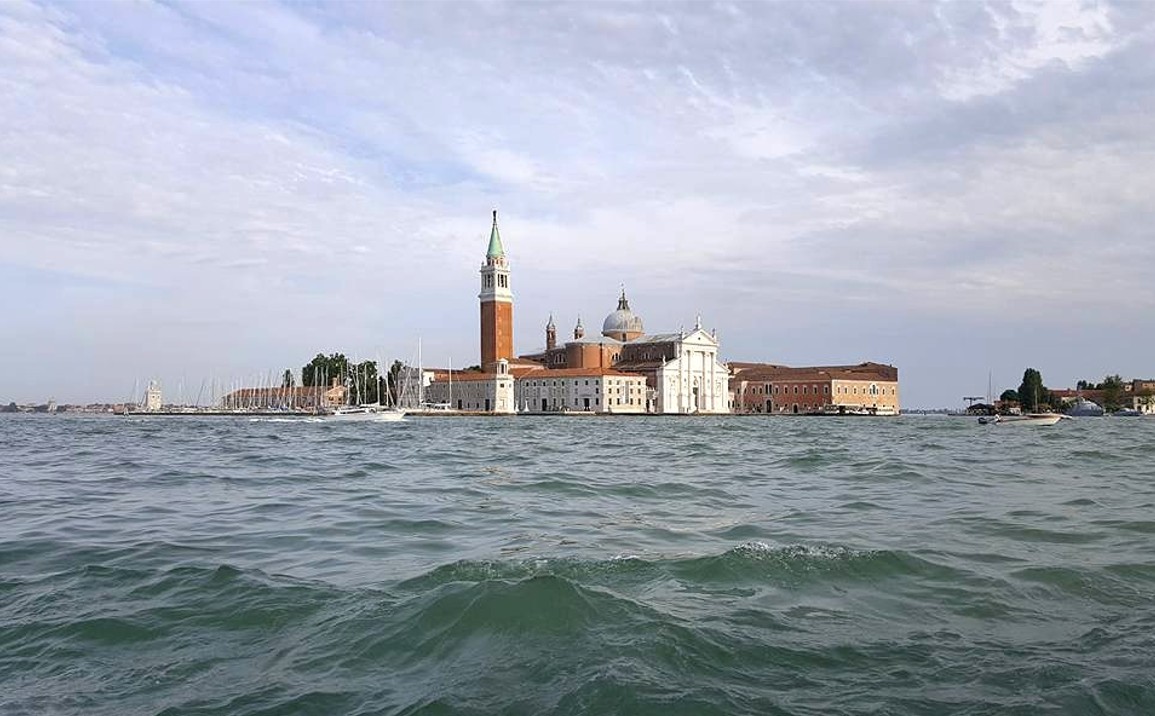
View of San Giorgio Maggiore. Photograph Phil Hall
by Phil Hall
Venice is one of the greatest sea cities. In the 5th century the Venetians rescued their shard of late Roman life from the Huns and Lombards by building way out in the Venetian lagoon on stilts. The city grew as a trading port. It became powerful and rich and Venetians built great galleys to trade along the Dalmatian coast with Byzantium.

Gustave Moreau’s painting of Venice (1885). Wikiart
Venice is spectacular and 30 million people visit it every year – fewer this year of the pandemic. But for professional, upper class travellers like Wilfred Thesiger ordinary people are not welcome in places like Venice, or the Empty Quarter. To people like Thesiger we are locusts; swarming ‘in and out of planes’. The ordinary traveller has ruined Venice for the elite traveller. Admittedly, Thesiger was an odd amalgam. He was only happy when journeying for long distances through wild, hot countryside in the company of lithesome boys.

I’ve seen locusts in Africa. I grew up in Kenya and Tanzania; their wings rustle, their black eyes stare. They eat quickly and noisily, and while they eat their wings shiver. For the cognoscenti, coiled away in in the corners of their cool dark palazzos in the Venetian lagoon we are all ‘oiks’ and ‘plebs’ anyway no matter what we do. We live by their sufferance. They are the custodians of life’s treasures. Of all high culture. This is not your town. Ramble on by. This is not your countryside. This is not your world. This is not your music, or your food, or your scene. Shuffle along. Just don’t finger the goods. You wouldn’t be able to afford them anyway. You are only here on sufferance.

Old Venetian sheet music and lute. Photograph Phil Hall
The actions of the elite sometimes preserve beauty: the Elgin marbles are an example. Give them back to Greece and who knows what Greek hoi poli will do with them. Better keep them here. Peggy Guggenheim didn’t waste her money on vaccinating small children against capitalism like Bill Gates, she spent it on great art. It is thanks to elitist projects that we have the great parks of London, the British Museum, and the Peggy Guggenheim collection in Venice. Are we grateful? Do we behave with appreciative decorum? Not at all!
In summer, people strip off their T-shirts and blouses and stretch out on towels in St James’s Park. We don’t examine and reflect when we look at artefacts from Egypt, we merely gawp. It’s a mystery to us. For the educated, wealthy elite, ordinary people ruin high art and desecrate beauty with their presence. In the past only the monied people could do the grand tour could visit Venice. Not now. Now almost anyone can go. Millions of anyones. However, to enjoy Venice as an ordinary human being you must be a muscular tourist. You must be able to withstand sustained physical discomfort.

Ice cream parlour in Venice. Photograph Phil Hall
Near the Rialto bridge a girl about five-years-old pipes up as she and her mother walk hand-in-hand. In French the little girl says: ‘Mother, don’t you think it would be a splendid idea to have an ice cream?’ I would have been unable to resist. If she had been my daughter I would have replied. ‘Why my dearest, of course it would! Thank you so much for your suggestion, you have such excellent ideas.’. And we would have paused for 30 minutes to eat an ice cream. But her mother said No! and they carried on with their march.
On our last day in Venice I dragged a suitcase all the way across the island. According to my wife it was essential that we search for a leather bag for my youngest daughter. It took us all afternoon, plodding about with the rattling weight of a small heavy suitcase dragging behind me. My wife promised to deposit my efforts into the running account of my good deeds and subtract them from the inventory of my failings.

a pasticceria in Venice. Photograph Phil Hall
But I was tired. In the end, trailing behind her I got lost. I went into a little shop to ask for directions. The shop assistant was in conversation with her stocky, short-sleeved Venetian boyfriend. Even so, generously, she looked up and interrupted her conversation in order to give me directions. I thanked her and left quickly, closing the door behind me. Unfortunately, the door slammed.
I looked back the way I had come to see if my wife was there. As I turned back I saw the stocky young Venetian storm out of the shop. He was looking for me. I was an ill-mannered tourist who had slammed his girlfriend’s shop door.
For the Venetians, visitors move in slow motion. In the old days Londoners stood on the correct side of the escalator. You could tell who was new to the city, or a tourist. We never touched them as we swept by, never brushed them as we dodged past on the way to university or work. Nowadays, London is not quite as well-oiled. We play chicken instead. People are worse at following the rules and knock into each other accidentally on purpose. London can be a bad-tempered place. It’s full to the brim and its transport system can’t cope.

Venetian waterways. Photograph Phil Hall
The Venetians know their way about the gangways of their old ship. They avoid the main passageways and when they do have to cross them they do so artfully and at speed. A women actually ducked under my arm. A man twirled around me in an instant and spun off at an angle into a side street. Venetians are like spider monkeys and Venice is their rainforest.
Anyone who wants to study arcologies should study the history of Venice. The people who crewed Venice and its captains all brushed shoulders in the narrow streets. There was always the possibility of a long stiletto through the ribcage in the dark in response to serious offence. Better to share the wealth a little, spread it around and to try to get on with everybody. It’s a lesson the rich who use public thoroughfares in other cities should learn.
Many Japanese who visit Venice do so inspired by a beautiful anime series written by Jirô Tanaguchi. Oddly, to other Japanese visitors Venice is a reminder of our watery future, not our past. The other anime series that attracts visitors to Venice is set on a waterlogged planet called ‘New Venice’, a Venice from a flooded future.
Born into an exiled ANC family, Phil Hall spent his childhood in East Africa and India before settling in the UK. After a global education in languages, politics, and economics, he lived and worked across Europe, the USSR, Mexico, and the Middle East. Returning to the UK during the pandemic, he co-founded Ars Notoria Magazine and AN Editions, a publishing venture dedicated to Humane Socialist literature, art and philosophy.
Discover more from Ars Notoria
Subscribe to get the latest posts sent to your email.