The Philosophy of Tlön, Uqbar, & Orbis Tertius
By Peter Cowlam
Berkeley, who was Bishop of Cloyne in 1734, denied the existence of matter in a reply to Locke (1632–1704), whose conception of the universe was Newtonian and mechanistic, a place where material bodies conformed to a clockwork modus operandi – that is to say, a universe exhibiting solidity, figure, extension, motion or rest, and number. Among other things, these bodies operate on human sense organs, and on the immaterial substance of human minds – all of which amounts to a conjunction in those minds of ideas. Therefore what we perceive as the world around us is not really the world around us, but only our ideas of it. To Berkeley this was repugnant, not least because, although as a system it allowed that God may have created the world, it did not require God’s eternal supervision.[1] It was this that led him to deny the existence of matter, maintaining that material objects exist only through being perceived, or to put it another way, through the act of perceiving them. That things don’t cease to exist in our absence is Berkeley’s proof for the omnipresence of God, who at all times perceives all things everywhere.[2] It was in this way that for Berkeley the world existed as a divine syntax, through which any well-adjusted mortal can commune with his maker. By extension to that argument, J. L. Borges has speculated on what a mirror would reflect if there was no one but God to see into it? His seventeen-page story (long for him)‘Tlön, Uqbar, Orbis Tertius’,[3] opens as follows—
‘I owe the discovery of Uqbar to the conjunction of a mirror and an encyclopedia’.

for Berkeley the world existed as a divine syntax. Frontispiece ‘The Works of George Berkeley’
We now have a kind of revision of Berkeley, where Uqbar is an undocumented region of Iraq or of Asia Minor, one of whose heresiarchs had declared the visible universe either an illusion or sophism, and that mirrors and procreation were abominable because they multiplied and disseminated that universe. As the story develops, it emerges that Uqbar is a region of Tlön, and that Tlön is an invented country, the work of a secret and benevolent society conceived in the early seventeenth century, and numbering Berkeley among its members. As the society’s work began, it became clear that a single generation wasn’t sufficient to articulate an entire country. Each master therefore agreed to elect a disciple who would carry on his work and also perpetuate this arrangement along hereditary lines. There is no further trace of this society until, two centuries later, one of its disciples is an ascetic millionaire from Memphis (the one in Tennessee) called Ezra Buckley, who scoffs at the modest scale of the sect’s undertaking. He proposes instead the invention of a planet, and with certain provisos – that the project be kept secret, that an encyclopædia of the imaginary planet be written, and that the whole scheme will have no pact with the impostor Jesus Christ (and therefore none with Berkeley’s God either). The date of Buckley’s involvement is 1824.[4] The timing of events in Borges’s story is approximately a century after that, when Buckley’s encyclopædia is beginning not to be a secret, and as a kind of mirror, figuratively, is starting to disseminate its own universe.

Reproduction of an image from the Tlön, Uqbar, Orbis Tertius Exhibition, Mark Peatfield
What kind of encyclopædia that is, and therein what kind of planet we behold, is something we glean at various points in the story. For example it is not a construct of objects in space, with the consequence that one of the languages of Tlön – necessarily a conjectural language – is without nouns. As its central unit are impersonal verbs, inflected by monosyllabic extensions bearing an adverbial value. Borges offers us, for what would be our own the moon rose above the water a Tlönic equivalent: upward behind the onstreaming it mooned.[5] In another language of Tlön, the prime unit, rather than the verb, is the monosyllabic adjective, which, in combinations of two or more, are noun-forming – therefore for moon read instead round airy-light on dark. We may say further, that because there are no nouns – or because nouns are composites of other parts of speech, and are subordinate to them – there can be no possibility of a priori deductive reasoning (and therefore no telos), and no possibility either of a posteriori inductive reasoning – which renders history void and ontology an alien concept.

Thracian Gold. Photograph Daniel Neves Cotta on Pexels.com
At this point we understand that we have entered into a Berkleian idealism with one critical attenuation, i.e. Buckley’s removal of the multiple and omnipresent percepts of a deity. It is tempting at this stage to recall Husserl – particularly when Tlön’s one cultural discipline is psychology – and to start to think about a phenomenology which does not merely bracket off objective reality, but parcels it separately into all its successive moments. This leads us to the interesting paradox that any citizens of Tlön drawing their present breath, are not the same citizens who drew their previous breath (I speak the chronologised jargon of an Earthling), and will become yet some other citizens in the act of drawing their next. This fantastic and replicating notion bears similarities to the position held by certain contemporary physicists, particularly Julian Barbour, who has argued that time as something measured by a clock isn’t consistent with a quantum theory of gravity. He has proposed that we may have to consider each moment as an entity in itself, moreover as an entity which does not change.[6] We, who are not of Tlön, believe in time because identifiable objects – persons, texts, the firmament – persist not as an act of mentation, but independently of us, through a succession of equally identifiable moments. Barbour on the other hand conceives of a universe giving rise to its entire stock of moments simultaneously, and what we call time is the approximation of those moments in a sequencing process that we ourselves perform[7] – we, of course, having invented, and having access to, nouns.

We, who are not of Tlön, believe in time because identifiable objects – persons, texts, the firmament – persist not as an act of mentation, but independently of us, through a succession of equally identifiable moments. Photograph by Tom Fisk on Pexels.com
Nowadays a persistent problem perplexing physicists is the absence of a single overarching structure unifying the macro and micro scales of Relativity and Quantum Theory. Nor does there seem to be much willingness to accept that these two aspects of our cosmos (though undoubtedly interactive) might be irreconcilable. Borges the philosophical writer approaches no such centred locus, for example desisting the solemnity of a Russell,[8] who having set out the essentials of Berkleianism then proceeds to critique it (Borges merely removes it from its European loci and returns it to an indeterminate world as Buckleianism). Derrida is apt to view formal European schema in terms of the human sciences, and records a privileged place to one in particular – ethnology (Greek ethnos, nation). For Derrida, ethnology could not approach to the status of a science until European culture had been decentred, change bringing with it the dislocation of metaphysics as a concept of European Being. Here also was the point at which European culture ceased to be the culture of reference (point also at which the reflected image of Berkeley gazes back at us as Buckley). Derrida would like to consider further that this point also is not principally one of philosophical and scientific discourse, but is at once political, economic, technocratic. Ethnology, he says, or implies, arises in discourse, a primarily European discourse, one that for all its liberal pretensions continues to employ traditional concepts. As a consequence of this, the ethnologist (and not just any ethnologist) accepts into his discourse the premisses of ethnocentrism (and the centrist race he has in mind is a European race) while at the same time denouncing them.[9] It is this dualism, or dynamic binarism, which in my opinion is the sine qua non of Borges’s art, in its character of non-European Europeanness.
Notes
[1] Borges, Jorge Luis (1986), ‘Tlön, Uqbar, Orbis Tertius’ in Labyrinths, p. 32, trans. James E Irby, Harmondsworth: Penguin Books Ltd.
[2] See Warnock, G. J. (1991), ‘Berkeley’, in The Concise Encyclopedia of Western Philosophy and Philosophers, p. 47, eds. J. O. Urmson & Jonathan Rée, London: Unwin Hyman.
[3] Russell, Bertrand (1991), History of Western Philosophy, p. 623, London: Routledge.
[4] Borges, Jorge Luis (1986), ‘Tlön, Uqbar, Orbis Tertius’ in Labyrinths, pp. 39–40, trans. James E. Irby, Harmondsworth: Penguin Books Ltd.
[5] Borges, Jorge Luis (1986), ‘Tlön, Uqbar, Orbis Tertius’ in Labyrinths, p. 33, trans. James E. Irby, Harmondsworth: Penguin Books Ltd.
[6] Smolin, Lee (1997), The Life of the Cosmos, p. 289, London: Weidenfeld & Nicolson.
[7] Smolin, Lee (1997), The Life of the Cosmos, p. 290, London: Weidenfeld & Nicolson.
[8] Russell, Bertrand (1991), History of Western Philosophy, pp. 626–33, London: Routledge.
[9] Derrida, Jacques (1993), ‘Structure, Sign and Play’ in Writing and Difference, p. 282, trans. Alan Bass, London: Routledge.

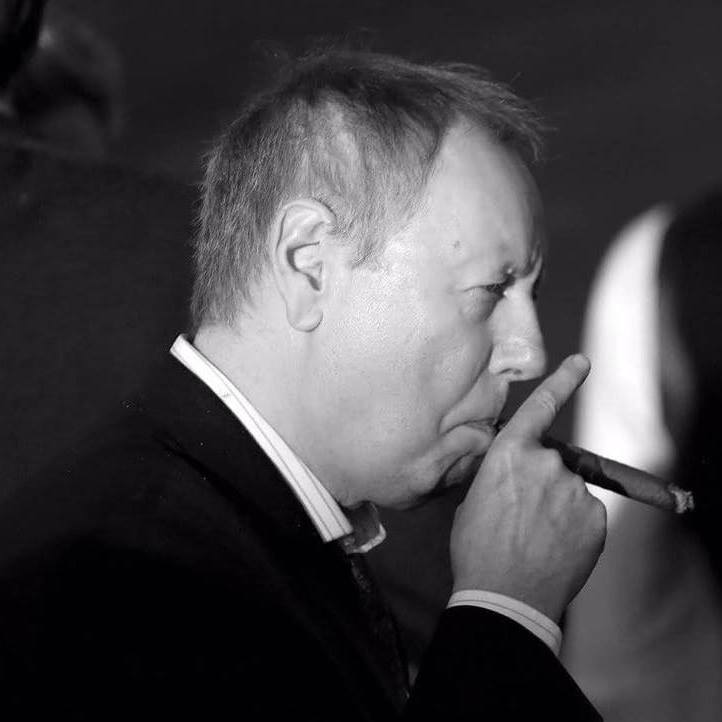
Peter Cowlam. Photograph courtesy of Peter Cowlam
Peter Cowlam is a poet, novelist and playwright. Ghosts in the Machine is his latest collection of poems, original poems in English alongside their translations into Italian, translations by Angela D’Ambra. His latest novel, That Was Hugo Blythe MP, is a satire on daily political life and is published by AN Editions.
Discover more from Ars Notoria
Subscribe to get the latest posts sent to your email.