Making keepsakes with pyrography
by Gill Rippingale
I’ve been making Keepsakes for a number of years now, and have posted pictures of various pieces on my blog, on Instagram, Etsy, Pinterest, and on my Facebook page, Hug-the-Tree Pyrography, together with descriptions, but of course the information can get buried quickly! So perhaps a recap of my methods for making these small art pieces is in order.
Creativity is me being me!
I want to begin however by mentioning an important factor, probably the most important, behind the creation of these pieces and behind all of my artwork; the reason for creating it in the first place. Creativity is my personal spiritual path and practice, and the way I interact with and interpret the world around me. It’s me being me, and an expression of feelings and subtle insights garnered through the interaction of my senses with the outer world, particularly the world of nature- a world which brings me joy and happiness.

I’ve mentioned before that I’ve never really lost the sense that creating something that has never existed before and will never exist again seems inherently magical and extraordinary! Making new lines on a blank sheet of paper or wood is wondrous and exciting and utterly compelling! So, creating a new Wood Keepsake begins with impressions received through my sense of touch.
The best woods to use are slow growing, light-coloured woods. I have a collection of small, oddly shaped pieces of exotic or native hardwoods, such as Holly, Hornbeam, Box (Buxus) Hazel, Pear, Apple and Pyracantha. Occasionally, I use Yew or Birch. They usually retain some bark on one or more sides, and are sliced through or with the grain, or both. The side with the bark will be rough, pitted and greyish, and the other sides will be sanded smooth and will often show growth rings and patterns. Even at this stage, before any artwork has begun, each of these pieces is unique, with its own history, its own life and its own beauty. with not too much grain. I handle my wood pieces frequently, sorting them out, turning them over in my hand, gazing at them, admiring them, and eventually I select a particular piece to work on.


More sanding, using the finest grades of sandpaper creates the smoothest of surfaces, beautiful to behold and to touch. And now I begin to take in the shape, the colour, the patterns of the grain and allow these impressions to work together to conjure an image. Images may or may not arise – some wood pieces remain in the pile for years!
When I do have an initial impression or idea, I’ll visualise how the design might fit and work with the particular shape of the wood piece. If the design is going to cover three or four sides, I need to have a rough idea of where particular elements of the design will look best. The top of a wood slice becomes an extension of the main face. The left and right sides can also be treated as an extension to the main face.

Even the base may be incorporated as an extension of the main face, or it may be treated as a separate design. For instance, if the main face will feature a woodland scene with trees, I may extend the roots down into the base. I often do this, and include a little sleeping mouse or creature among the roots. But I may decide on a two in one design, with unrelated images on different faces of the wood. Having mapped out an approximate design in my head, I begin to pencil in rough outlines on the wood. I don’t pencil in much detail at this stage, just rough outlines of animals and trees etc.

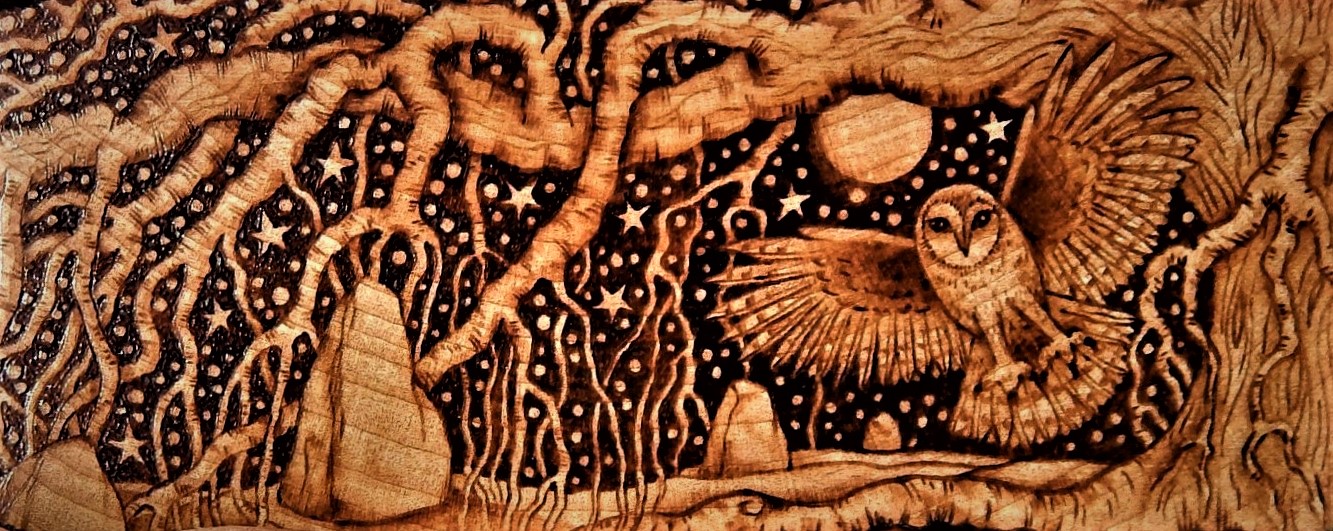
It’s time then to take up my hotwire pyro stylus and begin the burn! It’s always exciting to begin work on a new piece of wood and I quickly become absorbed in my work as I work around the outlines with my stylus, I always fill in the background first, which is almost always a dark starry sky and very slow and detailed work, as I create the ‘stars’ as I go. I often listen to music while I work, and allow other features of the design to unfold by themselves. It’s a little like telling a story, making it up as you go along!

When the background is complete, which might take a day or two, I begin adding shade and detail to the trees and animals. This is very slow work. Because I work on such a small scale, lines for animal faces, fur, paws etc must be extremely fine. The only way to create such fine lines is to use the edge of my spoon tip and adjust the heat to a very low setting. The whisker and fur strokes have to be precise and miniscule, with no room for error; the slightest slip or line in the wrong place can completely throw out the rest of the features of the animal, and there’s no rubbing out!

Concentration is absolute. I frequently discover that I’m hardly breathing! But working like this does require frequent breaks. I get up and leave my work space roughly every fifteen minutes, just for a few minutes, which allows my eyes to readjust. Those who are familiar with pyrography sometimes ask which tips I use. I create my pieces almost entirely using just my spoon tip. I adjust the temperature settings constantly, and I apply wax polish to finished pieces, but never varnish! The wood must of course be seasoned, and sanded as finely as possible. It is quite difficult to show photos that really capture the keepsakes – they are best being held and turned and viewed from different angles in the light.

Reprinted from an original article first published on the author’s blog.

Discover more from Ars Notoria
Subscribe to get the latest posts sent to your email.