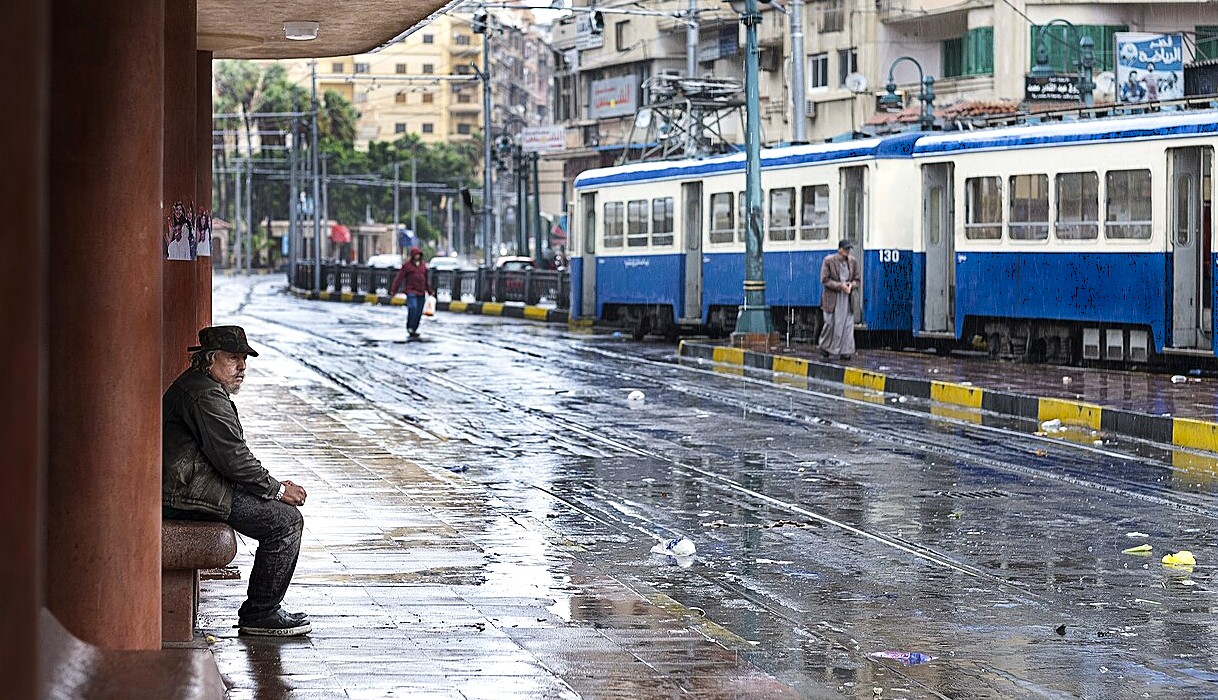
Alexandrian Tramway in the Rain. Photograph Mohamed Hozyen Ahmed, Public Domain
By Adel Darwish
Founded by Alexander and once governed by Cleopatra, Alexandria became a beacon of learning and cosmopolitan exchange. Today, in the name of development, the city’s physical memory is being dismantled — and the Ramleh tram is among its most eloquent victims.
There may be many cities bearing the name Alexandria — scattered from America to Central Asia — but only one shaped the imagination of civilisation. Established by Alexander the Great in 330 BC, elevated by the Ptolemies, and crowned by Cleopatra’s dramatic reign, this Alexandria was more than a settlement by the sea. It was a proposition: that intellect, diversity and beauty could coexist in civic form.
What now unfolds in Alexandria cannot be dismissed as routine redevelopment. It represents something deeper — the gradual unravelling of a city’s visible memory. Over the past decades, particularly in the post-Suez era, a doctrine of “modernisation” has embedded itself in official thinking. Its assumptions are blunt: speed over continuity, efficiency over elegance, scale over intimacy. The consequences are written not in policy papers but in concrete.
The removal of historical anchors and their replacement with anonymous structures is not accidental. It reflects a mindset in which disruption is rebranded as progress and uniformity mistaken for advancement. Bureaucratic planning cultures, shaped by post-war architectural dogma and incentivised by short-term returns, have treated inherited beauty as expendable. What was once civic memory is increasingly sacrificed to immediate utility.

Alexandrian Interior. Photograph Yaşar Başkurt on Pexels.com
George Orwell grasped that the control of memory is inseparable from the control of power. Altering textbooks and dominating narratives are obvious tools. Less visible, but equally potent, is the reshaping of physical space. Architecture is memory rendered tangible. As long as a city retains its façades, routes and landmarks, it quietly resists simplification. Remove them, and historical depth flattens.
Modern Alexandria, rebuilt from 1805 under Muhammad Ali Pasha, evolved into far more than a port. It became a layered chronicle. Greeks, Italians, Jews, Armenians, Levantines and Egyptians did not merely inhabit it; they inscribed themselves upon it. Schools, theatres, cafés and tramlines formed a visible grammar of pluralism. Few elements expressed that grammar more clearly than the Ramleh tram.
Laid down in the 1860s, the tramway was not simply transport. It traced a civilisational spine through the city. Its stops bore names that mirrored Alexandria’s strata of memory: Soter, recalling Ptolemy I; Cleopatra, symbol of the Hellenistic world’s twilight; Gianaclis, marking the legacy of Nestor Gianaclis and Egypt’s tobacco heritage.
One stop evoked an older resonance still: Dinocrates. Dinocrates of Rhodes, Alexander’s architect, conceived the city’s grid — rational yet humane. Legend recounts that, lacking chalk to mark the design, he used barley grains. Birds descended and consumed them. Some saw misfortune; Alexander saw destiny. The city, he believed, would nourish humanity — not merely with grain, but with knowledge. That legend captures an ancient understanding: cities are organisms, not machines.

Alexander The Great. Photograph Jastrow. Wikimedia Commons
The Ramleh tram carried that organism’s lifeblood. It linked villas and beaches, Greek cafés and French lycées, Ottoman quarters and British institutions. On its seats travelled schoolchildren, lovers, civil servants and dreamers. Boarding it meant moving not only through geography but through inherited time. To dismantle such a line is not renewal. It is the thinning of memory.
Authoritarian modernisation empties space of narrative. When distinctive features disappear, cities become interchangeable surfaces. Once the tram is gone, once boulevards are stripped and trees felled, Alexandria risks dissolving into generic sprawl — its uniqueness diluted by haste.
Modernisation, when properly understood, need not be hostile to inheritance. Cities evolve. They always have. Alexandria itself was layered repeatedly — Pharaonic, Hellenistic, Roman, Ottoman, European, Egyptian. But evolution differs from amputation. To widen roads by uprooting century-old trees, to silence tramlines that have carried generations, is not adaptation; it is rupture.

Alexandrian Tramcar. Photograph Mario Rivera on Pexels.com
There is also an irony. The very features being removed — tramways, shaded boulevards, human-scale transport — are now being rediscovered by forward-looking cities worldwide as models of sustainable urbanism. What others labour to reintroduce in the name of environmental balance, Alexandria discards under the banner of efficiency. In doing so, it risks losing not only heritage, but relevance.
For native Alexandrians, the tram is not sentimentality. It is structure. Its preservation is not an act of resistance to development, but resistance to amnesia. Remove the backbone, and civic coherence falters.
Consider the cultural coordinates at stake. The Trianon café, where E. M. Forster encountered Constantine Cavafy. Baudrot, where Lawrence Durrell took Eve Cohen on their first date — the future inspiration for Justine in The Alexandria Quartet. These are not romantic embellishments; they are markers on an intellectual atlas.
Beneath today’s pavement linger older presences still: Hypatia, slain for her intellect; Saint Catherine; Bonaparte; Kitchener; anatomists such as Herophilos and Erasistratos, whose inquiries expanded human knowledge. Cities remember through stone even when administrations forget.

Alexandria Adieu Adel Darwish’s personal history of ‘Alex’
Safeguarding what remains of Alexandria’s royal-era inheritance — tramlines, façades, boulevards — is not nostalgia. It is cultural self-defence against a mechanistic doctrine equating motion with erasure. The Ottoman and European layers did not weaken the city; they enriched it. The Ramleh tram, running from Victoria to Place du Tram Ramlah and beyond, testified to that enrichment.
Its removal sends a silent message to future generations: that complexity is disposable. To defend it is to affirm a different proposition — that Alexandria’s identity resides not in anonymous concrete, but in the accumulated elegance of its plural past.
Old cities trouble authoritarian minds. Regimes instinctively recognise what technocratic planners sometimes overlook: historic cities possess agency. Old cities unsettle power because they contain memory.
From Haussmann’s reshaping of Paris to Stalin’s demolition of historic quarters, regimes have repeatedly sought to simplify urban space. Ornate façades are replaced by blank planes. Names are altered. Streets widened into uniform corridors.

Montaza Palace, Alexandria, Egypt. ‘Ornate façades are replaced by blank planes.’ Photograph Ahnaf Saber Wikimedia Commons
The reasoning is consistent. Layered cities complicate official narratives. A tram stop bearing an inconvenient name, a café associated with a dissident poet, a square recalling an unfashionable era — all challenge the myth of clean historical rupture.
Glass and concrete are politically obedient. Texture is not. Buildings cannot be footnoted into submission. Streets carry the imprint of philosophers, conquerors and dissenters alike. They testify that history is continuous. To erase such testimony is not efficiency. It is anxiety — anxiety before memory’s quiet persistence.

Adel Darwish. Reproduced by permission of Adel Darwish
Adel Darwish has been a distinguished figure at the press gallery at the House of Commons through some of the most tumultuous political upheavals of the modern age. His reporting an analysis have informed literally millions, both across the Middle East region and internationally, and he is a regular feature across news channels the world over. Adel Darwish is the political editor of World Media, Middle East News and The Middle East Maggazine
The essay above draws on themes explored in Alexandria Adieu, Adel Darwish’s sixth book, which recounts life in Alexandria between the Second World War and 1960. During those years, the author witnessed the dispersal of more than 100,000 Alexandrians and the gradual erosion of many civic and cultural institutions. Combining personal recollection with historical reflection, the book seeks to preserve the intellectual texture of the city of his birth — a heritage that remains under mounting pressure.
Discover more from Ars Notoria
Subscribe to get the latest posts sent to your email.
You must be logged in to post a comment.