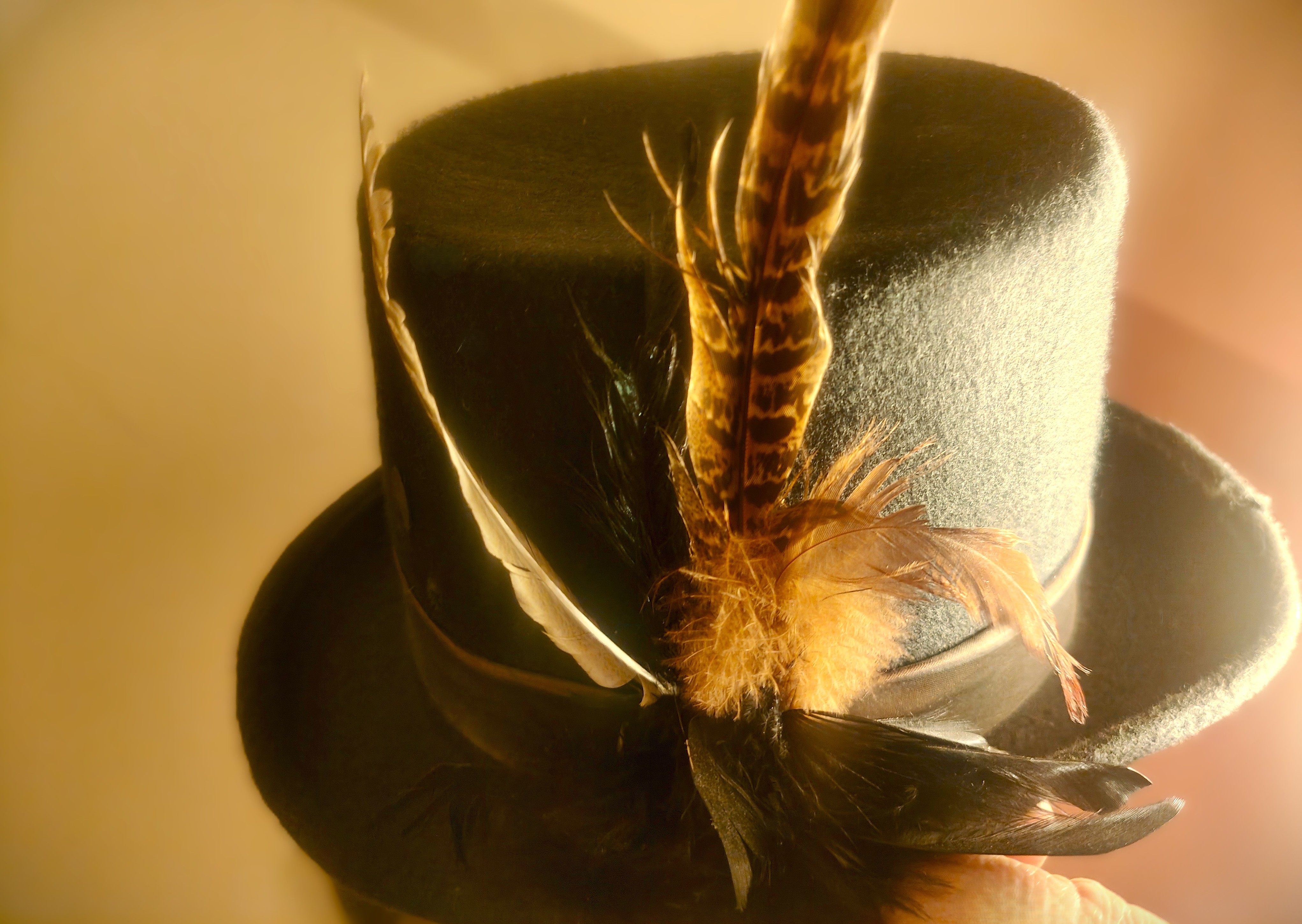
My Hat. Photograph Phil Hall
by Phil Hall
We’re talking about religion and the imagination. Some of the wildest thoughts human beings have ever had have been religious thoughts. Some of the most extravagant love stories, like the Song of Solomon—are religious. Some of the most apocalyptic science fiction ever written came from religious minds. From mana and the parting of the Red Sea, to great dragons and great giant Babylonian sex workers, to ideas about the gods themselves, parting the seas and throwing thunderbolts, thoughts about where the gods might live. Obviously in the clouds, or under the sea, or on top of mountains, or under the earth. From creation, into what Tolkien called “secondary creation”: the imagination is the very fabric of religion and myth. Arthurian stories are the invention of Malory, woven from scruffy fragments of older stories.
Jumping over fires. Raising the dead. Cosmic ages so vast they exceed thought; the Big Bang; the need of the Mexica sun for the blood of human beings to rise again in the morning; rabbits thrown onto the moon; clever spiders made gigantic; flying feather serpents and pathways through the underworld; Osiris chopped into pieces, chewed on by crocodiles and collected up again.
All the works of mythology, described without much empathy or understanding by Frazer in The Golden Bough, and then again with a little more understanding by Joseph Campbell, were actually elements of belief systems, as ridiculous and anachronistic as a top-hatted gentleman with a huge waxed moustache and his bull pizzle fertility cane, extracted from a Victorian street. These things made sense once upon a time.

The Death of Adonis (1709) by Giuseppe Mazzuoli. Photograph Yair Haklai, Wikimedia Commons
I was at a Quaker meeting the other day, and I asked somebody what they thought of angels. Without hesitating they said, “Oh, angels are actually extra-terrestrials.” And so the scientistic fantasies of writers like L. Ron Hubbard, with their reactionary smears of technological verisimilitude, appear.
And Velikovsky, Sheldrake, Eric von Däniken, and all the rest of those quacks ply their trade in phishing you into believing their own half-arsed crap. Though the expert in these matters of Wow!, Jacques Vallée, himself says: no, these things have been around forever, and they’re clever. They take the shapes they want to take because they understand the way we think. They were angels and demons after all. They’re manipulators. They can be to us whatever they want to appear to be, because he thinks that whatever they are, they do exist. And he uses the example of Fatima, the Lady of Fatima, and the two solar disks, the thousands of people all looking up, blinded.
And here we come to the point.
Religious people imagined things, sometimes rather worrying things. For example, the author of Genesis wrote that Lot’s wife turned into a pillar of salt; that the angels of Sodom were sodomised; that Lot slept with his daughters; that Noah cursed his son Ham because he saw Noah drunk and naked after the building of the ark, and a world flood where everyone dies except the hero and his family and farm.
And on and on. After having imagined things to the breadth and height and depth of the cosmos, religion then turns around… and clamps down. And tells hoi polloi readers: don’t imagine anything new.
The Qur’an (if you read it past the first pages) compels belief, with threats. Or else you will suffer the imagined eternal damnation. The Christians did much the same. The Buddhists were insanely smug about the conclusions they had reached after long meditation on iron bottoms. The Taoists couldn’t give a shit.
But the point is: the religious imagination turns around and tells you, “This crazy stuff is real. Buy in. Three for the price of one!” And you must buy in and eat the other egg, because clearly the priests did actually predict the flooding of the Nile, so they must be right about everything else, too.
The reality of other people’s imagination hems you in like the nigh inescapable walls of Wormwood Scrubs. There was a yoga project to help prisoners meditate their way to freedom. The stone-faced banks you see around you, and the ginormous skyscrapers wrapping around financial usury and fraud, and the museums telling stories about colonialism built in Palladian. And all of these are figments of someone else’s imagination, not yours, (oh younger, softer person entering into the world). And the solid temples and the churches rising to the skies are now community centres and cafes before they are places full of priests and ministers forcing parishioners to bow their heads and say uncle and the Our Father.

The Sphinx of the ancient Egyptians. Photograph Hesham Abeid, Wikimedia Commons
All of that is so solid and so real, and so articulated, that it’s there to tell you: do not reimagine. Because to reimagine is to be a revolutionary.
But you have the right to imagine what you want. Those are the words, and that’s the key. What do you want, and what do we want? What does your family want? What does your street want? What does your town want? Well, get together and reimagine the world around you and remake it in your collective image.
This is something that art and literature gives us. This is the freedom we require to move forward in life. This is how we overcome blindness. And to ask yourself what do we want, frees you up to contemplate new worlds that might at first might seem impossible: the building of houses in different ways, new transportation systems, new queer relationships, and on and on and on. Don’t leave reimagining the world to toxic, South African-born, nerdish sociopaths with rockets and AI.
It was the caterpillar in Alice in Wonderland who said, “Why, sometimes I’ve believed as many as six impossible things before breakfast”. Give it a go! Strengthen the muscles of your imagination. Just because you entertain an idea doesn’t mean you have to invite it to stay.
If, for example, Beatriz Villarroel, astrophysicist and UNESCO prize winner, conducts a survey and discovers that there were a hundred thousand shiny objects orbiting Earth before the first satellite, Sputnik, went into orbit (someone else has just confirmed the observation) you will now have the power of your own imagination to think about what those objects might be. Do you need to be told what to imagine?
Well, clearly you are told what to think. You are told what to imagine. You do so without sometimes ever asking cui bono; who benefits? Because who are you, full of chutzpah, to dare to reimagine what has already been imagined and made real in stone and plastic and steel, in roaring engines, in flickering lights on screens, in colours, in story after story after story, in tried and tested methods for the delivery of pleasures and sensations, in status, in schools, at work, and everywhere else?
Now, a Marxist would call this the ideological superstructure of our capitalist society, and we exist within its interstices like termites in rotten wood. So that if you did happen to live in Babylon, you would certainly be a follower of Bēl Marduk. And if you were a follower of somebody else’s imagined god, and not the god of the ‘son of the sun’ the ‘bull-calf of Utu’; you’d be in big trouble in the city of bar-ki-bar.
In fact, you probably wouldn’t even question it, because you would have been brought up loving date syrup produced by Marduk’s priests; you would have walked through compacted mud edifices in the dimensions dictated by Marduk’s priests; you would have listened to early versions of the ode of Gilgamesh chanted by Marduk’s priests; watching the miracle of agriculture and the products agriculture gave you to eat, provided by Marduk’s priests; and you would have seen the scribes, on the orders of Marduk’s priests, indenting impossibly complex words and mathematics onto clay tablets; you would watch the big boats on the river carrying cargo and Marduk’s statues. How could you possibly disbelieve the wild and crazy story thought up by some controlling mind about Marduk?

Marduk’s Mušḫuššu. Photograph Allie Caulfield, Wikimedia Commons
One of my daughter’s friends is obsessed by the tarot. Obsessed by magic. But the tarot is just a system of symbols and images that allow an unconscious accretion of associations; the freeing up of a shaped mind, a more intuitive way of formulating thought. The cards are a set of fuzzy hieroglyphs.
In living memory, in the 1960s, people born in the early 1950s and 1940s had been brought up to think in very rigid ways. They struggled to free themselves from stiff ways of reacting and thinking. They needed to escape that confident solidity of conventionalism. In the 1980s, people born in the 1970s were conditioned into believing that the only possible kind of society was a capitalist society, despite the evidence in front of their own eyes in Cuba and elsewhere. Thatcher’s generation tried to escape There Is No Alternative by using a cocktail of nihilism, scepticism, travel, sybaritic indulgence and mildly innovative lifestyles set to music.
People have always used a variety of tools to escape systems of thought imposed onto them; rigid thinking that nowadays we are less beholden to in the free-flowing cosmopolis where cultures intersect and cross-fertilise.
In the 1970s, women were escaping the 1950s idea of women. And if you were gay, there was something wrong with you, according to the conventions of the 1950s. All sorts of things were true that are now considered nonsense, but you were made to internalise them, and you were forced to imbibe these ideas through the agency of institutions like family and school, and made to take them seriously through the oppression of socialisation and peer pressure, and and the need to get accepted into the workplace.
In the early 1950s, Angela Davis was not allowed as a girl to go into a library and read books because she was not ‘white’. That was ‘reality’. But her mother said—mark these words—”Just because things are this way now doesn’t mean they should be this way, and it doesn’t mean they always will be this way.” Angela Davis quotes her mother, and Angela Davis’s mother’s comment is a key to becoming a reimaginer and creator of a better future in opposition to oppression.

Angela Davis and Soviet cosmonaut Valentina Tereshkova, 1972. Photograph Novosti Wikimedia Commons
Colonialism and racism and sexism and ableism and ageism destroy lives when they force people to internalise painful and negative ideas of themselves. Several Korean children at the Quaker exhibition Drawing for Peace seem to have internalised the description of themselves as ‘yellow’. There are pictures where children have literally drawn their faces yellow. A mustard yellow. These are internalised stereotypes of racism, of colonialism, promulgated by the consumption of Hollywood and US Television—products of that cultural sewage factory, of the metropolitan core, of corporate global capitalism.
It is difficult to escape your upbringing. To become assertive when you’ve always been told to shut up. To be unselfconscious about your sexuality. It is difficult. And there are all sorts of ways people try to untie themselves and allow their imaginations and creativity to flourish without anxiety. Sometimes freedom in the form of hallucinogenic drugs can kill you.
Put it this way: we live in a world that has been conjured up. But now our world is in crisis because of the conjurings of global corporate capitalism, and because of the fossilised, wild imaginings of hundreds of thousands of people who are now dead. We are in deep shit. A bloviating baboon is spearheading a scorched-earth policy and bombing Iran, supporting and enabling the extermination of Palestinians, and celebrating racism and global warming. It’s about time we reimagined the world and fashioned it anew.
The first creative act is to understand that you have the right to do so; if you met Einstein, or Tesla, or if you met Shakespeare, or Gandhi, or Teresa of Ávila, you would only ever be meeting a human who once sat on the toilet and shat just like you. There isn’t that much of a difference between you and Mozart or Jesus. Degrees of worth are exaggerated. You can respect people and listen to them without abasing yourself.
The Quakers were killed and jailed by the Puritans, who insisted on their own way of seeing things. They were jailed, killed, beaten up because they refused to doff their caps; to take off their hats in church or before magistratesand judges and in the presence of their ‘betters’. All humans are equal!
Think about the Mexican Revolution. Along with every revolutionary struggle comes the effort to reimagine society, where people who were previously controlled and exploited and ordered about must decide how they want to live. A vast collective reimagining takes place. Before the Mexican revolution, indigenous culture was something to be eradicated, or, at best, preserved in a museum. During and after the revolution, Diego Rivera paints the walls in the Palacio Nacional with Tenochtitlan as a market. Statues go up to Cuauhtémoc, and new Mexican institutions are born that precede the social democratic reforms of Britain by 25 years. A new society is fashioned from what the people say they want and from the rubble and treasure of the old society.
Let your imagination run wild, wilder than the craziest mystics ever born. The first step for you, in reimagining the future, is to refuse to take off your hat. Of course, you have to actually buy a hat first before you can do that. The future depends on it.
Born into an exiled ANC family, Phil Hall spent his childhood in East Africa and India before settling in the UK. After a global education in languages, politics, and economics, he lived and worked across Europe, the USSR, Mexico, and the Middle East. Returning to the UK during the pandemic, he co-founded Ars Notoria Magazine and AN Editions, a publishing venture dedicated to Humane Socialist literature, art and philosophy.
Discover more from Ars Notoria
Subscribe to get the latest posts sent to your email.


You must be logged in to post a comment.