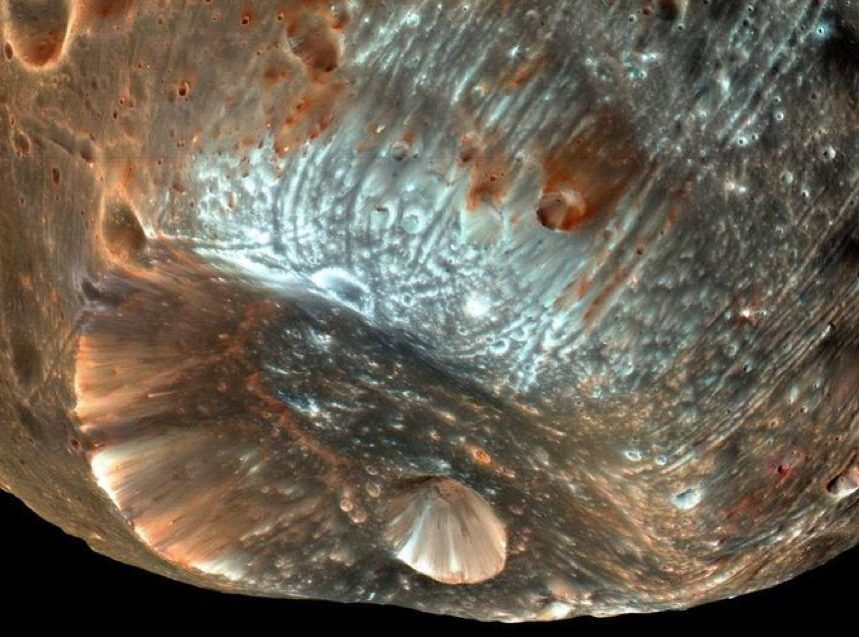
Does Phobos look as if it is a pile of rubble, or does it look like a battered 500 million year old metallic hulk? Photograph NASA
Will 3I/ATLAS, bide its time in the Oort cloud before swinging in again for the kill?
by Phil Hall
John E. Brandenburg is a plasma physicist with a background in nuclear propulsion, fusion research, and space plasma physics. He has worked at institutions including Lawrence Livermore National Laboratory, Sandia National Laboratories, and NASA-related projects. He is best known in alternative circles for his controversial hypothesis that Mars experienced two massive, anomalous thermonuclear explosions in its geological past; he interprets this event as deliberate nuclear attacks that destroyed an ancient civilization 500 million years ago.
Brandenburg’s evidence revolves around isotopic anomalies in Mars’ atmosphere and on its surface: a xenon-129 excess, where the ratio of ¹²⁹Xe to ¹³²Xe in the Martian atmosphere is unusually high and matches the signature of fission from nuclear weapons (similar to open-air nuclear tests on Earth), rather than natural processes or moderated reactors. There are krypton and argon anomalies, including elevated levels of certain krypton isotopes (e.g., ⁸⁰Kr) suggesting intense neutron bombardment, and high ⁴⁰Ar/³⁶Ar ratios pointing to neutron capture on potassium in surface rocks; and there is uranium and thorium distribution, where orbital gamma-ray data from missions like Mars Odyssey show enhanced levels of Uranium and Thorium on the surface in chondritic ratios, contrasting with depleted levels in Martian meteorites, suggesting a planet-wide debris layer from exploded devices which had Uranium-Thorium casings.
Brandenburg models two large air-burst events (there are no large craters at these sites) centred over Acidalia Planitia (near Cydonia Mensa) and Utopia Planum (near Galaxias Chaos). These are regions with surface features some interpret as possible archaeological ruins.
Yields are estimated in the range of billions of megatons, sufficient to alter the planet’s climate, strip atmosphere, and create global effects. Brandenburg links this to the idea that there were artificial structures at Cydonia, such as the Face on Mars and nearby pyramids. He argues the explosions targeted these sites, implying a planetary nuclear massacre. This connects to the idea that the apparent silence of the cosmos may be explained by the danger of rival growing intelligent civilisations being wiped out, with Mars as a warning to Earth.
Metal Phobos

Color image of Phobos, imaged by the Mars Reconnaissance Orbiter on 23 March 2008.
There is a new mission planned to go to Phobos to investigate this year. The Martian Moons eXploration (MMX) mission is being prepared by the Japan Aerospace Exploration Agency (JAXA) and is scheduled to launch in 2026. The mission will return to Earth in 2031. What will it discover?
Phobos is the largest and innermost moon of Mars and it measures roughly 27 by 22 by 18 kilometres. Its most dramatic feature is a crater: 9 kilometres wide, indented into the moon. Across the surface of Phobos are shiny, linear grooves 30 metres deep, 100 to 200 metres wide, and up to 20 kilometres long. Phobos has a low density.
In the 1950s and ’60s, Soviet astrophysicist Iosif Shklovsky suggested that Phobos might be hollow and artificial, among other things, based on calculations of its orbital decay. In the 1970s, scientists at the Space Research Institute (IKI) in the USSR proposed a shift in focus: to study Mars’s moons rather than the planet. This might have been partly in order to study the anomalous nature of Phobos. The mission was officially approved in early 1985. The missions were called Phobos 1 and Phobos 2.

Shklovsky with fellow astronomer Inna Shcherbina-Samoylova in the 1950s. Photograph Shamaev Wikimedia Commons
Phobos is an anomaly. It circles only 6,000 kilometres above the Martian surface in Medium Mars Orbit (MMO) far closer to the planet than Earth’s Moon is to Earth, or any other moon of any other planet in the solar system. Phobos completes one orbit every 7 hours 39 minutes, reinforcing the idea that it might have been placed there and actually be an artificial satellite. It moves faster than Mars rotates!
Here is a diagram of what an undeformed Phobos might have looked like before it was battered by impacts. This putative triaxial ellipsoid shape is the idealized “smoothed-out” version of a metallic skinned Phobos. This is a mathematically accurate surface with no craters, grooves, or surface roughness (assuming that Phobos was in reality a deformed metal artificial object).

Details in the ImageSemi-axes (radii): 12.95 km × 11.30 km × 9.16 km (full dimensions ≈ 25.9 × 22.6 × 18.3 km)
The longest axis (X, horizontal in the view) points toward Mars (tidal locking). The shortest axis is the polar one (vertical in this rendering),
A triaxial ellipsoid shape offers several unique benefits for an orbiting space station. Its three unequal axes create a natural gravity-gradient stabilisation, allowing the station to passively align with Mars and drastically reduce propellant use for attitude control. To generate 1 g at the radius of Phobos would require a spin rate of only 0.37 Revolutions Per Minute. At this scale, gravity gradient torques are larger. The three unequal axes of Phobos (12.95, 11.30 and 9.16 km) would create distinct moments of inertia. The station would naturally align with its longest axis pointing at Earth and its shortest axis along the orbit direction. No active thrusters would be needed for basic orientation over vast periods of time saving immense amounts of propellant. The triaxial shape allows the orientation of the highest curvature (shortest axis ends) toward the highest stress directions, which means thinner hull material could have been used where loads were lower. At 13 km scale, even a 10% reduction in hull mass would have saved millions of tons of material.
The effectiveness of the triaxial ellipsoid’s passive stabilisation (gravity gradient) depends on altitude. It is too strong in Low Mars Orbit (causing vibration, oscillation). At 6000k above Mars the 7-hour 40 minute Medium Mars Orbit is the sweet spot. In Medium Mars Orbit the Phobos space station would get 7 hours of sunlight for solar power for every 54 minutes of eclipse by the planet which would give it time to cool down.
The triaxial ellipsoid optimises the volume-to-surface-area ratio, reducing hull mass compared to a cylinder shape, while its ability to spin on different axes allows a continuous gradient of artificial gravity (from microgravity to higher g) within a single rigid structure. The smooth, curved surface distributes internal pressure and rotational stresses evenly, enhancing structural efficiency. Additionally, its asymmetric geometry would enable flexible docking and easy crew orientation during spacewalks.

Details in the ImageSemi-axes (radii): 12.95 km × 11.30 km × 9.16 km (full dimensions ≈ 25.9 × 22.6 × 18.3 km)
The longest axis (X, horizontal in the view) points toward Mars (tidal locking). The shortest axis is the polar one (vertical in this rendering),
A core zone near the center would have been an area of microgravity for manufacturing or fuel storage. The three distinct end zones would have had different gravity levels for habitation, agriculture, and industry. The object would have long transit corridors along each axis (from 6 to13 km long) that could host linear accelerators, mass drivers, and transit systems. While challenging to manufacture in the past on Earth, modern fabrication techniques make this shape a compelling option for future long-duration, multi-purpose stations. In other words, if Phobos were, in fact, to be a deformed triaxial ellipsoid, it would make sense as an technical extremely ancient archaeological relic.
However, the problem remains. If Phobos really were an incredibly ancient space station it would have fallen out of the sky. To last million years in orbit it would need some stabilisation method.
The ideas of John Brandenburg, despite being published in many peer reviewed journals and despite the strong evidence he offers and his impressive career at NASA and elsewhere, of course, are ideas that have been frantically debunked.
The notion that Phobos is light, artificial and covered by a metallic outer layer has also been summarily dismissed. The conclusion reached is not based on actual research, but on Occam’s razor. In other words, the ‘simplest’ solution is assumed to be the most likely one. This is a fallacy of inductive logic. In attempting to visit Phobos the Soviets understood the possibility of artificiality was real. They certainly must have been surprised by what happened when they did go there with Phobos 1 and 2.
The spacecraft Phobos 2 featured a torus-shaped instrument compartment sitting on top of an Autonomous Propulsion System (ADU). The Soviet-made engine could fire three times more often than previous probes and had a guaranteed lifespan of 460 days. The probes had onboard flight computers and used modern microprocessors for better control. The platform was designed for high-precision manoeuvring near low-gravity targets. Two specialised landers for landing on Phobos were planned: PROP F, a 50-kilogram ‘jumping’ lander with spring-loaded legs, and DAS, a long-duration probe intended to deploy a 20-metre radar antenna and anchor itself with a harpoon.
Neither would ever operate. Phobos 2 launched on 12 July 1988 from Baikonur Cosmodrome and arrived at Mars on 30 January 1989. It carried 25 scientific instruments, including gamma-ray and X-ray spectrometers, a high-energy burst detector, and instruments to search for cosmic gamma-ray bursts. On 27 March 1989, while manoeuvring in Martian orbit to meet Phobos, the probe disappeared. Official accounts said the failure was either because of an onboard computer malfunction or a problem with the radio transmitter. BUT other accounts say it was attacked by a very large spaceship that appeared in the last photograph the Phobos 2 mission took.

Phobos, the probe Phobos 2 was lost. Official Soviet accounts attributed the failure to either an onboard computer malfunction or a problem with the radio transmitter. BUT other accounts say it was attacked by a huge spaceship that appeared in the last photograph the Phobos 2 mission took. Photograph Космическая программа СССР
Marina Popovich, a celebrated Soviet test pilot and the third woman to break the sound barrier, in 1991 in public lectures regarding Phobos 2 claimed that an infrared image taken by Phobos 2 on 25 March 1989, two days before loss of contact, showed a needle-shaped object against the blackness of space. This object measured approximately 25 kilometres in length and 1.5 kilometres in diameter. The same craft cast an elliptical shadow on the surface of Mars.
Soviet analysts calculated the shadow to be 26 to 30 kilometres long – dimensions that match the length of the needle-shaped craft. According to Popovich and others, the 25-kilometre-long needle-shaped craft took the Phobos 2 probe out of commission on 27 March 1989 after Phobos 2 fired a laser at Phobos.
The probe failed during its final approach manoeuvres to study Phobos, a timing that Popovich and others considered significant. The Soviet probe carried a powerful laser for experiments on Phobos. The use of this laser might have triggered a defensive response from the needle-craft, resulting in the destruction of the probe. The Phobos 2 last image is not explained by lens flare (the Soviets themselves said it was not lens flare). The official report cited the loss of Phobos 2 as a computer malfunction or “radio transmitter failure.”
This is implausible for three reasons: The final telemetry showed abnormal yaw manoeuvres, as if the probe was attempting to avoid something. The probe had redundant systems. A single malfunction would not cause total loss. The probe was transmitting correctly seconds before loss, then went silent permanently—characteristic of catastrophic physical destruction, not a gradual failure.

Marina Popovich. Photograph Военно-Воздушные Силы,
Popovich’s claims were discarded and an alternative explanation offered: that Phobos is a pile of rubble. Look at the picture of Phobos and decide for yourself. Do you believe your own eyes? Does Phobos look as if it is a pile of rubble, or does it look like more like a battered metallic hulk? Notably, Buzz Aldrin deepened the mystery of the origins of Phobos when he pointed out that there was a huge oblong-shaped structure visible on the surface. He suggested that the USA send a craft to investigate it. Investigate Phobos is exactly what the Soviets were trying to do.
It must be noted that theories about John Brandenburg, based on the discovery of xenon traces (which could only have resulted from two enormous nuclear explosions), suggest that Mars was attacked, perhaps from space. Notably, recently, the anomalous object 3I Atlas (with 22 anomalies making it extraordinarily unlikely to be a natural object) did a close fly-past of Mars, suggesting a follow-up observation mission by the people who destroyed the civilisation and life on the planet. It is possible that the drive-by killing of Mars suggested by Brandenburg happened many millions of years ago; however, it might have been at this precise time that the artificial satellite Phobos was also attacked.
Megalithic Artificial Objects on Mars

A raw image from the Mast camera (Mastcam) onboard NASA’s Mars rover Curiosity, taken on 2022–08–07 at 20:58:23 UTC. (Image credit: Mars analyst notebook, NASA)
Increasingly, more and more megalithic artificial objects are being discovered on Mars, including one perfect cylindrical object, poles, flat surfaces, pyramidical structures, and what look like saucer-shaped buildings on the edges of cliffs and caves. All this suggests the ruins of a civilization and a huge catastrophe that happened a long time ago.
Brandenburg put the date of the catastrophe at around 500 million years ago, based on Martian geological strata and the estimated age of the anomalies and his calculations regarding the nuclear explosions.
- The Anomalous Cylinder: Location – Gale Crater, specifically in the Paraitepuy Pass (a narrow gap) on the lower slopes of Mount Sharp (Aeolis Mons). Context – This is the shiny, perfectly smooth cylindrical object (roughly 20 cm long with a flat end) photographed by NASA’s Curiosity rover in August 2022. It appears partially buried in the Martian regolith. At the time the image was taken, the rover was operating several kilometres away on the slopes of Mount Sharp. Why anomalous? It stands out due to its geometric precision, smooth surface, and lack of similar rocks nearby. Mainstream explanations suggest it is likely human-made debris (e.g., from the rover’s landing system or a shed part), while figures like Avi Loeb have called for the rover to investigate it as a potential non-natural object. Gale Crater is near the Martian equator, a major exploration site due to its layered sedimentary history and evidence of ancient lakes.
- The “Doorway”. Location – Also on Mount Sharp in Gale Crater, near the “East Cliffs” area. Photographed by Curiosity on Sol 3466 (May 7, 2022). Description – A small rectangular opening/fracture in a rocky mound, roughly 30 cm (12 inches) tall and 40 cm (16 inches) wide — about dog-door sized. It has straight edges, a flat top, and a dark interior, giving the appearance of a carved entrance, doorway, or cave mouth with possible vertical “pole” or pillar-like rock formations nearby in the same outcrop. Scientific explanation – NASA and geologists describe it as a natural open fracture in sedimentary bedrock.
- Caves and Cliff/Saucer-shaped Features: Mars has thousands of candidate cave entrances, mostly natural lava tube skylights, pit craters, and collapse features. Anomalous ones (including possible artificial-looking entrances, saucer-shaped structures on cliffs, or sheltered “buildings”) are often reported in these regions: Primary areas – Arsia Mons, Pavonis Mons, and other Tharsis volcanoes (classic lava tube “skylights” and pit chains, e.g., the “Seven Sisters”); Hebrus Valles (northern hemisphere) where recent studies identified potential water-carved (karst-like) caves and sinkholes; the Elysium Mons region, which includes large pit candidates and possible cave entrances; Gale Crater / Mount Sharp cliffs, where near the doorway various small cave-like openings and sheltered overhangs appear in rover images, sometimes with saucer or dome-like eroded features on cliff edges; and Cydonia Mensae and other regions with “megalithic” claims — pyramidal hills, but fewer confirmed cave entrances. Some researchers highlight dark, rectangular or arched openings in cliffs that look like engineered entrances, along with what appear to be saucer-shaped or cylindrical structures perched on cliff edges or inside cave mouths. These are are cited as possible artificial shelters from a past civilization (tying into Brandenburg’s ideas). Summary of locations: Cylinder and Doorway — both in Gale Crater / Mount Sharp (Curiosity’s playground). Caves — widespread, with notable clusters in volcanic regions (Tharsis, Elysium) and outflow channels like Hebrus Valles.
The Possible Implications of 3I Atlas

3I Atlas, with three symmetrical jets and a jet anomalously facing the Sun https://lweb.cfa.harvard.edu/~loeb/TA2.pdf
Is there a relationship with the drive by destruction of a civilisation on Mars and the arrival into the inner solar system of 3I Atlas in 2025? John Brandenburg was fearful of the interstellar object in the light of his research into what happened on Mars. The interstellar object 3I Atlas, that cruised by Jupiter during March and April 2026 with three symmetrical jets and a jet anomalously facing the Sun on entry and exit from the inner Solar System, arrived in a stealthy fashion from the direction of the centre of the galaxy where it was hard to distinguish among all the stars. At the same time, on closest approach to the earth it was hidden behind the sun. Here is The Sentinel Network’s well founded depiction of 3I Atlas, which looks remarkably like Phobos as an ellipsoid.
3I Atlas’ orbit is statistically impossible for a natural object. It aligns within 5 degrees of the ecliptic plane, a probability of 0.2%. It threaded a very close approach to Mars and a relatively close approach to Venus and before heading directly for Jupiter. The cumulative probability of this sequence is 0.005%. Its destination is precise: it intercepted Jupiter at exactly 53.5 million kilometres, the exact boundary of Jupiter’s Hill Sphere, which is the optimal point for orbital insertion or deploying sub-probes. This was not a random flyby. That was an orbital insertion point for Jupiter.
The object’s showed non-gravitational acceleration at perehilion that steered it closer to the edge of Jupiter’s Hill Sphere. Its 16.16 hour rotation was precise and stable, unlike a tumbling comet. Its jets were tightly collimated and straight, sometimes for millions of kilometres and pointed sunward bothe coming and going. On a rotating body, jets must smear into spirals. That they remain straight means the nozzles are actively steered, reaction control systems. The persistent sunward jet is a retro-rocket, physical confirmation of a braking manoeuvre. The 7.74 hour wobble in this jet, exactly half the rotation period, indicates gyroscopic precession.
Observations confirmed extreme negative polarisation, a property that does not exist in the natural comets, indicating a metamaterial surface. Chemical ratios were extreme outliers: CO₂ to H₂O, CO to H₂O, CO to HCN. The nickel to iron ratio was unheard of in natural meteorites and comets, matching industrial superalloys. The colour shifts from red to green to blue, consistent with a plasma drive. Ninety nine per cent of the visible light comes from the jets and coma. The nucleus contributes one per cent. The hull is hidden behind its own exhaust.
If 3I Atlas were a comet then it would just be an speeding Interstellar visitor, but if 3I is under controlled flight the possibility also exists that it may be an interstellar visitor that parks in the Oort cloud.
If this is so, then it could be going back to the Oort cloud. If 3I Atlas is the ancient object linked to the destruction of Mars, there may be another fly-by of Earth in the future, this time a far more destructive one in the spirit of the Dark Forest hypothesis, similar to the fly by of Mars with 3I Atlas as a kind of Von Neumann sentinel-killer for another, far more powerful space-faring civilisation. 3I Atlas trailing in its wake a million-kilometre-long tail of nanomachines and a hydrogen cyanide cloud ready to drop atomic bombs the size of skyscrapers.
Future Fly-bys and the Dark Forest

Will 3I/ATLAS, bide its time in the Oort cloud before swinging in for the kill? Photograph NASA / JPL-Caltech
Questions
The loss of Phobos 2 near the moon, and the observation of a massive needle-shaped object (reported via Marina Popovich), could represent lingering sentinel technology or a follow-up by the attackers. Visually, Phobos does present a stark, angular, grooved appearance in high-resolution images that some find more consistent with a damaged engineered object. Now we can ask the questions:
Look at the picture of Phobos and decide for yourself. Do you believe your own eyes? Does Phobos look as if it is a pile of rubble, or does it look like a battered metallic hulk? Is John Brandenburg right about the destruction of Martian civilisation by an interstellar visitor? Was 31 Atlas that visitor? Are we on Earth in danger of being killed future by 3I Atlas swooping in again, this time in a drive by planetary killing?
Bibliography
Aldrin, B. (2016). No Dream Is Too High: Life Lessons from a Man Who Walked on the Moon. National Geographic Books. [Discusses Phobos and proposed missions]
Angry Astronaut, The. (2021). *The Anti-Tail of 3I/ATLAS and the Nanomachine Swarm Hypothesis*. YouTube video series. Available at: https://www.youtube.com/@TheAngryAstronaut
Brandenburg, J. E. (2011). Evidence of Massive Thermonuclear Explosions on Mars in the Past: The Cydonian Hypothesis and Fermi’s Paradox. Journal of Cosmology, 19, 8275-8295.
Brandenburg, J. E. (2015). Mars: A Cosmic War? A New Look at the Evidence of Nuclear Explosions on Mars in the Ancient Past. Self-published / Proceedings of the Space Technology and Applications International Forum (STAIF).
Brandenburg, J. E., & DiPuccio, D. (2015). The Mars Cydonian Hypothesis: A New Analysis of the Face on Mars and Associated Pyramids. Proceedings of the American Physical Society.
Loeb, A. (2022). The Curious Cylinder on Mars: A Call for Investigation. Medium / Scientific American blog. Available at: https://avi-loeb.medium.com
Mars Odyssey Gamma Ray Spectrometer Team. (2002–2010). Elemental Composition of the Martian Surface: Uranium, Thorium, and Potassium Distributions. NASA / Arizona State University. Data available via NASA PDS.
NASA/JPL-Caltech/MSSS. (2022). Curiosity Rover Mastcam Images: Gale Crater, Paraitepuy Pass (Cylindrical Object) and East Cliffs Doorway (Sol 3466). Mars Science Laboratory Mission Archive. Available at: https://mars.nasa.gov/msl
Popovich, M. (1991). Public Lectures on the Phobos 2 Mission and the Needle-Shaped Object. Transcripts cited in: Hoagland, R. (1992). The Monuments of Mars: A City on the Edge of Forever. North Atlantic Books.
Scarmato, T., & Loeb, A. (2026). Periodic Wobble of the Post-Perihelion Jet Structure Around 31/ATLAS. arXiv preprint arXiv:2601.10860.
Sentinel Network™. (2026). 3I/ATLAS // RECONSTRUCTION v5.1. Interactive 3D model.
URL: https://3i-model.thesentinel.network/
Accessed: May 2026 (v5.1).
Shklovsky, I. S. (1959). The Artificial Satellite of Mars. Publication of the Sternberg Astronomical Institute, Moscow. [Original calculations on Phobos orbital decay]
Soviet Space Research Institute (IKI). (1985–1989). Phobos 1 and Phobos 2 Mission Documentation. Academy of Sciences of the USSR. Mission summaries available via RussianSpaceWeb.com and NASA NSSDCA.
Space Research Institute (IKI). (1989). Phobos 2 Loss of Signal: Official Technical Report. IKI Academy of Sciences, Moscow.
University of Houston / Lunar and Planetary Institute. (1998–2023). Martian Meteorite Database: Krypton, Argon, and Xenon Isotopic Ratios. Available at: https://www.hou.usra.edu
Various Authors (NASA / USGS). (Multiple years). Cave Candidate Catalogue for Mars: Lava Tube Skylights, Pit Craters, and Collapse Features in Tharsis, Elysium, and Hebrus Valles. Astrogeology Science Center. Available at: https://astrogeology.usgs.gov
Discover more from Ars Notoria
Subscribe to get the latest posts sent to your email.



You must be logged in to post a comment.