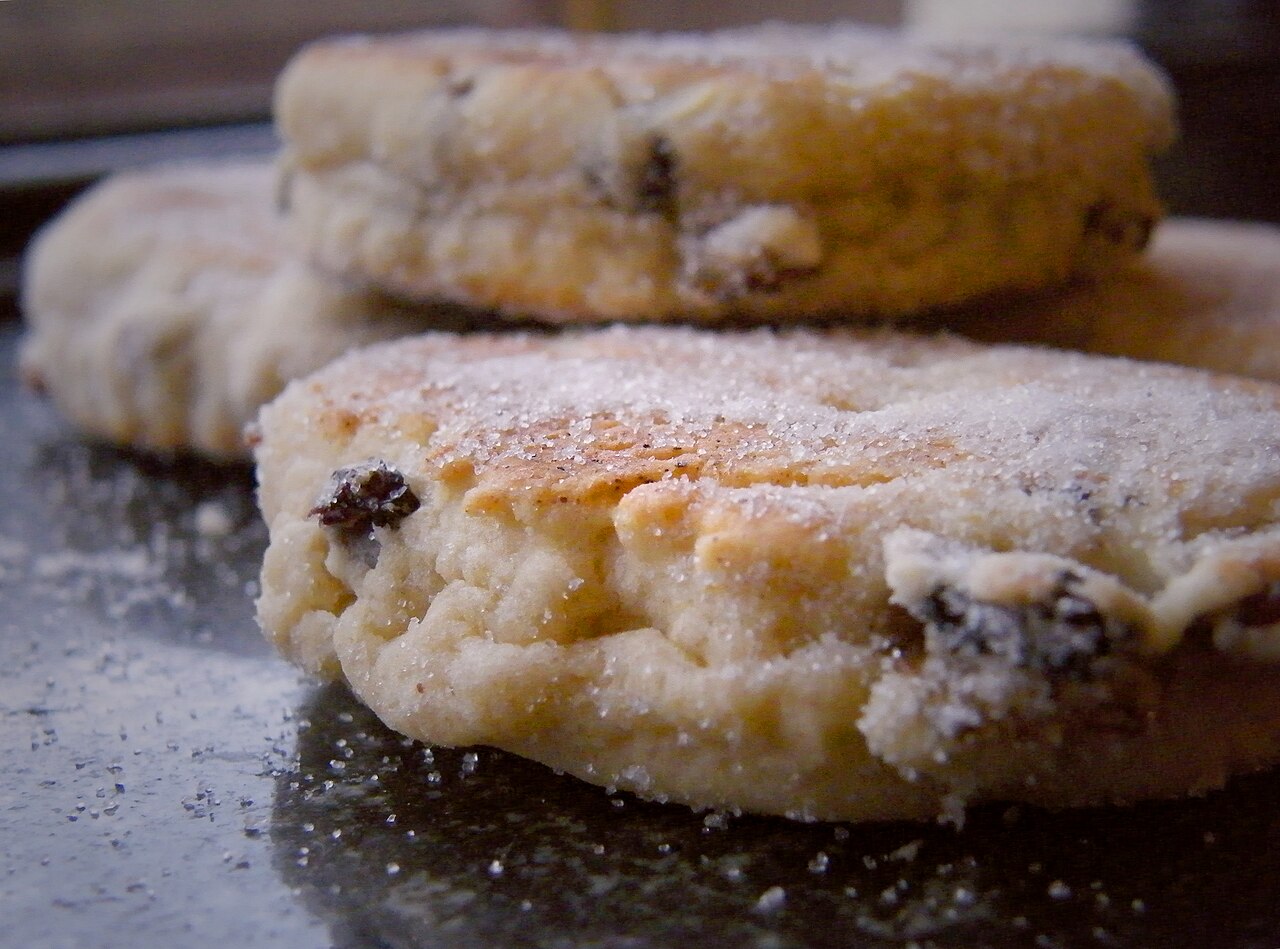
Welsh Tea Cakes. Zingy Yellow. Wikimedia Commons
Reflections on English and Welsh Nationalism
by Pete Field
Before I start asking questions I must state my position. I am English, from the North-East of England and I support a United Ireland, an Independent Scotland, a free Wales and independence for the North of England. Devolution with significant powers to allow more self-determination would go a long way, but I would like to see people in these areas free to choose self-government if they so wish. Amusingly, only the English and the Northern Irish Protestants identify as British: in my personal associations and friendships there is no such thing as a Scottish British person or a Welsh British one. That tells me something. Nonetheless, some things worry me about nationalism.
Robert, who is from South Wales, pointed out to me that the Brexit referendum in Wales, which gave a slight lead to Leave over Remain, had been swayed by the presence of large numbers of English residents who voted in Wales. According to The Times of the 22nd of September, 2019, the Welsh Leave vote was caused by retired English people who moved to Wales. Danny Dorling of Oxford University, who did the research says, ‘Wales was made to look like a Brexit-supporting nation by its English settlers.’ According to the 2011 census, the Times says, 21% of people living in Wales (650,000) were born in England. The majority for Brexit was 82,000, with the Leave vote higher in border communities with more English settlers.
Another result of Dorling’s research is that the mass of the Brexit votes were from the south of England, leaving Welsh Wales, Scotland, the north of England and Northern Ireland as generally anti. This means that these countries and No-voting regions of England are being forced into Brexit and out of Europe against their will. As less affluent areas with higher levels of migration to look for work they also face extra problems if they lose access to jobs in Europe and if business declines or prices rise: they may have more to lose than the south-east of England.

Welsh ponies. Photograph by ‘Boys in Bristol Photography’ on Pexels.com
At this point people who live in these regions are, in a sense, all in the same boat: we are all being forced to accept an agenda written in London and the south of England by the Boris Johnson’s of this world. I voted against Brexit because I believe in the benefits of a united and peaceful Europe and I also do not believe that a better Britain is possible on the back of a xenophobic Brexit which blames Europe for problems actually caused by forty years of right-wing neoliberal policies in the UK.
However, I also back independence for the English ruling class’s ‘colonial possessions’ in the British Isles. Isn’t that rather contradictory? I suppose one’s view of Brexit depends on one’s view of Europe and its benefits, and likewise one’s view of Welsh or Scottish independence depends on whether the Union is seen as beneficial for those countries by their inhabitants.
Some English voices claim that Scotland is over-subsidised by England and would fall to pieces as an independent state, and Wales certainly does not look affluent. There are trees growing out of buildings in central Cardiff. Both countries benefit from the proximity of England as a place for their citizens to migrate to in search of work. According to Wikipedia there are 617,000 Welsh people in England with another 17,000 in Scotland. There are almost 800,000 Scots in England and another 50,000 elsewhere in the UK outside Scotland. Clearly, England has its attractions and free movement of population so that people can find work seems like a very useful benefit from being in the UK. There is also a huge part of the population of the UK that is of shared descent.

Siambr (Welsh Parliament). Photograph Welsh Parliament Wikimedia Commons
Free movement of population also means that English people can live in other countries such as Wales and 650,000 English-born people live there, with another 400,000 in Scotland.
The population of Wales in 2019 was 3.136 million and Scotland numbered 5.454 million, Northern Ireland 1.885 million. These are countries with relatively small populations. The population of England in 2019 was 56,286 million, over ten times the population of Scotland and eighteen times the population of Wales.
The settlement of Wales by large numbers English people who now constitute a fifth of its population and can swing policy through voting, raises a number of interesting points.
The first point is that although the number of ‘settlers’ is large in proportion to the overall population change is inevitable and what it means to be English or Welsh also changes. A substantial proportion of those incomers – almost a quarter – are pensioners. At some point those pensioners will die and be removed from the equation. Although their property may remain in the family one wonders how many people would move from England to Wales simply because they had a house there. I would assume that the remainder of English people in Wales will have children who go to school in Wales and will grow up in Wales. It would be surprising if at least some of these children did not identify as Welsh and in any case if they stay in Wales their own children are likely to consider themselves Welsh. Perhaps English people in Wales will be keen to be absorbed and seen as Welsh, or they would not have moved there and in any case as soon as you sound like a local (second generation) you effectively are a local, whatever the colour of your skin or your religion or provenance.
One wonders how many ‘Welsh’ people have English or other foreign roots a few generations back. My own region, the north-east of England had a huge population increase in the nineteenth century as people flocked to the mines and the factories from around the UK. Many north-easterners have Welsh or Scottish roots or ancestors from other parts of England, but how many people can trace their family tree back more than a few generations? If you are white and Polish or South African you soon blend in and you become an ‘authentic’ local.

Traditional Welsh dance and dress, Photograph Senedd, (2009) Wikimedia Commons
If you look different to other people, dress differently or keep up a religion which visibly separates you from the people you live among then clearly you will probably be seen as different and absorption may be more difficult. Acceptance is possible, but invisibility is not. This is also a tribal numbers game. People may be friendly to people they consider as different while there are only a few, but when the numbers of newcomers increase the feelings may change as locals feel threatened.
But even if you look and sound like a local you may still not be safe from discrimination. In Northern Ireland you only have to say your name and the person you are talking to will know if you are from a Catholic or a Protestant background. There may be consequences. By contrast in England, in general, nobody cares about which sect or religion you belong to. The advantage of being less determinedly religious is having less bigotry. English people look on Northern Ireland with bemusement: why don’t they just drop it?
There are black people in Wales whose ancestors came there hundreds of years ago and they are considered Welsh. They constitute a small proportion of the population. I would hope that any more recently arrived black or ethnic minority people are also considered as Welsh. But what happens if those people are also English? Can they self-identify as Welsh once they become resident in Wales? Will they be acceptable to the locals as Welsh? Will they be allowed to sing in the eisteddfod and be druids and participate in Welsh historical re-enactments?

The Welsh singer, Shirley Bassey. Photograph 1971. Photograph Rob Mieremet – Nationaal Archief Wikimedia Commons
Can I be a Muslim Pakistani ‘English’ person and move to Rhyl and become Welsh? Should I want to be Welsh? Am I part of an occupying force of foreigners even if I was discriminated against somewhere else and want to escape discrimination by moving to Wales? Is it OK to be an asylum-seeker from Afghanistan and want to be Welsh? Is that better or worse than having a retired white English stockbroker move in next door and wanting or not wanting to be Welsh? If we the new arrivals have children will our children be Welsh?
Is the Brexit vote a sign that there too many English people in Wales? If so, what is an acceptable figure? At what point can we say that an English presence in Wales or Scotland or Cornwall is having an undue effect on local life and politics. If that ‘limit’ is reached should there be a ban on more arrivals or expulsion of those who are already there? Reform would agree, but this is ethnic cleansing, which tends to have a bad name in Palestine, Serbia and other trouble spots, because ethnic cleansing is associated with genocide.
One might suggest that ethnically cleansing Wales of English pensioners could not possibly be genocidal because the population of England is so large that there is no danger to the culture or existence of English people as such. Pensioners could just move over the border (if they could afford it). Of course the forced expulsion of English from Wales, while maybe guaranteeing a more authentically Welsh vote and way of life, might provoke the tit for tat expulsion of Welsh from England, which would fill Wales with unemployed Welsh people so it might be a bad bargain. And how could you prove you were Welsh? The Nazis had these problems with defining who was German and who was not. It would be hard to police such ethnic movements and we would soon be in the territory of vigilante gangs stopping people in Conwy and asking them to say the Lord’s Prayer in Welsh or sing the first few lines of Cwm Rhondda or face a beating.

The Lady of Cornwall with her flower girls at the 2007 Esedhvos in Penzance. Photograph Lady of Cornwall Wikimedia Commons
Welsh nationalists used to burn down holiday cottages owned by English people as a protest against rising house prices in Wales. The increase in house prices caused by affluent city folk moving in is common all over the world, so it is not really about ethnicity. It is about income distribution. It would be better maybe if Welsh people had not sold their houses to English holidaymakers. But were those Welsh owners prepared to sell to their ‘own’ people for less? No, they were not. Did councils set aside a certain number of low-priced houses for locals to buy? No, they did not. In other words, did anyone take action to protect poorer locals and promote their ability to buy or rent cheaply? Not really. In my book that adds up to one thing: the people with money and power do not actual cares about poor locals not being able to afford housing and having to emigrate. They are the problem!
England is next door. Letting people migrate to England for jobs reduces pressure on local authorities, businesses and government in Wales to take action to improve the economy and make the country more egalitarian. In Asia whole countries are practically living off remittances from migrant workers in the Gulf states. One might say the same for the British colonies of England. It is very convenient to allow your jobless to migrate to the UK from Pakistan or Africa or to migrate to the USA from Latin America. African and Latin American countries are released from the demands of the unemployed.
Britain is the most unequal country in Europe and after the USA the most unequal country in the developed world. One feels that the countries of the so called Celtic fringe may sometimes have slightly more interest in left politics, but apart from free bus passes for pensioners and subsidised university places none of this translates to much on the ground: same capitalist system, same inequality.
I want to return to the idea of identity. Identity underpins nationalism and, come to that, regionalism. It could be argued that the region is the natural area to which we feel we belong. The Italians recognize campanilismo – the love of one’s own bell tower as a more potent force than nationalism, and countries such as Italy and Germany spent most of their history as collections of small regional entities or city states. Of course to speak of the campanilismo of the British after they stole 36 million square kilometres from every other country is a bit rich.

The Red Dragon, symbol of the Welsh nation. Photograph Rickfive Wikimedia Commons
It is not surprising that people cling to their own language and customs and feel comfortable, more or less with people who look and speak and eat, think and behave exactly like they do. However, in a global world with international travel and migration, a post-colonial world where Indians and Pakistanis see opportunity in Britain, Indonesians go to the Netherlands and North African Arabs to France, we have to get used to the fact that new languages and customs are among us and the old-fashioned ethnic assimilation of Welsh into England and vice versa may no longer be so simple. The English are being asked to accept and embrace difference and yet (perhaps hypocritically given their colonial past) many fear it.
One of the most disappointing things for Caribbean immigrants to the UK in the sixties was the level of hostility from white people. The government did not prepare the locals for the influx of migrants and the British mindset at the time was intrinsically racist, with a long-held white supremacist view of the world. People from the Caribbean were taught to see Britain as Home, as were people all over the Empire.
But some of the Brits didn’t mean it and despite noble war service and extraordinary efforts made by people all over the Empire Britain was not ready to welcome black, brown or Chinese people onto its home turf. Scotland, Wales and Ireland were enthusiastic participants in the money-making game of empire, but they too, while being colonies were not over-keen to welcome large numbers of black brothers in to their own homelands.

Photograph Alan Fryerg Wikimedia Commons
Britain has attempted to create a multicultural society and to some extent this has worked, despite institutional racism in the Home Office, the Police and at the highest levels of government. Once cannot now legally discriminate against people by race, nor can anyone be insulted because of the way they look, or sound, or ask for them to go back there they came from. Except in the Celtic lands of the west.
It is common to hear some Scots (Nats) express their dislike of the English – it is almost a tradition. Woe to the Scot who says he thinks we all have a lot in common, or has too many English friends. Aren’t there too many English people in Wales? Are they diluting the culture? Is Wales becoming less uniquely Welsh because of them? Maybe it is, in the same way that England is different now that millions of Muslims and black people live there. It must be possible to create a new identity which is somehow authentic and satisfying. It is necessary. To a large extent we have succeeded.
The problem which is now perplexing the British right wing, and in particular the mainstream parties in the face of ultra right parties like Reform is this: Is it possible to limit the number of newcomers entering the UK without being actually xenophobic? The experience of Europeans in the UK post Brexit suggests that the answer might be No. Once we start on the acceptable numbers, the limits and exclusion we are on the path of ethnic cleansing, full stop.
What I need to understand is whether we can and should allow immigration and if so whether there are there limits. Perhaps, if they were allowed to millions of poor people in Africa would immediately move to Europe. That might be too difficult to cope with. Do we care enough about them to support Africa, to make it unnecessary for them to move? No, actually, not really. Rather like emigration from Wales or Scotland to England. Nobody back home seems able to make the country affluent enough to employ all its citizens who want jobs, or to make houses cheap enough for those people to afford them. Cornwall – Kernow – is a case in point. Locals sell cottages to rich Londoners rather than poor locals because money is … well … money! Local kids end up over the Tamar.

Wales is the home of Rugby. Photograph PeeJay Wikimedia Commons
What is the difference between being a Welsh nationalist who wants fewer English people in Wales and being a nationalist in England who wants fewer black people and Pakistanis in England? The racist skinhead and the proto fascist argue that their culture is being diluted by foreigners. That same skinhead is usually quite happy to shop late at night in a Pakistani-owned shop; eat curry and Chinese takeaway and bop away to American black rap music, and he went to a multicultural school.
Despite recent Bible-toting efforts, not many Nazi skinheads go to church, maybe because the message of love thy neighbour sticks in their throat and even the dear old Anglican church looks kindly on communicants abroad. Though let’s remember the prime instigator of racial hatred in the UK, Tommy Robinson, claims he converted to Christianity in prison. The English far right nationalists have been selective about what they accept and reject from the new immigrant cultures and quite a lot of resentment is simply economic: they cannot understand how immigrants can get into ‘their’ country and how some of them end up being successful doctors, lawyers and accountants and drive fancy cars and own big houses when they themselves do not have these things.
Never mind the immigrant’s endless hours of backbreaking toil or study; the shops open all hours or the children’s arduous studies to become doctors or engineers: the white racists are generally unwilling to make this kind of effort, but seem to think that privilege is theirs by birthright.
If you leave school early, are semi-literate, take too many drugs and are disinclined to work or study you will sink downwards in society, whether you are white or not, whether you are English, Scottish, Irish or Welsh. Are the skinheads right to worry that other people are ‘taking their jobs’? They are right to worry, full stop. They are right to worry that they themselves are underachievers in a world of hard work and effort and exploitation. As Brits they are living in a highly unequal society which further limits the chances of working class people, whether white or not. Their real enemy is the exploiting monied class not their hard working neighbours.

The Daffodil is the symbol of the Welsh. Photograph Phil Hall
A better plan would be to agitate and vote and organise for a more egalitarian society that would give everyone a leg up. Free education, as in Scandinavia and most European countries, could do wonders for the UK, socially and economically, but instead of copying our neighbours, we cut ourselves off from them. It is easier to blame foreigners for our woes than it is to fix the inequality and injustice and lack of investment in our own society. The caveat here is that Scandinavian countries are more homogenous and becoming increasingly less tolerant of difference and more exclusive about who their social welfare system benefits.
In the UK and elsewhere, immigrants have been shown to boost the economy by injecting cash, hard work and ideas. Immigration sometimes also supplies cheaper labour. Is Wales exempt from this effect? Is immigration good for Wales from an economic point of view? If so does that mean non-white, non-British immigration or does it include people who may be white or non-white and also English, Scottish or Irish? If there is an increase in prosperity due to immigration would that compensate for a corresponding loss of identity? Is identity actually based on a percentage of ethnically pure locals (to be defined) or can it include people who like to share cultures and learn the language. Interestingly, most Celts do not speak their native language or even appear to want to learn it, though all Scots must learn to dance the ceilidh.

The Welsh White Sheep. Photograph Vertigogen Wikimedia Commons
I recently listened to Bragod: Welsh musicologist Robert Evans who plays the traditional Welsh bowed lyre or crwth, and Mary-Anne Roberts a black Trinidadian based in Cardiff who sings with him. She has made traditional Welsh music her own. Modern popular music in the USA has become the popular music of the UK, but it is rare to find ethnic minority people who are interested in the traditional music of Europe or the UK.
It is probably just as rare to find thuggish hooligans who love traditional English folk music. The Welsh and Scots cling to their music as a sign of national identity. The English have abandoned their own music, though English folk traditions are now making a strong comeback among the young. The truth is that we all live in a culture of shopping, lift music and supermarkets. That is what unites us. We mostly have boring and/or underpaid jobs. That unites us too, or should do, but instead of building a more equal society the lazy minded and intolerant look to blame the outsider and.
I do not believe that our culture as such is eroded by a mixing of peoples. If people want to listen to traditional music or engage in traditional arts they will do so. If football has become more popular than archery it is just change. Pakistanis can play football and enjoy it. White people can eat curry. We can intermarry. We might can even share religions: the UK is becoming less religious as far as Christianity is concerned, which makes the behaviour of some religious people seem odd and sometimes intolerant. But we were there not so long ago.

A traditional Welsh Bardic instrument. Photograph Andreas Praefcke Wikimedia Commons
If in Wales hiphop and rap are more popular than bardic music then maybe it is more about big money and radio airplay than anything to do with, say, England. Cultures change over time. We stopped bear baiting and witch burning. We are no longer have most of our people living on the land. We have become urban. We watch TV and surf the internet on our phones. For most of us our culture has become more global and more similar. Is there a culture that will be eroded – or have we already moved on and left those traditions behind? In my view we need to strengthen and share these traditions, especially in schools. If anything it seems that western clothes, sport, technology and economics have gone global while many interesting cultures and countless languages have actually been wiped out by colonialism and systems of global corporate capitalist exploitation with powerful marketing.
There have been clear efforts right across Europe to build nation states by discouraging the use of minority languages such as Welsh, Irish and Breton, to assimilate the Bretons into France, for example. However, the fact that the Irish, far from being keen to learn their own language, generally prefer the language of the ex-oppressor to the east is an interesting one. Our cultures do not die out simply because migrants destroy them or outnumber: they change because ordinary people abandon their practices and choose the new, the alternative, the modern and – let it be said – they reject the old and the traditional.
We tend to keep what we like of our past. We pay for what we value. If we do not wish to pay it is often because we do not value. Shall we sell our houses to foreigners? It might be unwise to transfer a large slab of the property market to nonresident billionaire landlords, as is currently happening in London and many other metropolises. Does it matter if we sell small cottages to pensioners from over the border? If those sales create a shortage of affordable housing then why do we not take action to remedy that? The English in Wales may end up going back to England, but I doubt it in the same way that I think the Chinese, Pakistani, West Indian and Indian communities of Britain are there to stay.

Traditional Welsh costume. Photograph Photochrom Print Collection Wikimedia Commons
If people who consider themselves to be British natives are going to stop seeing people who seem a little different as a bunch of foreigners then that applies to all of us. Those English people who patronise Wales, tell the Welsh off for speaking their own language in their own country and see Wales as part of England are almost certainly the same people who vote for the racist right in elections. I dislike them, but they are there, the Brexit voters and jingoists. Were it not for them it might be easier for Scots and Welsh people to forget the ruling class English oppressors of the past and present.
My area of northern England/Southern Scotland was once a Celtic kingdom with a Celtic language, Cumric, that finally died out in about the twelfth century as Anglo-Saxon and Danish took over. Are Northumbrians and Scottish lowlanders a Celtic people? Perhaps they are. For the ‘Celtic’ nations we are all English, but if we examine the genome of the English we will find that not much divides us from the Celt and those Celts themselves also have very different backgrounds.

The trip up Mount Snowdon. Photograph Jack Redgate on Pexels.com
It is a significant moment when you realise that genetically you may be very similar to someone who looks very different, never mind the people who look very like you. We can find joy in mutual support and celebration of each other’s lives and cultures. A lively interest in all cultures and a willingness to make peace and friendship with all peoples helps to dispel fears of invasion and cultural epistemicide. And invasion and epistemicide is exactly what the British carried out when they had colonies. What we love in culture we should use and share and keep alive as a community.
All the people of the UK, in every part of it, must have a braver and more imaginative mindset! By struggling for a more egalitarian society we improve the life chances of everyone and our own collective survival. Can regional nationalism in the UK lead us to a fairer, more compassionate and more ecologically viable society? That is highly questionable. It could very well be a dead end.

Pete Field graduated from Oxford University with a passion for all things French. He began his peripatetic life working as the assistant to a lumberjack in the Pyrenees. He is a translator a teacher and an artist and successful illustrator. He has lived and worked in Italy, Germany, Spain, France, The UK, the Arabian Gulf, and lives in Manchester with his Iranian – English family.
Discover more from Ars Notoria
Subscribe to get the latest posts sent to your email.



You must be logged in to post a comment.