
Production Cels Courtesy of Geoff Dunbar
Interview with an animation great
Geoff Dunbar has been a major figure in the world of British animation since the early 1970s, winning several awards for his films, and creating a truly impressive volume of work. Animator/producer/director Dunbar is best known for Lautrec (1975), Ubu (1980) and Rupert and the Frog Song (1984), but he has a long list of credits, and is greatly respected for his pictorial innovation and highly original approach to filmmaking. Fellow editor Phil Hall and I were delighted to be able to talk with him.
Paul Halas: It’s great to be able to talk to you, Geoff, because I’ve been familiar with your films almost since I reached adulthood, which speaks of resilience and great inventiveness on your part. Your work is new to Phil, however, and seeing your films for the first time, he had a very positive reaction to them.
Phil Hall: I was absolutely astounded. I saw Ubu and I just thought it was really shocking. It just seemed very topical – especially with the advent of Trump.
Geoff Dunbar: That’s quite true.
Phil: I was stunned by Ubu, and then Lautrec was so intelligent – and it really was Toulouse Lautrec. And Daumier too, absolutely Honoré Daumier. They were truly an homage… very, very serious.
Geoff: Well, they are. They can’t be anything but. It was a very peculiar time when I came across Lautrec, because at the time I was working at Halas and Batchelor Animation, in London, at the time it was taken over by Tyne Tees Television at the start of the 1970s. The studio produced a large volume of commercial animation, some of which was pretty good creatively, which led me to working in Amsterdam, Paris, Hamburg, Dusseldorf, Madrid etc., but there was still space for some of us to take on individual projects, as my official title was head of special projects.

Lautrec won the Palme d’Or. Credit Geoff Dunbar
I had in my team several highly skilled animators, several of whom had been based in Halas and Batchelor’s second studio, in Stroud, Gloucestershire. People such as David Unwin, John Perkins, Tony Whitehouse and Harold Whitaker – Harold was a very under-sung artist and a terrific animator. Not household names, but greats of the animation world. Anyway, the idea for Lautrec came after I found a funny little book in the Charing Cross Road (London) about Lautrec’s sketches. The sort of thing he might do on a table napkin in a restaurant, for example.
Paul: Did the studio finance the film?
Geoff: It was backed by the Arts Council, and I was able to use the studio equipment at the time. I was given pretty much free rein back then, and we spent quite a lot of time on it. Lo and behold, it was enormously successful on the awards circuit. Winning a Palme d’Or is pretty special… it actually changes your life when you do that sort of thing.
Then I broke away from there. Tyne Tees and Halas parted ways, and I wasn’t altogether happy with the direction of the main studio. So I started my own company called Grand Slam Animation, which was when the Ubu thing came in. The Arts Council was very aware of Lautrec’s success and offered to fund another film. I’d recently see Ubu performed at the Royal Court, which set me on the path creating this insane project. And we were completely serious about making it insane. I told our team we had to make it jagged… irrational. It had to be silly. And the drawing is erratic and splashy… influenced by the work of a guy called Yochi Kuri…
Paul: A Japanese animator. I remember him from numerous film festivals; very economical style, loud, vibrant, and hilariously funny.
Geoff: I remember him from one of them in Romania. Your dad, John Halas, was there too. It would’ve been around 1971-72… He had no English and I had no Japanese, but somehow we communicated.
Paul: As kids, my sister Vivien and I were dragged to film festivals all over the place. I say dragged, but they were instructive. Formative. We got to see experimental animated films from all over the world, but Eastern Europe in particular. And at the height of the Cold War!
Geoff: There were several greats in the 1950s and 60s. Innovators. Gasho Gasparovitch, Jan Lenica, Zlatko Grgić, Tony Zaninovitch… to name but a few I was lucky enough to spend time with.
Paul: Walerian Borowczyk, Karel Zeman, Ivan Ivanov-Vano… Strange how some of the names have stuck, but then so have some of the images.
Geoff: It was a rich and wonderful time…
Paul: But also another age. And the 1970s and 80s brought more innovation, invention, and also challenges.
Phil: If I may make a comment… Eisenstein, the filmmaker, said the eye is liberated; you can see the running train from the tracks. The imagination is absolutely released, and I think this is even more true when it comes to animation. It’s almost as if the failure of animation to become almost the greatest art is a failure of the human imagination.
Geoff: Yes, that’s a great point. I was very conscious of Eisenstein, even although I had no formal film education. I discovered animation when I was about 10 years old, but I’ve drawn all my life. I came into the business as a kind of apprentice, so what I know is what I’ve gathered along the way.
Paul: Which may well have contributed to the versatility in your work. Which brings us back to Ubu. An unusual choice. Alfred Jarry and the Theatre of the Absurd.


we wanted to be anarchic, true to the spirit of Alfred Jarry. scenes from Ubu. Credit Geoff Dunbar
Geoff: I wanted animation to be seen the same way theatre is. Now, years later, computer AI has arrived and completely changed the landscape etc., and flattened those dreams. But anyway, Ubu, Alfred Jarry… we wanted to be anarchic, true to the spirit of Alfred Jarry. We had to do it as if he was our animator, our director.
The reason Ubu came about was when Jarry was a schoolboy his class put on puppet plays. His main character was a cruel parody of his teacher, Félix-Frédéric Hébert, a very gentle man by all accounts, who eventually evolved into Ubu. Ubu then became a play, and when it was eventually performed it caused an uproar. Anyway, it’s that story that led me to the slightly rebellious idea of making Ubu.
The thing that astonished me was the reaction it received. It was tremendous, and it won a clutch of awards, including The Berlin Owl. So then I thought, what do I do next? Thankfully I was enjoying a great deal of creative freedom, and that’s when I became involved with Paul McCartney, who by the way was a huge fan of Alfred Jarry, Pataphysics and Ubu Roi. He wanted me to make an animation of Rupert Bear. Rupert had been very dear to me as a boy, and at Christmas we always had a Rupert annual, as did so many of our generation.
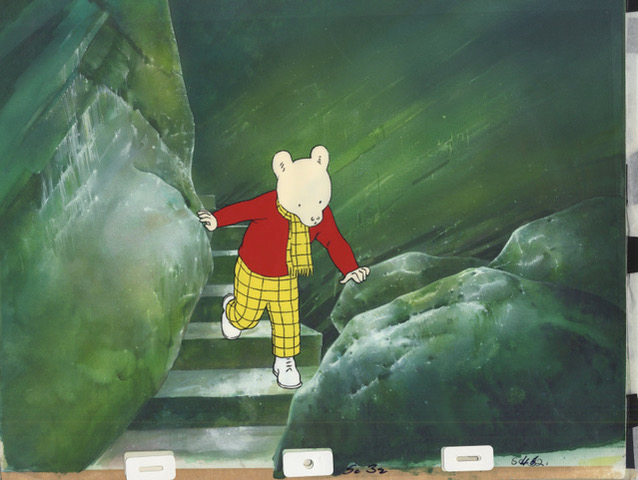
Production cel from Rupert and the Frog Chorus. Courtesy of Geoff Dunbar.
Other animators had been tried for Rupert and attempted to change him into a cute little teddy, so Paul McCartney asked if I’d have a go. I answered I’d loved Rupert as a child, so he asked me to write a one-pager to see how it went. In the event I wrote a few lines on how English and precious he is to many people across the English-speaking world, and we should keep in firmly in that world and environment, so we went from there. Rupert and the Frog Chorus grew from that. It wasn’t to be messed with; very much England, circa 1954. I made a budget and we started – and that’s when we began discovering how to do it!
But remember the fabulous song and music that accompanied it, a Paul McCartney and George Martin arrangement.
This film would involve a very different technique of filmmaking from Lautrec and Ubu: beautiful, traditional cel animation… even although that too involved a fair amount of experimentation. I felt it should be treated equally as an art project, again an homage to the art and subject of its era (and an homage to the art of Alfred Bestall).
Initially we tried to keep to the formula of the annuals; beautiful colour covers and beginning and end papers, and black and white illustrations telling the story inside. However, when we ran a test, the black and white illustrative style didn’t look so good on a screen, so we decided to go with the full colour approach throughout. (Incidentally, the annuals contained the most wonderful illustrations; first by the great Mary Tourtel, and when she became ill by the equally great Alfred Bestall.) Luckily, at the studio we also had great talents, so we went at it with great artistic gusto. Do you remember the part where the frogs jump off a cliff, and under the water they spread out into all those patterns? Animation by Mike Smith and colour coordinated brilliantly by the ceramist Theresa Edwards.
Paul: Very well. Like Disney’s Fantasia and then some. Incredible colours.
Geoff: That was the idea. It was especially strong in early Disney… the drunken mouse sequence in Dumbo for example… Anyhow, Rupert was a massive hit, it won a BAFTA Award, and it’s still showing all over the world.
Then we had an idea for making a feature film of Rupert, which had been the original plan. It was going to be lavish and trippy – that was the key word. But then it never happened, because the backers had failed to negotiate the feature film rights in time and the price had quadrupled. It was very sad for all concerned, and also sad for the British film industry.
Phil: Some of the images in Rupert are quite psychedelic. The 1960s. Were you a part of all that? And of course there was Paul McCartney…
Geoff: That was all before we met, but I was very much a 60s man: bell-bottom trousers, tie-dyed tee-shirts, Indian shirts… my hair was bigger than Jimi Hendrix. The thing I didn’t do was take drugs, nor would I advocate it. I drank a fair bit, and at the end of productions we’d all get pretty squiffy – they were very intense work schedules, so it was a way of letting go. I smoked a little cannabis and nearly died laughing, but was about it. Scotch and good wine, they were about it for me.
Paul: Most big projects nowadays depend more or less on AI. The great Japanese animator Hayo Miyazaki describes AI as one of the greatest insults to humanity, or some such words. What you take on this?
Geoff: It doesn’t frighten me; people can do what they like. I was watching some old photos being brought to life and it was simply mind-boggling. How do they do it? It’s absolutely astonishing, but it doesn’t frighten me. I think most of it is crap, but then I would, wouldn’t I?
Paul: Do you think there’s still a place for old fashioned, cel animation?
Geoff: Well, let’s not call it old fashioned, and certainly not 2D; let’s call it classical or trad. So first you might need a rostrum camera and film to be back in the genre, which would be very difficult to find. And production costs nowadays would be extremely high, even the animation cels. (Incidentally, there’s certainly a market for high quality old production cels, they can sell for a fortune.) But there’s still a place for hand-drawn animation, in the same way there’s a place for poetry in the realms of literature. Mind, like you, I was brought up on people like Saul Steinberg and Ben Shahn… Robert Blechman was a huge influence on me back in the Halas and Batchelor days. So, computers are a handy tool and slave, but can never be the true master…
Phil: One thing that was very impressive for me, as someone who’d new to your work, is the Cunning Little Vixen. I was astounded by that. It’s a whole animated opera… Janáček.

The BBC sent me off to Janáček’s home. Still from the BBC film by Geoff Dunbar

Janáček had got the idea from a contemporary comic strip. Still from the BBC film by Geoff Dunbar
Geoff: I’m delighted you mention that. It was at a time when things were pretty bleak in the industry. Some other studios were keen on it because, sadly, there was the feeling that it would be one of the last hand-drawn films to be made in London. I was still involved with Paul McCartney on short film ideas, but when the BBC approached me I took it on, because people in my studio were desperate for work. A pretty good reason, I might suggest.
The BBC sent me off to Janáček’s home in the Czech Republic, a little village, with surrounding woods, where I got a real feel for the place. In the film I kept to the style of the 1920s, because Janáček had got the idea from a contemporary comic strip. A bit more in the budget would’ve been good – in the end some of the staff were working for nothing – and, come to think of it, I still haven’t received a penny from the deal. But we all mucked in. Our industry was like that, friends from all over, from the USA to Eastern Europe, we were a global village. We wanted to make good work, and this was often financed by the commercial jobs we did.
Paul: Some of the adverts were great.
Geoff: Thank you Paul, yes, the 1970s and 80s were a golden period for that. Many of the commercials were highly creative. We had some great talents in London at that time.
Paul: So what happened?
Geoff: Well… this is a theory, and I’m not saying it’s absolutely true, but it’s this: American producers came over with a massive budget, wanting to make a film called The Sword of Camelot, or similar. It was to be a disruptive vehicle to our creative enclave of animation. They held meetings with our people in pubs in Soho (the Mecca for UK animation). One of my animators signed up, saying he couldn’t afford not to, that their wages were so high… So in the end, a lot of people went over to them. And we found ourselves short-staffed, while at the same time we were being undercut by East European companies, as the Berlin Wall had come down. It was a hard time.
Then a fellow who’d worked as Kubrick’s assistant approached me, saying the Camelot project he was working on had run into trouble, and would I come over and take a look at it? Well, it had been a very lavish production at some point, but when I went there the producer had gone, the director had gone, it was a shambles. At first sight the only people there appeared to be admin staff and background artists. I was taken to this little viewing theatre and shown this animated film that was just so poor. So very crappy. I looked around the studio and realised nothing was screwed to the walls. Then I saw more bad work in progress… all despite the vast amounts of money that had been thrown around.
Had all this happened to corrupt our industry? Maybe I’m a little paranoid about these things, but there are certainly some senior British animators who have agreed with me on this. It disrupted the British animation industry, and it had been such a hotbed of creative talent before this weird advent.
Phil: If you had enough money and resources, and all the stars were aligned, is there any project you’d love to do? Maybe something like The Cunning Little Vixen? Even if in reality it’s unlikely to happen?
Geoff: All the time. I’m not a man to give up. My dearest dream is to make L’Enfant et les Sortilèges (The Boy and the Magic) by Maurice Ravel, that would be a high spot. I paint and I draw, and I’m working on a very interesting project with a charity at the moment, which is quite moving. I have some little stories of my own, that I’ve written and illustrated; I may put those forward for publication in the future.
I made a book with a good friend of mine, Michael Hirst, well known for the Vikings series, a beautiful little thing that we’re very proud of and was received very warmly, so we may make a series of those adventures – we shall see.

I made a book with a good friend of mine, Michael Hirst. Photo credit Geoff Dunbar
Paul: So, la lutte continue. As well as being a magazine, we happen to be a micro, independent publisher as well. We only produce a handful of titles, left field works we think should be published rather pitching for the popular market. But you could say we’re tilting at windmills.
Geoff: That’s really interesting. I’d love to hear more about it.
Phil: We have a mutual friend, David Melling, who’s chiefly known for his children’s book illustrations. He seems to have done pretty well out of it.
Geoff: David is a terrific artist and one of our best, and he’s certainly kept the wolf from the door. He’s a close friend and his children’s books are indeed splendid, also his serious work is quite fantastic.
Phil: We showcased his work. It’s beautiful.
Geoff: We became drinking pals and we meet up once a fortnight for a glass of wine, or whatever, and put the world to rights… as one does.
Phil: You and him both live in Abingdon, which, by coincidence, is where I lived when I was nine. East St Helen’s Street. I used to take a dinghy and go up and down the river; the riverboats used to nearly run me down. And… I remember, I went to Dunmore School. I remember a certain Mrs Burt clouting me on the head with a textbook on occasion!

Abingdon is my home. Photograph Geoff Dunbar
Geoff: I remember her too! All bustle and tweeds – a real harridan!
Phil: God, we had the same teacher! She was awful! She did something in the War, helping triangulate the bombing or something. I can’t remember anyone else, but Mrs Burt…!
Paul: David Melling said he’s always loved Abingdon because you had nature right on your doorstep. Wonderful country walks, all sorts of subject matter for his art.
Geoff: When we were kids you could cross the bridge and be right in the countryside. There were snipe there, hares, foxes, badgers, and any number of bird types… but you certainly don’t see the snipe now. I also loved all the time I spent in Scotland, but Abingdon is my home. And as you’ve seen, nature is a theme in a lot of my work.
Phil: What do you remember of the Halases?
Geoff: I worked in the Halas and Batchelor studio early in my career, but sadly never actually collaborated directly with John Halas or Joy Batchelor on any projects. Joy Batchelor was very gracious, and although John Halas was a little distant to begin with, we got to know each other well and eventually became friends. It was a great time.
Paul: The studio was well known for developing animation talent. Tony White, Bruno Bozzetto, Graham Ralph, Roger Mainwood, Brian Larkin… Many more I can’t think of.
Phil: One of your films we haven’t really talked about is Daumier’s Law. It was very impressive.
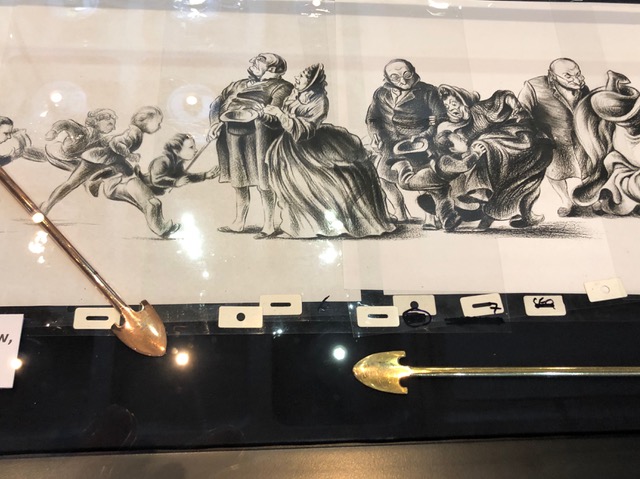
The film ‘Daumier’s Law’, couldn’t be anything but a homage to Honoré Daumier, the French Painter and sculptor. Production cels from Daumier’s Law. Credit Geoff Dunbar
Geoff: Well, we have to thank Paul and Linda McCartney once more for helping to get that off the ground. It was another hit, and ended up winning a BAFTA, plus awards at Cannes and Valladolid.
Phil: Paul has referred to Daumier in connection with a project he’s working on.
Paul: It’s a novel called Outre-Mer, and the early chapters take place in Paris at the time of the Commune. Daumier’s illustrations gave me some wonderful background.
Geoff: He was fascinating. One of the early Impressionists, at least in style anyway. Very political of course, he was locked up for a while, in the Bastille, quite unafraid to show the injustices of the day.
It was another of those films where I was able to work as I liked. I’ve been very lucky in that way. It was a very organic production because I didn’t really know how it was going to end. There was no story handed to me, I was just given the raison d’être and a budget and allowed to fashion the storyline, which I enjoyed very much. But always remember, I had Paul McCartney’s fab music to inspire me.
People say I made millions from it, but of course it doesn’t work like that. You have to work like mad and shave everything to the bone, but however many hours I worked it paid off. The film was successful artistically, and it won a great deal of acclaim.
Finally, something that’s important to me. Although I’ve always been an animator and will always be an illustrator or whatever, there’s one thing you must remember. What you’re doing is making a film. And you just happen to be using animation. Don’t let the animation take over the construction of the story. As George Santayana said, “Nothing is really so poor and melancholy as art that is interested in itself and not in its subject.”
Paul: Which is something too many creators ignore…
Phil: …and a fitting point to end with. Thanks so much for speaking with us, Geoff.
Paul Halas, the Arts and Lifestyle Editor of Ars Notoria and co-founder of AN Editions, is a writer of Jewish heritage whose escape from 1970s hippidom was the discovery that he could invent stories. He spent forty years contributing to various Disney magazines and books, as well as a variety of non-Disney comics, books and animated films.
Discover more from Ars Notoria
Subscribe to get the latest posts sent to your email.

You must be logged in to post a comment.