UCLA Charles E. Young Research Library Department of Special Collections Public Domain
B&B and the Schencks
by Norman B. Schwartz
When Al Capone was finally indicted by the federal government in 1931, it was not for his usual practices of prostitution, extortion, gambling, and bootlegging. The government could not gather enough evidence to prove these crimes in a court of law, so they chose income tax evasion instead. A judge fined the evader $50,000 and sent him to federal prison, first in Atlanta, Georgia, and eventually to Alcatraz in San Francisco. After seven years, six months, and fifteen days of incarceration, he died in his sleep of complications from neurosyphilis on Palm Island in Biscayne, Florida, in 1939.
Unlike other warring Mafia families, which usually experienced internecine warfare when their capo dei capi was deposed or imprisoned, the Chicago mob continued to operate peacefully. Before going to prison, Capone designated his heirs and divided their responsibilities. Frank Nitti (1886–1943) was the first among many. Once Capone’s bodyguard, he rose through the ranks to become what, in the corporate world, would be considered the CFO, the chief financial officer – the man in charge of the mob’s money.

Al Capone’s mugshot. Miami Police Department Wikimedia Commons
Soon after taking charge, Nitti learned that two of Capone’s lower-level soldiers – George E. Browne, the business agent for Chicago stagehands, and a onetime pimp, now enforcer, Willam Bioff – were “rolling in dough,” tossing it around in nightclubs like Club 100. As their jobs were of the more humble, less demanding kind – Browne threatened Christians and Bioff extorted Jews – Nitti summoned them to his mansion and demanded an explanation.
Browne, fearing for his life, confessed that besides their usual chores, they had been collecting protection money from Barney Balaban, who owned a chain of 125 theaters in Chicago and other Midwestern cities. Browne had warned Balaban that unless he contributed $25,000 to a local soup kitchen feeding the starving population of Chicago, there would be violence on his properties. Balaban agreed. The donations, as the theater owner suspected, never got to the poor. They ended up in B&B’s pockets.1
When Nitti heard of their scheme, he did not punish his soldiers as they had been expecting. He sent them off to Hollywood. “We are going to make millions,” he said. Nitti, knowing he already had control of union projectionists in movie theaters, reasoned with the exceptional business sense that had made him Capone’s successor that if he could also gain control of the technical and craft unions on the coast, he could also bring moviemaking to a standstill. He convinced other capi from both the east and west coast that if they stood united and formed a national syndicate, there could be much more money coming to all of them. In an age of petty crime, Nitti was one of the first to envision what later became known as organized crime. Nitti began by making Browne the president of the combined International Alliance of Theatrical Stage Employees that had begun in 1893 with Local 1, the union of stagehands of the New York theater, which by the 1930s had expanded to include other locals that controlled backstage crews and projection booths throughout the country. When B&B arrived west during the early days of sound, the Hollywood branch of the IATSE had only 175 members. Those were the days of the six-day work week and long hours without overtime. After Browne’s installation with Bioff as his first assistant vice-president, more and more studio workers – carpenters, propmakers, grips, and day laborers – in looking forward to better pay and shorter working hours, began joining, pleased to pay the union dues that B&B had raised by $5.

At the White House, front row, left to right: Barney Balaban, Paramount; Harry Cohn, Columbia Pictures; Nicholas M. Schenck, Loew’s; Will H. Hays; Leo Spitz, RKO. Back row, left to right: George Schaefer, United Artists; Sidney Kent, 20th Century Fox; Nathan J. Blumberg, Universal; Albert Warner, Warner Bros., in 1938. Harris & Ewing, photographer Public Domain
Threatening a strike of the projectionists in New York City brought Bioff face to face with a powerful man who would be both their collaborator and adversary. Nicholas Schenck was the president of Loews Inc., based in Manhattan, the parent company that owned the MGM studios in California and many theaters throughout the nation. Bioff first asked Schenck for $2,000,000 a year to assure that all things on the sound stages and in the projection booths of both coasts would run smoothly. He reminded the New Yorker that he had the power to shut down every movie theater in America. What good would their Hollywood product be if no one could see it?3
Schenck, who had run the Palisades Amusement Park across the river from New York City on the New Jersey coast, was not one to be intimidated by someone from Chicago who, despite his position on the coast, still looked and acted like the little fat man who had once threatened Chicago’s mom-and-pop kosher chicken dealers: Schenck refused. A few days later, hat in hand, Bioff returned to Schenck’s Times Square office with another offer; this time he said he would consider a mere million as equitable payment. Once again, Schenck refused.4
In April of that year, 1936, Bioff, never one to take no for an answer, came up with another suggestion: knowing Schenck’s ties to his film producer brother Joe in California, one of the most powerful men in Hollywood, Bioff proposed the payment be divided among all the owners of the biggest west coast studios – $50,000 from Warner Brothers, MGM, 20th Century Fox and Paramount and $25,000 from their lesser competitors. Nick spoke to Joe, who convinced the others.
Brother Nick physically made the first payout to Bioff in his suite at the Waldorf Astoria, dropping a bag full of bills on the bed. Nick, who was then on first name basis with Bioff said, “Willie, I’m a guy who likes to get his money’s worth. No raises.” Bioff promised.
The Schenck brothers knew they were much smarter than the bagman Bioff. They wrote off their contributions as a business expense, avoiding government taxes; and instead of delivering cash in bags, bundles and pillowcases, as was the Chicago custom, proposed a more genteel legal action. Joe suggested that if a friend of Bioff’s would sell negative film to the studios, even at an inflated price, Bioff would get his payoff as a commission on every sale; and all parties would benefit from a generous kickback from the supplier. These strange bedfellows, sons of Jewish immigrants from eastern Europe, thought they had come up with a perfect plan, only to be challenged in their scheme by, of all people, the workers. It didn’t take the heads of the many local unions involved to realize that little, if any, of the money that they and their members were paying in dues was not coming back to the locals. What they did not know was that it was not all ending up in B&B’s pockets either. A third of it was going directly to Nitti in Chicago.

Frank Nitti, the mafia enforcer. Wikimedia Commons
This all occurred when the IATSE and a competing group, The Federation of Motion Picture Crafts, were fighting over who would control the Hollywood unions, which included the actors. Ironically, Browne and Bioff’s downfall came not at the hands of their expected enemies, but from an unexpected source: Robert Montgomery, a charismatic actor, Screen Actors Guild president, and father of Elizabeth Montgomery (born 1933), future star of Bewitched. When approached for money by Bioff for representation and protection, Montgomery, who on rare occasions had played a tough guy, refused. “Not here, you don’t,” the actor said.
The producers, so Montgomery noted, were not as brave as he had been. He observed they seemed to be afraid of making a move unless Bioff approved. Montgomery guessed correctly that there was some sort of conspiracy. Having also played detectives, the actor hired a local version of Sam Spade to discover what B&B and the moguls were doing for each other’s financial benefit. Montgomery then informed the newspapers and the Treasury Department.
It took many years to indict B&B, but eventually the federal government summoned its first Federal Grand Jury. The US Attorney informed its members that the two Chicagoans had demanded $2,000,000 as protection money. New Yorker Nick Schenck, granted immunity in return for his testimony, was happy to testify as to why he had agreed to Bioff’s demands. He replied, “He said I had to pay, or bad things would happen.”5 He admitted that even as these extortions were taking place, the IATSE was demanding an increase in salary for its union employees. When Willie Bioff was called to the stand, he told the jury that he was not acting alone; part of his agreement with the brothers was that he cross the country and personally deliver payoffs to brother Nick.

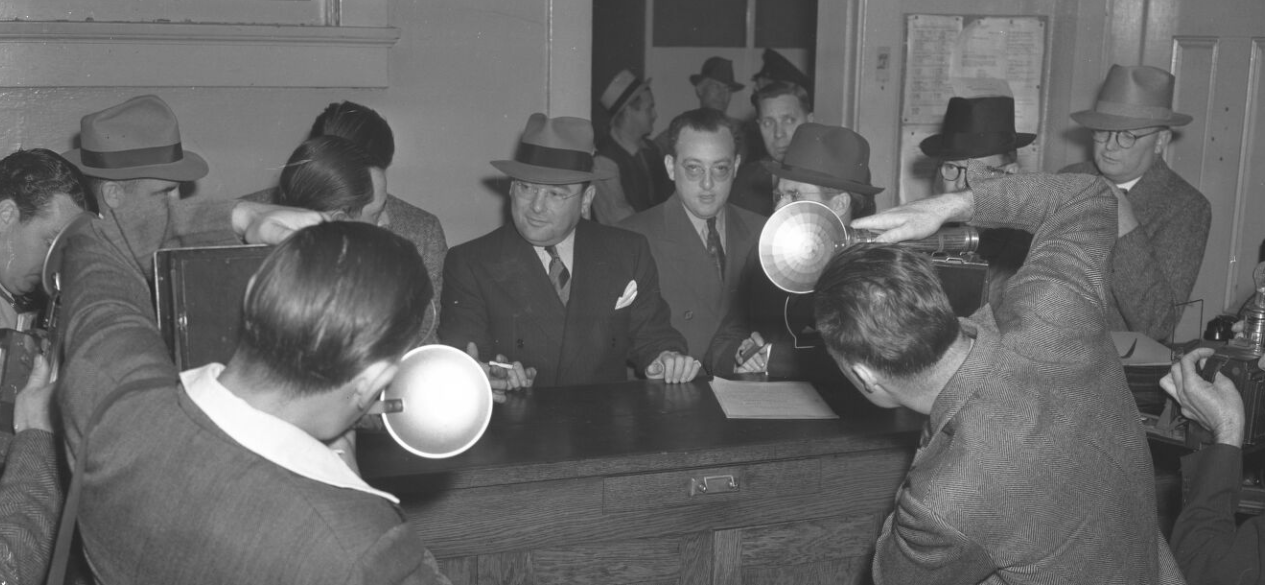
William Bioff smoking in front of Superior Court where he was indicted for tax evasion, Los Angeles, 1939. LA Times. UCLA Charles E. Young Research Library Department of Special Collections. Public Domain
In 1943, a court sentenced Bioff to ten years in prison and Browne to eight. To reduce their sentences, they had revealed the names of six of Frank Nitti’s Chicago associates involved in their schemes. The authorities imprisoned all of them. In March of that year, Frank Nitti put a bullet to his head. After the court convicted him of income tax evasion, Joe Schenck served only a year in prison.
Because B&B aided the government’s case by naming Nitti’s associates, the government granted them parole in 1944. Paramount Pictures moved to recover $100,000 from Browne, but learned the clever extortionist was nowhere to be found. He had disappeared, never to be seen again. Willie Bioff changed his name to William Nelson and moved to Arizona.
Shortly after the Nitti colleagues he had named were released from prison in 1955, a bomb wired to the starter of Nelson’s car parked in front of his 1250 East Bethany Road, Phoenix residence, exploded, killing him.
President Harry Truman pardoned Joe Schenck in 1945. No longer a convict, he went back to work as a top executive at 20th Century Fox, the studio which he had formed in 1935 with Darryl Zanuck. There, he met a then-unknown twenty-year-old starlet, Norma Jeane Mortenson, stage name Marilyn Monroe, whose initial contract was for only six months. In 1946, the same year, Robert Montgomery resigned to be replaced by Warner Brothers’ Ronald Reagan as president of SAG. Joe Schenck, seventy years old, had become Marilyn’s lover, mentor, and protector. She called him “Uncle Joe.” He helped to have her contract renewed at better terms and for a longer period than before. By 1953, she had become the studio’s biggest star.
After the scandals and the grand juries had long been forgotten, the stagehands and projectionists, the cameramen and editors of the IATSE unions and the members of the Screen Actors Guild in Hollywood and New York slowly cleaned house, ridding themselves forever of gangster influence.
Organized crime, too, progressed from its inconsequential beginnings to legally running hotels and gambling casinos in Las Vegas – a far more lucrative and less dangerous business than extorting money from kosher butchers in Chicago and the big and little shots of Hollywood.
In 1981, twenty years after he had been President of the Screen Actors Guild – the union that was responsible for bringing down B&B – Ronald Reagan became the 40th President of the United States.
Notes
1The story of Balaban and the Mafia is described in Moguls: The Lives and Times of Hollywood Film Pioneers Nicholas and Joseph Schenck, by Michael Benson and Craig Singer, Citadel Press, 2024. This is an excellent history of these years.
2Quoted in Moguls: The Lives and Times of Hollywood Film Pioneers Nicholas and Joseph Schenck, p. 186.
3Ibid., p. 188.
4Ibid., p. 189.
5From the court transcript. See also KateFortmueller, Luci Marzo et al, Hollywood Unions, Rutgers University Press, 2024.
Norman B. Schwartz is the author of the comic novels ‘ALL THINGS small‘, Paradise Now, Don Juan in Space, True (Cinema) Confessions, Hollywood: Below and Beyond, and the DIY guide, The Art Of The Schnoorr. He spent over forty years working on films in Hollywood and Rome. Norman was the first ADR sound editor / post-production dialogue director to be admitted to Academy of Motion Picture Arts and Sciences in Los Angeles.
Norman B. Schwartz’s essays will appear in sequence monthly in each issue of Ars Notoria Magazine. In October of 2025, a paperback edition of the complete collection of his essays titled: HOLLYWOOD Actors & Politicos / a Shared Profession was published and is available for purchase from Centre House Press and Amazon
Discover more from Ars Notoria
Subscribe to get the latest posts sent to your email.


You must be logged in to post a comment.