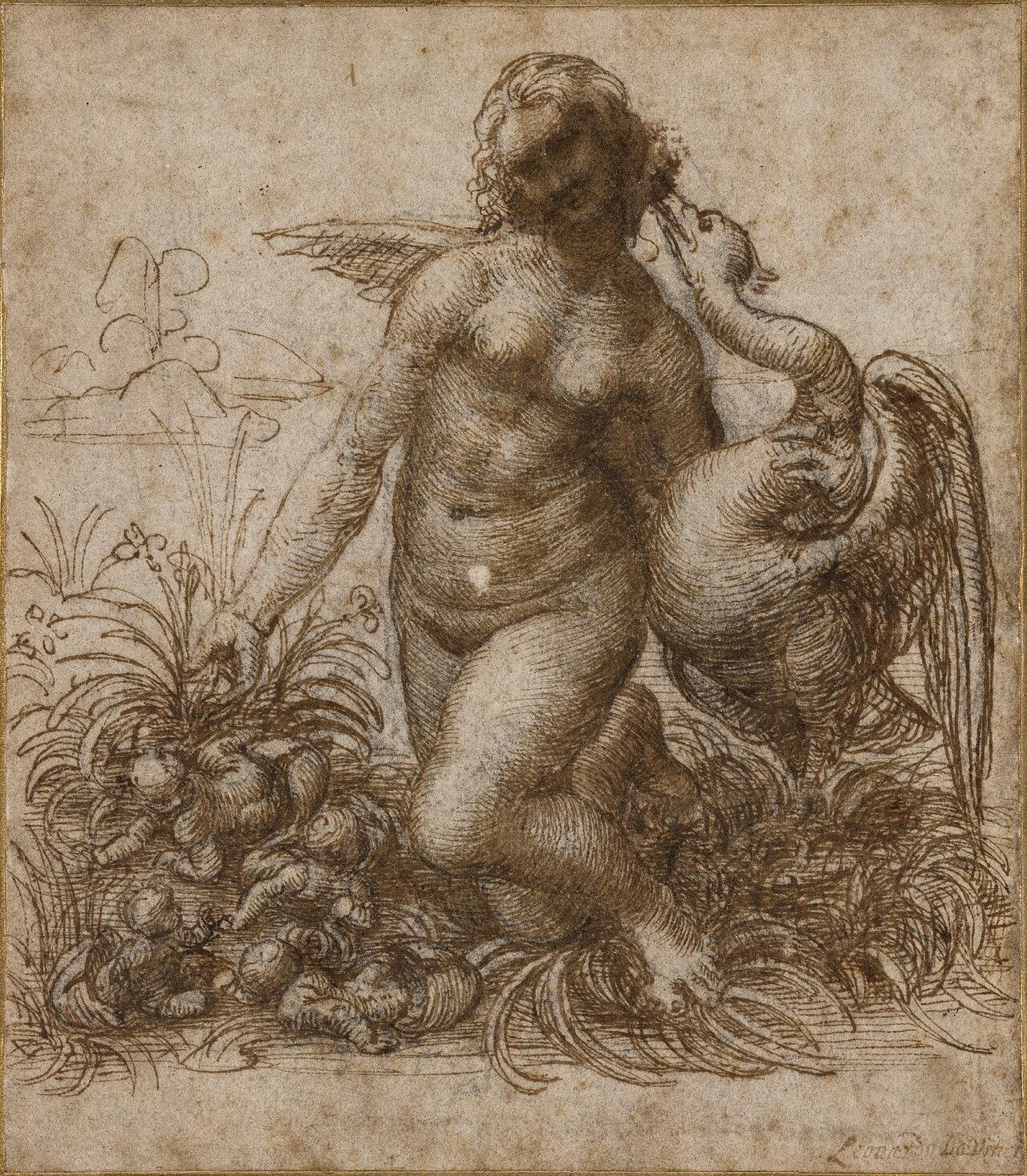
Study for Leda and the Swan (now lost), c. 1506–1508, Chatsworth House, England Wikimedia Commons Public Domain
Sylvia Vetta is a British author, journalist, and community activist whose work explores the intersections of gender, class, and race. Raised working-class in Luton, she married her Indian-born husband Atam Vetta at a time of widespread hostility toward mixed marriages, an experience chronicled in her acclaimed memoir Food of Love. As a freelance writer for The Oxford Times, she profiled 120 inspirational people from five continents in her popular Oxford Castaways series, later collected into three books. Her novels include Brushstrokes in Time, the only novel celebrating the courageous artists of China’s Stars Art Movement (including Ai Weiwei), Sculpting the Elephant, and Not so Black and White, co-authored with Nancy Mudenyo Hunt. A passionate library campaigner, she organised the Pied Piper Procession that helped save 20 libraries from closure, and she has been involved in community and development projects for over 40 years, including twinning her village of Kennington with Musanda in west Kenya. She is a founder organiser of the Oxford Indie Book Fair and believes that art, music, and storytelling can connect people across continents.
Here, Sylvia Vetta responds to works of art, from Leonardo da Vinci’s notebooks and Francis Bacon’s triptychs to Paul Nash’s wartime paintings and ancient Chola bronzes, with poems that explore creation, destruction, love, and loss. Using ekphrastic verse, she enters the minds of artists and their subjects, transforming visual imagery into meditations.
Sudeep Sen, Poetry & International Editor
Il Noccilo: The Heart of Things
Leonardo da Vinci’s notebooks V&A
His seed heart pulses
driving a vortex of blood
bursting within branching veins.
Leonardo buys the caged bird;
sets it free to see it fly. How?
Why? He must know now.
Sketch follows sketch, frantic,he
finds stallions muscles and movement;
Why? He must know now.
So much to see: so much still to do.
His seed heart, within his aged body, yearns
‘Tell me if anything ever was done.’
Francis Bacon
Tryptych August 1972
Beneath his paint encrusted shoes
Layers of debris line the wooden floor.
He paints a life.
Yet no life enters here.
His models are pinned and glued
to the wall:
ripped, cut and torn.
Crossed legged is the pose
picked from piles of photographs.
George Dyer in his pants
seen through another’s lens.
The lover fractures his life force.
Brushwork smeared as
Francis’s heart is torn apart.

Totes Meer (Dead Sea) 1940-1 Paul Nash 1889-1946 Presented by the War Artists Advisory Committee 1946 Wikimedia Commons
Totes Meer
Nash’s moonlight casts silver shadows
on ripples of white crested waves.
Framed in sea-scaped sky, he paints his pasts.
The artist’s brush, oiled with iron, meets
memories of soft sand beneath his feet.
Surf rises over his art’s conceit,
ebbing gently over naked toes?
His strokes ripple across the canvas close,
until dawn sheds an eerie light over
a sea of twisted metal, a Totes Meer.
A graveyard of lifeless flightless
planes, no longer graceful no longer free ,
a sea of dead machines; grounded pilotless.
How many, Icarus-like, died at sea?
The artist John Buckley who made the Headington Shark (in the roof ) made Embrace to go on the Berlin Wall. The wall came down. I suggested the Belfast Wall and wrote this poem.
Embrace
Joined at the hip; you have tasted the apple.
whatever tension, whatever the pain
Be bound -wrapped around -inseparable.
Trapped in tender embrace you struggle.
you ask why and how together you came
Joined at the hip; you have tasted the apple.
From different communities you blame
the other, you fight, you cry, you soften,
you are bound – wrapped around -inseparable.
One from the church; the other the chapel.
A fateful kiss and God willing amen
joined at the hip; you have tasted the apple.
With distrust and hate you must still wrestle
but as you battle your bindings stiffen.
You are bound – wrapped around – inseparable.
Stand upon the wall and be a symbol.
Bask in sun, survive the rain and remain,
joined at the hip; you have tasted the apple.
Be bound- wrapped around-inseparable
                                                                 Dancing with the Gods
                                                               Chola Bronze (Circa 900AD)
                                                                       Enter
                                                                 the ring of fire
                                                                Yes     You       Dare
                                                              Shiva   dances.  He,  Lord
                                                          of creation    and     destruction,
                                                       of mesmerising beauty and sensuous power.
                                                          Who can resist his rhythmic wheel?
                                                             Dance   like   the  firefly
                                                            until   your heart  melts
                                                               in the flames of his
                                                                       pyre.
Pierre Bonnard
found it hard
to paint anyone apart
from his wife in her bath.
Sylvia Vetta’s webpage: https://www.sylviavetta.co.uk/about/
Discover more from Ars Notoria
Subscribe to get the latest posts sent to your email.

You must be logged in to post a comment.