
Sudeep Sen is Cloud Hidden Whereabouts Unknown. Photograph Sudeep Sen
For Shekhar & Vinita
“The sun at home warms better than the sun elsewhere.”
— Albanian Proverb
by Sudeep Sen
How one lands in a hitherto unvisited place, that goes on to, quite accidentally, become a new home, often defies logic. For the past year or so, I have been living at the outer edge of Almora, in the mohallah-village of Dhungadhara, situated in the Kumaon region of the Himalayas, in Uttarakhand,
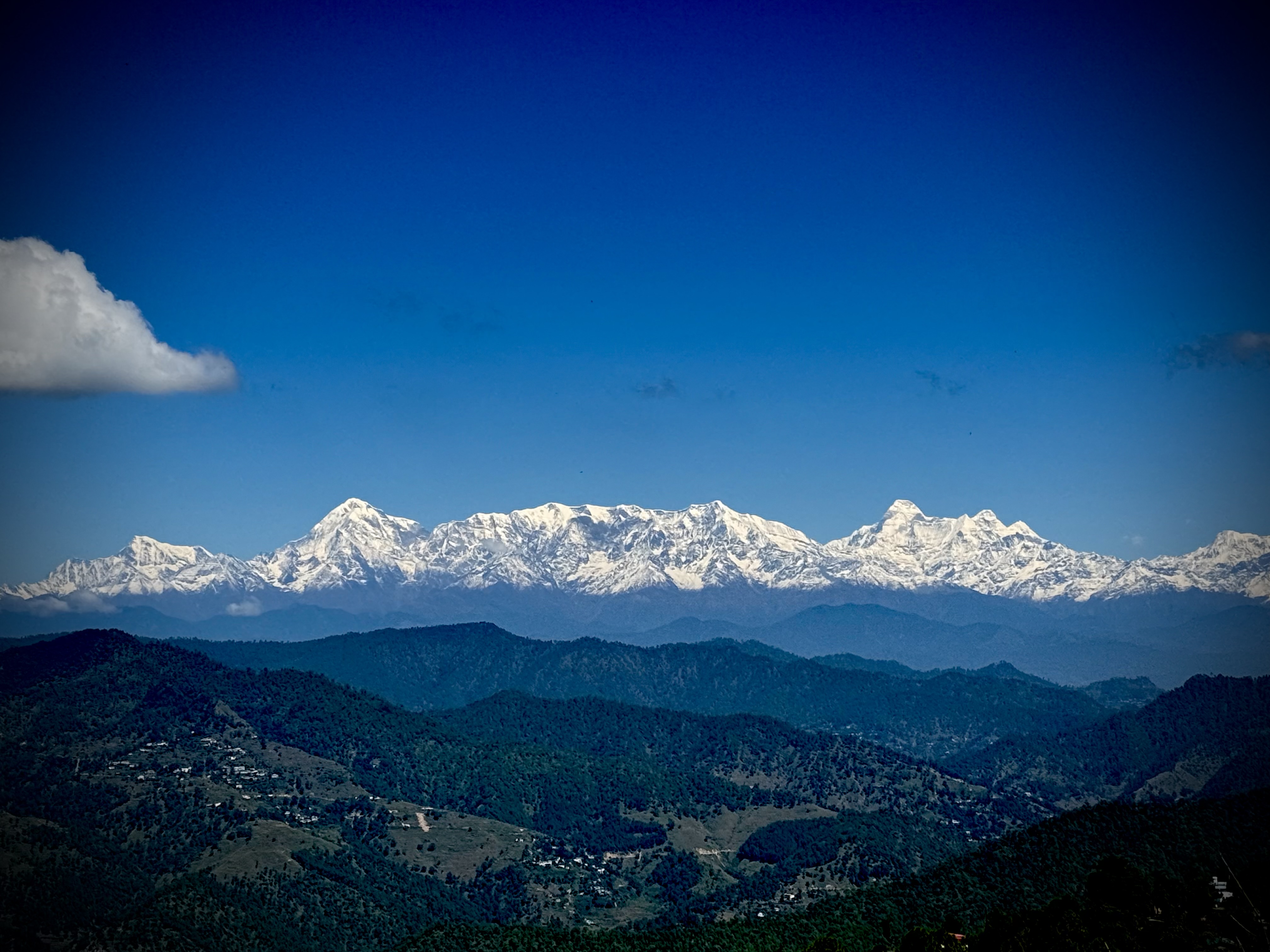
I wake up every day to spectacular sunrises that bathe the high mountain ranges with an ever-shifting colour palette. With the passing hours — hues alter, sun’s directional light changes, repainting the pine-clad slopes with soft pastel tints — champagne, soft orange and pink, pale blue, snow white, and more. From my cottage, Kranti Kutir’s large picture-windows, I see these scenes play out in the valleys and hills beyond — repeated with subtle variations each day.
Photograph Sudeep Sen
Let me start with where it all began — my life in the Himalayas. In December 2025, I spent ten quiet days at a friend’s sprawling home, a 100-year old Indo-British bungalow, charmingly named ‘Deodar Homestay’. Surrounded by thick pine-forests and the mountains the property is a classic blend of old-world colonial charm and modern living.
The owners, Shekhar and Vinita , who I have affectionately nicknamed bhai and behen (brother and sister) had invited me to stay with them when my asthmatic wheezing flared up in the pollution-tainted air of New Delhi.
For the past decade, I have been contemplating leaving my hometown on account of the poor air quality it offers. Over that time, my lung’s capacity has reduced steadily. And for a life-long non-smoker, that is a shocking fact. My pulmonologist said he could keep me going with medication, and Ventolin puffs, but the real cure would be to leave the city for fresher climes.
A few months prior, I had visited Almora as an invited speaker at the eponymous Almora Literature Festival, held on the spectacular hill-top of Malla Mahal in the city’s old quarters. After my reading, a tall slender man and an elegant saree-draped lady came up to me to get a copy of my book autographed. I learnt that he was a well-respected lawyer, and she, the Principal of the leading Sharda Public School.
Dughadhara Village on the edge of Almora. Photograph Sudeep Sen
The literary events of the day had ceased, and we started walking away from the festival venue, through the narrow lanes of the old stone-paved bazaars, lined on both sides with intricately carved, traditional wooden buildings. Shekhar asked what my plans were for the evening. I had none, so when he invited me home for a drink, I accepted happily.
The 5-acre Deodar Homestay is adjacent to the Circuit House, at the edge of the neatly-maintained cantonment area. The house itself is surrounded by lush green gardens, with 360-degree views of the awe-inspiring Himalayas. This bungalow, with its high ceilings, wooden beams, hand crafted furniture, its British era exteriors embellished with local Kumaoni artifacts, has been storing memories of its occupants for more than a century. Enhanced now with modern amenities, beds with fresh linen sheets, windows draped in thick velvet curtains — it was the perfect place for me to catch my breath, literally.

Photograph Sudeep Sen
One of my favourite spots, apart from the wide, view-filled verandahs, was the glass-walled sunroom. I would often spend the day there reading, writing, or gazing at the landscape. A tiny stone Buddha kept me company — its stillness creating a silent echo. The only distraction came from the hanging bird-feeder stations outside — from the mountain avians, as they flapped and fed.
The pathway skirting the estate was perfect for my evening walks. And if I was feeling adventurous, I would step out of the compound, and follow a winding mountain road in the quiet, salubrious, cantonment precincts. Sometimes I would stop at a roadside tea-stall for steaming ginger masala chai, or tuck in momos at a tin-shed kiosk. If I walked far enough, I would reach ‘Bright End Corner’, where I would be audience to the riotous skyscapes at sunset— panoramic nature-paintings.

Photograph Sudeep Sen
The bungalow’s overall atmosphere was simultaneously intimate and inclusive, open and private. At one end was the large roaring wrought-iron fireplace, and on top a copper kettle on constant boil. In the corner stood a gramophone record-player with an array of vinyls. The walls were adorned with paintings, and a generous library of books. I spent many evenings in the large living room, where extended members of the family, and guests, would intermingle and enjoy fresh, home-cooked meals. The local Kumaoni food has its own place in the heart of the people — and its most important ingredient is love.
This living room was the centre-piece of the property — a salon-like treat most evenings, where I met a host of interesting people— teachers and professors, poets and politicians, lawyers, business people, and young couples who had fled the concrete constructions of the cities to set up homes in the adjacent hamlets of Chitai and Kasar Devi.

Photograph Sudeep Sen
Time is slow here, defined by the diurnal clock — wake up with the sunrise, and return indoors before nightfall. This is necessitated, partly, by the reported presence of leopards prowling in the later hours — the burnt-hair smell they emanate marking their presence. Within a few days I found myself smitten by the simple life of the mountains, the clean air, the stunning vistas, and the helpful neighbourliness of the pahari people.
And much like the lines from ‘Hotel California’, the well-known song by Eagles — “You can check-out any time you like, but you can never leave” — I decided I wasn’t leaving. I started looking for accommodation in Almora and the neighbouring precincts like Kasar Devi, Pappersalli, Chitai and elsewhere — finally settling for a modest, rented cottage, ‘Kranti Kutir’, with its rich history and spectacular Himalayan views.
Photograph Sudeep Sen
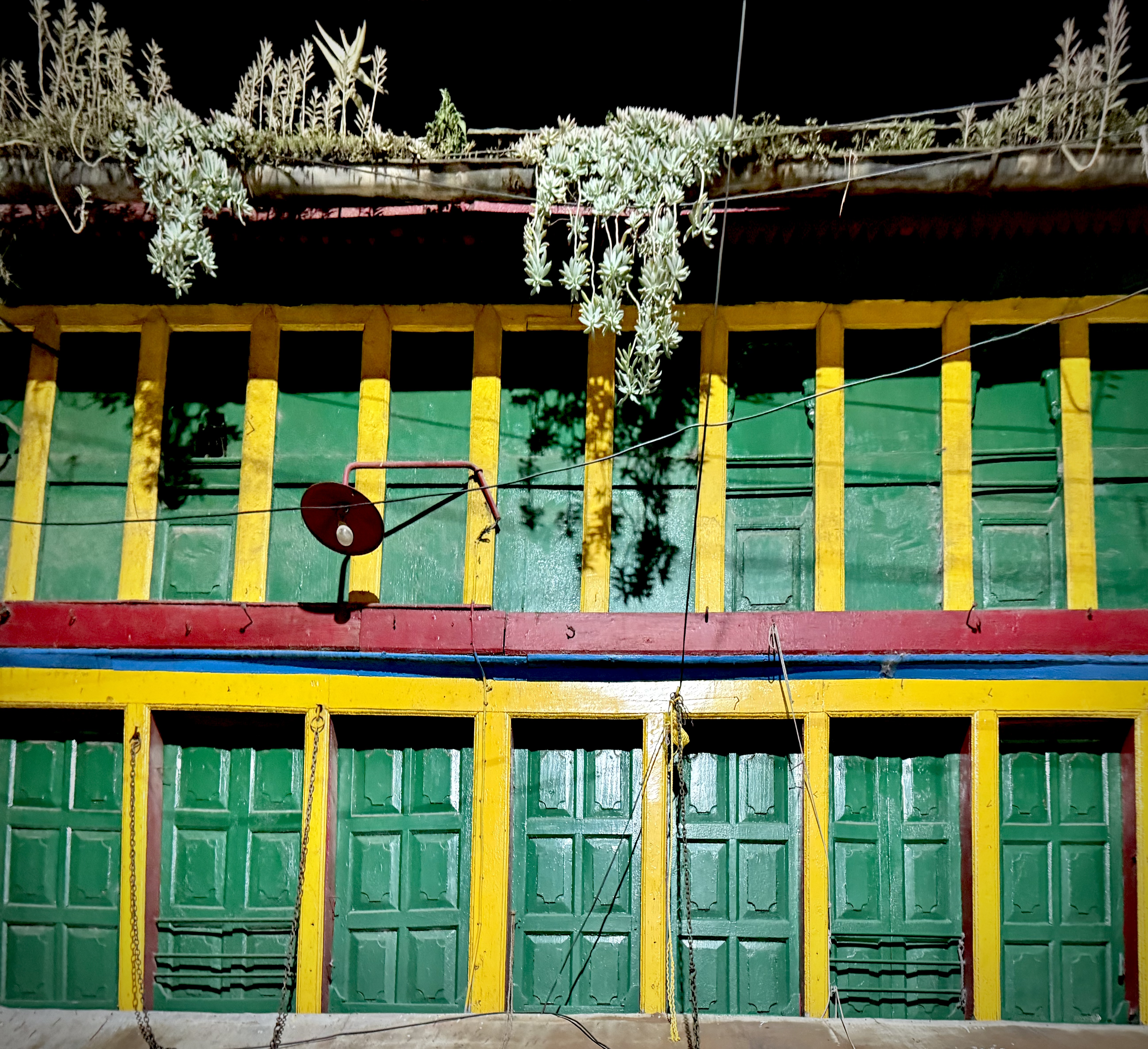
The village of Dhungadhara is now my new home — the local seamstress, milkman, tailor, cobbler, grocery guy, vegetable vendor and neighbours are my community. The winding, uneven road in front of my cottage is too narrow for cars to ply — it is little more than pagdandi, an old semi-paved path suited only for human foot, donkeys and horses — even though youngsters now zip around dangerously in their two-wheelers. ‘Kranti Kutir’ — which literally translates as ‘Revolution(ary) Cottage’ — was built in 1942. I have learnt since that during the time of British rule in India, prominent local leaders of the Freedom Movement held meetings here. But that is another story, for another time.
DEODAR, ALMORA The sky-high deodar trees in parallel platoons —outline the blue folds of the snow-crowned Himalayan mountains — forming filigreed grill-frames. Statuesque, bark-woven — they shield us from sun’s severe blaze. The rays, laser- sharp — the air’s nip, crisp — embraces my weakened lungs, slow-resuscitating them. Pure oxygen-ozone here negates, partially,the abrasive pollutants embedded in my trachea —as my chest’s trapped wheeze, groans in slow motion. My homestay sojourn injects relief — a spark allowing me to breathe again. But mostly, I love the love of friends-as-family — its blessed innate poetry.
As I wait for the electric-kettle to boil again for the nth cup of Earl Grey tea — I realise I feel a lot healthier. My long mountain walks are making me stronger. My unhurried life feels more peaceful and meaningful. I am productive, without being overwhelmed — such is the magic of the Himalayas.

Photograph Sudeep Sen
Sudeep Sen’s [www.sudeepsen.org] is widely recognised as a major new generation voice in world literature and ‘one of the finest English-language poets in the international literary scene’ (BBC Radio), ‘fascinated not just by language but the possibilities of language’ (Scotland on Sunday). He received a Pleiades Honour (at the Struga Poetry Festival, Macedonia) for having made “a significant contribution to contemporary world poetry”. His prize-winning books include: Postmarked India: New & Selected Poems (HarperCollins), Rain, Aria (A. K. Ramanujan Translation Award), Fractals: New & Selected Poems | Translations 1980-2015 (London Magazine Editions), EroText (Vintage: Penguin Random House), Kaifi Azmi: Poems | Nazms (Bloomsbury), Anthropocene: Climate Change, Contagion, Consolation (Pippa Rann, 2021-22 Rabindranath Tagore Literary Prize winner), and Red (Nirox Foundation, 2023). He has edited influential anthologies, including: The HarperCollins Book of English Poetry (editor), World English Poetry, Modern English Poetry by Younger Indians (Sahitya Akademi), and Converse: Contemporary English Poetry by Indians (Pippa Rann). Blue Nude: Ekphrasis & New Poems (Jorge Zalamea International Poetry Prize), and The Whispering Anklets are forthcoming. Sen’s works have been translated into over 25 languages. His words have appeared in the Times Literary Supplement, Newsweek, Guardian, Observer, Independent, Telegraph, Financial Times, Herald, Poetry Review, Literary Review, Harvard Review, Hindu, Hindustan Times, Times of India, Indian Express, Outlook, India Today, and broadcast on bbc, pbs, cnn ibn, ndtv, air & Doordarshan. Sen’s newer work appears in New Writing 15 (Granta), Language for a New Century (Norton), Leela: An Erotic Play of Verse and Art (Collins), Indian Love Poems (Knopf/Random House/Everyman), Out of Bounds (Bloodaxe), Initiate: Oxford New Writing (Blackwell), and Name me a Word (Yale). He is the editorial director of AARK ARTS, editor of Atlas, and recently on a fellowship as a writer-in-residence at the Nirox Foundation (South Africa). His professional photography is represented by ArtMbassy, Rome [http://www.artmbassy.com/artists.html]; and currently the inaugural artist-in-residence at the Museo Camera (India). The Government of India awarded him the senior fellowship for “outstanding persons in the field of culture/literature.” Sen is the first Asian honoured to deliver the Derek Walcott Lecture and read at the Nobel Laureate Festival.
Red by Sudeep Sen can be purchased at all good bookshops.
Discover more from Ars Notoria
Subscribe to get the latest posts sent to your email.


You must be logged in to post a comment.