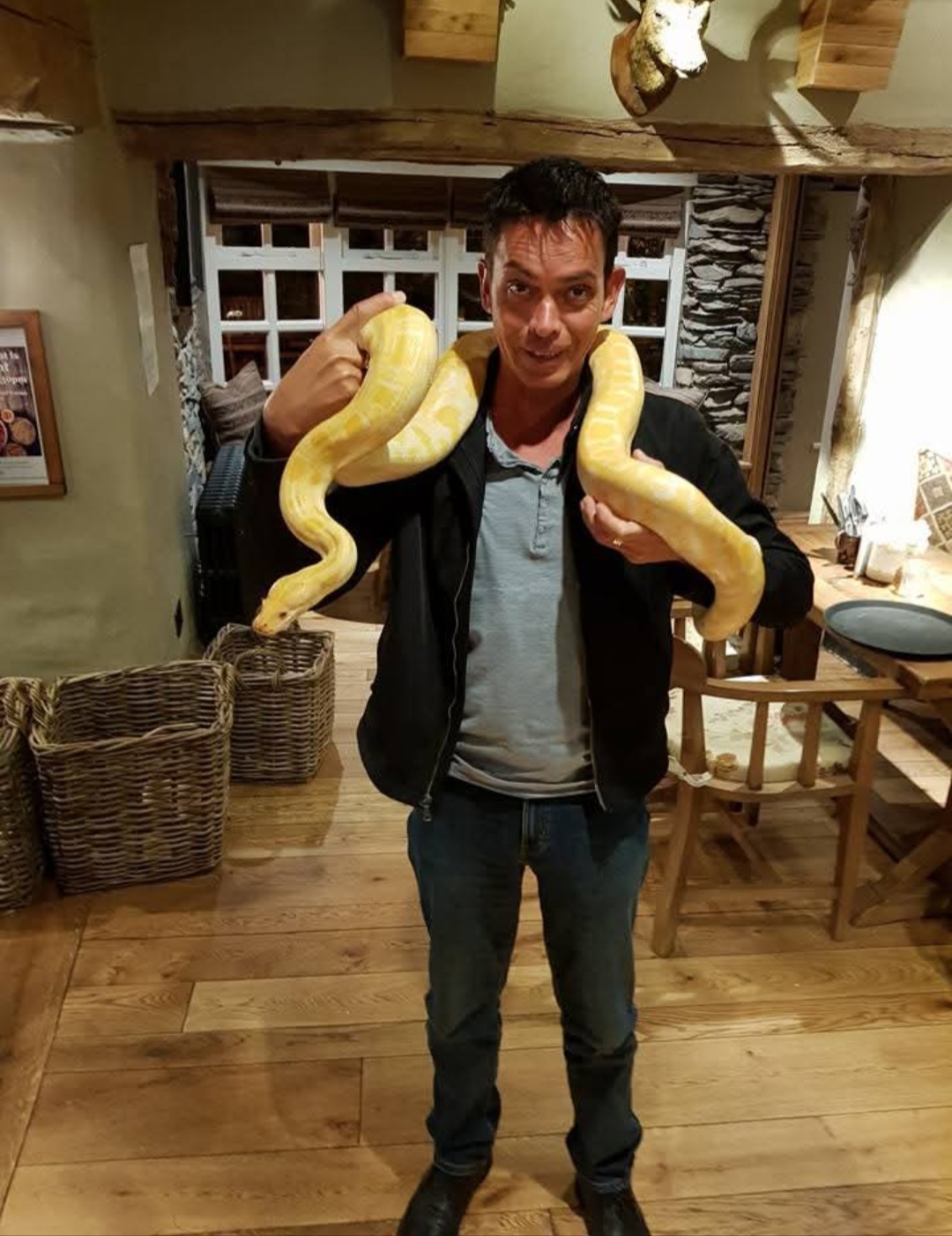
Martin Yip
by Margaret Yip
I met Martin in Whitehaven, where I worked for him. He was only 21. Martin had lots of energy. His restaurant was on three floors. The kitchen was in the basement. He could carry five or six plates in his left hand and on his arm and three in his right hand, and run up two flights of stairs to serve customers. Or he would carry seven cups and saucers, the cups full of tea or coffee, and glasses filled with ice cream balanced on top.
He was a good writer; a calligrapher, and he loved listening to Chinese opera. He dressed well, in black suits and pristine laundered white shirts. He wore a bow tie and polished black shoes and wore a big Seiko watch. I was attracted to him also because he reminded me of the lovely people who took part in our Pentecostal church when l was a child. They were Jamaicans there, Ceylonese and Africans who dressed well and who smiled and were always kind.
When Martin had to sell his restaurant because of debts, we moved to Southport. There, in Southport, we worked in another restaurant, but that restaurant went bust and all the staff were given notice. It was customary, as a sign of protest at the closure of a restaurant, to break anything breakable. At closing time, all the deep sinks of the restaurant were filled with smashed crockery and glassware, and then the sinks were filled with soapy water.
We moved again to Bury, where I made my first ante-natal appointment. My due date was closer. The baby was coming, and I still hadn’t seen a doctor. I was told that l couldn’t be booked in for a bed because ‘Your family doctor is still in Egremont.’ l was ordered to return to Egremont and so I did and made an appointment for two weeks before my due date.
Martin found a job in Barrow-in-Furness. We moved again!
I travelled alone from Barrow for my first appointment, arrived at Hensingham Hospital, and sat in a small cubicle with seven other women. l had no coat, but it was a nice day. I was told to take off my clothes and wait. All the dressing gowns were gone. When I looked around, there were only four people who had dressing gowns. I sat in my knickers and bra. After my examination, the Doctor said “I hope you have brought your suitcase because you won’t be going home. Your blood pressure is far too high. You need bed rest.’
I was admitted and began ‘sleep therapy’. A retired midwife sat at the side of my bed all the time I was awake, which was only for meals. At breakfast, I was given a pill and slept until lunch. Then another pill. This went on for two whole weeks.
On Tuesday afternoon, Martin’s only day off, he caught the train and came to visit me in the afternoon. As soon as he had left, a doctor arrived and said,
” We are going to induce you to enable labour.”
Porters arrived and I was taken down in the lift for the procedure. There were two nurses and a doctor present. I was placed on the table, my legs stretched up wide, and each ankle was strapped to a pole on either side of the bed . The doctor held a long instrument with a hook at the end. He said:
“Just relax. I am going to break your waters. It won’t take long .”
He was wrong. After many attempts, and a lot of pain, he gave up and proceeded to stretch my womb with his hand . I was whimpering in pain. One nurse slapped my thigh sharply and said, curtly,
“Be quiet!”
I was back in my room, feeling exhausted and vulnerable. In the next room, I could hear a lady screaming. I asked the midwife what was wrong.
“The lady next door is a midwife, too. She is having her first baby and making a fuss over nothing.”
My evening meal arrived. I didn’t eat.
The next day, I went into labour. After what seemed like hours, my daughter was born. She weighed 6lb and 2 ounces. I named her Suzanne. I needed 22 stitches. Then they gave me a jab to stop the bleeding. I felt like I had been kicked by a horse. The following day was Thursday. Doctors surrounded my bed. One older than the others looked at me and asked,
” Why did your parents give you permission to marry so young?’
I can’t remember my answer. He went on.
“Do you know what mongolism is?”
‘Yes’, I said, ‘We had a lovely neighbour in my village who had that complaint. ”
He raised his eyebrows and then continued: ‘When your baby was born, we thought there was something seriously wrong with her, but once we were told your husband was Chinese, that explained it. All is well.’
He strode off and the other doctors followed him.
Martin arrived the following Tuesday. Suzanne was one week old. He said, “I have managed to get someone to take you and the baby home by car, but you have to leave with me today.”
Another lecture at the side of my bed from a different doctor: “It is the Queen’s regulations you stay here ten days after giving birth. If you leave before then, you will be responsible for anything that happens to your baby.”
He strode off, too.
I packed and signed myself out. No one in the hospital said goodbye. No one helped me down to the car.
In Barrow, we rented one room in a two-up-two-down terraced house owned by one of the waiters at the restaurant. It was very basic. The room had bare floorboards. The only furniture in the room was a double bed pushed up against the damp wall. A ragged piece of netting covered half the window, which looked out over a row of dilapidated sheds. There was no bathroom, and the loo was in the backyard. There was, however, a dark blue new pram parked in a corner. Martin must have had a win at the bookies.
I set to as soon as I reached home, scrubbing the filthy floor boards with bleach and Ajax, scouring the paintwork, cleaning the windows. It took hours. Meanwhile, Suzanne slept in her new pram. Then she slept again after her feed.
Finally, with fresh bedding, the pages of a magazine pinned over the windows and a small lamp switched on, at last the room was clean. In those days small terraced houses like that could be bought for as little as £100 with a £10 deposit, then 10 shilling a week. But even this was beyond our means.
Later that year, the waiter we rented the room from died of cancer. He was only 46. We moved again, to a small one-bedroom flat with basic furniture and threadbare carpets. It was three pound a week, a lot of money for us and the bills piled up. It wasn’t long before our utilities were cut off. The arrears may have only been two pound, but it cost ten pound to be reconnected. Once again, we had to rely on candles for light. We heated water and cooked on a coal fire.
Three months later, I was pregnant again. The birth control pill became available in 1960, but had to be paid for. It was not available free on the NHS until 1974.
My family doctors were Doctor Kirk and Doctor Booth. I visited Doctor Kirk because l was suffering from morning sickness. I asked him for something to ease it. He refused to prescribe anything, saying: “morning sickness is a sign of a healthy pregnancy. You will get over it”.
Years later, I remember the name of the medicine for morning sickness was Thalidomide; the medicine that caused terrible birth defects in thousands of children. My second daughter Linda was born on the day before my first baby. Suzanne was born in September.
Linda weighed 6lb. I now had two little girls, both were less than a year old. In just two years, Martin and I had had to move five times, and we were about to do it again. This time, we moved in with a local Chinese family. They were very traditional, so I rarely addressed them because they were older. I was younger, only 18. Their little boy, David, aged five, had been diagnosed with encephalitis, a swelling of the brain. He couldn’t walk or talk. The treatment for encephalitis in Britain in those days was electric shock. His mother decided it would be better to take him to Hong Kong for treatment. I was to care for her three elder children. They returned a year later and their little son had fully recovered. I never found out how they cured him.
We needed to move out!
This time the council offered us a three-bedroom prefab with a big garden. The estate was a good community. They welcomed us. It was 1969, but people were still struggling. We all did what we could for neighbours, sharing what we had with each other.
Martin changed jobs and went to work long shifts in the local wire works. It was more money, but we were no better off. Gambling was still Martin’s big problem.
I worked in a local butcher. I baked for them. I would start at 5.30 am and finish at 8.30 am. I was home in time to take the older ones to school. I made pork pies. The butcher let me make the sausages, feeding the sausage meat through a machine. I turned the handle, and the meat squeezed into the sausage skin; the intestines placed over the end of the pipe. Then I twisted the tube into single sausages, then folded them into bunches. I didn’t know that the jelly I fed into pork pies was made from boiled up pig trotters and gelatin
All the time l worked there; I never once picked up a wage packet. The staff were allowed to take food home food like chicken, liver, stewing steak, sausages, pies and eggs. It was not free. It was deducted from our pay packets, so that when my bill was tallied up at the end, my wage was always spent.
My next two children were born at home in the prefab.: Martin was born in September 1970, then David, just missing September, arrived on the 28th of August 1971.
1971 was also the year of the new decimal currency. So, instead of having 240 pence in the pound, there would only be 100. Harold Wilson, the then PM, said: “This does not mean the pound in your pocket will be devalued”. But of course it was. Prices doubled overnight. I never knew what my husband truly earned; he never told me. ln 1966, you didn’t receive a family allowance for the first child. When Linda was born in 1967, the Family Allowance for people on low incomes was 8 shillings and 40 pence per week.
In 1972 with four small children, we were to move again, this time south, to Cardiff in Wales. Martin found a job as the manager of a city centre restaurant. All six of us were to share one room in the staff house just across the road from Cardiff Arms Park. Again, the accommodation was bad. Mice were a problem, loads of them. I would lie in bed with a small lamp on, watching them scamper around and over our coats that hung by the door. The room was dingy and damp, with four single beds, and there was no cooker or fridge. There was a rusty cast-iron bath with an old geyser above it. Two more days scrubbing with bleach and Ajax. Well, at least it smelled better.
I was blessed with a good family doctor in Cardiff. I met him when he visited Suzanne. She contracted whooping cough. Many people don’t remember how horrible whooping cough is. It stops you from breathing and the sufferer makes horrible ‘whooping’ sounds. The Doctor said: “It’s a shame you are all living in one room. The other children are sure to get it.” He was amazed when they didn’t.
I mentioned in the first chapter of my memoir, Isobal and Henry, that my dad wasn’t a fan of doctors. He grew up before the NHS was even thought of. I thought I was very lucky with family doctors. They had a lot of time for me; maybe because I rarely bothered them. But while the doctor was tending to Suzanne, he noticed that I suffered from nervous eczema. My face started to peel despite the cream he prescribed. I peeled the skin off in strips, but the nervous eczema remained. The specter of gambling was always present in the background. The city casinos were open every night into the early hours.
My husband’s addiction made me curious. I went there one night. They had free coffee and cake. My sister was visiting, so she looked after the children and I filled in for someone working at the casino who was off sick. I watched the gamblers. The casino was plush and glamorous, the croupiers all wore evening dress. People sat around the French Roulette table. One man was losing a lot of money. At a turn of the wheel, he put a set of keys on the table. The croupier raked them in. These were for a garage business he owned in the city. He lost his business.
Martin worked such long hours in split shifts. Then he would then go to the bookies and come back late. The children and I lived our own lives. He gambled away most of his wages every week. There were no laws against it.
We lived in Cardiff for two years. The children and I enjoyed Cardiff. Most fine days would find us in the castle grounds. If we had money for the train, I took the children to Barry Island.

Margaret Yip is a mother of 5, grandmother of 7 and great grandmother of 2. She lives in a small village in Cumbria. She is for social and economic justice, social housing and the NHS and she opposes all forms of prejudice and hatred.
Discover more from Ars Notoria
Subscribe to get the latest posts sent to your email.