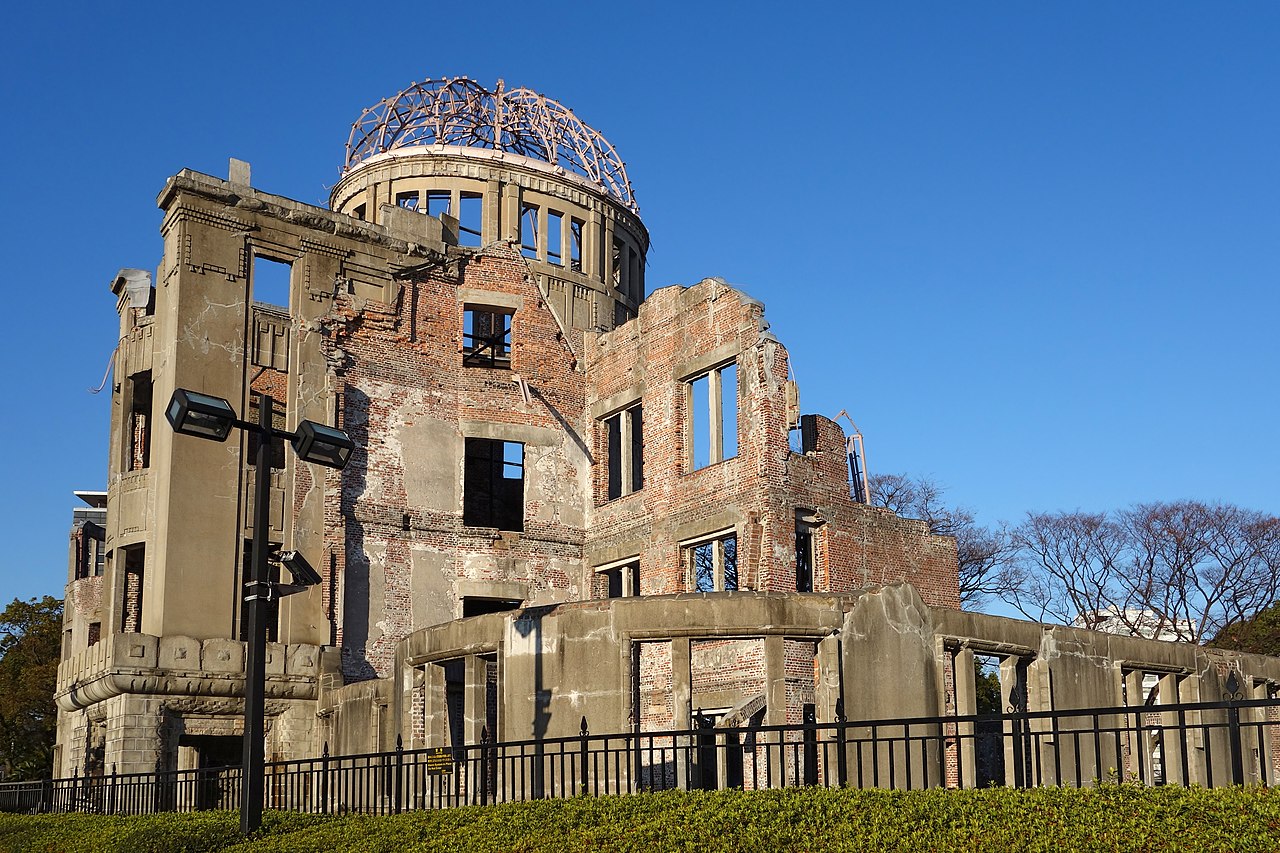
Genbaku Dome, a Peace Memorial in Hiroshima
Shinso Hamai. A-Bomb Mayor – Warnings and Hope From Hiroshima
Published 2010 by Publication Committee for The English Version of the A-bomb Mayor, Elizabeth W. Baldwin [Translator]
Review by Mark Stanley Frankel
.
Shinzo Hamai

This book shows how a determined and upright public official can advance the cause of peace. Shinzo Hamai (1905–1968) was the first popularly elected Mayor of Hiroshima. He served 1947–55 and 1959–67. Thanks to his vision and competence Hiroshima struggled through devastation, disease and despair to re-emerge as a Peace Memorial City. Hamai dedicated himself to the city’s recovery and the abolition of nuclear weapons. He held the first Hiroshima Peace Festival and led the struggle to make Hiroshima a Peace Memorial City. This book summarises 20 years of history in which Shinso Hamai devoted heart and soul to peace and reconstruction. It is an insider’s account of the hardships suffered and the passionate efforts to save humankind from destruction.
Loyalty

This autobiographical book, translated into English by Hamai’s son, shows the father as a hero but of a modest kind, in that he was a diligent and faithful public servant who was in the right place at the right time with the right moral character and set of skills. One of his virtues was his loyalty to the Emperor and his community, although it took a turn which may seem strange to us. When the atomic bomb made Hiroshima a raging inferno, everyone who could still move was struggling to get out but Shinso Hamai, then a city official in charge of rationing, was threading his way through the flames to get in. His first priority was to feed and clothe the survivors. Then a week later came the country’s surrender. It is shocking for the reader to find that Hamai’s loyalty to the Emperor meant that he was surprised and dismayed by the surrender, as he had assumed that despite the atomic bombing of his city the war would go on. ‘How could surrender be possible after all that the country had been through?’, he asked himself. He considered that those of his colleagues who had been killed outright were the lucky ones. It is disturbing to learn from Hamai’s book of his unflinching patriotism. It was only the Emperor’s brave decision to surrender, thus overruling the fanatics in the military who wanted to fight on to utter destruction, that brought the war to an end and made peace and recovery possible.
Peace Declaration 1947
Surrender did not immediately end the suffering. The following year, 1946, there was a typhoon which flooded the ‘atomic desert’, the area in the city centre seared flat by the bomb. Shortages of food and other necessities, together with radiation sickness, meant 1946 was a grim year which saw local people reduced to eating grass. Thankfully, thereafter recovery gathered pace linked with Hamai’s determination to dedicate the rebuilding to the cause of peace. A Peace Declaration was issued on the second anniversary of the atomic bombing to accompany a Peace Festival.
Today, on this second anniversary of the atomic bombing of Hiroshima, we,
Hiroshima’s citizens, renew our commitment to the establishment of peace by
celebrating a Peace Festival at this site, and expressing our burning desire for
peace.
The citizens of Hiroshima will never be able to forget August 6, 1945. On that
morning, exactly two years ago today, the first atomic bomb to be unleashed on a
city in the history of mankind fell on Hiroshima; it instantly reduced the city to
ashes and claimed the precious lives of more than 100,000 of our fellow citizens.
Hiroshima turned into a city of death and darkness. Yet as some slight consolation
for this horror, the dropping of the atomic bomb became a factor in ending the
war and calling a halt to the fighting. In this sense, mankind must remember that
August 6 was a day that brought a chance for world peace.
In 1949 the A-bomb Cenotaph was set up, the official memorial monument. The inscription is, translated, ‘Let all the souls here rest in peace for we shall not repeat the evil.’ The wording was controversial at the time. There were some who argued that the people of Hiroshima had not committed the evil of dropping the bomb so a promise not to repeat it was absurd. In 1983 an explanatory plaque in English was added to say that ‘we’ refers to ‘all humanity’, not specifically the Japanese or Americans, and that the ‘evil’ is the ‘evil of war’. The message of the inscription is a general one, that the lesson of the atomic bomb is the hope for peace.
Reasons for success

Hamai succeeded in making Hiroshima a Peace Memorial City because he took the local people with him. He understood the importance of action and agency and that he and the people of Hiroshima could not just wallow in self-pity and victimhood or look to outsiders to rescue them. It is a fundamental truth that any kind of peacebuilding activity cannot have a sustainable impact without having a firm, local foundation. 1 There was local ownership and local capacity development. To give the people of Hiroshima cause to support his whole project, Hamai was careful to link the peace-building aspect with the ordinary re-development of the city, to avoid any suggestion of irrelevance or disloyalty. This meant he got the Emperor’s support and that of a prince of the royal family.
Ironically, Hamai had certain advantages because of the defeat of Japan. Defeat meant an
end to Japanese militarism and the autonomy of the armed forces, so that Hamai was able to take over the army’s drill grounds and turn them into peace parks. The defeat also ended Japan’s isolation, enabling it to win international support for the peace project. The Americans, having devastated Hiroshima and 120 other Japanese cities, became relatively benign occupiers providing stability and a program of political reform. It was the support of the senior officers of the occupying forces that got Hiroshima its special status as a Peace Memorial City. The people of the US state of Hawaii, where there is a large Japanese contingent, provided moral and financial support. An American philanthropist, Norman Cousins, paid for Japanese women suffering radiation burns to have plastic surgery in the US. Hamai also got the support of Moral Re-Armament, the anti-communist nondenominational revivalistic movement founded by the American churchman Frank N.D.
Buchman.
Hamai was cautious about support from Soviet and left-wing peace organisations though he was left-wing in terms of domestic politics, collaborating with the trade unions on labour matters. His caution about politically motivated peace organisations reflected his conviction that activism must be rooted in practical measures not ideology and has to be disinterested and forward-looking, focussing on its object which in Hamai’s case was making Hiroshima a living monument to peace. He said, ‘What is the point of arguing about ideology and wrestling things from one another in a sinking boat? I pray that the people of the world listen to the earnest pleas of the victims of Hiroshima and Nagasaki.’.
Nobel prize 2024

Hamai died in 1968 but in 2024 the success of his pioneering work was acknowledged by the award of the 2024 Nobel Peace Prize to Nihon Hidankyo, the Japan Confederation of A-and H-Bomb Sufferers Organizations, for their activism against nuclear weapons. While the movement for banning the bomb has failed to achieve its ultimate aim it has helped establish the ‘nuclear taboo’. The Peace Prize citation referred to the fact that the survivors’ tireless campaigning during the several decades meant that gradually an international norm has developed, stigmatising the use of nuclear weapons as morally unacceptable. This norm has become known as the nuclear taboo. Nuclear weapons have proved a deterrent to nuclear war if not, alas, to war itself. That, however, is a measure of Hamai’s achievement.
1 Hiroshima’s Post-conflict Reconstruction and the Importance of the Will and Capacity for
Peacebuilding in Local Society by Hideaki Shinoda,
Institute for Peace Science, Hiroshima University

Mark Stanley Frankel is a independent scholar of Quaker studies who lives in New Malden and in 2023 completed a PhD, ‘T. Edmund Harvey (1875–1955): liberal Quaker, Quaker liberal and politician of conscience’ with the University of Birmingham.
Discover more from Ars Notoria
Subscribe to get the latest posts sent to your email.


You must be logged in to post a comment.