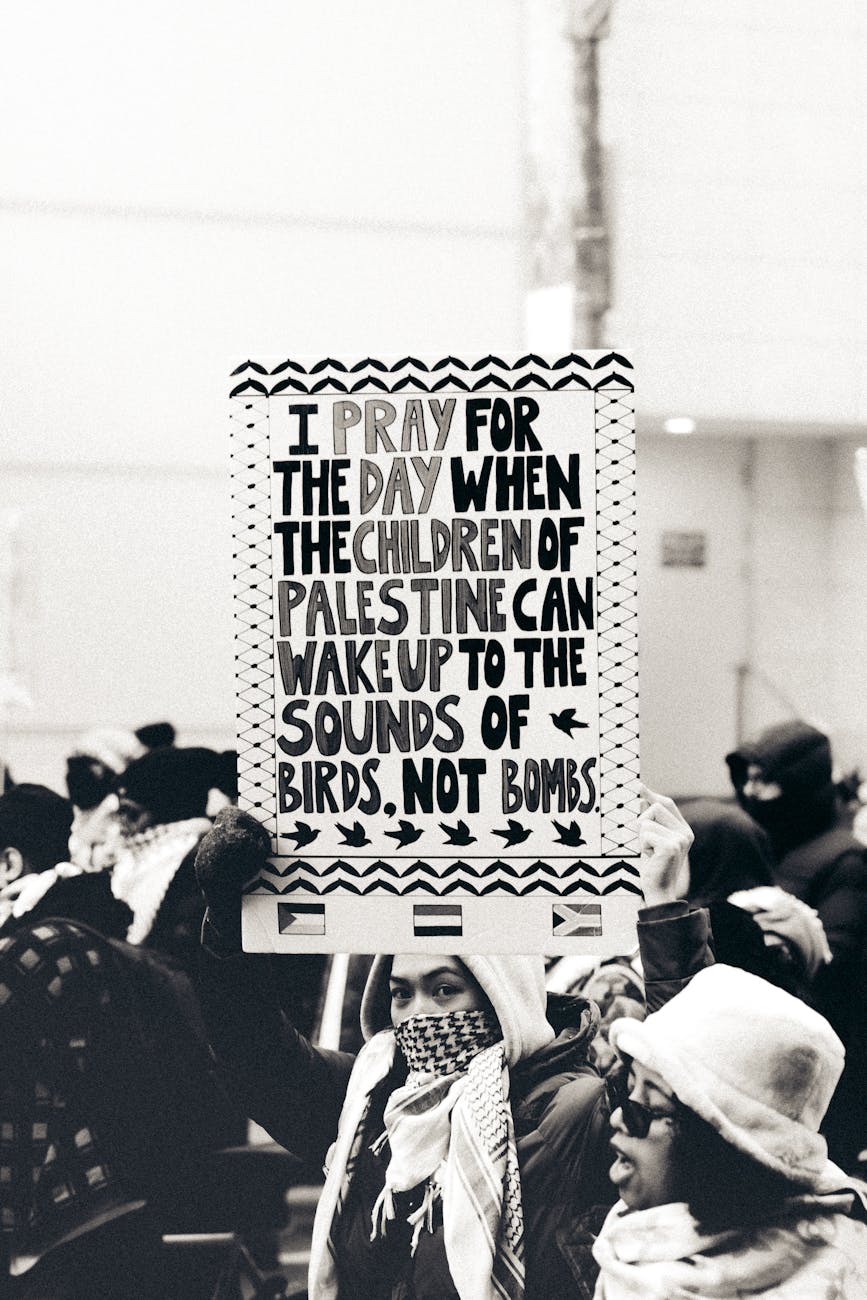
Silence and complicity are active ingredients in the cocktail of death that is Gaza.
Perhaps even more so than the bombs, rockets, bullets, disease, starvation, and torture that, according to a study published by The Lancet in July, have already likely wiped out near 186,000 people once indirect deaths are included.
The ability of Western allies of Israel to remain silent on the Israeli decimation of Gaza whilst continuing to support Israel militarily means they are clearly complicit in genocide. They could even face genocide complicity and sanction from the ICJ.
The renowned Egyptian American poet, prosaist, and aphorist, Yahia Lababidi, feels all this with fervor. And thankfully so. In ‘During a Genocide’, one particularly poignant poem from his eleventh book and new collection, Palestine Wail, he bluntly conveys the mortal blow of pure silence:
During a Genocide
–You will find that during a genocide
most words lose their meaning
Some sound empty & others strange
–Apart from unceasing prayer,
eloquence takes the form
of tears or kindness and solidarity
–Even a quiet moan or sighing
is preferable to false words or worse: a loud and wounding Silence…
Palestine is sacred to the Abrahamic faiths, and Lababidi has made religion central to much of his poetry. And Palestine is ancestral for Lababidi. Eighty years ago his Palestinian grandmother was forced to leave her familial home in Jerusalem at gunpoint in an event prior to the Nakba of 1948. Her family, the Dajanis, were appointed guardians of the Tomb of the Prophet David in Jerusalem in 1529, when Christians and Jews repetitively rioted over its control. Generations of Dajanis held this role until May 1948 when the British Mandate ended and Israel took over the site.
Since 7th October Gaza has undeniably become one of the most horrific, ugly, and unbalanced ‘conflicts’ of this century.
Lababidi began writing Palestine Wail – in effect, a love letter to Gaza – after October 7th last year. Its introduction and afterword, both written by the author, include ample references to others; mostly poets such as Rumi and Gibran, but also writers, activists, artists, scholars, and intellectuals.
How any poet can hope to do justice to the magnitude of Gaza may seem baffling. For it is mostly beyond words. But Lababidi does, at least as far as it is possible to do so. Also by acknowledging the futility of words – especially if insincerely expressed – he deftly uses his prose and poems to explore the relentless horror, anguish, and suffering; the understandable resulting anger; and then something – however intangible – resembling trust, compassion, and hope. He warns us that if we ignore the latter – which he refers to as ‘spiritual laws’ – the repercussions will be insurmountable. Throughout Palestine Wail, he ultimately attempts to transcend ire and embrace hope, emphasising the moral duty we have towards each other. Indeed ‘Hope’, his aptly titled opening poem in the introduction, indirectly urges us to do the same:
Hope
–Hope’s not quite as it seems, it’s slimmer than you’d think and less steady on its feet
–Sometimes, it’s out of breath can hardly see ahead and cries itself to sleep –It may not tell you all this or the times it cheated death but, if you knew it, you’d know how Hope can keep a secret
Lababidi further uses his introduction to bullet-hole us into remembering that silence, and what he refers to as the ‘pandemic of indifference’, are the enemies of love for humankind.
He states the aphorism coined by writer and Holocaust survivor, Elie Wiesel: ‘The opposite of love is not hate but indifference.’ His poem, ‘The Elephant in the Room’, expresses this indifference via the tactics many of us use to avoid a discussion over anything we feel is too tricky for us to acknowledge:
The Elephant in the Room
–How polite our friends the way that they avoid mention of complicated affairs—
–Palestinian and Israeli
–Is it because they find it rude to talk Murder over dinner or do they see this bloody mess as terribly embarrassing –A drawn-out family feud…which, in a sense, it is
The last line of ‘The Elephant in the Room’ is rich with metaphor. It reminds us of how especially futile and tragic this ‘feud’ is.
If we do not wake up from our indifference and silence then the pain of the sufferers ‘will grow roots’, Lababidi insists. ‘If we choose to turn our back to the wailing of our suffering world, and carry on amusing ourselves to death, violence like a karmic serpent will wind its way to our doorstep.’ An historical law that Lababidi alludes to is how those who have been systematically victimised by violence and oppression will eventually retaliate and, when they do so, how it will be done with vengeance. This, he conveys, is what connects us throughout time as human beings. This reasoning is encapsulated by a stanza in the poem ‘Open Letter to Israel’:
Truth, and conscience, can be like large, bothersome flies – brush them away and they return, buzzing louder
tens of thousands slaughtered, half of whom are children no, these are unbearable casualties to ignore.
And in the final stanza of ‘Radical Love’:
Radical love understands there is no October 7, 2023 without May 15, 1948, our September 11th…
Where is the global condemnation, he wonders, and succinctly so in ‘Say Something’:
Say Something
–If you’re uncomfortable saying Genocide,
–say mass murder, say boneyard, say unmarked graves, say pity the children say
–humanity under the rubble… say Lord, forgive us the enormity of our sins
–At least, say not in my name
–I’m waiting to hear from you
–Please, say something
As an Arab American, Lababidi rightly feels deceived by the United States’ indifferent support of the relentless genocide in Gaza. Indeed this support has only intensified since 7th October. And Biden et al continue to echo the lies of the Israeli propaganda machine.
In poems such as ‘Stranger in a Strange Land’ he decries, ‘America is a psychopath, a gaslighting, abusive partner that insists on being loved, no, worshipped as saint and saviour…’
The results of this ‘gaslighting’ are extensive. As Lababidi says in ‘Double Bind’, ‘To secure the world’s sympathy. Palestinians must be saintly – yet, Israel has universal trust despite continuing to act monstrously.’
In ‘Ceasefire’: ‘What a blood-thirsty world…when calling for ceasefire is considered controversial.’
Within his lengthy afterword Lababidi shouts down the lies of Israel’s justification for its crimes against humanity. Liberal individuals and the Western media too, for failing to speak out and condemn, and for continually running with warped narratives that reinforce the Israeli one so that its public – the world’s public – will forever misunderstand. And those that do understand, rarely say so.
He quotes Malcolm X, on the danger of mainstream media. ‘If you’re not careful, the newspapers will have you hating the people who are being oppressed and loving the people who are doing the oppressing.’
Again, he further references others, particularly those who have spoken out against the slaughter in Gaza. The likes of Norman Finkelstein and Gabor Maté. Those who do speak out, he says are true artists, and – for ‘daring to speak truth to power’ – they are ‘dangerous’.
It is the Palestinian journalists who threaten Israel most of course. As of late August, near 200 have been killed in Gaza since 7th October. Many were targeted whilst working in the enclave for media outlets. Western media often ignore the evidence reported and published by these ‘dangerous’ Palestinians. I will take the liberty of quoting Owen Jones, the British journalist, author, and political activist describing those who deserve our anger most:
I’ve just watched a video of a Palestinian man
Holding a child’s lifeless body, the boy’s skull
Entirely hollowed out, just a face remaining.
At this point, it’s not the twisted freaks still supporting this who should make us angriest.
It’s those who are still silent.
In light of recent evidence including that from Israel’s network of torture camps and prisons, these monstrosities likely extend way beyond what has been exposed so far. Then there is the growing 95,000 injured and the 1.9 million people displaced.
Lababidi calls out the complicity of so-called democratic Western leaders in one of the world’s longest running, unresolved wars of the twenty-first century. The seeds of which in truth were partly planted by Europe – especially the British with Balfour – over a century ago – resulting in a ‘war’ that has cumulated in a genocide.
The continued danger of this blinded complicity means that Israel will not only extend its atrocities but will never be held accountable in any way either.
By far one of the worst genocides of the twenty-first century, Gaza will go down in history for generations to come, just as the Holocaust did. And does. And along with its silence and complicity, not dissimilar to that of Nazi Germany.
Israel is now seen to be exploiting its war on Gaza to justify actions against Palestinians and to expand control over Gaza and the West Bank.
I await further work from Yahia Lababidi.
Palestine Wail is available from Daraja Press, Barnes and Noble and Wardah Books.
Yahia Lababidi (@YahiaLababidi) a poet of Palestinian background, is the author of twelve books of poetry and prose. His latest is Palestine Wail (2024), moral, spiritual & political reflections written during the unfolding Gaza genocide. Please visit his YouTube channel for daily reflections: https://www.youtube.com/@Yahia.Lababidi
Tina Bexson is a news & feature writer/Middle East researcher living between Cairo, Sinai and London. @TinaBexson
Discover more from Ars Notoria
Subscribe to get the latest posts sent to your email.
Comments (2)
Comments are closed.