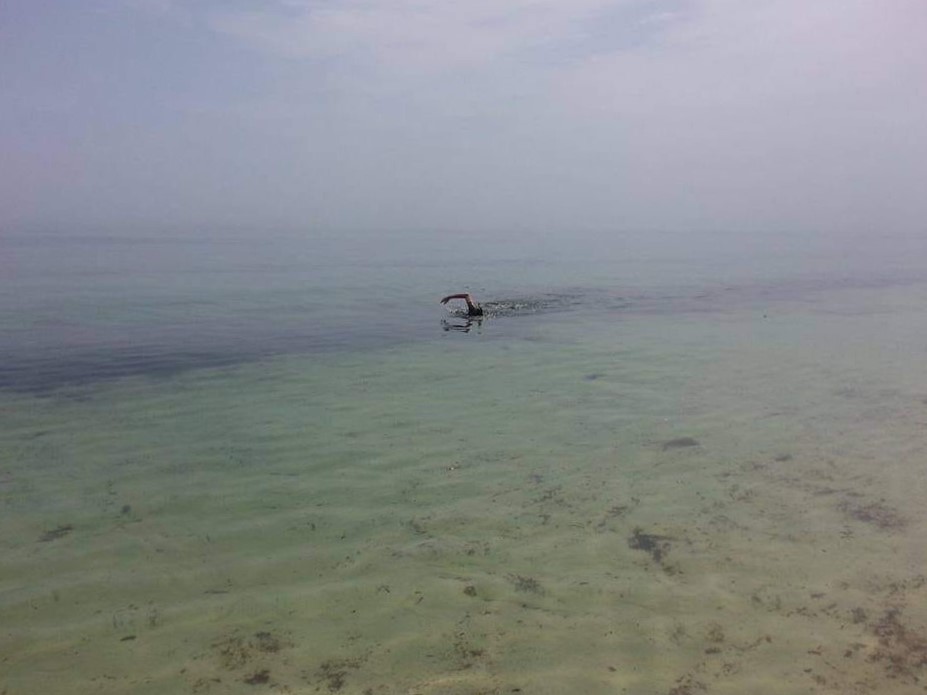
John Lawrence swimming, Phil Hall
by Phil Hall
‘And your Lord taught the honey bee to build its cells in hills, on trees, and in habitations; Then to eat of all the produce of the earth, and find with skill the spacious paths of its Lord: there issues from within their bodies a drink of varying colours, wherein is healing for men: verily in this is a Sign for those who give thought.’
From the Holy Koran, Surah Al Nahl.

Where am I?
We are part of the Middle East. Jordan and Iraq flow into Saudi Arabia and Saudi Arabia clasps hands with Egypt at Sinai, the runnel of the Gulf of Aqaba flows between them. The country looks across the Red Sea to Sudan, and then askance at Eritrea.
The reaction sunglasses go black when I leave work in the afternoon. I must put them on to see past the glare of harsh sunlight. Even wearing dark glasses, I have to squint a little; the sun leaks in through the sides – and I feel my palms and lips burning.
In the desert town of Rahima, the terminal spigot of the Ghawar oil field, bees entered my study and formed a small round hive. I was frightened by the strangeness of their sudden appearance and killed them all with insecticide.
I watch the confluence of pilgrims who circle the Kaaba on TV. I switch channels. There is a women covered from head to toe who is sitting in a great silver armchair on a stage. She is reciting her poems to a large audience of men. They smile and nod as she chants in a gruff voice. Two academics sit behind desks to her left. They are there to judge her poetry and take careful notes. Poetry is show business.
There are fifty, a hundred, two hundred Arabic language TV channels. I have travelled through a portal and here I am, in 1433, living as a guest in the home of Christianity’s younger brother, at the centre of the Islamic world.

At Ramadan the students were always tired and sleepy from a lack of food and water and from having stayed up after the breaking of the fast to serve the friends of their fathers. First they served coffee before the meal and dates. Then, after the meal, they served tea and sweets to their fathers’ friends and to their older male relatives. They are allowed to go to bed in the early hours of the morning.
The windows were blacked out in one staff room. Teachers who were not Muslims were allowed to drink tea, water and coffee there in secret. To drink something in front of a fasting colleague would have be the height of bad manners.
The management of the training centre where I worked had a military mindset. It was established initially by the American army. Shut your male students into a well lit, air conditioned, but windowless classroom. Lock the door. No one has permission to leave unless they want to go to the toilet.
These were male students in their twenties who had never had a formal girlfriend (those who wanted one) and who didn’t quite have enough money saved for the dowry in order to get married.


Walking into class that day I addressed the trainees. Before I could begin the class they asked me.
‘What do you do at the weekends?’
‘I drive my car. You’ve seen it, the Abu Hadida‘ – they laughed – ‘to the Corniche, and I swim there with my friends.’
‘Every weekend?’
Yes, almost every weekend.
‘Teacher’, a young man got my attention, ‘this rijal here has tried to kill himself three times. He had depression.’ Some of the other trainees turned to look at the young man.
‘Show him your wrists.’
The young man didn’t show me his wrists. He looked weary. His head sunk a little into his chest.
‘But he is OK now teacher. He cured his depression. Do you want to know how? He will tell you.’
Unsmiling, practiced, the trainee in the corner said:
‘Every day in the evening I would go to the sea to watch the sun go down. I would sit there for hours staring out to sea.’
‘And that cured you?’
‘It took many months’ he said, ‘but yes.’


Ras Tanura (otherwise known as Rahima) is the source of the greatest wealth any human being has ever known up to this point in history. It is the spigot of the vast Ghawar oilfield that lies under the Arabian desert in the Eastern Province of Saudi Arabia. The small town has the largest oil terminal in the world and the second largest oil refinery. Eight million barrels of oil are exported every day. A little way up the coast is a huge gas plant. By all rights, Rahima’s streets should be paved with gold and diamonds. Instead it is a small, slightly ramshackle, masculine little town. The centres of great wealth, like the coal mining towns of the north of England and Scotland, or the Ruhr full of steel plants, or Pittsburgh, are rarely the most beautiful places.


Andre took me under his wing. Andre is generous. He’s helped me find a flat and explained to how to deal with students. How to glad hand them. The students like bonhomie. Andre got me a sim card. I could make a long list of things Andre did for me.
I moved out of the compound after a week. It was thriving, but a little unhygienic. Outside was an unmanned gun emplacement. The heavy machine gun, there to protect the foreign workers, was wedged into the back of an empty pick-up truck parked in the shade. The guards were in their huts drinking strong Iraqi tea.
I had dinner with Andre: a hamburger, fries and a coke. Andre’s face wrinkles just before he says, for the hundredth time: ‘There is something else I need to tell you about this place.’ He’s been here 14 years, so I listen attentively.
‘A person like you may have trouble here, says Andre, ‘because you seem a little intimidating. But you do have a friendly face so you’ll probably be OK.’
We buy sunglasses for him in the mall. There is a poster of four fashionable young people jumping for joy at the entrance. All four smile, but the faces of the girls are misted over. Three women and their children come into the air-conditioned mall and I step to one side and wait. ‘Thank you’, says Andre, ‘you are learning.’
The Muezzin stop singing. We walk through the hot streets because Andre needs the exercise and I need to get to know the town. He shakes hands with all the shop keepers. He cracks a joke with them. Calls them all my friend – asks them where they are from.
I buy four pairs of socks. Two pure cotton bed sheets, a phone top up card and a bottle of Bounty chocolate milk. The shopkeeper slips in a packet of Fruit Polos into my shopping bag which I discover when I get home.
‘I used to walk a lot in Greece, in Crete, I loved walking. Tomorrow we’ll walk on the corniche.’
The name of the melting promontory of land we are on translates from the Arabic as ‘The Brazier.’ Ras Tanura. ‘Cape Oven’. It’s other name, Rahima, means ‘mercy’.
Between the Gas plant and the terminal there is a stretch of beach called The corniche. It is a pretty beach. The sea has been dredged. The corniche constantly has to be shored up by hard working people from Pakistan or Bangladesh.

If it were left alone it would revert to mangrove swamp and mud flat. In fact, this is what the other side of the little peninsula looks like. Slowly, gradually, the government has come round to recognising the importance of conserving the mangroves.
The central reservations of the roads of Ras Tanura grow native purslane, which you can eat. It grows very well in the desert without using too much water.
When I first arrived in Rahima, I asked about the beach. It would be a relief to experience something like the sea. Well, in fact, the sea. There it was. Right in front of me. But Ras Tanura was not just a sunny beach. It reminded me of Redcar and a visit to the old ICI plant on the North west coast of Yorkshire. Sometimes in Rahima there was a smell of rotten eggs in the air, sometimes an acrid amber haze that stung your eyes and hit you at the back of your throat. These are the almost invisible by-products of cracking petroleum.
A pugilistic Irishman said confidently that the beach was not worth visiting. I ignored him.


I walked a couple of times along the corniche with Andre. I decided to do an early morning walk every day, but had to get up too early for Andre, at 4.30 am. I found another friend called Ashraf who was willing to keep me company. We walked the Corniche together almost every morning. Normally, after half an hour or so the fishermen would arrive. Sometimes to catch whitebait.


I made a note in my diary:
‘Yesterday, not even the fishermen were there. I was alone. Today I made hotcakes with maple syrup for colleagues who came back with me from the walk, and I will make more of them for anyone who comes with me next Thursday. Yesterday we saw something in the morning. It was beached a few hundred yards off-shore and glowed in the dark.’

Intrigued by my description of this object, a colleague came to have a look. He sat on the sea wall staring at it until the sun came up. Ashraf and I marched the five kilometres up and down while Pete stared.
When we got back to Pete from the walk he said.
‘It is a piece of pipe and those are chemicals that are glowing.’
I told him that I wished I could swim in the sea and he said: ‘Of course. Next week.’ We made plans. Neither of us bothered to think about the chemicals that were probably in the water.

At the weekend I picked Pete up in my Crown Victoria station wagon and we went for fresh bread from the bakery and sweet tea. He lent me a snorkelling mask. We ate the bread and tea and got out of the car at the car park.
Pete took off his shirt and just walked into the sea. Just like that! And I followed him.


After the swim we went to eat at a Yemeni restaurant. There was a Yemeni bakery right next to it and they passed fresh bread to us through a hole in the wall.


This became our routine. On Saturday and Sunday we loaded up and went to the sea. Afterwards, we went to a Yemeni restaurant. Pete and I rummaged through Rahima town. He was convinced that there was a lot to do and explore, and so we walked around it and got to know all its restaurants and shops and backstreets. There were families there, but there were so many more men than women. They sold good food in Rahima, but none of it was immaculately presented apart from the sweets and cakes in the Palestinian cake shop. The juices were fantastic. My favourite was mango and avocado, a combination you don’t find in London.


In a way my weekends were embarrassing for me. I was a family man in my fifties. It was like a second childhood. I was playing in the sea with friends instead of keeping my family company in London and supporting them in ways that were not merely financial. Video calling was impossible and there was only email.


People often said they would come with us, but cancelled at the last moment. A few of them lived up to their word: John, Sam, Mark, James, Rob. Del was a good friend who invited us on to the compound reserved for direct-hire workers. They had a private beach. Week after week, for more than four years (with three month breaks for winter) Pete and I and our friends would drive down to the beach. I would chauffeur them there.
Later, we bought the best snorkelling equipment we could.
Slowly, I developed aquatic comfort, but was always a spine-chilling, transforming experience to submerge; to feel the surface film of water rise up my body and cover my head and to be in the underwater.
Nearly five years of my life were imbued with strong marine magic. My weekends might otherwise have been spent going to Bahrain for entertainment. Did you know there are seasons under the water just as there are on land?


Pete said: ‘Never mind, the rest of it. Never mind any unpleasantness. When I look back at my time in Rahima all I want to remember is going to the beach, having interesting conversations and eating in all the dives of Rahima.’ This is exactly how it happened. Like Pete, all I have chosen to remember are friends, conversations, the sea, food and ferrying everyone to and from the beach.

Looking back, it is easier for me to understand the experience than it was living through it. I walked along a Gulf metaphorically and literally. The Gulf is not the Indian Ocean. The Arabian Gulf is a large body of water that hides a deep ravine – and across the Gulf from Rahima is Iran. The delta of this Gulf was the warm wet home of human civilisation.

Abu Hadida means Father of Iron, it’s an affectionate Saudi name for a big old American car.
Rijal means man
Phil Hall was born into an ANC family in South Africa. The family was forced into exile in 1963 after his mother was imprisoned and his father banned. They relocated to East Africa, where his parents continued their activism and journalism. In 1975, after a period living in India, they journeyed overland back to the UK, eventually settling in Brighton.
Phil pursued a broad education, studying Russian, Spanish, politics, economics, literature, linguistics, and English grammar and phonology. His path led him to live and study in Spain, the USSR (in Ukraine), and later in Mexico, where he married and started a family. Over the next decade, Phil and his partner balanced activism with work before relocating to the UK—a move initially intended to be permanent.
However, professional opportunities took him to Saudi Arabia and then the UAE, where he spent ten years before returning to the UK during the COVID-19 pandemic. Back in Britain, he founded Ars Notoria Magazine and, alongside fellow humane socialist Paul Halas, launched AN Editions, a small venture dedicated to publishing thoughtful, progressive and exciting new books.
Discover more from Ars Notoria
Subscribe to get the latest posts sent to your email.


You must be logged in to post a comment.