a short story by P.W. Bridgman
A Common Destination
By different pathways, in early 1951, two men eventually found their separate ways to a common destination. They arrived within a week of one another, Mr. Bell by his own steam, Jesse Nazaire not.
Nazaire: Feral, Fit, of Sound Mind and Guilty
Nazaire was arrested and charged with murder in late 1949. There was no direct evidence to link him to the killing. The case against him was entirely circumstantial.
His application for bail was denied.
Dr. Finlay, the Crown’s psychiatrist, described Nazaire to the court as “feral”. He chose the word carefully, using it first in 1950 when he gave expert testimony about whether Nazaire was fit to stand trial. (He was found fit.) Finlay next used the word at the inquiry into whether, at the time of the murder, Nazaire would have been of sound mind and could, therefore, be held criminally responsible for it. (Relying on Finlay’s opinion, the court determined he had been of sound mind at the relevant time.) And Finlay once again described the prisoner’s history and behaviour as “feral” at Nazaire’s trial, before a jury, on the murder charge. (He was ultimately convicted.)
This repeated use of the word “feral” impressed upon the jurors who heard the case that, unlike them, Nazaire was an outsider. He had no violent history: just a middling record of vagrancy, loitering and couple of minor food theft offences. But the members of the jury also learned, as context (but not as admissible evidence per se), that Nazaire had slept rough all his adult life. That he had not served or even supported the Dominion war effort in any way. That he had never held a paying job. Rather, they learned, he had run away from home and left school at 12, keeping mostly to himself. He lived in the shadows by his wits. He was “feral”. Like a wild animal. Frightening. An enigma to all but the omniscient Dr. Finlay.
Who were they to disagree?
Nazaire’s only words to anyone regarding the charge against him were, “I have never killed anyone.” He spoke them quietly to the police when he was arrested, then later to his court-appointed lawyers, and still later to the court when he was asked to enter his plea.
Nazaire displayed an extraordinary aloofness and indifference during all of these proceedings. It was 1951. Murder was a capital offence, punishable by death. His continuing detachment lent new credibility to the defence’s earlier arguments about his degraded mental condition. But it was too late for that.
Though almost always shackled, including while in the prisoner’s dock, Nazaire could be seen periodically twisting his body and limbs into grotesque postures while the Crown’s case was going in. He’d lock up his joints and manoeuvre his limbs and extremities in ways that appeared physically impossible. The judge’s repeated cautions against making these distracting spectacles had little effect.
Some in the courtroom who observed Nazaire’s contortions thought he may have been attempting to overcome boredom. More thought he was feigning it.
Overall, Nazaire gave the impression of being, at the very least, outlandishly eccentric. To the jurors, he was from another world or, at least, from some unimaginable part of this world that was not theirs. “Feral”. The Crown’s arguments, and Finlay’s expert evidence particularly, reinforced that impression. But to be fair, so also did Nazaire’s habit of adopting bizarre postures and paying no attention to what was unfolding while court was in session hearing his case. Still, the manoeuvres did not seem to be strategic, a ploy to curry pity or mercy. He performed them not only in the courtroom but also when he was alone in cells downstairs, both before and after the court day, and in the prisoner transport vehicle that ferried him back and forth between the courthouse and the remand centre. He had even been seen by hikers performing them at his little campsite, deep in the woods a mile or two from the Tiger Dunlop Tomb, long before the murder occurred. It was just something he did. Just as, when listening to testimony, one of the jurors absently worried her rabbit’s foot keychain until very little of its fur remained. That was just something that she did.
Not much of use was learned from Finlay’s pre-trial psychiatric assessment interview of Nazaire. He declined to answer almost all of the psychiatrist’s questions. Given this unresponsiveness, Finlay had to base his expert opinions about Nazaire almost solely upon his sparse clinical observations and the meagre school, hospital and police records that comprised his thin file. That would have daunted almost any other medical expert. But Finlay was like an anthropologist who was content to extrapolate an entire civilisation from a couple of bone shards and a scrap of broken pottery. He had his sinecure; he was comfortable in the Crown’s stable of experts and His Majesty kept him well fed. Doctors (and specialists particularly) were more deities than mortals then, even in the eyes of the law. In case after case, Finlay was the thoroughbred whose evidence carried the Crown across the finish line to victory. He was almost sure to do so again here.
Nazaire’s apparent lack of interest in his own case flummoxed his lawyers, too. “I have never killed anyone,” he told them confidently as he sat cross-legged on the floor of their office with his neck twisted far back over his shoulder. Confident about what? That the truth would finally out? That God would see him through this? Who could know?
Nazaire’s disengagement severely limited his lawyers’ ability to build a strategy for his defence. Though he erratically gave answers and skeletal comments—just enough to persuade them that he retained the mental capacity to instruct them—his counsel got nothing from him, like an alibi for example, that they could use to raise any affirmative defences. All they had was his bare denial. The case against Nazaire therefore had to stand or fall based on that, together with whatever weaknesses his lawyers could exploit in the Crown’s case against him, to raise a reasonable doubt and justify his acquittal.
Eventually the verdict was given. The Crown’s case against Nazaire stood. He was pronounced guilty.
No defence evidence had been (or could have been) led on his behalf. Though some real weaknesses in the prosecution’s evidence (including in Finlay’s expert opinions) had been noted and exploited during cross-examination, they did not suffice to raise a reasonable doubt in the jurors’ minds. So, Nazaire was convicted.
When the foreman pronounced the guilty verdict, Nazaire responded in the same quiet voice, saying that he had never killed anyone, just as he had done when he entered his not-guilty plea. But this time he added: “I forgive everyone here who is responsible for this mistake”. For all present it was an unexpected and unsettling moment of lucidity.
Sufficient grounds for appeal were not thought, on the law at the time, to exist in the record of Nazaire’s trial. He declined, in any event, to give his lawyers instructions to appeal. Thus, a few weeks after his conviction the appeal period lapsed and he was sentenced to death by hanging. He took the opportunity at his sentencing hearing to tell the court again, in a quiet and respectful voice, that he had never killed anyone and that he forgave the jury, the trial judge, Crown counsel and the sentencing judge for their mistakes.
Friday, January 5, 1951 was the date fixed for Nazaire’s transport from the Huron County Jail in Goderich to the Don Jail in Toronto. His execution there was scheduled to take place a week later, at 12:00 noon on Friday, January 12, 1951.
Mr. Bell: Formal and Punctilious
Mr. Bell received his commission for the J.N. matter—his thirteenth—as usual, by post. The crisp, ivory-coloured, legal-sized envelope bearing embossed Department of Justice arms over a return address in Ottawa was mailed to him—“Mr. W. Bell” as per his request—c/o General Delivery at the old post office in Elora. Mr. Bell lived a few miles away in Fergus, where he was known as Dr. Cruickshank. His habit was to ride his bicycle to Elora on Monday mornings between 9:00 and 9:30 a.m. to collect any Department of Justice mail he was expecting.
Mr. Bell quickly read the letter of engagement and file he’d been sent and then responded to the J.N. commission with his acceptance. His reply was accompanied by what had become his usual and (he thought) modest personal stipulations. They had never been challenged. The Department was to reserve the east-facing, second-floor room with the bay window at The Aspidistra on Broadview Avenue. (It was a bracing, 13-minute walk from there to the Don Jail). Mr. Bell would stay at the hotel for two nights, checking in on the day before the assignment was to be carried out and checking out the day it was completed. The Department would arrange a driver to take him from Union Station to the Aspidistra and back again.
Mr. Bell would take his breakfasts and his dinners in his room (no kippers or fish of any kind, or lamb, please). He specified Ribena blackcurrant cordial and Red Rose tea (no coffee) with each meal, and Horlicks before bed at 9:30. If a pint bottle of Jules Robin VSOP could be placed in the room before his arrival, that would be greatly appreciated. His account with The Aspidistra was to be settled directly between the Department and the hotel; further, a draft to his credit covering the travel allowance of $15—to cover his bus and train travel (Fergus/Guelph/Toronto and return), light refreshments en route and his fee of $400—was to be delivered by the Department to the Bank of Montreal branch at St. George’s Square in Guelph, marked to the attention of the manager, Mr. Liveridge, for immediate deposit to Dr. J. Cruickshank’s savings account.
Mr. Bell had some practical stipulations that he also insisted must be followed.
Two days before the assignment was to be carried out, J.N. was to be weighed while wearing light clothing and no shoes. Mr. Bell was then to be notified by telegram in Fergus of the prisoner’s weight; by return telegram, he would order the procurement of a burlap sandbag of an equal weight and—after consulting the Official Table of Drops and performing the necessary calculations—the preparation of two pieces of rope of a specified length, one to be employed for the rehearsal drop and the other for the assignment itself.
While the technical requirements of the procedure were well known at the Don Jail, Mr. Bell nevertheless made further stipulations. Those included that the rope to be employed for the assignment must be a minimum of ¾ of an inch, and a maximum of 1¼ inches, in diameter, and that it was to be boiled, stretched and dried before use. The knot in the noose was, in turn, to be lubricated liberally before being tied. Mr. Bell specified that soap or, ideally, bacon grease be used for this purpose (to ensure easy slippage once the noose was placed under load).
Officer Apostolović: Unflappable, Firm and Pragmatic
Officer Bogdan Apostolović was assigned primary responsibility for Nazaire during his one-week stay at the Don Jail, awaiting execution. This was done at the bidding of Mr. Bell. There was some grumbling but no will within the prison administration to do other than cooperate with this and all of Mr. Bell’s requirements.
Some relevant history helps to explain this remarkable deference. Apostolović had won Mr. Bell’s respect on his third, fourth and seventh assignments. All three prisoners on those occasions had been unruly, explosively profane and unpredictable. Apostolović had managed each with a firm but calm hand, nurturing their trust and tactfully defusing potentially disruptive outbursts before they escalated. The officer hadn’t ever had to call for backup support. Mr. Bell, in turn, had never had to call for the use of chloroform before those three particularly difficult assignments were, in his word, “consummated”.
An uneventful procedure, unmarred by any scene or disruption of any kind, was what Mr. Bell strove for during the lead-up to, and consummation of, all of his assignments. This could not always be guaranteed, of course. But he knew the chances of that were greatly improved when Apostolović was the one to guide the prisoners through all the preliminaries. So, Mr. Bell would not hear of any other prison officer being given primary responsibility for his subjects. His “subjects”. That’s what he called them, and in an odd kind of way he doted upon them. There is a right way and a wrong way to do everything and Mr. Bell wished to complete his assignments with his subjects properly, efficiently and with unquestioned professionalism.
Mr. Bell knew from the file he’d been given that Nazaire presented entirely idiosyncratic potential complications. He was unpredictable in different ways from any of Mr. Bell’s former subjects. Nazaire had always unsettled sheriffs and court and prison staff with his indifference, his odd contortions and his occasional strange and discomfiting remarks. Mr. Bell was right. This was plainly a case for Apostolović. No one at the Don Jail dared to suggest otherwise.
As Mr. Bell expected, trouble began on Nazaire’s first day at the Don when he was escorted from the prisoner transport vehicle to his cell by a sheriff and a regular duty officer. He dropped gently to the floor just outside his cell door, like a ballet dancer performing the splits. In that position, with his legs fully extended in opposite directions, he could not possibly be led through the doorway and into his cell.
Apostolović was summoned straightaway to assist. By the time he arrived, Nazaire had (as if in an imitation of Nijinsky), extended both of his arms horizontally as well.
“Leave him with me. I’ll call for assistance if I need it,” he told the sheriff and the other officer. After giving him the large iron cell key, the two men withdrew, leaving the situation in Apostolović’s hands.
He and Nazaire spoke for several minutes (or, at least Apostolović spoke to Nazaire for several minutes). Nazaire was soon on his feet with his arms at his sides. The door was unlocked, and he walked into his cell without incident.
When the story of Nazaire’s slightly troubled introduction to the Don was later related to him by telephone in Fergus, Mr. Bell nodded knowingly to himself. Apostolović’s successful handling of the situation was entirely in character and boded well for the uneventful completion of the assignment overall.
Other officers brought Nazaire his food and conducted the lights-out, midnight and early morning bed checks to verify his presence in his cell. But seeing him through the judas window, bent in different pretzel-like postures every time, spooked them, as did the mannerly way he thanked them when they delivered him his meals. They were all therefore grateful to have Apostolović take care of almost everything, especially the one-hour exercise intervals that Nazaire spent each day in the small yard reserved for the use of prisoners awaiting execution. During those intervals he was unbound and accompanied only by Apostolović. The understanding was always the same: “Leave him with me. I’ll call for assistance if I need it.”
There were no outbursts. Indeed, there were no further incidents. During his circuits around the exercise yard, it appeared from a distance that Nazaire and Apostolović were engaged continuously in conversation. The prisoner seemed calm. Sometimes, as they walked, Nazaire locked up his knees and elbows, adopting a kind of rigid, stick-man gait. Sometimes he stooped to bow deeply from the waist, putting his palms down flat on the ground before him and walking in a curious, bent-double way. Often, he would invert his body, prop himself against a wall and walk sideways, crab-like, on his hands with his feet following along above him, only lightly touching the bricks. And just as often he would pause, lie down and manoeuvre his limbs into positions, and lock them there—positions that seemed impossible physically and must have required that his shoulder and hip bones be temporarily eased from their sockets and then eased back into them later. A marvel, though a strange one.
Apostolović never commented on or reacted to Nazaire’s odd postures and bizarre displays during their tours around the exercise yard. The two simply continued to talk about whatever it was that occupied them, Apostolović trailing along beside or behind, attentive and showing no signs of judgment or apparent concern.
A Special Request
“The prisoner has a special request.”
“Go on,” said Mr. Bell.
“He wishes to have his wrists left unbound”.
“That is most irregular.”
“It is, but the prison administration will not object if you approve it.”
“Indeed, they will not,” said Mr. Bell.
He paused for a time to ponder the request.
“It’s not obvious that he could do much of anything to interfere if his wrists are left unsecured,” Mr. Bell mused aloud, fussing absently with the frayed tip of his well-worn school tie. “Although, I suppose he could try to get hold of the rope above his head and break his fall,” he mused further, “Although that would be an entirely vain effort”.
Apostolović nodded his agreement.
“It would be inconvenient. And disagreeable.”
“Truly.”
Mr. Bell thought further and continued: “I suppose the rope could be heavily greased, well above the noose, to prevent that.”
“Yes,” said Apostolović.
“And if this concession is granted, he will likely be more willing overall to cooperate when his time comes,” continued Mr. Bell.
He considered Nazaire’s request for another minute. Then:
“I’m disposed to grant it.”
“The governor will need to be told,” said Apostolović.
“Of course. But it’s a formality. The decision is mine to take,” said Mr. Bell again.
“Oh yes. A formality only. I’ll tell the prisoner and the governor you’ve agreed.”
“You do that. Thank you. Thank you, Apostolović.”
“Thank you, sir.”
“Oh… and one last thing. Do please make absolutely certain that the rope is heavily greased before the noose is tied, and that it is greased for several feet above the knot as well.”
“Of course, Mr. Bell.”
Consummation Day
“No antics, now. That’s our understanding, isn’t it?”
Nazaire nods his agreement.
Apostolović leads him, handcuffed and shackled, to the ante room outside the execution chamber. It is only 40 paces from the cell to which he had been moved for his last night. Two other officers follow them quietly at a discreet distance. “I’ll call for assistance if I need it,” Apostolović had told them.
The short walk proceeds slowly, but uneventfully. The laboured clanking of Nazaire’s leg shackles heralds their approach. The door to the ante room is painted a bright red. Mr. Bell waits for them on the other side of it.
When Apostolović knocks, the door opens. Nazaire and Apostolović walk in past the two officers who stand on either side of the entrance. They then pause. In the back of the ante room, behind a heavy glass, steel-framed window, the governor, another officer, a priest, and two citizen observers are seated on folding metal chairs. Nazaire nods faintly at them. The priest and the two citizen observers nod in return. The prison doctor is there too, standing in the corner holding a mask and vial of chloroform, should they be needed.
Apostolović and Nazaire approach the entry door to the chamber itself and halt there. Like the wall that surrounds it, the door of the ante room facing the chamber is constructed of thick tempered glass, surrounded by sturdy metal framing.
They peer inside.
In the far corner on the left stands a closet-sized room segregated from the rest of the chamber. This room has its own door. The wall that faces the platform has a small window built into it, at head height. Over it is mounted a red, incandescent bulb. Beneath it is a metal grille.
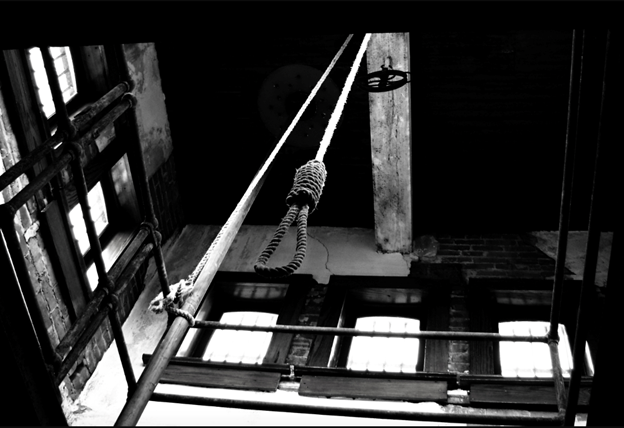
The noose dangles over the platform. In contrast to the gunmetal floor and the dank stone walls of the rest of the chamber, it is a brightly glistening wheaten colour. Though the air in the room is still, the noose swings slightly, back and forth.
Nazaire says something barely audible to Apostolović. The officer nods in reply, then looks back over his shoulder at Mr. Bell and nods again.
Mr. Bell comes forward and joins them at the entry door to the chamber. They pause for a moment.
“This is Mr. Bell,” says Apostolović to Nazaire.
“Good morning,” says Mr. Bell.
Nazaire nods to his executioner. “Good morning. Unlike you, I have never killed anyone,” he says.
Mr. Bell draws a shallow breath, glances quizzically at Apostolović, as if to ask, Does this mean trouble is brewing? Apostolović looks firmly at Nazaire, then turns back to Mr. Bell and shakes his head. Mr. Bell trusts the officer’s judgment and his anxiety subsides.
Nazaire remains still and quiet.
“Shall we?” says Mr. Bell.
He knocks gently on the door to the chamber. One of the two general duty officers inside pulls it open and points the way. Nazaire, Apostolović and Mr. Bell enter and stop, not far inside. The chamber is clammy cold and stinks of bacon fat.
One of the officers removes the shackles from Nazaire’s ankles. This is routine. The other unlocks and takes off his handcuffs. This is far from routine.
The governor, watching with the other observers from the ante room, shifts uneasily in his folding metal chair.
Once Nazaire’s cuffs are removed, the first officer hands Apostolović the black cloth hood. It is neatly folded and Apostolović tucks it under his arm.
Now released, Nazaire remains still and quiet, his expression no longer indifferent but lost.
Apostolović asks the two general duty officers to step back. He and Mr. Bell lead Nazaire to the platform and position him at the centre of the metal square in the middle of it, next to the dangling noose. Then Apostolović, too, steps back.
Mr. Bell glances up at the loose coil of rope on top of the wooden beam above, its length from there to the noose precisely determined by him, earlier, taking account of Nazaire’s weight, the Official Table of Drops in his copy of the 1947 Handbook of Procedures for Military Executions, and the reported result of the rehearsal drop.
Nazaire is still motionless and quiet.
Mr. Bell takes hold of the noose and carefully fits it over Nazaire’s neck and tightens it, bringing the knot snugly, but not too snugly, up behind his subject’s ear. He pauses to reach into his breast pocket for a tissue and fussily wipes the bacon fat from both of his hands and drops the tissue onto the platform next to Nazaire’s feet. A pained look of disgust lines his face.
Mr. Bell then asks Apostolović to pass him the hood. Nazaire inclines his head slightly toward Mr. Bell to make it easier for him to position it and pull it down and into place, but it catches on his left ear.
While these ministrations proceed, the silence and tension in the chamber have become almost unbearable.
The hood now covers Nazaire’s eyes but it continues to catch on his ear. Mr. Bell continues to fiddle.
At that moment, Apostolović sneezes loudly, three times in rapid succession. The sound bounces wildly off the stone walls of the chamber, startling Mr. Bell and the two general duty officers out of their wits.
By echolocation, Nazaire turns his head in Apostolović’s direction.
“Bless you,” he incants into the shattered remnants of a cavernous silence.
“Maria Vergine!” exclaims one of the officers, the Italian one. He drops to one knee and crosses himself.
A foul oath escapes Mr. Bell’s lips.
Everyone’s nerves are wholly frayed.
Slowly, the damp, ominous silence is reconstituted in the chamber. All eyes are trained on the partially hooded Nazaire. And on Mr. Bell.
The Italian officer starts to sob, his shoulders heaving.
“Quiet!” shouts Apostolović, his face red with exasperation, his calm demeanour briefly lost. The distraught officer turns away, muffling his sobs.
The governor shifts again in his folding metal chair inside the ante room.
Nazaire stands silent and still. Mr. Bell passes his left arm behind his head, cradling it, almost, like a child’s or a lover’s. Reaching around, he presses the prisoner’s left ear gently against the side of his head with the fingers of his left hand while he tugs at the bottom edge of the hood with the thumb and forefinger of his right. His cheek, and Nazaire’s, nearly touch.
He manoeuvres the hood, at last, gently into place.
Apostolović retreats to the side wall and joins the two other officers. He glares at the Italian.
Mr. Bell disappears into the room at the side of the chamber with the small window and grille.
The priest in the ante room begins to read from his breviary. He cannot be heard in the chamber.
The red light comes on over the small window, accompanied by a faint hum.
Mr. Bell calls out, “Stand clear!” loudly through the grille.
Nazaire then raises his left arm, and his right, to the horizontal. Outstretched, he somehow locks his arms in place and allows his head to loll slightly down and to the left.
“Lower your arms!” comes the harsh command through the grille. It ricochets around the dank stone walls hollowly, like a rifle shot.
Nazaire’s cruciform posture does not change.
Apostolović makes to approach him.
“Stand clear!” Mr. Bell shouts again through the grille.
The heavy metal lever scrapes as he pulls it.
The trap door opens and, for the barest moment, Nazaire seems suspended in midair.
Then he drops, perfectly vertical, arms still outstretched, and disappears though the opening in the platform.
There is a terrible pause, then a sound, a terrible sound, when the rope jolts and abruptly tightens.
Mr. Bell’s discarded tissue, tossed up by the disturbance of the air, flutters briefly over the trap door’s opening and then follows Nazaire down through it.
Silence returns to the chamber. It is broken only by the creaking of the rope, fastened securely to the beam above, now taut and straining, fully under load, its work done.
Mr. Bell has not moved from the small room. His face is framed in the window above the grille, watching. The rope swings gently toward him, then away, then toward him again, creaking, creaking, sounding for all the world like his wooden rowboat, 50 years ago, tied to the dock at his parents’ cottage on Lake Joseph, rocked by lake water lapping gently against its hull.
***

P.W. Bridgman writes poetry and fiction from Vancouver, Canada. The World You Now Own, his fifth collection, was published by Ekstasis Editions in Sepember 2024. You may learn more about Bridgman and his writing life by visiting his website at www.pwbridgman.ca and following him on Twitter via @PWB_writer1.
Discover more from Ars Notoria
Subscribe to get the latest posts sent to your email.


You must be logged in to post a comment.