Hollywood’s Golem version of Mandela
by Phil Hall
The Western media approved of what seemed like Nelson Mandela’s overly conciliatory beginnings after his release in 1990 and later saw the reflection of their own intentions in the strategies and policies of Thabo Mbeki’s government, the government that followed Mandela’s.
In fact Mandela and the ANC were ransomed into agreeing the terms of a settlement imposed by the USA. Mandela and Trevor Manuel signed the secret deals with the IMF to commit South Africa to market oriented policies at the expense of reconstruction.
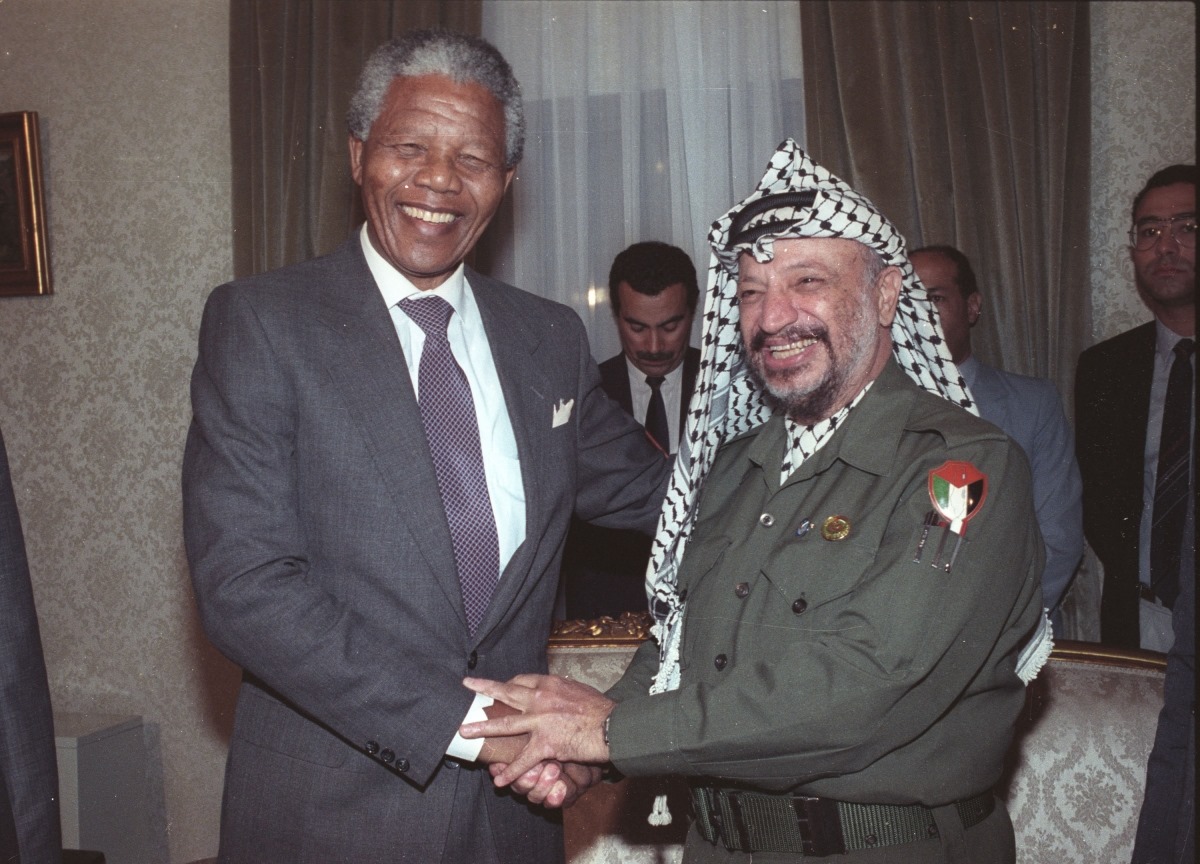
But four months after his release Mandela spoke out against the US distortion of history and came out strongly in support of the PLO. His clear statements supporting the Palestinian people were ignored by Hollywood, which attempted to take control of Mandela’s story and image. Perhaps Nelson Mandela should have been firmer about rejecting the flattering and distorting portrayals of his role in the struggle for freedom in South Africa.
Hollywood, especially in films like ‘Invictus’, directed in 2009 by Clint Eastwood, personalised the whole of the liberation struggle of the ANC from the time the ANC was founded in 1912, and framed the struggle around the “Christ-like” actions of one individual. – no, not the Christ-like actions of Albert John Mvumbi Luthuli who founded the ANC. Eastwood had probably never heard of him. Even after making the film I wonder if the 94 year old actor knows who Luthuli is.
When he made the film, what did Clint Eastwood know about South African politics? What do any of the mainly narcissistic, money-grubbing denizens of Hollywood, who portray every Russian as a gangster, every Arab as a terrorist and every Mexican as a criminal, have to say of about the history of South Africa? You can’t even rely on them to give a decent account of their own history. Lincoln, played by the British method actor, Daniel Day Lewis won the Oscar for best actor, not Leonardo di Caprio, who, perhaps, deserved it more for playing Calvin J Candie; Candie the sadistic plantation owner.
If you take Hollywood’s depiction of historical figures seriously then you probably thought Barak Obama and Henry Kissinger fully deserved the Nobel peace prize. Perhaps you also thought getting high at Live Aid, donating a few pounds to Bob Geldof and listening to Queen meant you were helping make poverty history.
Hollywood makes a travesty of any history it touches. In Invictus Hollywood composted the whole of the South African struggle into the actions of one person: Mandela. It cast him as a celebrity politician, shorn of real political meaning and revolutionary danger. Nelson Mandela, in a travesty of his true role in the struggle, is presented as a dignified and moderate middle class Black American with a South African accent. But, it was not for nothing that Margaret Thatcher thought of Mandela as a terrorist.
Morgan Freeman played Mandela in Invictus. His depiction of Mandela is off-putting. It is a perfect example of what Spike Lee called The Magical Negro who sorts out the problems of the main character, who is white. In this case, the hero of the film is the captain of the Springboks rugby team played by Matt Damon – with an awful south African accent. The vanity for hire of the Hollywood actor. These A-Listers are Dorian Grays with pictures locked away in their basements.
In the film Invictus Mandela gallops to the rescue of the white community, the community who benefitted so obscenely from Apartheid and who benefitted so unfairly from the post-apartheid settlement imposed on South Africa by the USA and the IMF.
Mandela, according to the Hollywood narrative, was there to reconcile “senselessly” warring parties. Showing the senseless warring, the film Invictus showed pictures of the rioting between Inkatha and the ANC supporters. It is hinted that the reason why the USA, and Afrikaners and other white South Africans, opposed full South African democracy and supported Apartheid was simply that it seemed necessary to do so during the cold war. It was a simple mistake to classify Mandela as a communist and a terrorist.
History has plenty of people who made great sacrifices for the liberation of South Africa, many who did not survive the Apartheid regime. Here are a few of their names. Look them up!
Solomon Mahlangu, Joe Gqabi, Ruth First, Dulcie and Reg September, Chris Hani, Walter Sisulu, Bram Fischer, Moses Kotane, JB Marks, Aggie Msimang, Robert Sobukwe, Oliver Tambo, Yusuf Dadoo, Josiah Jele, Albie Sachs, (*) Steve Biko, Mapetla Frank Mohapi, and many, many others.
If you want ‘saints’ then South Africa has many saints who died in exile or at home in South Africa, or were mutilated and psychologically damaged, by the former Apartheid regime. There are many saints of the liberation movement in South Africa and of the broader liberation movement in Southern Africa none of whom Hollywood seems to have any knowledge of, or would desire to commemorate in film.
What was it Ricky Gervais said about Hollywood actors at the Oscars in 2020?
‘So if you do win an award tonight, don’t use it as a platform to make a political speech. You’re in no position to lecture the public about anything. You know nothing about the real world. Most of you spent less time in school than Greta Thunberg. So if you win, come up, accept your little award, thank your agent, and your God and fuck off, OK? It’s already three hours long. Right, let’s do the first award.’
No other important ANC figures are ever shown in this film. Oliver Tambo, who was the President of the ANC, is invisible. Invictus puts clear water between Mandela and the rest of the ANC. The Executive Committee of the ANC is shown, instead, as a vengeful young rabble in a ramshackle barn. They are faced down by the great statesman who, with his immense gravitas, tries to talk sense into them.
But there is something even more repulsive about the Hollywood spinning of South African history. On behalf of their Golem Mandela, Hollywood decides it forgives the white South Africans for Apartheid. Forgiveness was the prerogative of the victims of Apartheid not of its supporters. The US supported Apartheid.
The US government supported Apartheid while black people were hanging from southern trees in the South, but then so did Kennedy, Johnson, Nixon, Carter, Reagan and Bush. George Bush who was accused of being an undercover CIA operative in the early 60s. The USA supported Apartheid in the sixties and the seventies. Thatcher supported Apartheid and so did Reagan. The consumers of Hollywood history forget that the CIA, MI5 and MI6 were bugging ANC office in Penton Street in King’s Cross and sharing the information with BOSS agents in the South African embassy – that it is possible that they colluded in the bombing of the ANC offices.

The demonisation of Jacob Zuma
In contrast, Jacob Zuma, a harder nut to crack, was painted by the West exaggeratedly as the “devil” to Mandela’s “saint”. They conveniently forgot that Jacob Zuma was also locked on Robben Island. On the 14th of February 1964. He was released 15 years later in March 1979 and then he worked as the head of ANC intelligence, actively fighting for the liberation of South Africa, while Mandela was in jail. Jacob Zuma, portrayed as a devil by the West, actually saved the “Rainbow Nation” from being balkanised; he got Inkatha supporters to vote for the ANC in the early 1990s. It was Zuma who stopped the civil war not the Hollywood Mandela on his own.
Mandela vs Koppel
Five months after his release, Mandela came out in support for the people who had supported the struggle in South Africa for so many years and he began to be quietly ignored and side lined and silenced: But here are extracts from Nelson Mandela’s answers to interview questions put by Ted Koppel for ABC News on a US talk show in 1990:
‘One of the mistakes which some political analysts makes is to think that their enemies should be our enemies. That we can and we will never do. We have our own struggle, which we are conducting. We are grateful to the world for supporting our struggle, but nevertheless, we are an independent organization with its own policy, and the attitude of every country towards _ our attitude towards any country is determined by the attitude of that country to our struggle. Yasser Arafat, Col. Gadhafi, Fidel Castro support our struggle to the hilt. There is no reason whatsoever why we should have any hesitation about hailing their commitment to human rights as they are being demanded in South Africa. Our attitude is based solely on the fact that they fully support the anti-apartheid struggle. They do not support it only in rhetoric. They are placing resources at our disposal, for us to win the struggle. That is the position.
‘Firstly, we are a liberation movement which is fully involved in a struggle to emancipate our people from one of the worst racial tyrannies the world has seen. We have no time to be looking into the internal affairs of other countries. It is unreasonable for anybody to think that this is our role. I have been asked by somebody, wants me to express an opinion on the differences that are taking place within the U.S.A., and he has made his position quite clear that there is racialism in this country. I have refused to be drawn into that. Why should Mr. Siegman accept my refusal to be drawn into the internal affairs of the United States and, at the same time, want me to be involved in the internal affairs of Libya and Cuba? I refuse to do that.
‘As far as Yasser Arafat is concerned, . . . we identify with the PLO because, just like ourselves, they are fighting for the right of self-determination. I went further, however, to say that the support for Yasser Arafat in his struggle does not mean that the ANC has ever doubted the right of Israel to exist as a state, legally. We have stood quite openly and firmly for the right of that state to exist within secure borders. But, of course, as I said to Mr. Siegman in Geneva, and others, that we carefully define what we mean by secure borders. We do not mean that Israel has the right to retain the territories they conquered from the Arab world, like the Gaza Strip, the Golan Heights and the West Bank. We don’t agree with that. Those territories should be returned to the Arab people.
‘I also explained [that] that in our organization, we have Jews. In fact, Mr. Gadhafi did not allow us to open our offices in Libya precisely because we had the courage to say to him, “We work with Jews in our organization,” and he didn’t allow us to open an office until February this year, when he had to accept us as we are. We are not prepared to be dissuaded by anybody. We have an independent policy which we assert, and no matter with whom we discuss.
‘One of the problems we are facing in the world today are people who do not look at problems objectively, but from the point of view of their own interests. That makes things difficult, because once a person is not objective, it is extremely difficult to reach an agreement. One of the best examples of this is to think that because Arafat is conducting a struggle against the state of Israel, that we must therefore condemn him. We can’t do that. It is just not possible for any organization of individuals _ of integrity _ to do anything of the sort.
‘I am saying that it will be a grave mistake for us to consider our attitude toward Yasser Arafat on the basis of the interests of the Jewish community. We sympathize with the struggles of the Jewish people, and their persecution, right down the years. In fact, we have been very much influenced by the lack of racialism amongst the Jewish communities.
‘In our own country, in the political trials that have taken place, when few lawyers were prepared to defend us, it has been the Jewish lawyers who have come forward to defend us. I myself was articled _ I’m a lawyer by profession, and I was trained to become a lawyer _ by a Jewish firm at a time when few firms in our country were prepared to take blacks. And as I have said, we have many Jews _ members of the Jewish community _ in our struggle, and they have occupied very top positions.
‘But that does not mean to say that the enemies of Israel are our enemies. We refuse to take that position. You can call it impolitical or a moral question, but for anybody who changes his principles depending on whom he is dealing (with), that is not a man who can lead a nation.
‘Apparently, Mr. Koppel, you have not listened to my argument. If you have done so, then you have not been serious in examining it. I have replied to one of our friends here that I have refused to be drawn into the differences that exist between various communities inside the U.S.A. You have not commented that I am going to offend anybody by refusing to involve myself in the internal affairs of the U.S.A. Why are you so keen that I should involve myself in the internal affairs of Cuba and Libya?’
Hollywood hasn’t heard of Mac Maharaj
Another example of a key player in South African history is Mac Maharaj – completely ignored and forgotten in the Western media and in the kind of history books of about South African written by the heirs to Robert Conquest and Donald R. Morris.
Mac Maharaj of the Communist Party of South Africa intervened to stop the Bophuthatswana leader Lucas Mangope being restored by the Apartheid government. The actions of these two people, Zuma and Maharaj were much more important in preventing civil war and balkanisation than Mandela’s support for the Springboks. The Springboks were a powerful symbol of the Apartheid regime, and boycotted throughout the world in the decades prior to democracy coming to South Africa.
Hollywood doesn’t make films about the the assassination of Patrice Lumumba, or the persecution of the Mao Mao. There are no British or Hollywood films about Ian Henderson’s war in Kenya.
Kenyatta was a hero of the British for allowing business to carry on as usual after independence in Kenya. Kenyatta was said to have made a deal in Jail with the British before he was released. But the independence fighters, the Mao Mao, were demonised. Just as Umkhonto we Sizwe fighters were demonised. The Mao Mao were hunted down by psychopathic colonial brutes like the British colonial policeman, Ian Henderson. He later went on to torture and kill people for the government of Bahrain were he was given the name The Butcher of Bahrain.
In 2016 Morgan Freeman went to Jerusalem and posed in front of the Israeli flag. I wonder what Mandela’s reaction would have been to that and if Freeman has reconsidered his support for Israel in the light of the ongoing genocide. On his Facebook page Freemen endorses Kamala Harris and says nothing about the killing of Palestinians in Gaza.
Mandela is dead, but if Nelson Mandela’s bronze statue outside the South Bank – with Nelson signifying and reconciliation – could speak it is almost certain that the statue would condemn Israel strongly, fully support the establishment of the state of Palestine and the struggle of the axis of resistance.
- Article derived partly from my review of the film Invictus written in 2009
- There was a film called ‘Biko’, but it was really about Donald Woods and his family
Discover more from Ars Notoria
Subscribe to get the latest posts sent to your email.

You must be logged in to post a comment.