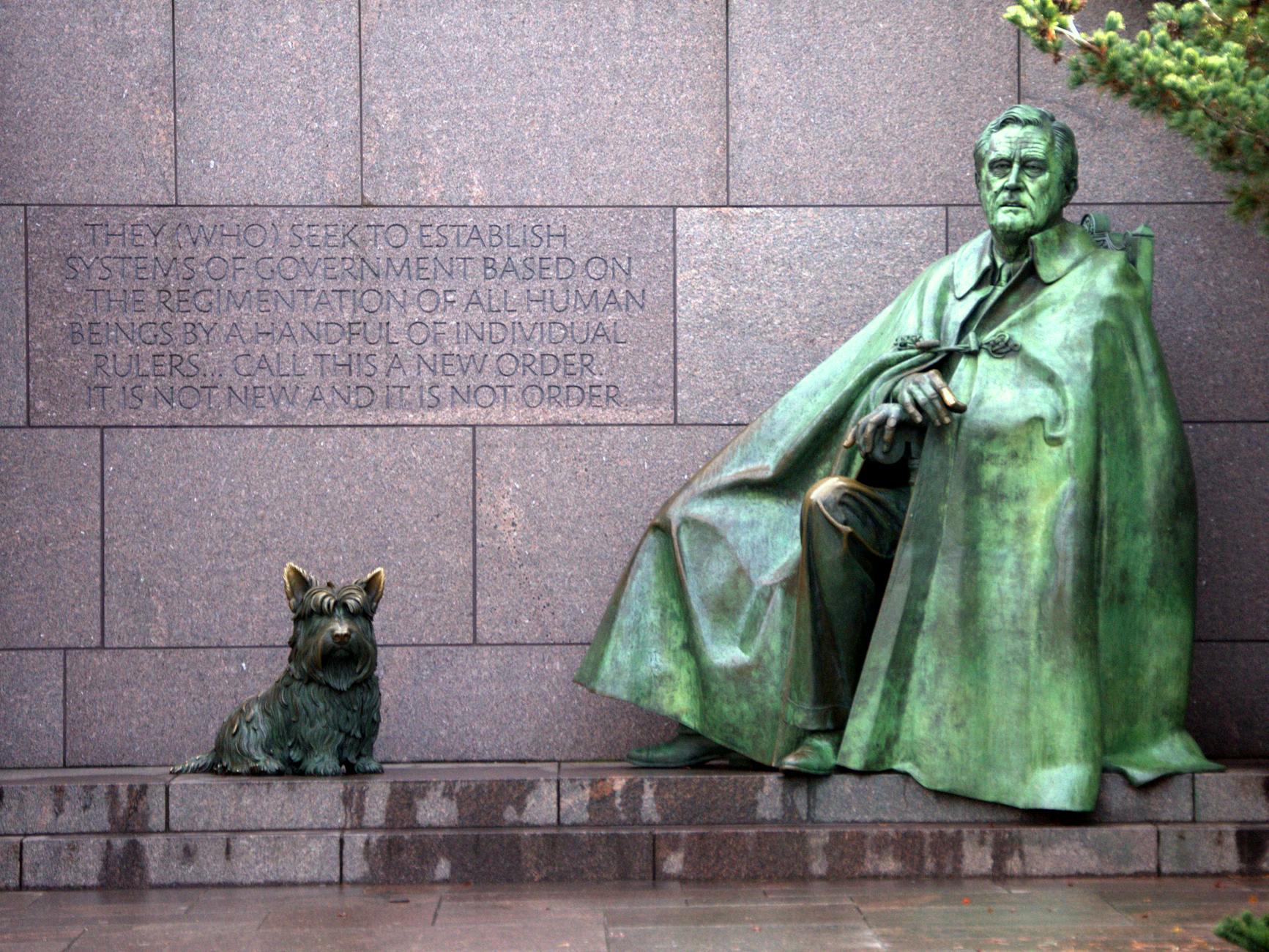
Bronze statue of FDR with his dog, Fala, Pexels
by Norman B. Schwartz
In his younger and leaner days, Orson Welles was summoned to the White House by the President of the United States. Franklin Delano Roosevelt greeted the actor, who he admired. “I am delighted to meet the second greatest actor in America,” the President said, loftily. FDR felt he had every right to boast about his own theatrical ability – after all, he had been on the road playing the role of benevolent patrician for many years before the younger man even became an actor. Roosevelt and Welles had much in common; although they both came from privilege, they had enormous sympathy for the underclass.
FDR boasted of his Dutch aristocratic ancestors who settled in the New World and founded New Amsterdam He was accused of betraying the interests of his class by granting the American working-class social security, the abolition of child labour, and the right of workers to collective bargaining. In 1938, Young Orson, then in his twenties, son of a midwestern inventor and a musical mother, committed the offense of scaring the shit out of the nation’s radio listening public with a broadcast so terrifying that many of his fellow Americans actually believed that the Martians had invaded New Jersey.

In 1941, adding insult to injury, Welles co-wrote and directed a film script initially titled American, whose protagonist was an overindulged rich kid who used his considerable inheritance to purchase newspapers and love. Many viewed the film – about to be released by RKO – as an unmistakable portrait of America’s most powerful publisher, William Randolph Hearst. At first, Hearst tried unsuccessfully to buy the movie (now called Citizen Kane) in order to destroy the negative. Then he placed a ban, forbidding all his newspapers, magazines, and radio stations from reviewing, advertising, or even mentioning the film.
In 1944, FDR running for office again, invited the young actor to share the platform and campaign for him. Welles also worked backstage as a speech writer and comedy writer – he called it ‘joke suggester’. When the Republicans claimed that after the President had left his dog, Fala, a Scottie, behind in the Aleutians and had then sent a destroyer to retrieve Fala at the taxpayers’ expense, Welles wrote that the Fala’s parsimonious Scottish soul was furious at the false accusation. The American public agreed. By picking on a president’s dog the Republicans had gone too far. Orson’s joke helped turned Roosevelt’s fortunes around.
FDR won the popular vote and was elected President for the fourth time. Neither of these great public performers, Roosevelt or Welles, could have imagined a time when another actor, a genuine card-carrying union member, a President of the Screen Actors Guild, who had once called FDR “a real hero,” could become President of the United States.

Ronald Reagan may not have been America’s second-greatest actor, nor even its tenth. Still, he had been one of those handsome and reliable All-American leading men who had earned the brothers Warner a great deal of money. In 1947, as the head of Actors’ Guild, he was called before the House Un-American Activities Committee to testify about the influence of the Stalinist leaning Communist Party of the United States (CPUSA) in the making of movies.
As Reagan said in his own defence, and also in defence of his union (as he saw it) that he had fought against a small clique of leftist members, some of whom he suspected of being communists: “We have been eminently successful in preventing them from, with their usual tactics, trying to run a majority of an organization with a well-organized minority.”
But by the 1950s, Reagan, no longer the union president, or the movie star he once was, was reduced to co-starring with a chimp in Bedtime for Bonzo. But, as a client of the most powerful agency in town, MCA, he became one of the first actors of his generation to embrace television. MCA had packaged The General Electric Hour and offered Reagan the job of the host who, on occasion, acted in one of the episodes. The genial Ronald Reagan impressed his corporate sponsors with his ability to sell their product with absolute conviction and by the way he used his middle-aged, but still boyish charm and enthusiasm. In addition to his weekly acting and hosting chores, General Electric enlisted Reagan as a motivational speaker.
Handed a script, which he duly memorized as carefully as he had memorized Drake McHugh’s dialogue in 1942’s Kings Row—“Where’s the rest of me?”—Reagan spent eight years traveling America as a corporate spokesman visiting hundreds of GE research and manufacturing facilities, Rotary clubs, and Moose lodges. It is doubtful that he understood everything his scripts asked him to say about burdensome taxation, or the failures of state socialism. Still, he thought he did know from personal experience something about conspiratorial left wingers.

If Reagan was the first American actor to become the head of state in 1981, he was not the first to abandon performing for politics. In 1944, film and stage actress Helen Gahagan, wife of Melvin Douglas (Garbo’s leading man in Ninotchka) was elected to the House of Representatives from California’s 14th district, the East Bay of San Francisco. Helen aspired to higher office but lost out in the 1950 Senate race because her opponent, the relatively unknown naval officer and veteran, Richard Milhous Nixon, asserted that the former actress was “pink right down to her schnorrer underwear.”.
In 1965, George Murphy, song and dance man of Irish extraction, succeeded where Helen Gahagan Douglas had failed. No one could have accused Murphy of wearing red underpants. George, a Republican, became the first American actor to become a United States Senator.
In 2003, Arnold Schwarzenegger, another Republican, did him better; he was elected to the higher office of Governor of the same state that Murphy had represented. At the time, many thought that if Arnold had not been born in Austria, thereby making himself ineligible for the presidency, he might have had an excellent chance of becoming the second actor to inhabit the White House.
Since then only a few less famous performers like wrestler and actor Jessie Ventura, Governor of Minnesota and Saturday Night Live writer and comedian, Al Franken, Senator from the same state, have entered national politics. None with the success of their predecessors.
Today, it is hard to imagine that once-upon-a-time when a person aspired to public office, they had to spend hours traveling from state to state in a private railroad car, memorising the speeches. Each time the train pulled into a whistle stop, the candidate walked to the rear of the train, stood on a raised platform and recited the same speech in a voice loud enough to be heard by all gathered at the station. The train then moved on to the next town, where the same speech was given. Nowadays, given today’s celebrity culture, one does not need to act to play the role of politician – or even to have been one.

Since the invention of the microphone and the teleprompter, it is now possible for anyone with a reasonably pleasant-sounding voice and potentially appealing personality to stand behind a rostrum and read from an electronic text as the words others have composed for them scroll before their eyes. Today’s politicians, unlike the politicians of FDR’s and Welles’ generation, need not understand a word they are saying in order to deliver a speech.
Today’s candidates must photograph well and have charisma, a word once only applied to entertainers. Recently, we have seen many examples of seemingly attractive and electable personalities who might have been actors, but weren’t, and others who might have a political agenda or don’t. Among them: is a self styled Irish American with the looks and polish of a Boston Brahmin and none of the beery cheerfulness of the potato-famine immigrant, an eloquent African-American born in Hawaii to an 18-year-old white mother and a 27-year-old back Kenyan father. Another candidate is the son of a real-estate developer whose father was born in the Bronx and whose wife came from the village of Tong on the Hebridean island of Lewis. Last but not least, there is the bubbly daughter of an Jamaican economics professor at Stanford University and a woman from Tamil Nadu, the capital city of the Indian district of Chennai.
Depending on one’s political point-of-view, none, some, or all of the above were and are either highly qualified, or totally unqualified for the part they chose to play in their country’s governance. Nowadays, none of them need to be great actors like FDR.

Norman B. Schwartz is the author of the comic novels ‘ALL THINGS small‘, Paradise Now, Don Juan in Space, True (Cinema) Confessions, Hollywood: Below and Beyond, and the DIY guide, The Art Of The Schnoorr. He spent over forty years working on films in Hollywood and Rome. Norman was the first ADR sound editor / director to be admitted to Academy of Motion Picture Arts and Sciences in Los Angeles.
Norman B. Schwartz essays will appear in sequence monthly in each issue of the magazine with a view to Centre House Press publishing the entire collection of essays in book form in spring 2026
Discover more from Ars Notoria
Subscribe to get the latest posts sent to your email.


You must be logged in to post a comment.