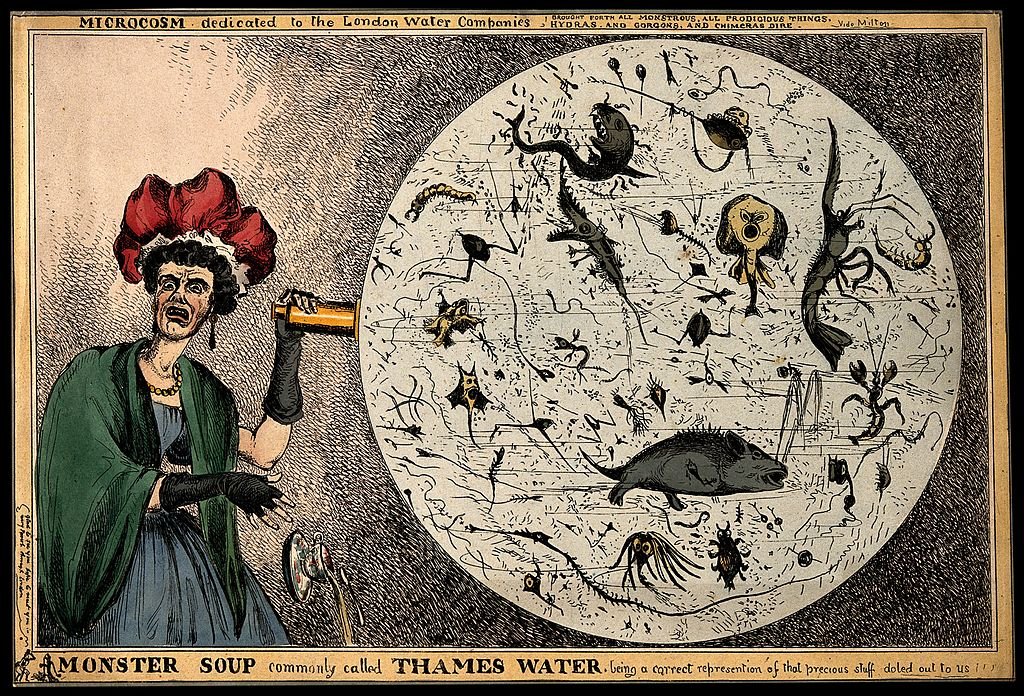
Are offshore tankers a temporary solution to the sewage crisis?
by Paul Halas, Phil Hall, Steve Parker, Nicole Stocks, Karl Rutledge
.
.
Officially, the United Kingdom ceased to be a developing country when Sir Joseph Bazalgette CB, a descendent of French Huguenots, designed a new sewage system to solve the problem of the Great Stink emanating from the Thames river, in this way helping to solve the problem of cholera and other diseases caused by the sewage. With the current sewage crisis, the United Kingdom teeters on the brink of re-entering underdevelopment. This situation has arisen because of the structural flaws that inevitably arise when a natural state monopoly is privatised.
A parliamentary committee report has criticised England’s rivers, describing them as a hazardous mix of sewage, agricultural runoff, and plastic waste. Judges have determined that the current legal breaches by water companies could have been prevented with better infrastructure and greater investment in water treatment. According to the BBC, water company lawyers argue that only the original 1991 privatisation agreements are valid, dismissing any subsequent amendments. Unison has condemned the water industry’s mismanagement of sewage as a national scandal, blaming privatisation.

Following the Great Stink of 1858, Benjamin Disraeli, the founder of One Nation Conservativism, decided to invest in the health and future of London and Joseph Bazalgette was commissioned to design the London sewage system which became one of Victorian Britain’s most significant achievements – far more beneficial and enduring for ordinary Londoners than the British Empire. As Chief Engineer of London’s Metropolitan Board of Works, Bazalgette lead this massive project which involved building 1,300 miles of sewers, 82 miles of intercepting sewers, and using 320 million bricks.
Though we thought we had resolved the issue of water pollution and disease, the problem has returned, caused by the people who permitted the pollution in the first place: the Tories. If only they were One Nation Tories like former Prime Minister, Benjamin Disraeli.
The effects of raw sewage
We don’t have a cholera epidemic thanks to antibiotics, there are no outbreaks in Greater London. However, the people of Devon experienced water contamination in May 2024, which meant they could not drink tap water for weeks. This while, according to the news service of ITV, the South West Water company (SWW) saw its profits increase by 8.6%. Human faeces can contain harmful bacteria, viruses, intestinal worms, and parasites which can cause stomach, intestinal, or liver illnesses. e. coli poses a serious risk, too: three Oxford crew members training for the boat race got e. coli from the polluted water of the Thames. There is also the danger of getting hepatitis, which, arguably is even more severe than cholera and can have lifelong effects.
Poor water quality harms natural ocean ecosystems and habitats and sewage can cause toxic algae blooms, which remove oxygen from the water causing the death of fish and other animals. The problem is severe. Great Britain has a population of around 70 million, and there is a critical need for proper, functioning water treatment.
Poor water quality greatly diminishes the quality of life for ordinary people, especially those who cannot easily escape to luxury destinations like Mustique, Necker Island, or the Seychelles. No one wants to swim in hazardous effluent. It prevents individuals from enjoying the mental and physical health benefits of our rivers and coast.
Paul Halas, a fisherman who fishes on the Frome notes: ‘Sewage problems have been in the news a lot recently, and our local river has suffered Surveys have shown a serious lack of fish in both numbers and diversity for almost all of the river’s length. The small fish species have largely disappeared: minnows are no longer seen, nor loach, and stickleback and bullhead numbers are vastly reduced. As for trout, which were always a visible presence throughout the river, they are now far fewer and smaller.’
Protection racket

The water companies seem to operate like a mafia running a protection racket. According to Unison, they have extracted £85 billion to distribute to shareholders, while management has paid themselves £25 billion over the years, and overall the companies owe £60 billion in debt. Now, failing companies are demanding a government bailout before investing in infrastructure. The companies rely on around 18,000 licensed sewer overflows to regularly discharge raw sewage into rivers and the ocean. Thames Water (Kemble Water Holdings) has released 85.9 billion litres of sewage into the Thames since 2019. In 2023, there were 3.6 billion hours of sewage release, more than double the 1.7 million hours in 2022. According to Unison, the number of sewage releases increased from 301,091 in 2022 to 464,056 in 2023, during the last full year of Tory rule.
Ofwat has proposed relatively small fines totalling £168 million for Thames Water, Yorkshire Water, and Northumbrian Water in its largest-ever investigation into sewage spills. Thames Water, which serves 16 million people in the UK, was warned by auditors in December that it might run out of money by April due to its £18 billion debt, which is 80 percent of the company’s value. Investors have offered £500 million upfront and an additional £3 billion if Ofwat allows the company to raise bills by 40 percent and resume paying internal dividends to its parent company, Kemble.
The Liberal Democrats, emphasising their environmental credentials, propose placing water companies into ‘special administration,’ as if they were merely failing primary schools. They suggest running these companies as public-private partnerships, which Sarah Olney refers to as ‘public benefit enterprises.’ During the election campaign there were suggestions that Labour had plans to renationalise the the water companies, an overwhelmingly popular action. Labour is now retreating from the possibility.
‘Labour will put failing water companies under special measures to clean up our water. We will give regulators new powers to block the payment of bonuses to executives who pollute our waterways and bring criminal charges against persistent law breakers. We will impose automatic and severe fines for wrongdoing and ensure independent monitoring of every outlet.’
Unison is far more direct, defining the problem as a structural issue which arises as a result of privatisation and the private ownership, calling the behaviour of the water companies a national disgrace. Water is a natural monopoly, prone to abuse and monopolistic practices by water companies. There was a time when water was unmetered and funded by taxes, which seemed sufficient. Now, taxation appears insufficient to fill the pockets of all these former Tory cronies who run the water companies.
A temporary solution

According to Steve Parker, while the new Labour government is working on addressing the issue (albeit not very quickly), a relatively low-cost, temporary solution to prevent sewage from being discharged into rivers and the sea is to store it. But where? The answer is to store sewage in tankers moored offshore and in river estuaries. According to Ken Lee from Malaysia, this approach has a precedent: overflows of rubbish and plastic are stored offshore by specially designed boats called Interceptors, managed by the Dutch NGO ‘The Ocean Cleanup.’ For example, the boat the Interceptor 2 is stationed in Malaysia’s Klang River.
The proposed temporary solution involves using large, sealed tankers or large cargo ships nearing the end of their working life to store sewage. These vessels would be moored offshore or in river estuaries, they would be linked to shore by large pipes that marry to sewage outlets. Diesel pumps would transfer the sewage to the tankers when land-based treatment facilities were overwhelmed by excessive rainwater. Once the treatment facilities have increased capacity, the sewage could then be pumped back at night. Alternatively, quiet electric pumps could be used onshore to manage the sewage transfer back and forth. Certainly it seems to be a better solution than sending hundreds of trucks loaded with sewage up and down the country.
Possible problems
There are two major technical challenges with this solution. First, the capacity of the anchored boats and ships needs to be considered. What size should they be? Could they be linked in a series? For instance, Thames Water released 553 million litres in one day in Mogden, SW London. A very large supertanker has a capacity of as much as 321 million litres, so two linked VLCC or ULCCC tankers could handle even this enormous flow. Of course it is unlikely that such a huge ship would be needed, or even acceptable to the local community. Smaller ships or boats could cope with smaller quantities.
Secondly, the weight of the sewage might cause the boat to go aground, requiring re-floating when the tankers finally need to be removed. The solution could involve adding buoyancy, using tanks or airbags fitted in a skirt around the hull, similar to those that were used to raise the Mary Rose. These storage ships would not pose a threat to navigation as they would be close to shore.
To address objections to the temporary placement of these vessels offshore, communities could be given a choice: offshore sewage storage or continued discharge of untreated sewage near beaches. Engaging communities in decisions about the location and specifications of the storage vessels could help. They could also participate in making the ships more visually appealing, perhaps by having children name the ships and local artists design murals.
Additionally, there could be creative uses for these ships, inspired by the Danes in Copenhagen who efficiently burn rubbish to generate power. The British government could explore how to process waste in order to produce methane and compost. Wind turbines, wave turbines, and weather stations could be placed on the ships, and various ancillary uses thought of – the limits set only by the imagination of the participating communities.
Communities can play a crucial role in sewage management decision-making through various approaches, by participating in public consultations, advisory committees, educational campaigns and by providing feedback – through creative collaborative projects.
What can we do right now?
Here is some useful advice and information adapted and added to from the Rivers Trust:
- Identify where sewage is being released and, for the moment, avoid swimming in these areas.
- Write to your elected political representative
- Report any signs of sewage
- Join your trade union and persuade it to take legal action against the mismanaged Water Treatment companies
- Join a political party that proposes to take strong action against the water companies
- Report any signs of other environmental incidents
- Join voluntary activist organisations like The Rivers Trust that work for sewage free coasts and rivers

Nicole Stocks is a passionate environmentalist dedicated to community well-being and an avid reader. Despite her desire to be vegan, she is currently undergoing treatment for a brain tumour, which requires her to consume more animal protein as part of her recovery.

Steve Parker is an electrical engineer with 56 years of experience, having designed and built electrical systems for factories in the UK and abroad. In his retirement, he finds joy in repairing toys for hospices and devising technical solutions to pressing problems.

Paul Halas is a fisherman, professional writer, a small publisher, and social activist who is deeply concerned about the state of our rivers. His work reflects his commitment to environmental preservation and social justice.

Karl Rutledge holds doctorates in astrophysics and theology. He is an advocate for LGBTQ rights and serves as the local Methodist minister for New Malden, where he combines his scientific knowledge and spiritual guidance to support his community.

Phil Hall is a small publisher and the executive editor of Ars Notoria Magazine. He is also a teacher, lecturer, and advocate for humane socialism, dedicated to promoting social justice and intellectual discourse through his work.
- https://www.thechemicalengineer.com/news/engineering-options-that-can-prevent-sewer-overflows-mag/
- https://www.thames21.org.uk/2024/04/the-uk-sewage-crisis-and-how-other-countries-manage-their-wastewater/
- https://www.ice.org.uk/news-insight/news-and-blogs/ice-blogs/the-infrastructure-blog/how-to-fix-uk-sewage-overflow-problem
- https://www.geeksforgeeks.org/alternative-arrangement-for-sewage-disposal/
- https://theriverstrust.org/key-issues/sewage-in-rivers
- https://www.wsws.org/en/articles/2024/04/11/arqz-a11.html
- https://www.bbc.co.uk/news/explainers-62631320
- https://www.sas.org.uk/water-quality/
Discover more from Ars Notoria
Subscribe to get the latest posts sent to your email.



You must be logged in to post a comment.