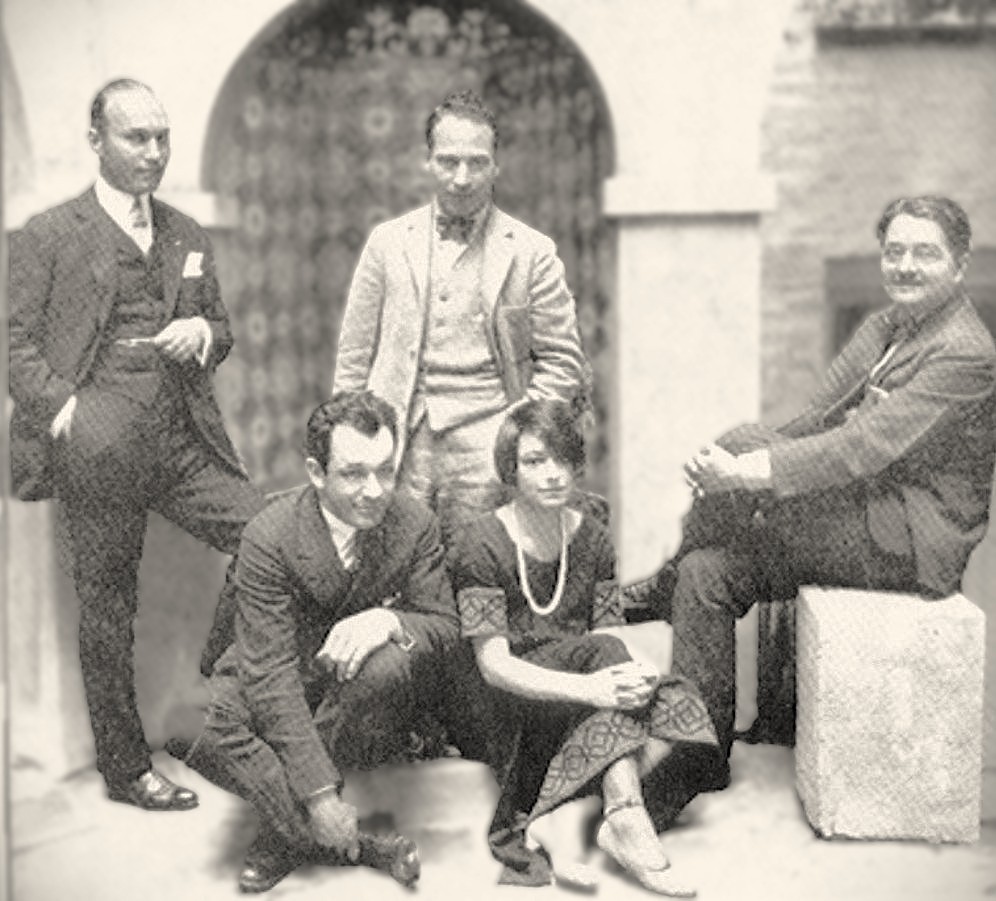
Parker, with Algonquin Round Table members and guests Art Samuels (editor of Harper’s and, briefly, The New Yorker), Charles MacArthur, Harpo Marx, and Alexander Woollcott, c. 1919. Photograph Unknown Author, Wikimedia Commons, Public Domain
Dorothy Parker and Politics
by Norman B. Schwartz
Of all the New York wags and wits who squeezed around the round table at the Algonquin Hotel on 44th Street over a hundred years ago, none was more feared in her time than Dorothy Rothschild Parker (18931967). She once said, “The first thing I do in the morning is brush my teeth and sharpen my tongue.”
Her barbs were quoted in all the papers and repeated from coast to coast; many attributed to her she never made. What did it matter? The best were so well known that there was rarely an educated person in her time who could not remember her reply when asked about horticulture (END NOTE 1) or what would happen if all the girls who attended the Yale prom were laid end to end (END NOTE 2). And yet, the part no one seems to remember is that of all her then famous colleagues, Robert Benchley, George S. Kaufman and Ring Lardner, she was the one of those few who had more than a casual interest in politics.
The outrage that first stirred Dorothy’s conscience away from the frivolities of the Algonquin was a trial of 1920 in Massachusetts of two Italian self-declared anarchists, Nicola Sacco and Bartolomeo Vanzetti, charged with a robbery and murder at a time of considerable anti-immigration and anti-Italianism in America. Sacco and Vanzetti belonged to an anarchist group called the Galleanists, who openly advocated revolutionary violence. When the police caught the two Italians seven months after the crime, the two men were carrying guns and pamphlets, but their investigators could find no evidence placing them at the crime scene or any money. Nevertheless, they were convicted of first-degree murder and sentenced to death in the electric chair.

Bartolomeo Vanzetti (left) and Nicola Sacco (right). Photograph Unknown Author, Boston Globe, Wikimedia Commons
Following their indictment, the bomb-making Galleanists began their violent counterattack, killing 38 bystanders, wounding 134, and threatening American embassies worldwide with bomb attacks. Despite this, the outcry about a miscarriage of justice – sending the wrong men to death – was so great that Albert Einstein, Bernard Shaw and H. G. Wells signed petitions of protest asking for a retrial, and to have the death sentence commuted. The execution was forever being delayed.
In 1927, Dorothy and the poet Edna St. Vincent went to Boston to plead a stay. The police arrested her. Fined five dollars for “loitering and sauntering,” she complained to reporters that the police had treated her “roughly.” But Parker’s campaigning and that of other prominent international figures eventually proved ineffective. Sacco and Vanzetti were executed in Charleston State Prison on 23 August 1927.

Carrying out the coffins of Sacco and Vanzetti from the funeral home in Boston. Photograph Unknown Author, Wikimedia Commons
Shortly after that, Parker first declared herself a socialist, but unlike many other protesters, no record exists of her affiliation with the Socialist Party of America. Dottie was not a joiner. Despite her increased political activity, she never abandoned the good life her New York pals enjoyed.
In the 1930s, the years of the Depression, she made many trips to Europe in first class and was often a house guest of Sara and Gerald Murphy – prototypes for the Divers in Fitzgerald’s novel Tender Is the Night. This was at their Villa America at Cap d’Antibes on the Riviera. During one of her numerous transatlantic crossings, Dorothy learned that a Mrs Mooney, the eighty-four-year-old mother of a West Coast labor leader serving a twenty-five-year sentence in San Quentin, was traveling in third class, accompanying a delegation of American communists invited to visit Soviet Russia. Mrs Mooney invited Dorothy to attend her companions’ shipboard meetings, but she was quickly bored. The dialectics oF conventional politics, either of the left or right, were not exciting enough to hold her attention, and she left the meeting early – most likely to join her friends for cocktails in the first-class lounge.

Gerald and Sara Murphy at Cap d’Antibes beach, 1923. Photograph Unknown Author, Wikimedia Commons
In 1934 she married actor-writer Alan Campbell. An agent friend suggested they sell themselves as a husband-and-wife writing team. Paramount in Hollywood offered them a yearly contract at $1,250 a week, equivalent to about $1 million a year today. At first, Parker resisted. She said that “Hollywood money wasn’t real money,” but “congealed snow that melts in your hand.” Once ensconced on the western coast, however, she soon followed the example of other fellow-New York expats, figures like Lillian Hellman and her lover Dashiell Hammett, always on the lookout for a worthy cause. She became one of the founders of the Screen Writers Guild (SWG), the first group in Hollywood to organize writers. Their studios protested, claiming they were not common workers but artists and therefore ineligible to unionize. Dorothy also protested. Shortly after, she declared herself a communist. But once again, there is no evidence that she ever joined the party.
In 1937, the same year she and her husband were nominated for an Oscar for writing the script for the original A Star Is Born, Parker also helped found the Hollywood Anti-Nazi League. She went to Spain during the Civil War, reporting back to the New Masses, the leading leftist magazine in America: “I want to say first that I came to Spain without my ax to grind. I didn’t bring messages from anybody, nor greetings to anybody. I am not a member of any political party…. I can’t tell you amusing anecdotes of the boys in the trenches. I don’t think there are any such stories…. I have seen the people in the country and in the cities wanting only to go about their lives, only to secure the future of their children. They ask only as much as you have, because they are people like you – they want to get up from their tables and go to their beds, to wake to a quiet morning, and the sending of their children off to school. They don’t think of accumulated money. They want to do their own work in self-respect and peace. They want the same thing that you have – they want to live in a democracy…. It is incredible, it is fantastic, it is absolutely beyond all belief…except that it is true.”

New Masses cover by Frank Waltz, September 1926. Wikimedia Commons
In 1938, Dottie had a taste of victory. The National Labor Relations Board finally ruled screenwriters qualified as workers under the Wagner Act and therefore could organize as a union. In the years that followed, she continued supporting progressive causes. For nearly a quarter of a century, the FBI documented her activities in a dossier of a thousand pages, tracking all her movements and causes, which alleged she had belonged to over thirty organizations, and contributed money to groups later described as communist fronts.
Cardholder or not, Dorothy continued to be an independent voice, an ardent supporter of whatever cause she felt was right. In 1940, the year before the United States entered the war, the Congress of the United States began what was to be another one or the first of many investigations about the alleged communist influence in Hollywood. The progressives in Hollywood felt outraged. Dorothy appeared before HUAC (the House Un-American Activities Committee) in Los Angeles and spoke passionately about her friends as she had once spoken about the Spanish people.
She told the chairman: “The people want democracy – real democracy, Mr Dies, and they look to Hollywood to give it to them because they don’t get it any more in their newspapers. And that’s why you’re out here, Mr Dies – that’s why you want to destroy the Hollywood progressive organizations – because you’ve got to control this medium if you want to bring fascism to this country.”

U.S. Rep. Martin Dies, 1938. Photograph Harris and Ewing, Wikimedia Commons
Dorothy’s passionate speech was mentioned in only a few newspapers. The committee’s real purpose had been to interview glamorous movie stars not disgruntled writers. Dies claimed that any number of actors “were very frank and submitted their books and records for our inspection,” publicly declaring that Fredric March, Melvyn Douglas, Humphrey Bogart, Jimmy Cagney, and Franchot Tone “are not, nor have ever been, Communist sympathizers.”
This proved to be a Pyrrhic victory. In 1946, after the war had ended, a Republican won control of Congress for the first time in sixteen years. This time, the party knew the nation was better prepared for their unsupported accusations. In 1947, with New Jersey congressman J. Parnell Thomas leading HUAC, and a young, former naval officer, Richard Nixon, as a prominent outspoken member, the committee promoted a narrative the nation was now ready to accept. The US had won the war, but lost China to communism because of domestic subversion. The Russians were out to steal our atomic secrets, aided by government employees and the insidious influence of Hollywood.
During their witch hunt, HUAC convened in California and summoned nineteen witnesses – mostly writers, many of them Jewish – known to be current or former members of the Communist Party. The industry trade paper, The Hollywood Reporter, labeled them “the unfriendly witnesses,” which prompted director Billy Wilder to say “Only two of them have talent. The rest are just unfriendly.”

Nixon as a lieutenant commander in the United States Navy, c. 1945, Wikimedia Commons, Author Unknown
At first, the studio heads resisted such outside interference. Louis B. Mayer’s hatchet-hand man Ed Mannix said, “No half-ass congressman is going to tell MGM how to run its business.” Asked about his staff writers who had written the script for Mission to Moscow, Mannix’s boss, Mayer, said, “They had farm collectivism in it, and I threw it out.” But it took little time after that before these powerful men changed their minds.
Jack Warner was only too happy to call some of his former employees “ideological termites…. Some of [their] lines have innuendos and double meanings and things like that, and you have to take eight or ten Harvard law courses to find out what they mean.” Lela Rogers, mother of Ginger, agreed; she offered in evidence the script of Tender Comrade, a wartime film about the lives of women on the home front sharing an apartment while their husbands were fighting overseas. Lela quoted one offensive line written by a known communist, Dalton Trumbo, that her daughter had refused to say: “Share and share alike – that’s democracy.” Parker had not received a subpoena, but she attended the HUAC hearings in solidarity with her fellow-writers. Many “fellow travelers” like herself, as they were being called by the committee, soon suspected they were about to be blacklisted. Some left the country; others began writing under a pseudonym. After completing her final Hollywood screenplay credit, The Fan, a 1949 adaptation of Oscar Wilde’s play Lady Windermere’s Fan, Dorothy returned to New York.
In April 1951, the FBI finally caught up with her and rang her bell. The moment the agents entered her apartment her dog started barking and wouldn’t stop. When asked by an agent if she had ever conspired to overthrow the government of the United States, Parker pointed to her pet, “Listen, I can’t even get my dog to stay down. Do I look to you like someone who could overthrow the government?” In her final years, forgotten except by a few cognoscenti, she lived alone with her dog in the Volney hotel on Manhattan’s Upper East Side. Whenever she consented to be interviewed about the Roaring Twenties, she denigrated her fabulous past: “The Round Table was just a lot of people telling jokes and telling each other how good they were,” she said. “Just a bunch of loudmouths showing off, saving their gags for days, waiting for a chance to spring them…. There was no truth in anything they said. It was the terrible day of the wisecrack, so there didn’t have to be any truth.”

The Upper East Side Historic District. Photograph Gryffindor, Wikimedia Commons
At seventy-three, on 7 June 1967, Dorothy Parker died of a heart attack. In her will, she bequeathed the bulk of her estate to Martin Luther King Jr, a man she much admired but had never met. Her cremation took place on 9 June 1967. Her literary executor Lillian Hellman, friend from their union organizing days, made all the funeral arrangements, but forgot to tell the crematory what to do with the ashes. They remained on a shelf in Hartsdale, New York, unclaimed for six years.
On 16 July 1973, the Ferncliff Crematory mailed her ashes to her lawyer’s offices in New York City, where they sat in a filing cabinet for another fifteen years until the National Association for the Advancement of Colored People (NAACP) claimed them, designing a memorial garden outside its Baltimore headquarters in 1988, twenty-one years after her death. A round plaque there reads—
Here lie the ashes of Dorothy Parker (1893–1967) Humorist, writer, critic. Defender of human and civil rights. […] This memorial garden is dedicated to her noble spirit which celebrated the oneness of humankind, and to the bonds of everlasting friendship between black and Jewish people.
Most likely Dottie would not have been pleased had she been present. Once again, no one followed the wishes of the lone wolverine, as a friend had called her. In life, she had never made much of her Jewishness. Her father, Jacob Henry Rothschild, had. Her Protestant mother, Eliza Annie Marston, had not. Dorothy received a great deal of her education at the Blessed Sacrament Covent School on 79th Street in Manhattan. Wise-cracking even after death, Dorothy Rothschild Parker would have reminded those present that day that she much preferred two simpler epitaphs she had already chosen—
EXCUSE MY DUST
or
THIS IS ON ME
1. “You can lead a horticulture, but you can’t make her think.”
2. “I wouldn’t be a bit surprised.”
Norman B. Schwartz is the author of the comic novels ‘ALL THINGS small‘, Paradise Now, Don Juan in Space, True (Cinema) Confessions, Hollywood: Below and Beyond, and the DIY guide, The Art Of The Schnoorr. He spent over forty years working on films in Hollywood and Rome. Norman was the first ADR sound editor / post-production dialogue director to be admitted to Academy of Motion Picture Arts and Sciences in Los Angeles.
Norman B. Schwartz’s essays will appear in sequence monthly in each issue of Ars Notoria Magazine. In October of 2025, a paperback edition of the complete collection of his essays titled: HOLLYOOD Actors & Politicos/ a Shared Profession will be available for purchase from Centre House Press.
Discover more from Ars Notoria
Subscribe to get the latest posts sent to your email.



You must be logged in to post a comment.