
Riley’s Crisp lorry. Credit Arun Kapil
All Tastes Are Equal – the Rest Is Theatre
By Arun Kapil
Back then – long before “scent” – smell was social currency. Curry smell meant immigrant. Chip-fat smell meant working class. Roast beef meant you’d arrived. In the seventies, Britain could be sniffed before it was seen. A school corridor told you who packed what lunch – and, by extension, who you thought you were.
In the playground, food was shorthand for difference. Ham sandwiches, Riley’s or Smith’s crisps and “chews” held the moral high ground. Even egg and salad cream made most of your peers recoil – opening your Tupperware to release a glorious sulphurous wave wasn’t for everyone. Anything foreign was suspect: smelly, messy, too loud on the tongue. Children learned to weaponise ‘pack-ups’ long before they learned long division.
“What’s that?” someone would sneer, eyes watering theatrically over my tiffin.
“Curry,” I’d answer, proudly.
But the word hung in the air like a challenge, not an answer.
Even comedy joined in. Monty Python’s French knight screaming, “Your mother was a hamster and your father smelt of elderberries!” was absurd, yes – but also a perfect British insult: olfactory warfare. To smell different was to be different and difference was something to laugh at from a safe distance.
Even within Britain, smell sorted people into neat boxes. The middle class recoiled from chip shops and kebab vans; the upper class hid garlic behind euphemism. Southerners mocked Northerners for blandness and vice versa. The nation’s tongue was at war with itself. Food wasn’t just nourishment – it was a map of belonging.

Fatt Pundit Curry. Photograph Arun Kapil
Not all of it was cruelty, though much of it was ignorance, a collective not knowing. Before cheap flights and package holidays, curiosity came mostly in tins. I remember the scourge of the “raisin-spotted curry,” a beige stew christened in curry powder and celery salt, made with hope, not skill. When Britain began to travel, it brought home the recipes but not the rhythm. Copy-and-paste cooking in the dark.
At home, food was pride stitched with self-consciousness. My dad cooked with panache – ghee shimmering, mustard seeds crackling – but when English neighbours dropped by, we’d open a window and light a candle. “They’ll think we smell.” I didn’t understand. To me, it smelled like life itself.
Those red-eye flights returning from India – cavernous Pan Am jumbos bound for Heathrow, our suitcases stuffed with jars of pickle, asafoetida and home-packed masalas – are etched in memory. My Taiji’s (aunts) pressed them into our hands like treasure, convinced no such magic could be found in England. They were right. As we shuffled down the aisle, the smell followed us: sharp, holy, alive. I thought it was glorious. Mum thought everyone was staring. Maybe they were – not in disdain, just unknowing. We carried a kind of magic they hadn’t yet met.
This was before taste went global, before spice became a lifestyle hashtag. Phones were fixed to walls, not palms. If you wanted to share something, you invited someone to dinner. There was no “post,” only plates. No curated light, just fluorescent honesty. Cooking was instinct and improvisation, guided by Good Housekeeping clippings in Mum’s scrapbook. Flavour was the only algorithm that mattered.

Brothers at the Taj. Photograph credit Arun Kapil
Today’s teens might never grasp the thrill of answering a phone without knowing who was on the other end – that jolt of surprise, that human risk. Cooking felt the same: every pot a blind date. Sometimes you got magic; sometimes, mush. But at least it was real. At least it had smell.
The very thing we once hid became the thing Britain fell in love with. The same turmeric that drew stares now lines every supermarket aisle. The same “foreign food” once mocked in playgrounds now headlines festivals and fine-dining menus. Yet I still remember the sting of those early days – when “curry” sounded like contagion. Maybe that’s why I’ve spent my life shouting about spice: to make noise for what was silenced.
The cure for most misunderstandings isn’t argument; it’s appetite – sating appetite. Sit down, break bread, share something delicious. It’s hard to hate someone whose food you’ve loved. The past is what it is; there’s no future in the past. But to taste, truly taste, is to connect – with history, with the present, with one another. So yes, maybe I’ve been on a lifelong mission: to learn, to master, to turn old insults into invitations and to shine a light on the best. To show that Indian food – with all its contradictions – isn’t “too much”; it’s just the right amount of everything. To prove that what once seemed chaotic is, in fact, beautifully balanced.
Because the flavour of prejudice is blandness – and the only antidote is curiosity, seasoned with humility. Taste: the universal leveller.

Asafoetida. Photograph Arun Kapil
Now imagine the tongue as a theatre. The lights dim. Salt sits with her legs crossed, shiny and self-assured. Sweet smiles from the corner, pretending not to crave attention. Bitter leans back, cigarette dangling, unimpressed. Sour can’t stay still. Umami, the latecomer, slinks in reeking of smoke and secrets. And then, bursting through the door, Pungent – the troublemaker, all rebellion and chilli. Astringent follows, prim and precise, clipboard in hand, while Madhura glides in after them – sweetness that doesn’t shout, just settles.
This is the full orchestra of taste. And every culture, every kitchen, plays its part: the shiny ones dressed in white porcelain and linen – French food with its sauces and gloss; Italian with its golden-hour simplicity; the Nordic with its tweezers and silence. Indian, Irish, Mexican, British, Nigerian, Ethiopian, once dismissed as too heavy, too spicy, too brown, too gloopy, too messy. Each with its own rhythm, each tuned to its own truth.
Some cuisines whisper, some sing, some roar, but all tell the same story: pleasure, joy, generosity. The trouble starts when we pretend the melody belongs to one section alone. All tastes are equal; the rest is theatre.
Masala Note – Plating:
Pretty gets the applause. But flavour’s the one that goes home with you.

A perfect smear of purée might win applause; a stew that hums like memory wins loyalty. Photograph Arun Kapil
Somewhere between the camera and the mouth, we forgot that the body doesn’t crave prettiness; it craves connection. Food that photographs well – airy, geometric, pastel – may please the eye, but it rarely moves the heart. A perfect smear of purée might win applause; a stew that hums like memory wins loyalty. A rich dahl, a pepper stew, a mole – each an orchestra in a spoon. They may look chaotic, but so does nature when you stand close enough to feel it breathe. The beauty of food isn’t symmetry; it’s truth.
The Electric Tongue: Sparks & Science
Beneath it all, the tongue is doing its quiet work – answering only to taste. A wet field of nerves and receptors, little gates flicking open and shut in voltage sparks. TRP channels – transient receptor potentials – those exquisite little gatekeepers that turn chemistry into feeling. Every mouthful is a charged conversation: calcium and sodium ions gossiping across membranes, signals racing to the brain. Flavour isn’t metaphor; it’s electricity wrapped in flesh.
A few weeks ago, I spoke at Ballymaloe about the science of flavour – TRP channels, spice, the electric pulse of taste. Rory, ever the most congenial of rebels – grace, mischief and mastery in one apron – had read the flavour chapter from Fresh Spice and thought it might spark something in the students. It did. The students’ faces lit up the way mine had in Copenhagen, the Nordic Food test kitchen, talking with Ben about bugs, microbes, Indian masala and dehydrating. Funny how taste loops back: old science, new kitchens, same hunger to understand why something delicious feels like truth.
We talk about five basic tastes – salt, sweet, sour, bitter, umami – as if that’s the full story. Salt steadies the body, keeps us in balance. Sweet is our ancient bribe for energy. Sour is curiosity made edible. Bitter warns, teaches, detoxes. Umami consoles – savoury, safe, the taste of belonging. And then comes kokumi – the encore. Kokumi compounds modulate salty, sweet, umami via CaSR. That deep roundness scientists now trace to gamma-glutamyl peptides. The taste after the taste. Why stews, curries and casseroles always taste better the next day: the proteins break down, receptors fire longer, the mouth hums deeper.
Masala Note – Kokumi:
The flavour after the flavour. The encore you didn’t know you’d ordered.

Ayurveda, that elder poet of the palate, had already mapped flavour. Photograph Arun Kapil
But Ayurveda, that elder poet of the palate, had already mapped it. Six rasas, sometimes seven.
Madhura – sweet with weight, cooling, oily, earth and water entwined. Katu – pungent, fire and air, the spark of life and desire. Kashaya – astringent, the moral one, pulling things together, tightening excess. Sour, salt, and pungent make us act; sweet, bitter, and astringent make us reflect. Ayurveda tied these not to tastebuds but to temperament, to seasons, to souls. The TRP receptors send data; the doshas send stories.
Science and Ayurveda both missed one thing – texture, the rhythm section of flavour. The first sense to arrive, the last to fade. Crunch, silk, fizz, chew: sound and touch folded into appetite. Texture is memory. It’s how the body recognises life. A crisp apple, a flaky paratha, a spoon of ghee sliding across rice – these are tactile truths. The pleasure begins before any molecule meets a receptor. The sound of crispness, the heat of the plate, the drag of sauce against bread – all choreography.
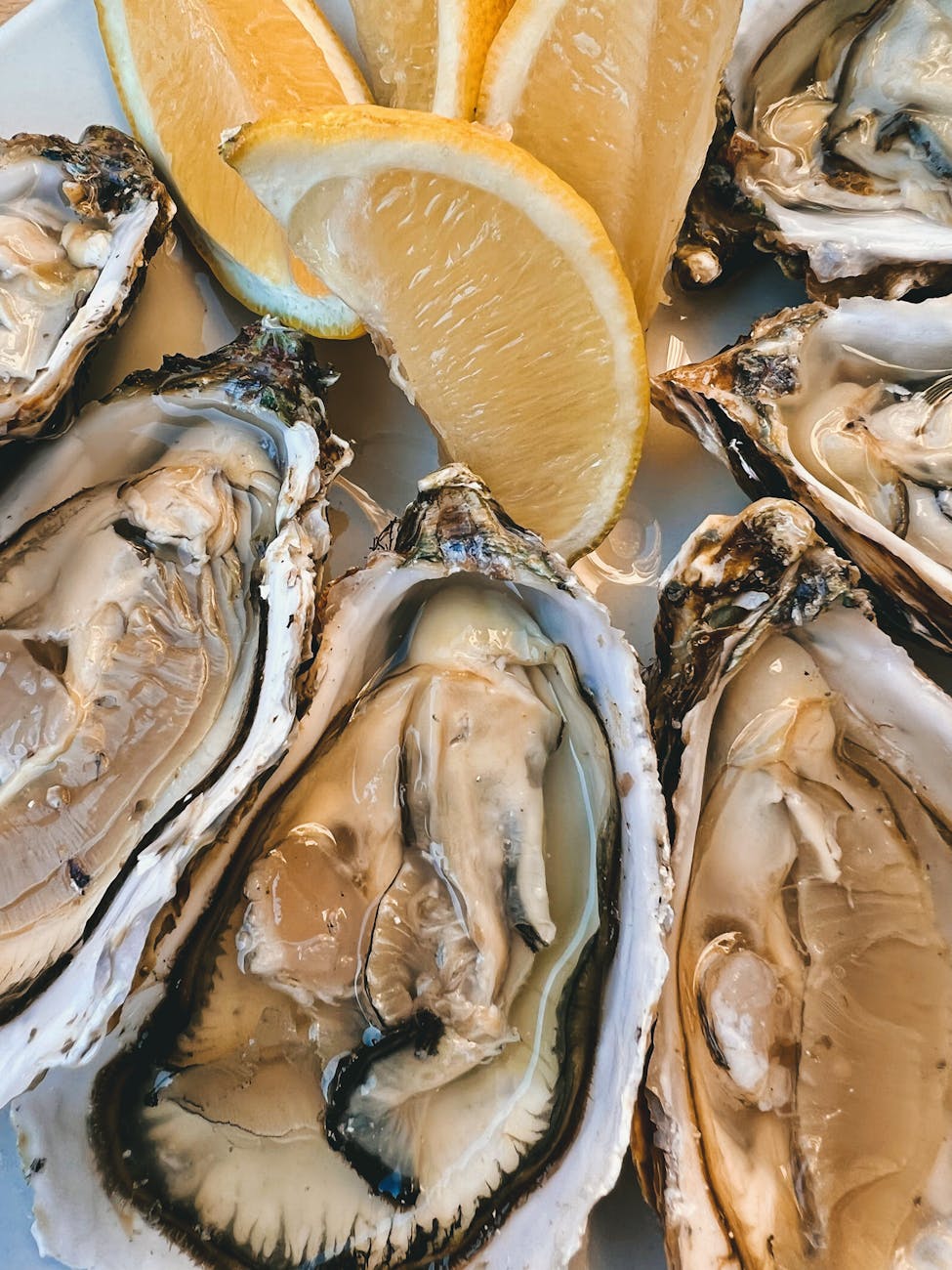
Every cuisine knows this instinctively. India layers texture like percussion: sev crackling over yoghurt and tamarind, boondi pearls bursting between teeth, papdi crisp colliding with puffed rice and chickpeas in the carnival of chaat. No two bites alike, every mouthful a remix. Mexico does it too: nachos beneath molten cheese, crisp tostadas meeting slow beans. Ireland hums in half-tones – the brine-soft slide of oyster met by the sharp acid crunch of shallot mignonette – salt against silk, sea against spark. Britain answers with crispy onions on curry, piccalilli beside hot crust pies, seaweed against hot chips. Nigeria and Ethiopia bring chew and sponge – the yielding of fufu, the sour elasticity of injera. Italy’s al dente, France’s nougatine crack and crumb, Scandinavia’s brittle rye and cured chew – each proof that the tongue alone can’t judge a meal.
Masala Note – Crunch:
The sound of satisfaction. If it doesn’t crunch, did it even happen?

Onion Bhaji. Photo by Lisa from Pexels on Pexels.com
Plating – that theatre of control – can sometimes feel like censorship. We manicure the plate to please the eye, but the mouth knows better. TRP receptors don’t care about symmetry; they crave stimulation: salt, acid, fat, heat, motion. Curries, tagines, stews – the once-called “ugly foods” – deliver that in abundance. They’re flavour democracies: everything mixing, nothing posturing.
To eat with the hand is to complete the circuit. Touch is the original sensor. Before we spoke, we felt. Fingers read temperature, viscosity, rhythm. They predict what’s coming, tell the tongue to brace. Western etiquette calls it primitive; Ayurveda calls it communion. Science sides with Ayurveda – our fingertips are wired with thermoreceptors that speak directly to taste. We’re built to feel our food. Forks and knives are polite interruptions.
Masala Note – Hands
Your fingers are flavour sensors. Cutlery is censorship.

Eating with your hands is the last honest act. Photo by Michael Burrows on Pexels.com
And yes, in a world of swipes and screens, maybe eating with your hands is the last honest act. When every experience is filtered and posted, flavour remains stubbornly un-uploadable. You can photograph a curry, but you can’t digitise the burn of mustard oil, the cool relief of yoghurt. Eating is still gloriously analogue.
Then there’s the punk chemistry of sensation, chemesthesis – the cool burn of mint, the hot chill of chilli. Menthol fools the brain into thinking it’s cold; capsaicin convinces it it’s on fire. Both are lies the body loves. The same TRP channels that sense salt and heat are tricked into overreacting. Endorphins flood in to calm the chaos, and suddenly pleasure is born from pain. Humans are the only species masochistic enough to enjoy this. It’s rebellion in the mouth – the taste of being alive.
Masala Note – Chilli
Pain is pleasure in drag. Capsaicin’s the bouncer who flirts as he kicks you out.

Capsicum’s the bouncer who flirts as he kicks you out. Photograph Arun Kapil
Each cuisine flirts differently. Ireland whistles its own tune – soft rain in the stew, sea air in the butter. Bacon and cabbage bring quiet salt; salmon, river-slick umami; potatoes, sweet earthy calm.
Apple pies, crumbles, fruit tarts – the sigh of sweetness after weather. Comfort with contrast. Indian food builds balance through chaos: sour tamarind, sweet jaggery, bitter methi, pungent mustard oil, astringent dahl, creamy ghee. Mexican food dances on lime and chilli – acidity cutting fat like a blade through silk.
British food, unfairly mocked, is comfort incarnate: gravies, pickles, pies, roots, the umami hum of beer and roast. It once mocked others of course – called curry “brown slop” – but time has flipped the table. Now it borrows spice with gratitude. Nigerian stews throb with defiance; Ethiopian cooking sings in sour. Italian is restraint itself – tomato and olive oil meeting salt and time. French cuisine polishes its edges, but beneath the gloss lie butter, broth, bitterness. Scandinavia pares everything back – salt, acid, smoke – flavour as meditation.
None superior, all connected.
Science says taste is the work of ions and neurons. Ayurveda says it’s energy in motion. Both are right. I say it’s chaos organised by love. Taste is voltage; flavour is soul. The mouth and gut talk constantly – a love letter between chemistry and memory. Piperine from black pepper kick-starts digestion. Turmeric’s curcumin cools inflammation. Capsaicin wakes circulation. What we call “heat,” the body feels as harmony. The chilli that burns your tongue soothes your stomach. The bitterness you reject detoxes your liver. The sugar you crave quiets the riot – for a moment. Flavour is feedback.
And so we circle back to equality – not political, but sensory. The hierarchy of cuisines mirrors the hierarchy of people: who gets seen, who gets served on white plates. But flavour doesn’t recognise those borders. The tongue doesn’t care about accent, income, passport, or postcode. It only wants contrast, variety – salt after sweet, crunch after silk, heat after calm. It knows balance, not status.
Bitter teaches. Sweet rewards. Sour provokes. Salt steadies. Umami consoles. Pungent excites. Astringent refines. Madhura restores. Texture lifts them all into movement – the crackle of the fry, the velvet of fat, the pop of pickle, the silence after the bite.
Sometimes I think of those flights again, the faint clink of glass pickle jars, the tang of asafoetida seeping through the luggage tape. Back then it felt like contraband; now it’s a badge of pride. We have learned to smell differently. The same smells that once marked outsiders now scent whole streets. The air changed before the politics did. And maybe that’s the quiet revolution: flavour teaching tolerance, one lunchbox at a time.
Flavour is democracy, theatre, truth. And the hand – always the hand – is the vote that counts. So go on, lick the spoon, tear the bread, eat with both hands. Don’t apologise for the mess; it’s evidence you were here. Taste is instinct and memory, science and soul. A stew of chemistry, curiosity, and rebellion. All tastes are equal – the best ones bite back. Flavour doesn’t behave. That’s why it wins.
Masale bolte hain
(The spices speak.)
Makhani Meatballs with Punk Pumpkin & Hazelnut, Paneer Smash

Makhani Meatballs with Punk Pumpkin & Hazelnut, Paneer Smash
RECIPE
A 10-minute feast of balance, bite and beautiful chaos.
Take a bowl, a handful of instinct and a small prayer to balance. Soak a fistful of cashews in hot water, blitz them with a fat thumb of ginger into velvet. Fry a chopped onion and 3 tsps of Green Saffron’s own Crackin’ Curry Powder till it sighs, stir in a good squeeze of tomato purée, 4 tblsps of butter and the cashew paste until it all turns sunset orange. That’s your makhani – buttery, lush, unapologetically rich.
Meanwhile, roll minced lamb with milk-soaked breadcrumbs, good pinch sea salt, coriander stems, dried methi (fenugreek leaves), a grating or two of fresh ginger and a hit of red and green chillies. This is the kind of meatball that doesn’t need to be told what shape to hold. Bake until barely done; let them finish bathing in the sauce.
On the side, roast wedges of pumpkin, skin-on till their edges char and caramelise – coated in cayenne, cumin, cinnamon, a flick of oil. Toast hazelnuts till they smell like….toast, discard the flaky skins, crush with lemon zest and paneer crumbs (feta if you must) – your Hazelnut Paneer Smash – and set aside.
Serve the meatballs glossy and loud, the pumpkin like burnt gold, the sauce running where it pleases, scatter the ‘smash’ generously over. Eat with your hands. Wipe the plate clean. The revolution tastes like this.
Masala Note – Hazelnut Paneer Smash:
Crunch, cream, tang: the holy trinity of texture. If it hits the plate and makes noise, you’re doing it right.
Arun Kapil, Food Editor of Ars Notoria, and punk food poet, founded and owns a spice company, Green Saffron Spices. He works sustainably direct with partner farms mainly to the west and north of India and some in the south. He works directly from source. He owns total chain of custody, depleting links in the chain, bringing direct line of sight to fields of cultivation. Arun and his partner Olive began by selling one or two sachets a week of bespoke blends with accompanying recipes at a farmers market stall in Mahon Point, Cork. They now sell spices and seasonings to globally based blue chips, onward food processors and are just in the throes of re-launching their brand, based on Modern India meal solutions, sauces, spice blends, naan, condiments and basmati. They started the business boot-strapping from the bottom up, managed with a good deal of jugaard. He considers himself to be a masaalchi and at best a khansama supported by a strong network of Irish, Indian and British agri-experts and businessmen.
Discover more from Ars Notoria
Subscribe to get the latest posts sent to your email.


You must be logged in to post a comment.