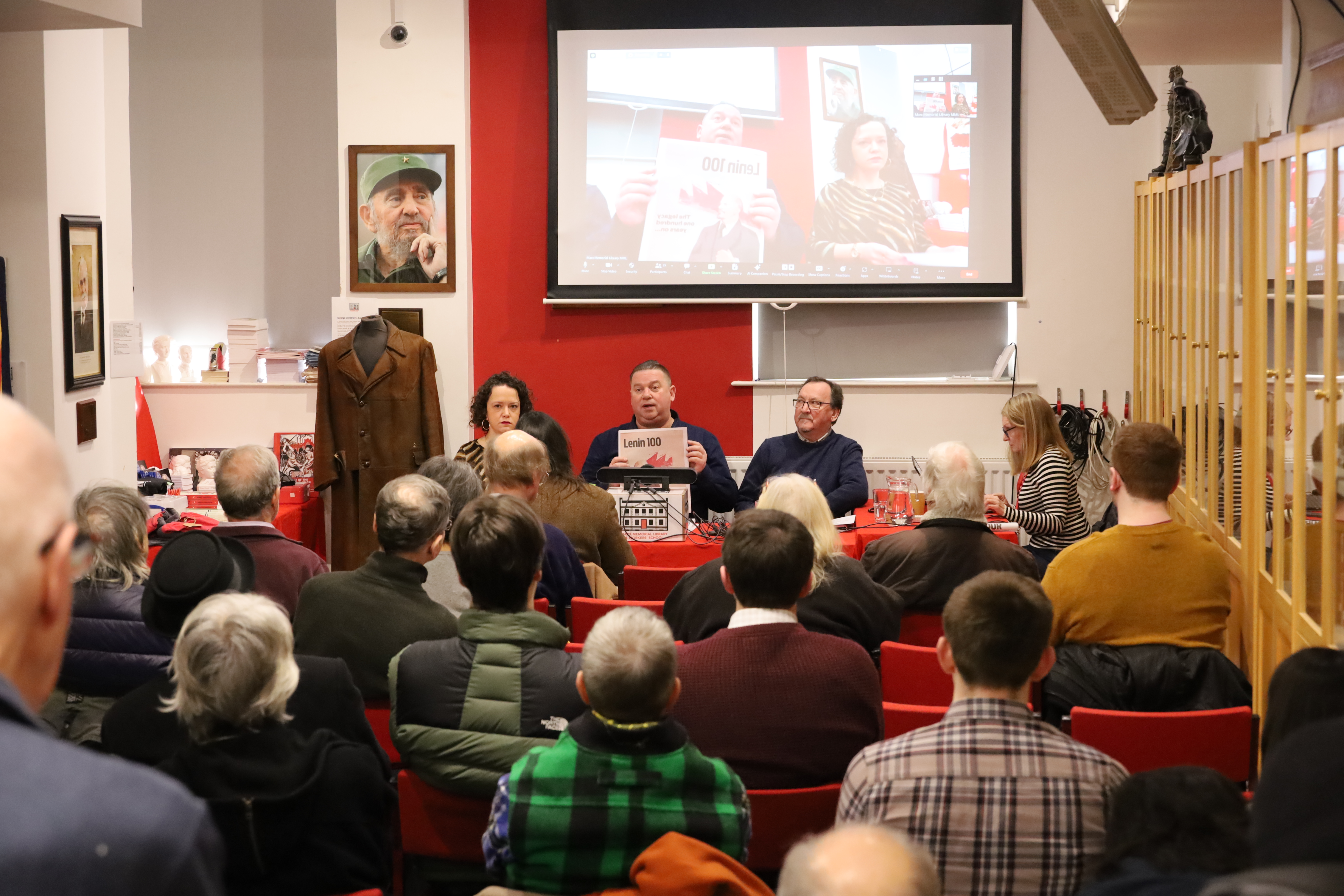
Alex Gordon giving a class. Copyright Karl Weiss, courtesy Marx Memorial Library
‘Financialisation and militarisation sustain this broken model. We need to advocate for peace and redistribution.’
An interview with Paul Halas and Phil Hall, editors at Ars Notoria Magazine
Alex Gordon is a British trade unionist, a leading member of the Communist Party of Britain (CPB) and one of the leading Marxists in the UK. He is best known for his long-standing activism within the National Union of Rail, Maritime and Transport Workers (RMT), where he served as the union’s National President. He has been a central figure in the RMT Broad Left, a socialist grouping within the union.
Within the Communist Party of Britain, Gordon holds several key positions, including membership of the party’s Executive and Political Committees. His political activism is defined by a commitment to Marxism Leninism, anti-fascism, and internationalist solidarity. He champions Marxist education, and was the convenor of the Lexit campaign, advocating an exit from the European Union based on a socialist and anti-imperialist analysis.
His ideological stance is further demonstrated through his active solidarity work. Gordon has been a consistent supporter of Cuba and the Palestinian cause. In essence, he is a significant figure on the British left, seamlessly integrating his roles as a militant trade unionist, a communist leader, and an anti-fascist internationalist.
Paul Halas and Philip Hall went to interview Alex to get a clearer understanding of his outlook on the current political conjuncture. Alex Gordon, did not disappoint, he gave Ars Notoria Magazine a masterful tour d’horizon.
Phil Hall: Alex, thank you for joining us. We’re here to discuss your work, and broad political outlook. I saw you in conversation with Gabriel Rockhill and Jennifer Ponce de León recently and I was impressed by your political acumen—you know what you’re talking about! We want to interview trade union leaders and understand what we can do as ordinary people in the current crisis. Perhaps you are one of the people we should be listening to and reading. What’s the vision, and how does it align with your goals—in the spirit of Lenin’s What is to be done?
Alex Gordon: My political background is as a trade unionist. I was national president of the RMT (the National Union of Rail, Maritime and Transport Workers) from 2010 to 2012 and again from 2022 to 2024, and this has driven my political engagement.
Paul Halas: How would Marx interpret and explain crises like the gig economy or a looming financial bubble?
Alex Gordon: We’re currently seeing the biggest concentration of fictitious capital in history, centered on the “Magnificent Seven” U.S. tech firms. Business media from the Financial Times to the Wall Street Journal has predicted a stock market crash for over a year now, and when this bubble bursts, it’ll tank the U.S. stock market, exacerbating inequality here in Britain. A Marxist analysis of the current conjuncture needs to understand how the crisis of UK Plc fits into this much bigger picture, focusing on the political dominance of finance capital and financialisation of the British economy, stemming from the ‘Big Bang’ in the City of London in 1986 and free movement of capital. Some marxist political economists such as Radhika Desai and Michael Roberts will be exploring these questions in a panel discussion at Marx Memorial Library in the run-up to Rachel Reeves’ 26 November budget.
Marx explained the law of value and revealed for the first time the inner laws of circulation of capital. He and Frederick Engels also posited the historic role of the working class in the context of urgent questions like “What should we do about the financial bubble?”, or gig economy exploitation. In my view, we need to start with accessible language, tying concepts to real issues of our present day — Uber drivers’ struggles, arms profiteering — then introduce and explain terms like surplus value.

In my view, we need to start with accessible language, tying concepts to real issues of our present day — Uber drivers’ struggles, arms profiteering — then introduce and explain terms like surplus value. Photograph by Viridiana Rivera on Pexels.com
Phil Hall: Diggers and Levellers like Winstanley, used religious language to demand land and justice—a revolutionary spirit akin to today’s modern non-conformism, like Palestine Solidarity or gig worker protests.
Alex Gordon: There is an argument that William Tyndale’s early Bible translation into common English contributed to a high literacy rate in Britain that helped catalyse radicalism.
Phil Hall: I suppose people read in English things along the lines of: ‘It is easier for a camel to go through the eye of a needle than for a rich man to get to heaven.’. Their reading of the bible in English sparked ideas about social justice.
Alex Gordon: Pamphlets, poetry, political satire, and newspapers like John Wilkes’s The North Briton carried this tradition into the 18th century, challenging power with pugnacious wit. Today, that same spirit lives in popular protest against police powers, or gig economy exploitation, AI-driven censorship and state surveillance.
Paul Halas: The gig economy — Uber drivers, Deliveroo couriers — face intense exploitation. What can the trade union movement do when these models seem union-proof?
Alex Gordon: The gig economy is the everyday face of a brutal extension of finance capitalism’s monopoly drive. Uber, a company backed by San Francisco venture capital, exploded during and since the COVID shutdown, delivering all kinds of goods and services from pizza and coffee to public transport services. Uber’s loss-leading business model undercuts licensed taxis to achieve a market monopoly position, then raises prices and cuts drivers’ pay once they achieve a dominant market position. Uber drivers globally say earnings per ride are dropping — they can’t make a living. This loss-leader model, exactly like Amazon’s retail monopoly, aims for monopoly control over urban transport, a key economic lever the left hasn’t analysed sufficiently. Clause IV of the Labour Party’s 1918 constitution called for “common ownership of the means of production, distribution and exchange”, but today venture capitalists are seeking monopoly control.

This loss-leader model, exactly like Amazon’s retail monopoly, aims for monopoly control. Photo by Sagar Soneji on Pexels.com
The GMB union in Britain has taken up legal challenges to platform working, arguing that ‘app workers’ are workers under UK law rather than independent contractors. But the UK’s weak employment laws allow companies to evade responsibility by calling them “partners.” Corbyn’s 2017 Labour general election manifesto proposed mandatory sectoral collective bargaining and a single worker status, which would have transformed the collective power of outsourced workers and gig workers. Starmer’s current Employment Rights Bill completely abandons sectoral collective bargaining. For my union RMT, the acid test is that the current Bill wouldn’t prevent another P&O Ferries debacle from taking place, when workers were sacked via a Zoom conference call and replaced with low-paid foreign labour working in prison-like conditions.
Gig workers around the world are resisting the conditions of their exploitation. We have seen mass delivery rider protests in London and globally for example, but the platform model has been developed to resist attempts at unionisation. In Britain, smaller unions such as IWGB and the App Drivers and Couriers Union (ADCU) have made some headway: IWGB’s employment tribunal win to classify riders as workers is mired in legal challenges, and GMB’s 2021 [expanded 2025] Uber deal offered insurance and recognition for app workers, though not full employment status.

Norcape IMO 7716086 at Rotterdam. Photograph Alf van Beem, Wikimedia Commons
Paul Halas: You referred to the third Great Depression can you expand on this? How does the armaments industry fit in, especially with deeply troubling events like the genocide in Gaza and the war in the Ukraine?
Alex Gordon: Since the 2008 global financial crisis, the G7 so-called ‘developed capitalist economies have been in the longest slump in the history of capitalism — real wages in Britain in 2025 are still below 2016 levels. In the 1930s, the Second Great Depression was “resolved” by World War II, which destroyed productive capital while killing millions. Today, the UK government’s 2025 Strategic Defence Review pushes the fallacy of arms spending as an “engine of economic growth.”
But this diverts public spending resources from social need to the profit lines of the military industrial complex, fuelling fictitious capital bubbles tied to tech-finance capitalism. Investors such as BlackRock and Vanguard, holding 16% of UK arms shares, profit while inequality grows. But the armaments industry is not job rich compared to public sector organisations like the NHS. In the context of NATO’s proxy war in Ukraine, arms manufacturers thrive on prolonged conflict, exposing us to the risk of nuclear escalation. A third world war would end all life on Earth. We need to expose how financialisation and militarisation sustain this broken model, and advocate for peace and redistribution.

the armaments industry is not job rich compared to public sector organisations like the NHS. Photograph by Somchai Kongkamsri on Pexels.com
Phil Hall: You mentioned Palestine Action’s civil disobedience. How effective is it, given risks of infiltration and state repression? Don’t you think Palestine Action could be manipulated by agent provocateurs?
Alex Gordon: Objectively, Palestine Action’s civil disobedience campaign has been phenomenally successful in making their point. They’ve targeted arms manufacturers and institutions complicit in Israel’s genocide, with over a thousand — possibly two thousand — supporters now arrested for holding up handwritten signs. This non-violent campaign — red paint may symbolise bloodshed, but spray-painting military aircraft isn’t violence — has tarnished the judicial system and police, exposing UK state authoritarianism. They’ve linked their protests to the genocide by referencing free speech debates. Despite risks of agents provocateurs in all direct action campaigns, their non-violence has undermined attempts by the state and the media to discredit them. Whether you agree with them or not, you can’t argue that they haven’t challenged the armaments industry’s profiteering and shown how direct action can shift discourse.
Phil Hall: Let’s talk about utopia — Eden, an unspoiled ideal. You’ve critiqued the limited horizons of austerity capitalism. How do you reimagine a socialist utopia. By the way, in the spirit of William Morris, what texts do you think a utopian socialist reader should look for? Austerity capitalism has shrunk utopia to mere survival..
Alex Gordon: Marx’s favourite dictum according to his family was: ‘Nothing human is alien to me.’ Of course, his lifelong friend and comrade, Frederick Engels wrote the key text ‘Socialism: Utopian and Scientific’ in 1880 to popularise Marx’s ideas for a general audience. We need to include William Morris’ News From Nowhere which imagined an Earth-based utopia free from profit, the state, and ugliness. In James Klugman’s collection of political pamphlets from the eighteenth to the twentieth centuries, which you can find at the Marx Memorial Library we see contemporary debates played out over contending ideas of socialism, as well as a rich tradition of anti-imperialist works. All this would be a good fit.

James Klugman in the Egyptian Army. Credit Marx Memorial Library
Phil Hall: You mentioned small businesses. Do you think socialists and communists should facilitate a strategic alliance between them and the working class against corporate capital?
Alex Gordon: Small businesses and workers share a common enemy in corporate capital — fintech and big tech. Small businesses today, as in the 1930s, are squeezed by banks and tech giants, just as workers are. In this third Great Depression, wages lag, and monopolies tighten. The Preston Model showed how local economies can create wealth by resisting corporate control through investing in local businesses. Starmer’s latest push for digital ID and data centres, backed by Microsoft and Nvidia, locks us into the US big-tech oligarchs’ system. Trade unions and working-class communities must lead resistance to digital ID.
Phil Hall: That connects to historical radicalism. How does that spirit inform today’s struggles, like Palestine Action or gig worker protests?
Alex Gordon: The 17th-century revolutionary spirit, expressed through non-conformist religious language, lives on. High literacy from Tyndale’s Bible translation fuelled radical ideas — Jesus as a carpenter, not a king. John Wilkes’s The North Briton challenged power and corruption through biting satire, rather like some protests against the armaments industry in our own time. But state repression — arrests for social media posts, or leaflets — mirrors those historical crackdowns.

John Wilkes’s The North Briton challenged power and corruption through biting satire
Paul Halas: You mentioned AI’s limits. How should we counter the dumbing-down of knowledge through corporate internet platforms?
Alex Gordon: AI has been pushed by the U.S. tech sector as a productivity fix to deliver economic growth and bring an end to this capitalist slump. But it’s a pipe dream. AI fundamentally is not creative, just regurgitative. Platforms such as Google and YouTube increasingly deliver AI-generated noise. We need to read real books, and have access to documents and archives, and education courses that offer real knowledge —books, pamphlets, discussions like Michael Roberts’ recent lectures at the Marx Memorial Library on the long depression, which sparked debate on AI’s limits. People need spaces where they can engage with scientific knowledge using the highest theory, which is Marxism-Leninism. We also need access to neglected and often hidden anti-colonial history, free from corporate filters.
Phil Hall: If the ruling class are clear who their real class enemies are they may be the best Marxists.
Alex Gordon: After the 2008 financial crisis, The Financial Times urged its readers to get to grips with Marx’s Capital in order to properly understand the key critique of capitalist social relations. The ruling class knows Marx’s Capital is a source of scientific knowledge.
Our role is to ground our collective struggles in Marxist analysis, not identitarian, or nationalist distractions. One thing we haven’t discussed is the emergence of socialist China as the first economic superpower in world history that has not previously been a military superpower, which is fascinating. China’s continuing economic growth under state control, lifting millions out of poverty but with tight political constraints. This model challenges the West’s four-decade long financial capitalist model during the neoliberal era.
Phil Hall: That’s a brilliant wrap-up of the current situation. Highly educational and illuminating. Thank you, Alex.
Alex Gordon: My pleasure. Good to meet you both.
Discover more from Ars Notoria
Subscribe to get the latest posts sent to your email.



You must be logged in to post a comment.